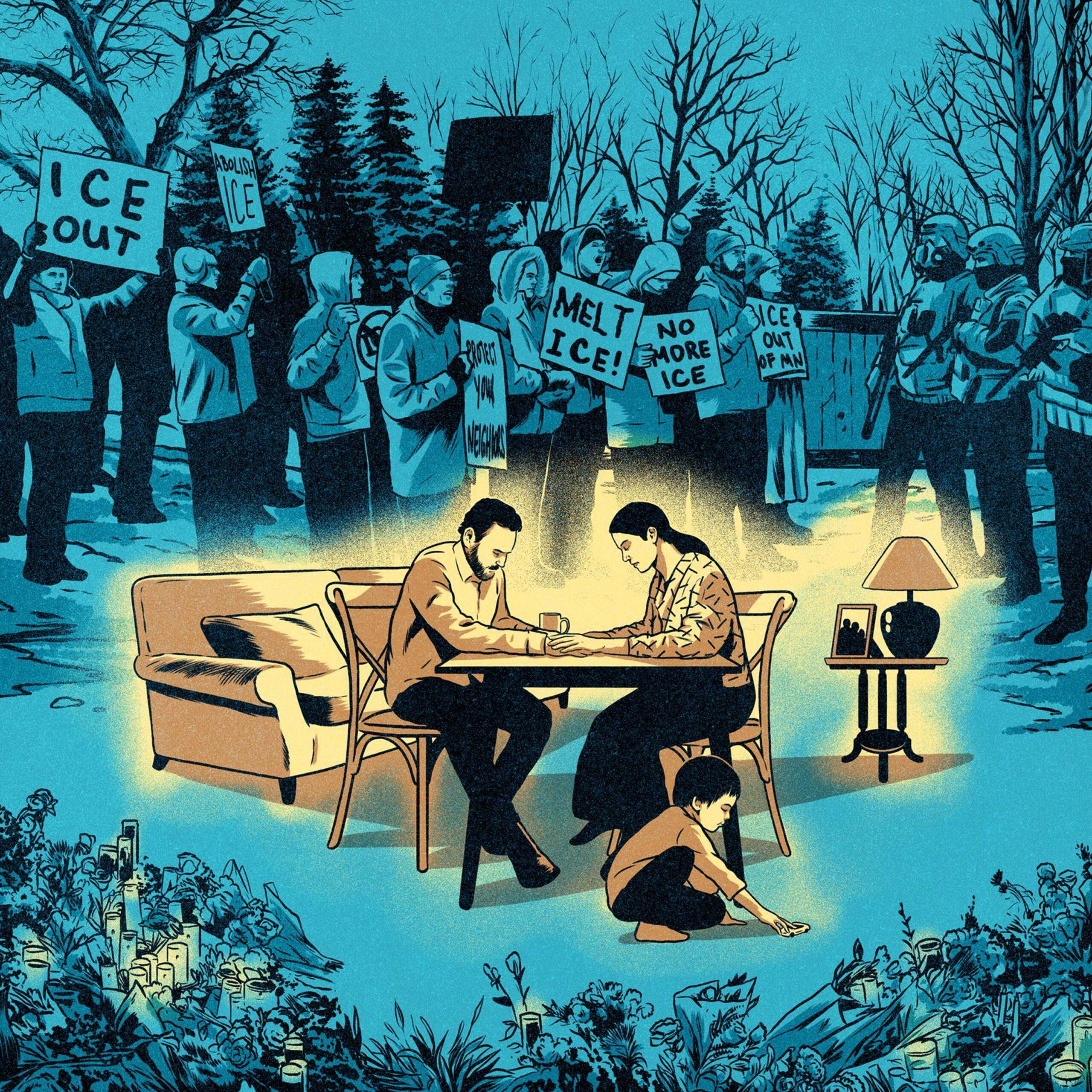
Inside the Hidden Network of Resistance in Minneapolis
Waves of federal agents forced countless Minnesota residents into hiding. Countless more responded with a movement unlike any other. A deeper look reveals the heartbeat of resistance—and the soul of the city.Inside the Hidden Network of Resistance in Minneapolis
Waves of federal agents forced countless Minnesota residents into hiding. Countless more responded with a movement unlike any other. A deeper look reveals the heartbeat of resistance—and the soul of the city.
The trailer park is calm, its streets empty and covered in snow. Idle trucks sit in front of pale-colored double-wides, every door closed, every window shade drawn. I’m riding in the passenger seat next to Tamara Moberg, a 63-year-old from suburban Minneapolis, as she drives through a largely Hispanic neighborhood on the edge of town. “It feels kind of eerie here, doesn’t it?” she says, car slowing as she tries to remember the address of our destination. “It’s almost too quiet.”
After a few minutes, Moberg pulls up outside a blue trailer. Boards cover the windows. There’s no sign that anyone is home. “This is it,” she says.
“Wait here.”
She gets out of the car, walks up to the door, and knocks. After a few seconds, a teenage girl in a T-shirt and sweats peeks her head outside. She smiles, and then Moberg turns around and waves for me to join them.
“It’s kind of nice,” the girl says after we get in, take off our boots and coats, and find a spot on the couch, “to finally have some company.”
I’ll call her Jessica. As with many others I’ll quote from my nine days spent reporting in Minneapolis, though, that’s not her real name. Several of the people I spoke with requested that their names be withheld from print out of fear of retribution or of being targeted by federal agents. Jessica is 17 years old, an American citizen, and stuck in the trailer she shares with three generations of her family, all of them fearful of what might happen if they venture outside. “They’ll be out in a minute,” she says, and offers us some water.
Soon arrive her mother, whom I’ll call Elena, age 42; her grandmother, whom I’ll call Lydia, age 69; and her younger sister, whom I’ll call Grace, age 12. They sit around the living room, adorned with soccer trophies and ceramic angels, and for a while they talk about how much they love the city, Minneapolis, that they now call home. “We love to go to the lakes,” Elena says, describing summer afternoons by the water, before she details their Sundays spent at church and then going out to lunch at one of the nearby Latin American food courts.
Lydia and Elena both came to the United States from Mexico. Elena’s cousins had immigrated to Minnesota, searching for better-paying jobs than they could find in their hometown, and they encouraged her to join them. Lydia followed, to be closer to her daughter and grandchildren. Now Lydia is retired, but for years she cleaned houses and hotel rooms, remodeled homes, and built roofs. Elena works in food manufacturing, doing long hours of hard labor in factories for little pay. She’s been in Minnesota for 22 years. Both her daughters were born here. She and her mother are undocumented. Her girls are American citizens.
“I know Mexico is my country,” says Elena. “But this is my home. This is where my family is. This is where my work is. My life is here.”
For the past few weeks, she’s barely gone outside. Beginning in December, the Trump administration deployed federal agents to Minnesota en masse—the number eventually peaked at around 3,000, a presence more than quadruple the size of the Minneapolis police force. Every day, masked men roamed the city and suburbs in unmarked cars, detaining immigrants (and sometimes natural-born citizens), then often jailing and deporting them. Earlier this month, the U.S. Department of Homeland Security said that more than 4,000 immigrants have been detained since the surge started. DHS insists that it is targeting violent criminals, but data from the Cato Institute showed that only 5 percent of those detained by U.S. Immigration and Customs Enforcement in October and November 2025 had violent criminal convictions, and 73 percent had no criminal convictions at all. Between January and July of last year, according to Cato, nearly 40 percent of the arrests ICE made were of people who hadn’t even faced a criminal charge. “This is a dramatic change from President Joseph Biden’s policies, under which only one in 10 arrests were individuals without any criminal charge,” Cato’s director of immigration studies, David J. Bier, wrote in a piece on the institute’s website.
I just want to go outside. I want to feel free. I don’t want to have to be so afraid.Lydia
Those like Elena and Lydia, who entered the U.S. without authorization, are most at risk of deportation. But the Twin Cities are full of stories of immigrants with proper documentation being captured and detained. Just last month, 5-year-old Liam Conejo Ramos was taken by ICE while wearing a blue bunny hat and a Spider-Man backpack. He and his father were sent 1,300 miles away to a detention center in Texas and held for 10 days before returning to Minneapolis. They are asylum seekers, both in this country legally. Now back in Minnesota, Liam is sheltering in place at home. His school has received bomb threats. He was the fourth child in his district to be detained in less than two weeks. When he tries to sleep, Liam’s father told Minnesota Public Radio, “he wakes up three or four times a night screaming ‘Daddy, Daddy.’”
The city’s people have revolted, staging massive demonstrations and organizing campaigns to observe ICE activity, often alerting residents to their presence with small plastic whistles that are ubiquitous around town. In recent weeks, federal agents have shot and killed two observers, Renee Nicole Good and Alex Pretti, just 17 days and less than 2 miles apart. In the wake of a national uproar over their killings, the Trump administration began downshifting its surge in Minneapolis. Border Patrol “commander-at-large” Greg Bovino, who falsely claimed that Pretti had planned to “massacre law enforcement,” was removed from his position on January 26 and replaced by “border czar” Tom Homan. On February 4, Homan announced the withdrawal of 700 federal agents from the region. On February 12, the administration said that its surge was ending.
Even with the promise to pull agents out of Minnesota, the federal government’s policy of mass deportations will persist. There will be more surges, and more violence, in more cities. There will be more of the same terror that has gripped this region for weeks. And as this administration turns its focus elsewhere, Minnesotans will be left reckoning with all that’s happened: the brutality they’ve witnessed, the economic devastation they’ve suffered, the losses they’ve grieved, and the strength and connection they’ve built through the radical act of looking out for one another.
Most days, Grace sits at home on her computer, meeting with teachers via Zoom as she tries to make it through the second semester of seventh grade. Jessica takes the bus to school once a week, to pick up assignments, meet with teachers, and see a few friends. Whenever she leaves the house, she keeps her passport in her pocket. She’s heard of agents awaiting students the moment they get off the bus. Elena has tried to keep working, but just days before we meet, federal agents showed up at her factory, and she had to slip out the back door and into a friend’s car to get away. Lydia never leaves. She cleans and crochets, and she sits on this couch, watching the Spanish-language news, monitoring where ICE is most active, praying that any members of her family who have left home will return safely.
“I don’t understand,” says Lydia. “Why don’t they like us here?”
She pulls the fabric of her pants, the same Minnie Mouse pajamas she wears almost every day. She begins to cry.
“I just want to go outside,” she says. “I want to feel free. I don’t want to have to be so afraid.”
“ICE out!”
“Fuck ICE!”
“ICE out!”
“Fuck ICE!”
“ICE out!”
“Fuck ICE!”
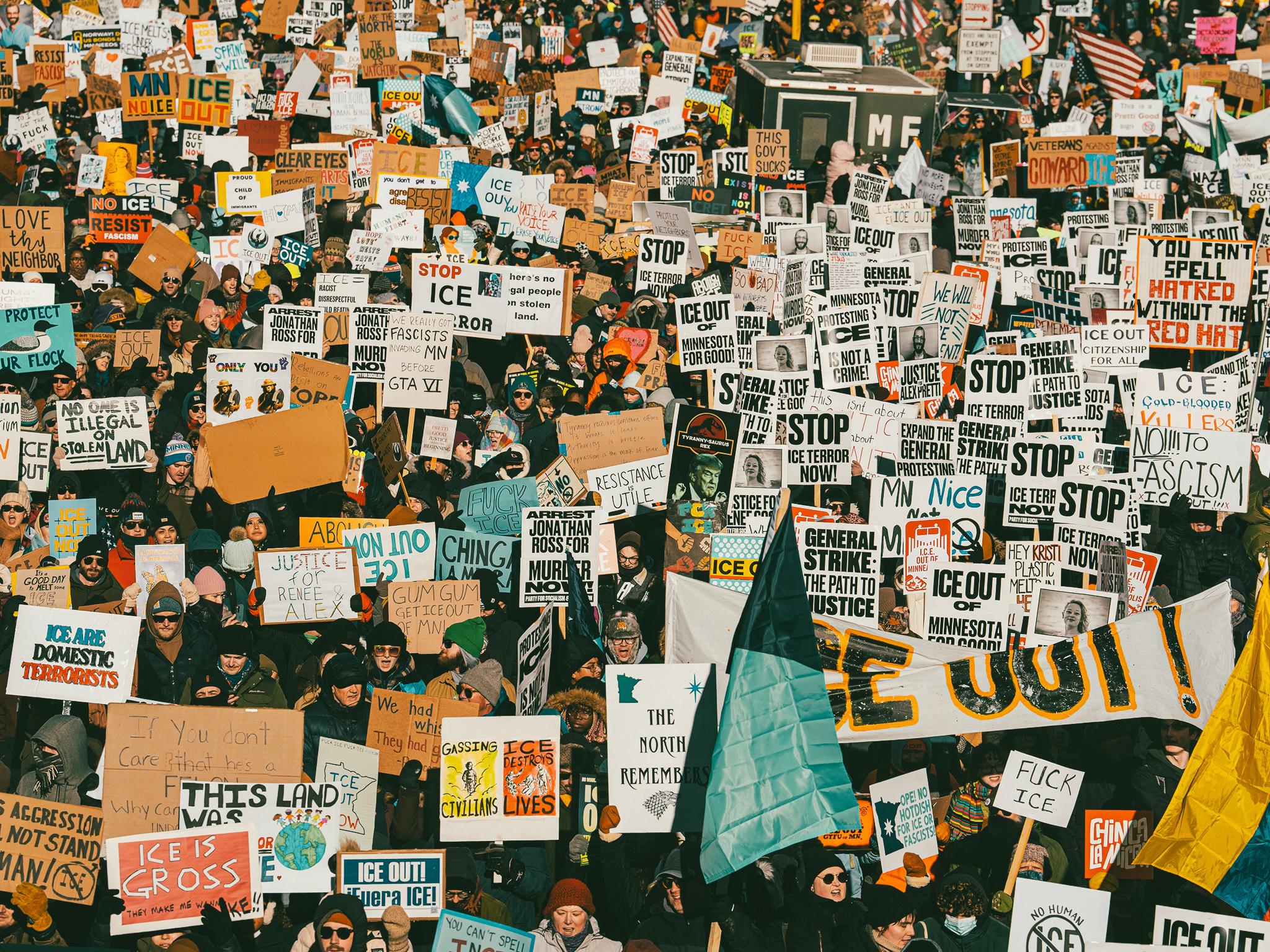
This is the soundtrack to the city, the chants that ring out on the steps of courthouses and in parks, on the streets of downtown corridors and residential neighborhoods. It’s a full-throated rebuke of the federal forces that have come to occupy Minnesota this winter.
When the influx of agents began, the Trump administration made Minneapolis the focus of its sweeping campaign to remove people it calls “criminal illegals” from the country. Since Trump’s inauguration in January 2025, ICE has more than doubled the number of agents under its employ; the “Big Beautiful Bill” allocated $75 billion for ICE, making its budget larger than that of the FBI, DEA, and all other federal law enforcement agencies combined. The administration has set a goal of 3,000 arrests a day. It has sent people to countries they are not from. It has revoked visas from immigrants who attended pro-Palestinian protests. It has defied orders from a federal judge by sending Venezuelans to a maximum security prison in El Salvador, and it sent surges of agents into Los Angeles; Portland; Washington, D.C.; and Chicago.
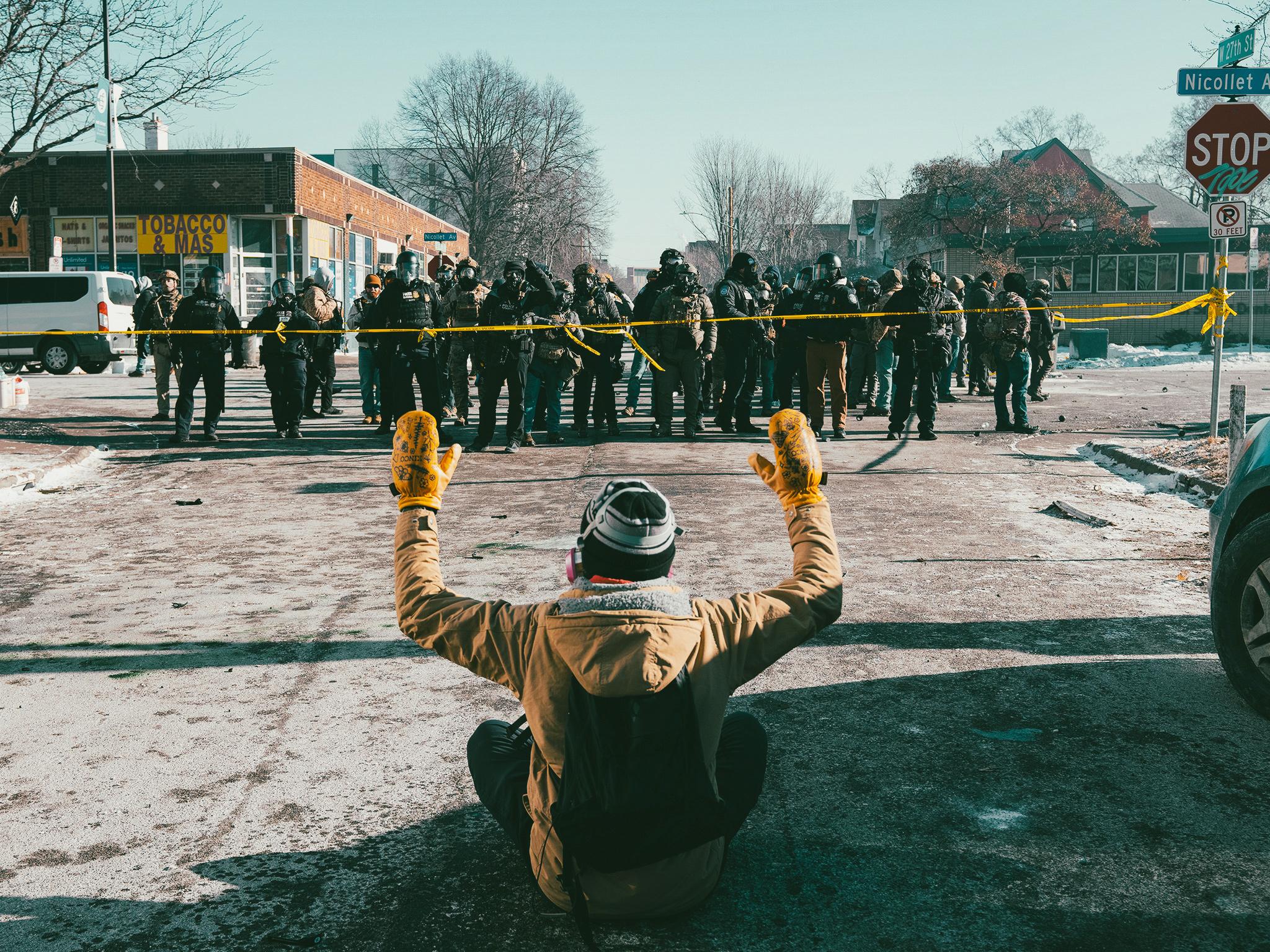
In Minnesota, the agents were met with staunch and immediate resistance. Protests spread through every artery of the city, shutting down major downtown streets, lining sidewalks in suburbs, arriving at the Bishop Henry Whipple Federal Building every morning to serenade federal agents with demands that they get out of town.

Read our Q&A with Ringer senior staff writer Jordan Ritter Conn on how he reported this story.
“This is probably my 50th rally,” Jeff Roberts, a 75-year-old, tells me one morning outside Whipple. He served as a Marine in Vietnam and regrets that he missed out on the anti-war protests of his day. “I’m making up for lost time,” he says. “Now, I’ve decided I have to finally step up. I have to say when something isn’t right. I have to do the things I should have been doing for a long, long time.”
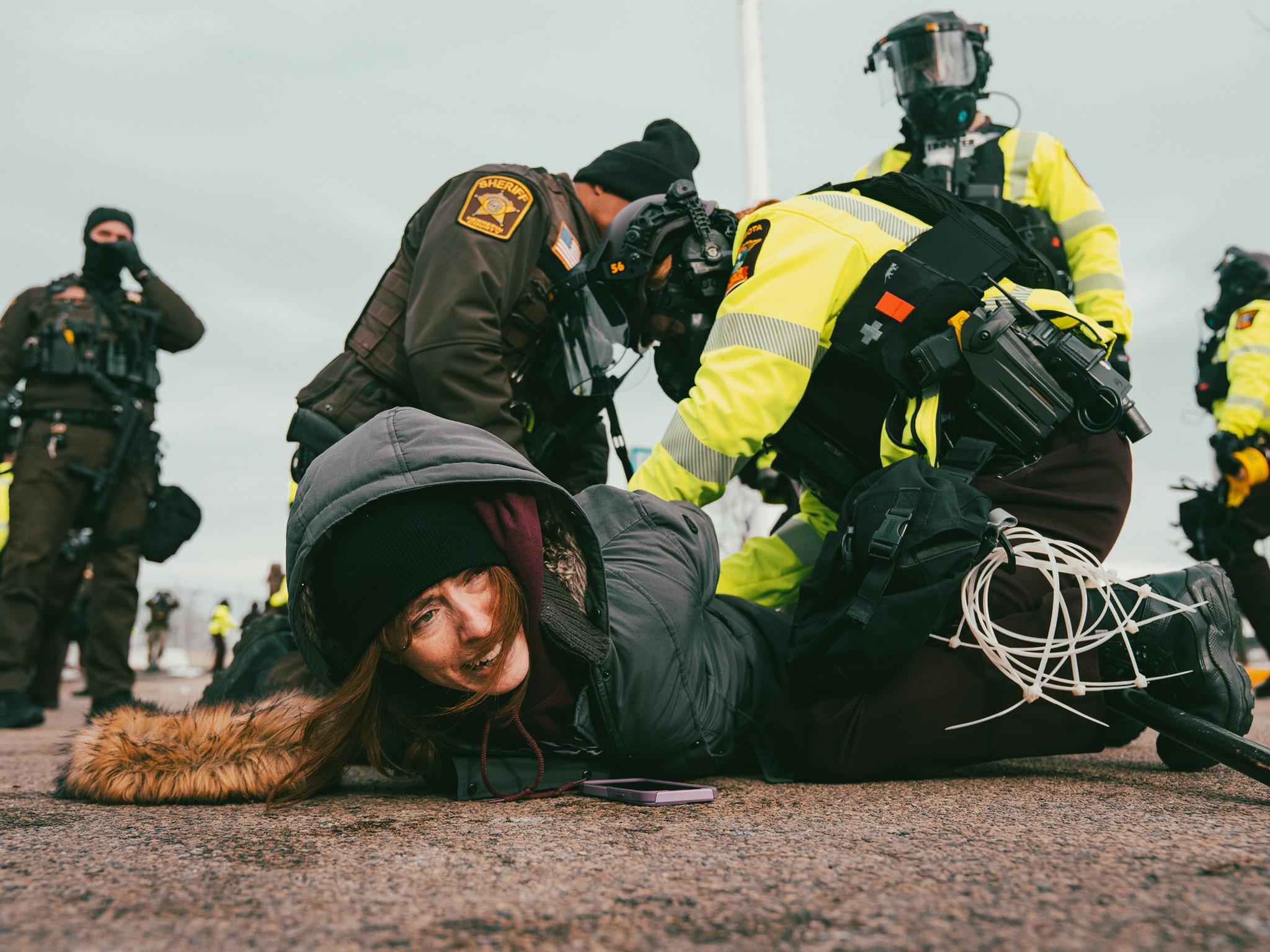
The protests have been largely peaceful. The crackdown on them has not. On January 7, federal agents shot and killed Good, an award-winning poet and mother of three, while she drove in her SUV. According to audio and video analysis performed by The New York Times, agent Jonathan Ross can be heard calling her a “fucking bitch” moments after firing his weapon. On January 24, two agents fired 10 shots in less than five seconds and killed Pretti, an ICU nurse at the Minneapolis Veterans Affairs Medical Center, after he attempted to help a woman who’d been pushed to the ground. His last words: “Are you OK?” On video, another agent can be seen clapping his hands the moment after Pretti was killed.
But that’s only the outermost layer of what’s happened in Minneapolis. I arrived in town three days after Pretti was killed, to a city consumed by grief and besieged by action. TV news and social media feeds broadcast images of masked agents trying to detain immigrants, while protesters screamed through tear gas for them to stop. They showed chaos and danger, confrontation and violence. They didn’t show what I found to be a profoundly powerful network of resistance—ordinary people uniting to protect, shelter, and care for their neighbors. A persistent belief, among both those who were born in this country and those who were not, that, as Lydia tells me, “the United States is supposed to be a place where all people feel welcome.”
I know Mexico is my country. But this is my home. This is where my family is. This is where my work is. My life is here.Elena
There was the social worker who goes from home to home helping immigrants fill out delegation of parental authority forms to ensure that someone will care for their children in the event that they get detained. She told a story of entering a home and talking to a family until a toddler rushed up to her, begging her to shush or else. “The police will come.” There was her husband, a high school teacher who keeps a watchful eye for federal agents outside his building and who monitors one of his students, a U.S. citizen, as he goes to the curb every day during lunch to hold a sign of protest in honor of his mom, who’s afraid to leave the home. There were the business owners at seemingly every coffee shop and bookstore in the city who leave out baskets of free whistles for anyone who wants to use them to alert their neighbors to ICE’s presence.
The protests were everywhere. They were loud and righteous and relentless. They were also only one piece of what the resistance here really looks like, of the story of a city banding together to protect the community it holds dear.
On a Sunday morning, I attended a church in south Minneapolis where staff members had put up signs instructing congregants how to clear their noses and flush their eyes if they got tear-gassed. Late in the service, a pastor invited congregants to come to the front and share their own moments of hope and despair. At one point, a thin, small, 58-year-old woman stood up to reflect on all she once saw protesting apartheid in South Africa, and all that she’d now seen in her home city in recent weeks, and the invisible lines of compassion and courage linking the two. Before returning to her seat, she said, in a calm and resolute voice, “I am not afraid to die.”
On a Monday in late January, I walk in the snow through a quiet residential neighborhood in south Minneapolis, past simply and tastefully decorated single-level homes. I’ve been given an address and told to arrive midafternoon, but I don’t even know whom I’m here to meet. A few days earlier, I told a source that I wanted to connect with people who’d been most affected by ICE’s presence in the city. That source put me in a group chat on Signal—the end-to-end encrypted messaging app that’s being used across the city to avoid surveillance—with several other people, all identifiable only by their initials. Communication happens exclusively through code names to avoid detection by a government they don’t trust.
I approach the front door and knock. No one answers. I knock again. Still no response. Soon a car pulls up, and two women emerge, smiling and apologizing for being late. Both are in their 40s or early 50s. One is white, wearing sweats. I’ll call her Claire. The other is Latina, wearing a clerical collar. I’ll call her Mia.
While Claire makes us tea and bakes cookies, Mia tells her story. She grew up in a small town in the state of Morelos, just south of Mexico City. As a little girl, she was awed by her paternal grandmother, a woman who led Bible studies, fed and clothed neighborhood children, practiced herbal medicine, and tended to the sick whom local doctors could not heal. “She was a tiny woman,” Mia says. “She didn’t know how to read or write. But in our town, she was a giant.”
Mia left her home country when she was 11, following her parents to the U.S. in search of better economic opportunities. She remembers staying in “safe houses” on either side of the border, sleeping on newspapers next to strangers, and peeing in bathrooms with no door. She remembers running across the border, ordered never to look back, terrified but trusting that wherever she was headed would be safer than where she’d been. She says she arrived with her family in Chicago, attending a school where even the other students from Mexico made her feel like an outsider; all of them inhabited a Mexican American culture that felt wholly distinct from her own.
She grew up, learned to read and write in English, and tried to make this place her home. But she lived every day in fear. She’d entered the U.S. illegally. Neither she nor any other member of her family was authorized to live in this country. “I never felt safe,” she says.
Whenever she saw police, her palms started sweating. Her heartbeat quickened. But it wasn’t just that. She struggled to make friends because she felt she couldn’t risk getting close to another person. The moment someone found out the truth of who she was and how she got here, that person would hold power over her that she could not bear. “The moment they know,” she says, “they have the power to destroy you. So I just stayed to myself.”
Then, in 2012, the Obama administration implemented the Deferred Action for Childhood Arrivals policy, which granted protection to unauthorized immigrants who had entered the country as children. Mia applied for and received DACA status, which gave her the ability to live and work in this country without fear. “I felt like I could finally trust people,” she says. “I didn’t have to be so afraid.”
She began to wonder how she could leave an impact on her new world. She felt called to ministry, to follow the footsteps of her grandmother, so she attended seminary and started speaking in churches. At first, it thrilled and terrified her. “For me, my whole life, being invisible and silent has meant keeping my family and myself safe,” she says. “As a pastor, it means being visible. So training my brain, and healing my body and my memory and my heart and my soul from the trauma, it’s all still taking a lot of work.”
While in seminary, Mia met Claire, a local pastor in a mainline denomination. Claire had recently been called to serve a largely white, aging congregation. “It was a dying congregation,” she says. But over time, that church, which is open to and affirming of LGBTQ people, connected with a large community of Hispanic worshipers, many of whom had felt cast aside by the more conservative Catholic and evangelical churches in which they’d been raised. Soon, it was growing into something younger and more vibrant. That’s when it hired Mia.
We’re taught to love our neighbor. Right now, it’s so clear who our most vulnerable neighbor is. We don’t need to be asking, “Who should I be helping?” The answer is right in front of our faces.Mia
In November 2024, Trump was elected president for the second time, promising mass deportations. The church began holding training sessions, inviting immigration attorneys to speak to the congregation about how to prepare for possible detainment and deportations—how to determine who would care for their children if they were deported and their kids were not. Other members of the congregation asked questions: What do we do if ICE shows up outside our front door on Sunday morning? How do we keep our church members safe?
On the day of Trump’s inauguration, he rescinded a government policy that had restricted immigration enforcement operations in churches and other “sensitive areas.” Claire and Mia’s church sprang into action. They assigned members to serve as guards at the doors—unarmed, but able to vet everyone who entered, passing along messages about any unfamiliar faces. When the federal government’s surge began, Claire says, they were prepared. “Since the moment ICE arrived in Chicago, we watched what happened, we talked to a bunch of people who were experiencing it, and we put our policies and procedures and teams in place. We knew they were coming here next.”
It’s striking just how heavily involved clergy are in the citywide resistance effort. Ninety-nine clergy members were arrested during a January protest at the airport. I saw the cloth at every demonstration I attended. So much of the robust network of organization and aid runs through the infrastructure of local congregations. “We’re taught to love our neighbor,” says Mia. “Right now, it’s so clear who our most vulnerable neighbor is. We don’t need to be asking, ‘Who should I be helping?’ The answer is right in front of our faces.”
Claire and Mia’s church also set up a fund for donating groceries to families who cannot safely leave their homes and a system for giving rides to doctor appointments or work for those who want to minimize the risk of detection. “So far,” Claire says, “we have not had to say no to a single rent payment, a single attorney fee, a single grocery run. Nothing.”
Before the surge, the church council had a conversation: What would they do if it became unsafe to meet for worship? Federal agents have set up shop in church parking lots across the city, using them as staging grounds to make arrests. For ICE, few environments are as target-rich as a Mass on Sunday morning. The church’s decision was simple: “If anyone is unsafe here, then none of us will be here,” Claire says. “The minute ICE comes here in full force, we will go underground.” Now, instead of meeting in their building or over Zoom, small gatherings of worshipers spread out in living rooms across the city, the locations changing week by week.
Over time, the church has grown more deeply interconnected, barriers dissolving between the English- and Spanish-speaking parts of the congregation. “No one is trying to be the savior of anybody,” Claire says. “We are each other’s neighbors and community. These are people who celebrate Thanksgiving and Christmas together, who live in each other’s homes and take care of each other’s children. The mentality is, ‘If they’re crying, I’m crying. If they’re rejoicing, I’m rejoicing. If they’re under threat, we’re all under threat, and if they’re taken, I’m going to be in deep grief.’ No one is doing some kind of good deed. They’re family.”
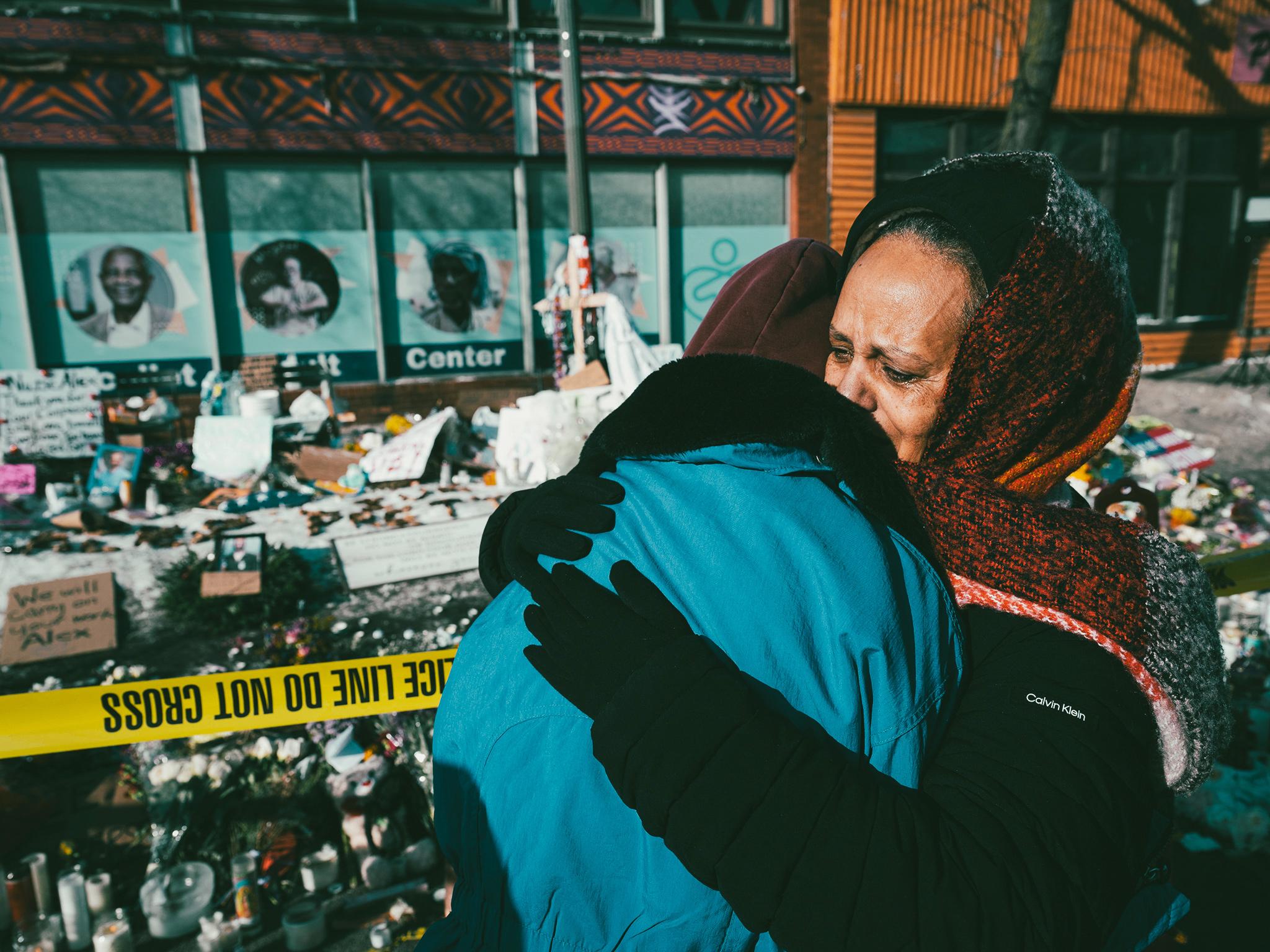
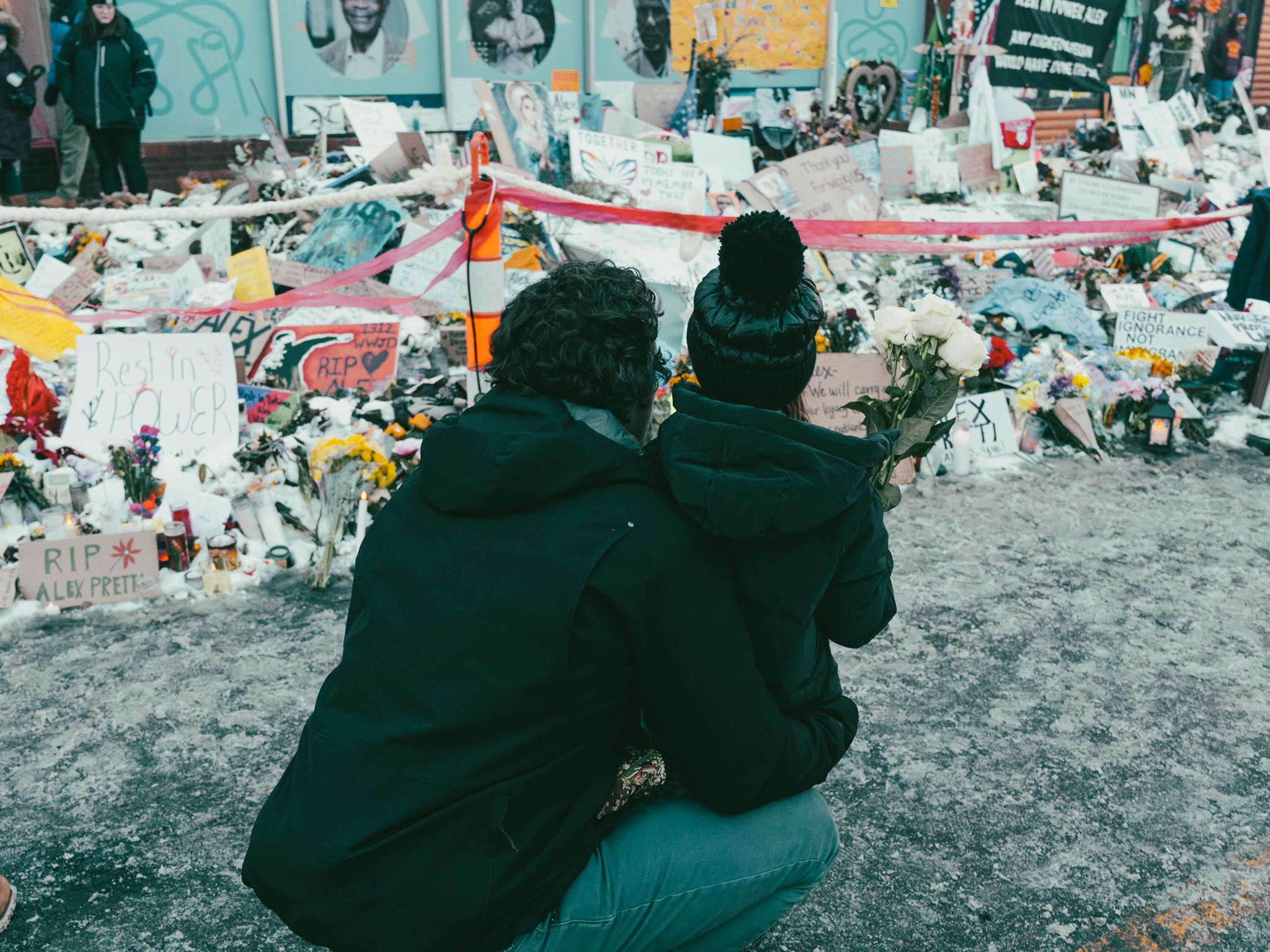
This mentality is on display everywhere I look in Minneapolis. It’s there in the young woman wearing layers of sweaters, pink tights, and thick boots who tends to the hundreds of flowers that have been laid at the site where Pretti was killed, alongside poems, paintings, and offerings of thanks. It’s there in the middle-aged man in a black hoodie who dutifully shovels the snow in front of Good’s makeshift memorial, preparing the ground for a jingle dress dance, a ritual meant to bring healing to those who suffer. It’s there in the work of everyone who transformed these sites from homicide scenes into sacred memorials, corners where people gather to weep and pray.
It’s there in the front-of-house restaurant workers who stand outside, clapping for protesters as they march, telling them anyone can come inside and use the restroom if they need. In the kitchen staff who peek out from the back door of the same restaurant, waving to protesters and wiping tears from their eyes. In the people who show up to give out hot dogs and pizza, hot chocolate and sambusas. In the woman who comes up one morning at the Whipple Federal Building, where hundreds of people are gathered in subzero temperatures, and says, “You look like you need this,” then hands me a packet of toe warmers and walks away.
Another morning, I arrive at a small storefront in a suburban strip mall and walk inside to find about a dozen volunteers packing and loading boxes with fresh produce and frozen vegetables, milk and juice, cereal and soup. “Things look a little different right now,” says a white woman who greets me, a 58-year-old former schoolteacher I’ll call Maggie. She’s been running this food shelf for several years. Until recently, that meant collecting items for impoverished members of the community or delivering food to seniors or people with disabilities. “The most deliveries we would ever do in a week is, like, 12,” she says. “Now, we’re doing that many in a day.”
Our job is getting food to people. We don’t ask where they’re from. We don’t ask why they’re here. We don’t ask about their papers or status. We give them food. That’s it.Maggie
The mission has also evolved. “Some of the people we’re helping right now are not necessarily typically living in poverty,” she says, “but they’re unable to work right now. They can’t leave home. They can’t go to the grocery store.” ICE routinely raids construction sites and factories, apprehends cleaning staff in hotels and kitchen staff at restaurants. When I went out to dinner during my time in town, I talked with servers about how they’ve adapted. Front-of-house staff rotate among themselves to give rides to kitchen staff; plans have been put in place to send workers out the back door when federal agents show up in the front. For the many Minneapolis residents who have decided they can’t leave home, organizations like Maggie’s have filled the gap.
Typically, Maggie gets about a dozen messages from potential volunteers each month. Recently, she received 60 in a single morning. “We’re so busy,” she says, “but if we slow down, if we stop, we start crying. We feel like we’re going to throw up. We just have to keep working.” She sends her delivery drivers out in vests with the logo and name of the organization in both English and Spanish. She has them text families a few minutes before they arrive, to tell them exactly what car they’re driving, so they know it’s safe to answer the door.
Maggie does not show up to protests. She sees herself as having one job. “Our focus is the food,” she says. “I don’t want to think about the government piece of everything. Our job is getting food to people. We don’t ask where they’re from. We don’t ask why they’re here. We don’t ask about their papers or status. We give them food. That’s it.”
And yet, it’s impossible to ignore why demand in her community has soared. She’s asked me not to name her or her organization because she doesn’t want to draw extra attention from ICE and Customs and Border Protection. Both here and in other parts of the country, ICE has staged operations outside food banks. It even detained and deported a man volunteering at a church-run food bank in Los Angeles. Just a couple of days before we meet, Maggie says she got a call from someone who saw blacked-out vehicles sitting outside her organization’s front door. Her drivers have seen federal agents in the trailer parks where they deliver and chosen to keep driving, rescheduling food deliveries for another time.
She takes me to the back and shows me a room with a sign on the door, marked “PRIVATE.” If federal agents arrive, workers have to let them in the building, but the agents cannot enter a private room unless they have a judicial warrant signed by a judge. If any clients are on-site at the time, Maggie explains, she cannot beckon them into the private room, because that would be considered “harboring” an undocumented immigrant, which is against the law. “But,” she points out, “I could say, ‘Sally is going into a private space right now. If you would like to join her, you are welcome to.’”
Staff have protocols in place to unplug computers if agents arrive, to take down signage showing their delivery schedules. “We don’t want them getting any addresses,” she says. “That’s the concern.”
The fact that this has become her work astounds her. “It’s hard to believe,” she says, “that this is real.” Yet she’s been most struck by the outpouring of support she’s received from the community. “People want to do anything they can,” she says.
She tells a story of a woman who reached out recently, begging for a way to help. Offering to scrub floors and clean toilets, to find any way to put herself to use toward the goal of getting hungry people food. Maggie pauses, getting teary. Quietly, she says, “I think about it, and I get overwhelmed.”
On my last night in town, I go to a small suburban church and see a burly white man and a small Latina woman both waving in my direction. Like with Claire and Mia, I’d only messaged with them on Signal. I knew nothing about them, not even their names. But they told me they could connect me with someone who’d been detained by ICE. So I get in the truck of the man, whom I’ll call Chris, alongside the woman, whom I’ll call Theresa. We start moving, and they tell me a bit more about themselves. Both are pastors.
As we’re driving, an SUV with tinted windows pulls up behind us.
“Well, would you look at that,” Chris says.
“Is that them?” Theresa asks.
“Looks like it,” Chris says. “I’ll keep driving.”
And so he does, staying on the main road and then turning down another, and the vehicle that had been behind us continues past. Chris loops around the block, then doubles back toward our destination. “All right,” he says. “We’re good.” Finally, we arrive at a small home, and we park and knock on the door. A short-haired, muscular man answers, smiling as he invites us inside. I’ll call him Daniel.
He’s from Venezuela. For more than two decades, he served in the Venezuelan army, but after Nicolás Maduro was elected president in 2013, he left the army and began working in politics, supporting an opposition party. The Maduro regime tightened its grip on power and began detaining and torturing Maduro’s political opponents, sometimes even the children of his opponents. Daniel knew friends and colleagues who were arrested and disappeared. He got scared. He and his wife decided to leave the country, to see whether things might settle down while they were gone. They applied for tourist visas to the U.S. and got quick approval. They had family in Minnesota. In 2018, after Maduro’s reelection, they came here for six months. Right away, Daniel felt at home.
He learned to love the cold, taught himself snowboarding. He got a work permit and started working construction jobs around the region. He threw himself into a local slow-pitch adult softball team and began to DJ and play quinceañeras and weddings. Occasionally, community members from other cultures would hire him for their parties.
When Trump was elected in 2024, Daniel knew he had to be cautious. He would take his work permit, Social Security card, and Real ID–compliant driver’s license with him everywhere. He would make sure to follow every law, never speeding or running a red light. But he didn’t worry much. “I have my papers,” he says, shrugging his shoulders, as he spreads out all of his immigration documents on the table before us. “I think, ‘I’ll be fine.’”
On days off from his other jobs, Daniel liked to drive “for the apps,” he says: DoorDash, Uber Eats, other delivery services. He would get in his car, fire up all the apps at once, and get started. He could pass the time, make a few bucks, work however long he wanted. Last Christmas Eve, he decided to spend a few hours driving. He pulled into the parking lot of The Home Depot to wait for orders. When he got one, he began his route, and within seconds he saw two unmarked SUVs trailing him. He drove slowly, then turned to drive around the back of the store’s building, and he saw three more vehicles right in front of him, with still more closing in. He stopped. He knew who this was. He knew what this meant.
I felt like a criminal. I am not a criminal.Daniel
He says federal agents opened the door of the car and pulled him out, barely saying a word, and then threw him into another vehicle. He says he did not argue, did not resist. When he tried to explain that he had legal status, he says, they told him they could sort that out later. He was stunned and shaking and afraid.
Daniel says he spent 36 days in detention, some at the Sherburne County Jail in Elk River, some at the Whipple Building, the headquarters of ICE’s and CBP’s operations in the region. His family found an attorney who took on his case. For weeks, though, he heard nothing. He sat in a cell with only one small window facing the hallway. “I felt like a criminal,” he says. “I am not a criminal.”
A guard gave him a Bible, and he sat and read for hours a day. Other detainees formed a regular Bible study, and that gave him a sense of community. In the afternoons, the mostly Latino Christians would gather on one side of the facility, and the mostly Somali Muslims would gather on the other, and all of them would pray. While he was in jail, he heard the news that Trump had removed Maduro from power, and he couldn’t believe it. The man responsible for his persecution in one country had ousted the man responsible for his persecution in another. He was thrilled and despondent, all at once. His attorney worked with his church to raise money to pay his bond. Finally, on January 29, he was released.
On the night we meet, he’s been out of detention for less than a week. He’s already gotten restless. So every morning, just after 5 a.m., his friend comes to pick him up and give him a ride to work, on a temporary job site in a small town where he hopes ICE is less likely to patrol. “I can’t sit at home,” Daniel says. “I have to work. I have this work permit. Why would I not use it?”
Sitting in Daniel’s living room, I look over at Theresa, on the opposite side of the couch. I notice two numbers written in black Sharpie on her forearm. “I don’t leave the house without those numbers,” she tells me when I ask about them a few days later. One is her A-number, the unique identification number assigned to all legal immigrants in the United States. The other is her attorney’s phone number. “I have them memorized, of course,” Theresa says. But she wants them on her body, just in case she’s unconscious or nonresponsive after being detained.
We talk again on February 13, a day after the administration announced the end of its surge into Minneapolis. She says she’s noticed small changes in the behavior of federal agents since Homan took over. They seem to be more narrowly focused on individuals whom they’ve identified as overstaying visas or failing to keep up with paperwork, or who’ve been previously deported and came back. She’s heard fewer reports of wanton detainments, fewer stories like Daniel’s. “It’s a little less violent,” she says. “For the last week, when they show up to take someone, they at least have people’s names.”
And yet, she says, no one trusts that the most brutal practices will not return. “In terms of the fear and the trauma in the community,” Theresa says, “things are still the same. If not worse.”
Just last week, during a Zoom worship service, she realized that one member of her congregation abruptly disappeared from her screen. She knew this was a man who’d been feeling sick but had been too afraid to go to the hospital. She checked on him later that day. His appendix had burst. Other members of her congregation have enlisted white neighbors to take their infant children to doctor appointments, FaceTiming in from the safety of their homes. “I cry a lot,” she says. “It’s painful.”
After Trump was elected in 2024, her church made a point to hold a celebration every Sunday. It didn’t particularly matter what it was for, so long as there was a reason to rejoice. “A dog’s birthday, a new car, someone’s report card,” she says. “We have cakes, cookies, meals, everything to say, ‘We are here, we are together, and we are joyful.’ And then at the end of the week, we say to each other, ‘I will see you next week,’ and we know that next week we will celebrate again.”
The absence of that celebration in recent weeks wears on her. She is grateful for the way so many of her neighbors have risen up to protect her and her church members, but she aches when she sees images of people together in the streets, united, while she and so many people she loves remain in hiding.
They chose this country. They made it their home. Even as they remain tucked inside the walls of trailers and apartments and houses, she trusts that they can find a way to continue reaching for one another, and for those neighbors who’ve worked to protect them. “We’re still connected to each other,” she says. “We are still relying on each other. We know we have to, no matter what.”