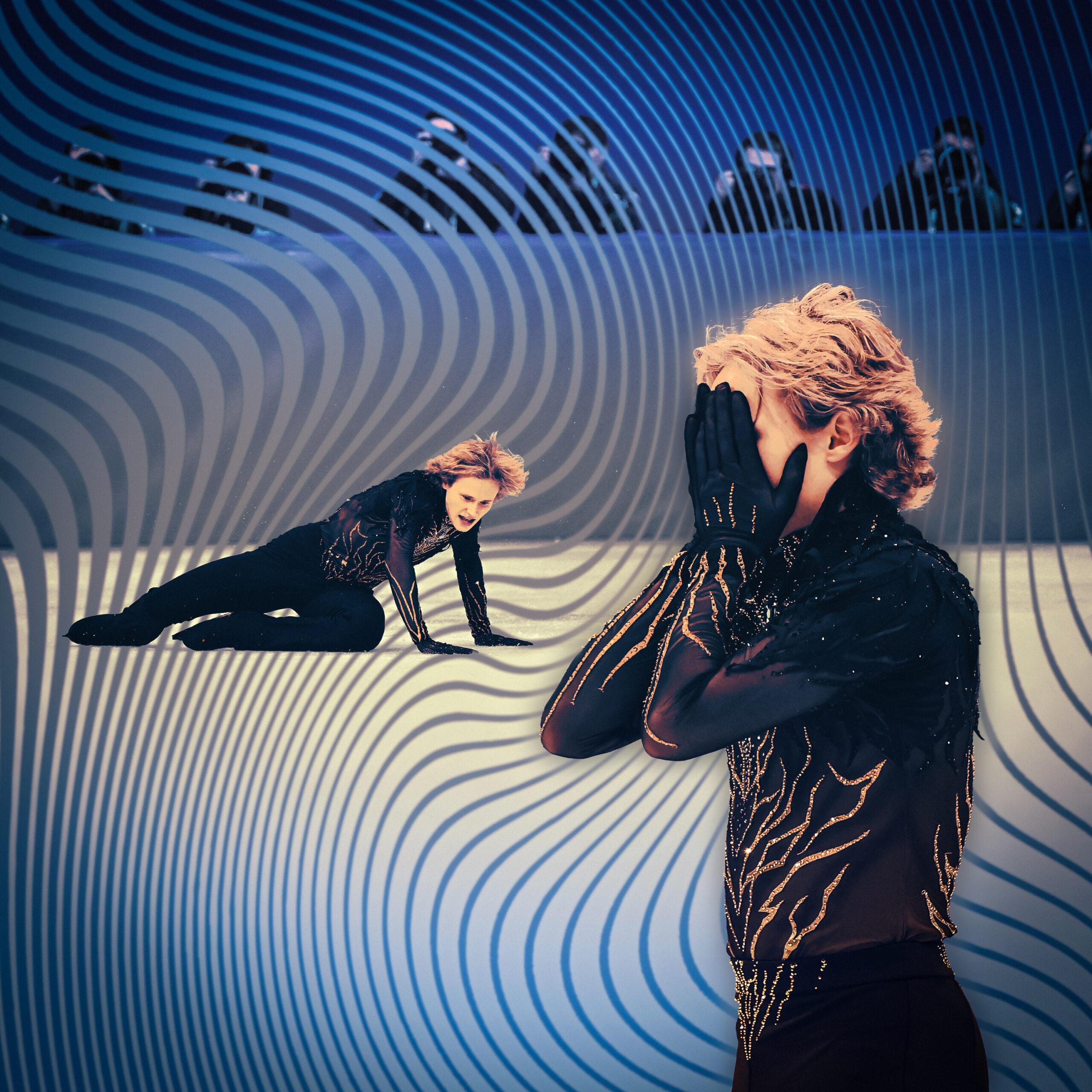

Finally competing in his first Winter Olympics after dominating the men’s figure skating circuit for years, the 21-year-old American Ilia Malinin was supposed to leave everyone speechless. Unfortunately, that’s exactly what he did. On Friday the 13th, the reigning back-to-back world champion known as the “Quad God” was the final athlete to take the ice for the men’s free skate. He led the field after the short program and was overwhelmingly expected to win the gold medal. What viewers hoped for was a few minutes of seeing heaven. What Malinin delivered was a front-row seat to a guy going through hell.
Skating to music that incorporated recordings of his own voice saying things like “the only true wisdom is knowing you know nothing,” Malinin hit the opening quad jump in his program, a quadruple flip, and then readied himself to attempt a move that he alone can do, the vaunted quadruple axel. Pretty much nothing went right after that. He popped out of some spins early. He tumbled to the ice upon landing others. The look in his eyes grew increasingly wild. He was white as a sheet. Before his routine had even ended, Malinin was already covering his face in disbelief. I was covering my face, too.
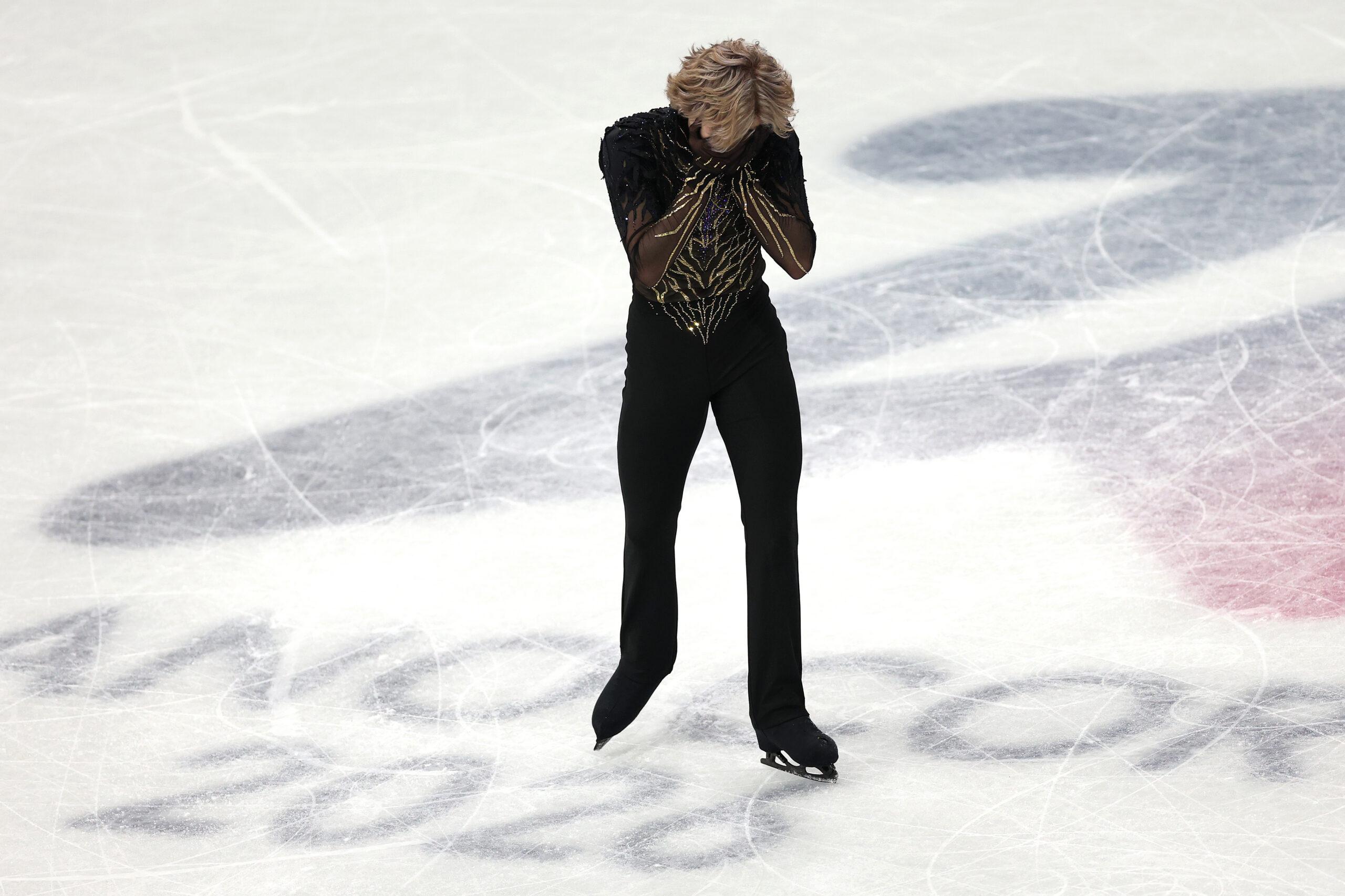
Ilia Malinin reacts after his free skate in Milan
The best way I can describe watching Malinin implode was that it made me feel young again … by which I mean it made me feel 10 years old, watching my favorite Knicks player, John Starks, put up 18 shots and miss 16 of ’em in Game 7 of the 1994 NBA Finals. Or maybe a better way to explain it is that it felt like an anxiety dream, one of those where I know that I have somewhere crucial and maybe even life-changing to be—and yet the harder I hustle, the slower I move.
Malinin entered the Milan-Cortina Olympics as one of the primo American favorites, if not the favorite, to win medals, hearts, and minds. A normie viewer’s delight and an NBC broadcaster’s (quad)godsend, Malinin boasts unprecedented, borderline-not-humanly-possible physical skills—one recent profile in The Atlantic described him as “The Man Who Broke Physics”—and a princely, porcelain doll visage. His mom and dad? Both Olympic figure skaters themselves. His portfolio of work? Google Malinin and you’ll find endless wonders indeed, like his routine to the Succession theme that earned him a record at the 2024 World Championships. His personality? Appropriately self-assured and remarkably loose, considering.
On Friday, about 40 minutes before it was his turn to compete, Malinin and the other top contenders took a warm-up skate. He had a jolly, I-got-this demeanor: Before getting on the ice, he even pretended he was about to do one of his beloved backflips, only to stop and shake his finger at his admirers, as if to say: ah-ah, just wait. What approximately no one anticipated in that moment was that by the end of the night Malinin’s smile would be gone and the whole world would still be kept waiting. But that, my friends, is what the Olympics are all about.
Last weekend, as the Olympics were just getting underway, I kept hearing on TV that I wasn’t seeing “the real Ilia.” In the short program of the team event on February 7, Malinin turned in an uncharacteristically uneven showing, landing in a place he wasn’t accustomed to: second. At the free skate the next day, the stakes were high: Malinin was the last American to compete, and he was vital to Team USA’s odds of success.
The routine wasn’t nearly Malinin’s finest. (He stepped out of one quad lutz and bailed on another planned combination, whereas Japan’s Yuma Kagiyama looked much crisper.) Still, it was the night’s highest-scoring effort, and it clinched the American team gold. I took two things from the early event. One was that Malinin definitely had some Olympics-specific jitters. The other was that the degree of difficulty in his routines was so far above the competition that he didn’t need to be perfect to win individual gold. In the short program on February 10, Malinin finished back in his usual first place. He seemed closer to his real self again, the one everyone kept raving about.
On Friday, I watched the Olympic men’s free skate just as the good Lord intended: in a local pizzeria, over some garlic knots, on a pair of televisions that were out of sync and also on mute. This made for a fascinating and almost existential viewing experience well before Malinin took the ice. Any time a guy fell—and sheesh, these guys fell a lot—I couldn’t help but glance over to the laggier TV to get one last glimpse of a happier and more innocent moment, before a skate edge wobbled or an ass hit the ice or a gold-medal hopeful let his mind grow too loud midair. Maybe it will be different this time, I kept hoping, rooting for a little rift in the time-space continuum that would give that nice Frenchman, Adam Siao Him Fa, a do-over. (And maybe result in me receiving a duplicate order of garlic knots?)
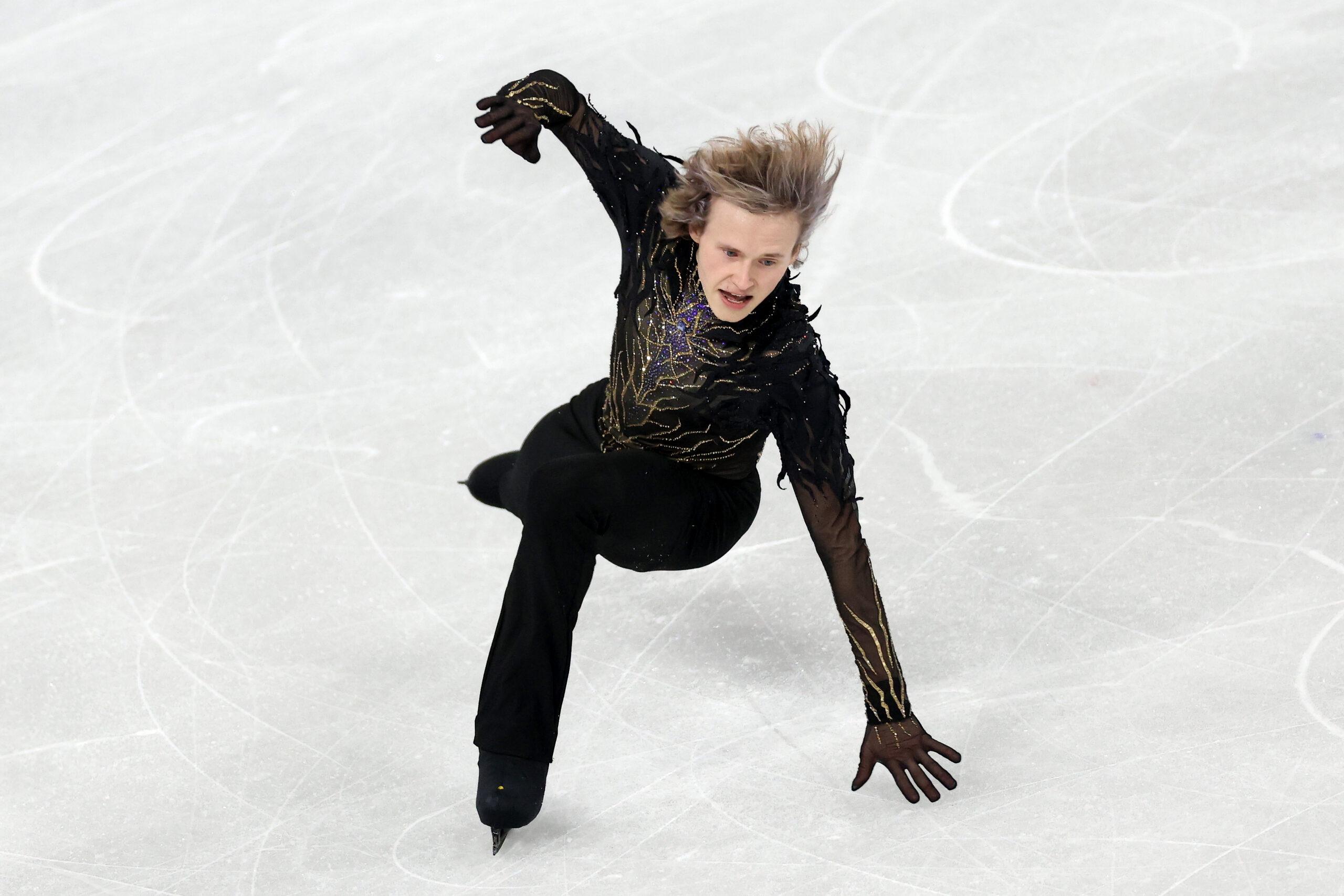
Malinin falls during his free skate
The combination of this no-volume broadcast setup and my understanding of Malinin’s dominance meant that, during his skate, I had a very incomplete grasp on just how badly things were going for the young man. I’m not particularly proud of this, but as an example: When he first bailed out of what was supposed to be his big quadruple axel shortly into the program, landing a ho-hum single instead, my confused internal reaction went something like, Ooh, maybe he does a whole schtick where he teases the audience by slowly building up to the big trick like an EDM DJ with the beat drop! How puckish! So avant-garde! Classic Quad God! A little later, when he took a full tumble that offered no room for optimistic interpretation, I thought: So what—didn’t all those other people fall, too? (They did indeed, which in hindsight may have served as something of a distraction; in this tippy-top tranche of elite competition, it probably doesn’t feel quite like business as usual unless one’s competitors are performing at their best.)
In the absence of being able to hear Johnny Weir and Tara Lipinski gasping on the broadcast, it wasn’t until Malinin fell again that I started to realize the worst was really happening, that the scenario I’d told my editor about—I’m pretty sure he’d have to, like, really fuck up not to win gold—was unfolding right there above the cash register. And even after all that? I still assumed that maybe the poor guy might just have to settle for, like, the bronze.
When I saw the result, eighth place, I gasped sharply enough that I startled the waitress.
This was the kind of sporting result that actually made me feel woozy for a while, like all the empathy in my body was rushing to the pit of my soul. All those fun statistics and stories, the ones that before the Olympics had been used by figure skating ball-knowers to begin to explain how truly head-and-shoulders above the competition Malinin was? Now, those same facts and figures were being shared to emphasize how shocking it was for him to wind up nowhere near the podium. (Until Friday, the last time Malinin missed a podium altogether was in 2022. His best free skate score since then was a world-record 238.24, while his lowest had been a 163.63—that is, until Malinin posted that 156.33 in Milan.)
Which made it a bona fide Olympic Moment, no doubt about it, because sometimes the most enduring Olympic Moments are also the worst ones. The Games offer a uniquely exquisite tension between higher-faster-stronger progression, all-eyes-on-you focus, and time between tries. It’s about as close as it gets in real life to the video game experience of meeting the final boss. Some performances leave you asking: How can anyone DO that? Others, like this one, raise a different question: How can anyone come back from THAT? Not an Olympics goes by in which I don’t find myself wondering both things with equal passion. The human fallibility on display is part of the appeal. “Experiencing that Olympic atmosphere, it is crazy,” Malinin told NBC just moments after he unraveled. “It is not like any other competition. It is really different.”
Malinin is only the latest marquee Olympian to spiral (and/or fail to spiral) out of control in front of the world. The defining image of Mikaela Shiffrin from the last Winter Olympics wasn’t her raising her poles in excitement at the finish line or crying on the podium; it was her balled up on the side of the mountain post-crash. (Last week, the “Olympic hex” struck again.) On Friday, it was impossible to watch the way Malinin made so many of his mistakes and not immediately think about Simone Biles’s scorching case of “the twisties” in Tokyo, both because of the yipsy similarities of their short-circuited mechanics and also because Biles was right there in the Milan arena watching Malinin, her smile hardening into a grimace along with everyone else’s.
You can go on and on. Nathan Chen in PyeongChang. Lindsey Jacobellis in Turin. For the old heads: the Dan vs. Dave Barcelona debacle. Even this winter, other Olympic hotshots besides Malinin have fallen short. For every fun American story, like the U.S. Korey/Cory curling team or Breezy Johnson winning gold in the downhill, there’s some bummer: Shiffrin finishing 15th in the team combined slalom, Lindsey Vonn being helicoptered off the slopes after a crash, the ice dance pair of Madison Chock and Evan Bates failing to get the gold they’ve sought since forever thanks to a French judge named, and I promise you this is real, “Jézabel Dabouis.” (There’s always one.)
Malinin, to his extreme credit, was present and talkative in defeat, giving special attention to the Washington, D.C.–based media that had been covering his rise long before Milan. “I’m heartbroken,” he told reporters, looking bewildered. “I don’t think I was prepared for the atmosphere of the Olympics.” A hot mic caught him griping to coaches that if only Team USA had picked him for the Olympic squad back in 2022, maybe he would’ve been used to the pressure by now. Maybe that was the problem. Maybe skating the long program in the team event last weekend was simply too much. Or maybe, as Malinin also posited on Friday, he simply came into the Winter Games too confident. “It’s the Olympics, and I think people only realize the pressure and the nerves that actually happen from the inside,” he told NBC.
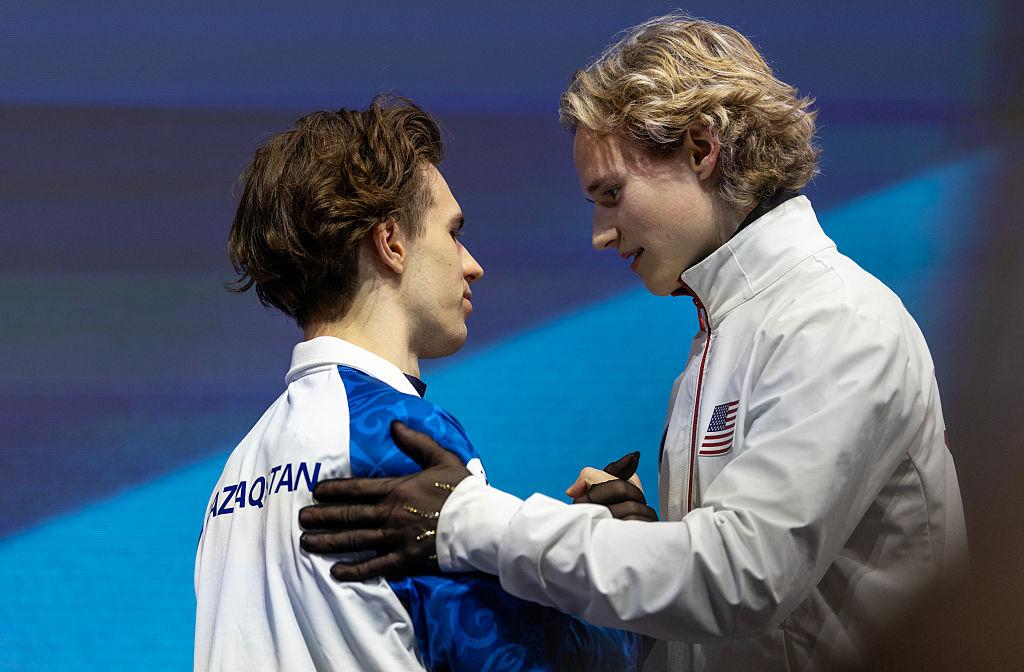
Malinin congratulates Mikhail Shaidorov after his surprise gold medal win
The children’s TV host Mister Rogers used to famously say that in an emergency, one should look for the helpers. The Olympic corollary of this is that whenever there’s a totally unexpected loser at the Games, there’s probably a really shocked winner nearby. On Friday, that person was Mikhail Shaidorov, also 21 and from Kazakhstan, who learned to skate at a shopping mall and still has braces on his teeth. He looked as surprised as anyone to be in this position.
Malinin went over and hugged Shaidorov—like, really, really hugged him—and I started tearing up in the damn pizzeria. (The waitress was polite enough to pretend not to notice.) From where I sat, there were two winners on TV: One of them was the gold medalist. The other was the guy only a few minutes removed from one of the worst moments of his life, actively giving an opponent his very best, because what else can ya do? On Friday, it was like a spell broke and the world saw the truth: even a Quad God is only human. What a broken and beautiful thing to be.