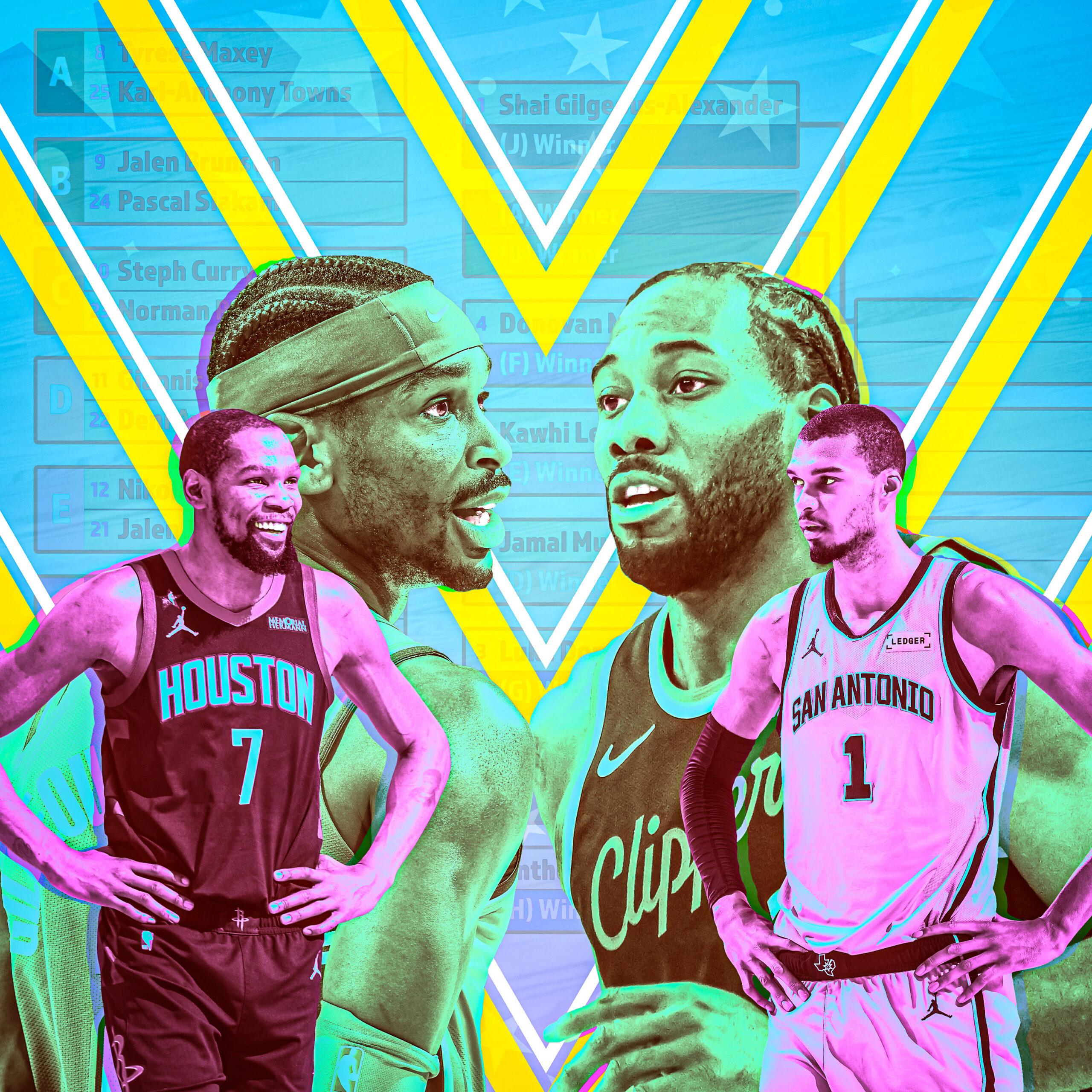

Last month, Victor Wembanyama and Anthony Edwards treated NBA fans to the duel of the season. Down the stretch of a close game in San Antonio, Ant hit tough jumper after tough jumper to keep the Wolves close. On the other end, Wemby answered with an array of nearly impossible shots. Edwards finished with 55 points in a loss; Wembanyama finished with 39 in a win.
Both players seemed to relish the matchup—two rising superstars poised to do battle for years to come. “I love it,” Edwards said after the game, although he did add one caveat: “I wish we could have just moved everybody out the way and just checked up—me versus him." So do we, Ant. So do we.
Every year around this time, in preparation for an All-Star Game that has lost all meaning and intrigue, NBA fans pine for a more competitive event. Why shouldn’t a one-on-one tournament be the answer? Let’s bottle the electricity of Ant vs. Wemby and put it on the stage it deserves. A one-on-one tournament would pit the league’s greatest stars against each other. It would put pride on the line and force players to compete. And it would encourage them to plumb the depths of their bags in a way that’s incompatible with actual NBA basketball. In short, it would be fresh and massively entertaining.
But who would win? Unfortunately, we probably won’t get a definitive answer anytime soon. For all of Adam Silver’s All-Star tinkering, it doesn’t seem like the idea of a one-on-one tournament has much traction. But that doesn’t mean we can’t try to answer the question here, using a mix of numbers and our own observations to evaluate the one-on-one bona fides of each NBA All-Star.
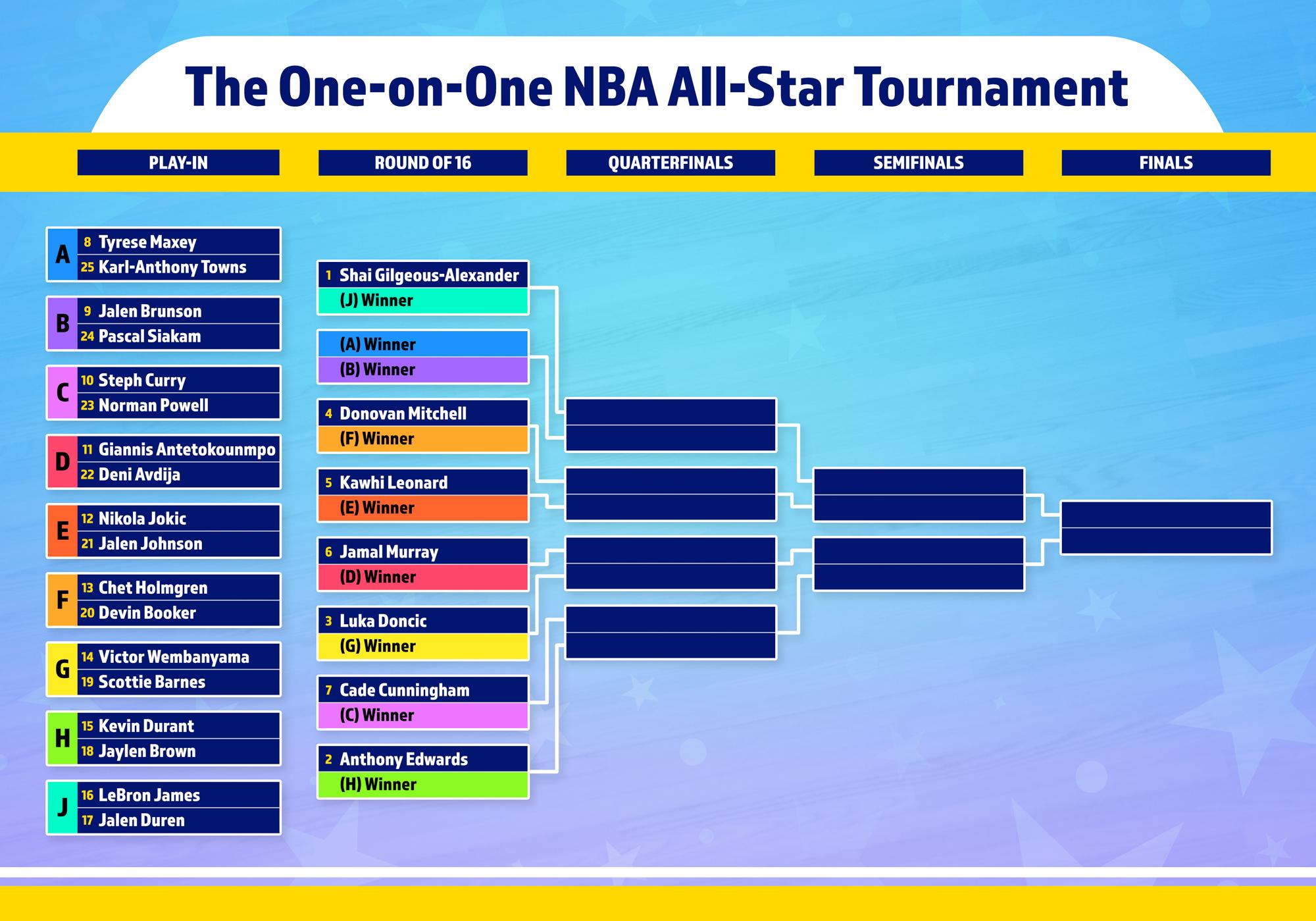
Here’s a bracket that seeds every 2026 All-Star from 1 to 25, ranked according to their performance in four categories that we’ve deemed essential to one-on-one competition: isolation scoring, on-ball defense, shooting ability, and ballhandling. From here, we’ll analyze every individual matchup and determine a winner, going round by round until we’ve crowned a champion. (To account for the complexities of a 25-person bracket, we’ve added a play-in round and awarded byes to the top seven seeds.)
Before we get into it, let’s outline the rules of our hypothetical games.
- First to 11 points wins, going by 1s and 2s. You have to win by two. The higher seed starts with possession.
- Games are make-it-take-it, which means a player who scores a bucket keeps possession.
- After makes, possessions reset at the top of the key. After misses, the defensive player needs to grab the rebound and take the ball back behind the 3-point line before they can score.
- No offensive rebounds, no putbacks.
- If a player gets fouled, they retain possession and reset at the top of the key. After six fouls, you’re disqualified.
Finally, a quick note on our methodology. It’s inherently inexact to strip a complex and free-flowing sport down to its component parts. Nikola Jokic may not dribble a lot during NBA games, but that doesn’t mean he wouldn’t be able to in a competition like this. Basketball’s beauty lies in the shady areas that can’t be quantified, and the excitement around a one-on-one tournament lies in the intrigue around just how each player’s unique game will translate. So we’ll use these statistics and seedings to inform our analysis, but ultimately we’ll choose a winner for each matchup based on what we think would happen in a real game of one-on-one.
With that preamble out of the way, let’s check up.

The Play-In
(8) Tyrese Maxey vs. (25) Karl-Anthony Towns
We start with an ideal amuse-bouche—a clash of styles that underlines what makes one-on-one so delicious. Maxey is a blur; he leads the NBA in miles traveled per game, at 2.8. Towns is more lumbering, although he does clock in at a respectable 2.1. There would be possessions when Maxey gleefully makes Towns look like a traffic cone, but the half-court format eats into Maxey’s speed advantage. Towns, meanwhile, could back Maxey down to the block for a buffet of jump hooks. KAT is shooting 46 percent on post-ups, which isn’t great, but his attempts primarily come against players who are much larger than Maxey. In this matchup, his size would ultimately prove overwhelming.
Who wins: Towns
(9) Jalen Brunson vs. (24) Pascal Siakam
Brunson lives for this shit. Forty percent of his field goal attempts come after seven or more dribbles; that’s the third-highest share in the league, behind only Shai Gilgeous-Alexander and James Harden. With no shot clock or dribble limit in this tournament, Brunson would stretch his offensive possessions to the breaking point, probing the paint for an advantage, pivoting and feinting, and ultimately baiting Siakam into fouls when he’s backed into a corner.
Who wins: Brunson
(10) Stephen Curry vs. (23) Norman Powell
On the one hand, stripping Steph of his teammates and the flow of the Warriors offense takes away so much of what makes him great. On the other hand, letting Curry put the NBA’s best players into a blender would be pretty sick! The transformative impact of Curry’s gravity has always overshadowed his ability as a one-on-one attacker; so far this season, he nets out in the 86th percentile of isolation scorers, according to data from Synergy. The problem is that Powell—the poster man for peaking in your 30s—has turned into a generational scorer during his first year in South Beach. Powell is scoring 1.17 points in isolation possessions this season, even better than Curry and tied with the reigning MVP for second in the entire league.
The key factor here, as it always is with Curry, comes down to shooting range. Powell would need to essentially face-guard Curry out to 35 feet; that’s just too much ground to defend on his own. Eventually, Curry would wear Powell out and then tell him “night night.”
Who wins: Curry


(11) Giannis Antetokounmpo vs. (22) Deni Avdija
This matchup pits two of the league’s preeminent foul drawers against each other. That’s not a knock. Antetokounmpo and Avdija are relentless drivers who basically force defenders to play beyond the rules to try to stop them. Giannis averages 9.9 free throws per game; that’s second in the NBA. Deni averages 9.4; that’s third. The difference is that free throws make up a larger share of Avdija’s offensive production—and in this format, fouls lead to a reset up top rather than two freebies. In a physical contest that forces both players to put the ball through the hoop, Giannis’s emergent one-legged fadeaway gives him the edge.
Who wins: Giannis
(12) Nikola Jokic vs. (21) Jalen Johnson
This format would necessitate a greater stylistic change for Jokic than for any other player in the field. The best player in the world would rather pass than shoot. He’d rather set a screen than probe for a bucket himself—and it shows in his statistical profile: Over 50 percent of Jokic’s shot attempts come when he’s possessed the ball for less than two seconds. That said, we’re not the least bit worried about his ability to adapt. On the occasions when Jokic possesses the ball for over six seconds, he is still shooting 55 percent; that’s better than Johnson is shooting overall.
Who wins: Jokic
(13) Chet Holmgren vs. (20) Devin Booker
Chet nets out with the 13th seed in our bracket, but his underlying profile reveals a pretty drastic split. Among the 25-person field, Chet ranks fifth in on-ball defense and fourth in shooting, but he ranks 24th in unassisted offense and 23rd in dribbling. That all tracks. Holmgren has taken a major step forward on offense this season by improving in all kinds of subtle areas, but we’ve yet to see the kind of offensive explosion that portends major one-on-one chops—especially when considering that the Thunder have actually needed a creative jolt amid injuries to SGA and Jalen Williams.
Who wins: Booker
(14) Victor Wembanyama vs. (19) Scottie Barnes
Barnes is the kind of sturdy, pugnacious forward who can get into Wemby’s airspace and give him problems. Unfortunately, his shot just isn’t sharp enough to score 11 points on Wembanyama. In a career year, Barnes’s 3-point percentage is still hovering around 30 percent. That would allow Wemby to sag off and protect the paint, snuffing out virtually any pathway Barnes has to score. Barnes’s defense would drag this game out longer than you’d expect, but that’s about all he can hope for.
Who wins: Wembanyama
(15) Kevin Durant vs. (18) Jaylen Brown
This is an anti-analytics fever dream. When Durant and Brown have it going in the midrange, there’s really nothing anyone can do to stop them. In that sense, the matchup itself is almost irrelevant. Durant is perpetually unbothered by whatever poor soul is trying to contest his jumper, and Brown has become almost Durantian in the way he’s carried the Celtics offense this year. Ultimately, Durant’s handle is a little bit tighter, his arms are a little bit longer, and his bag is a little bit deeper. His 40 percent stroke from 3 compared with Brown’s 35 percent might prove the difference in a format where deep balls are worth even more relative to the midrange.
Who wins: Durant
(16) LeBron James vs. (17) Jalen Duren
Hand up if you know what it’s like to get cooked by an old guy.
Who wins: LeBron
Round of 16
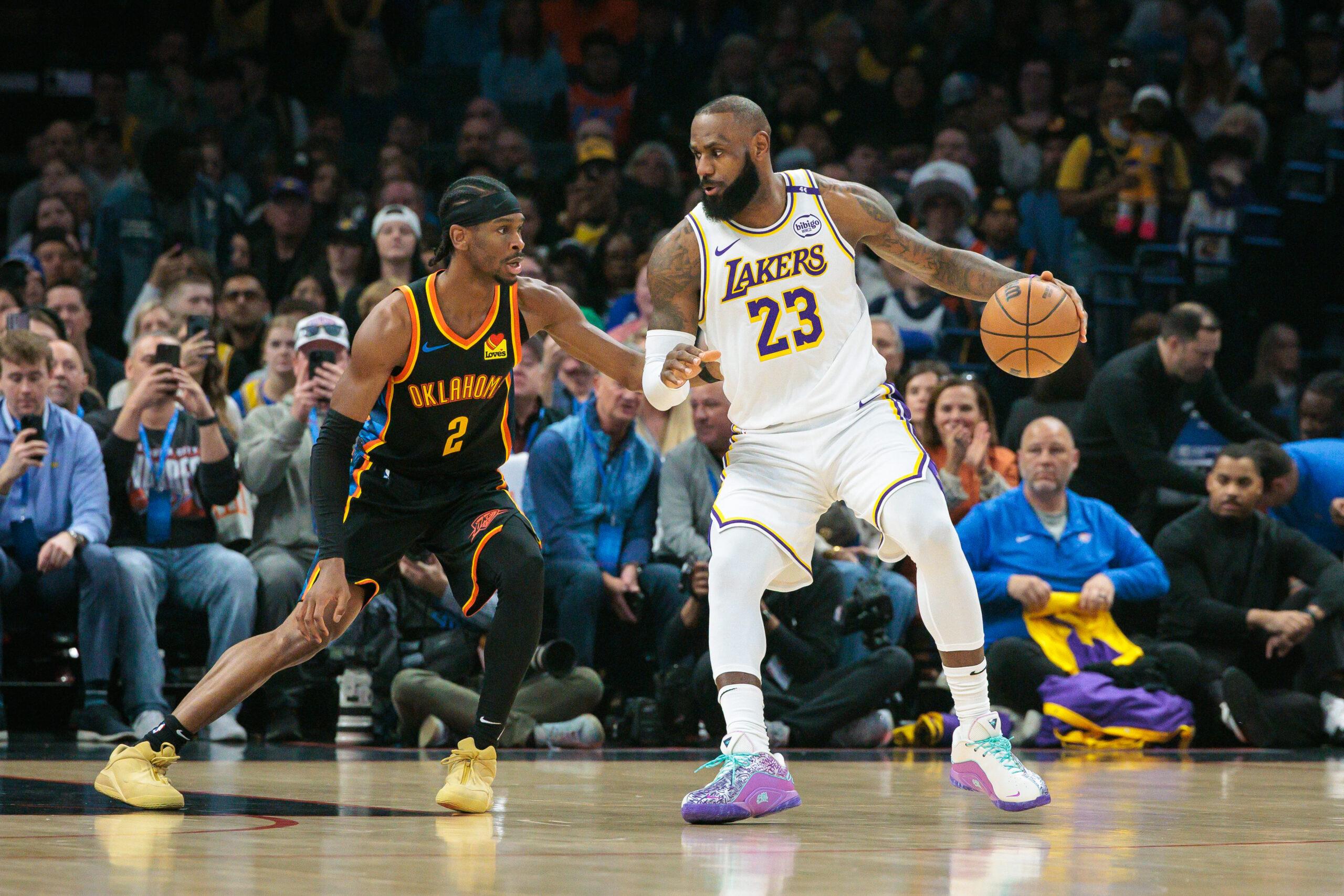
(1) Shai Gilgeous-Alexander vs. (16) LeBron James
In all seriousness, don’t sleep on LeBron in this format. At 41, in his 23rd season, he has seen, used, and guarded every move in the book. He’s still absurdly strong, has the highest basketball IQ in the field, and can turn up the athleticism in moments when he needs to. He’s shooting 65 percent in the clutch this season, which suggests that just because he’s surrendered the car keys to Luka doesn’t mean that he can’t take the whip out for a spin every now and again.
Unfortunately, he’s going up against Gilgeous-Alexander, our top overall seed. At this point in his career, SGA can press on all of LeBron’s defensive pressure points. He is shooting 39 percent on pull-up 3s this season, so it’s not viable to simply sag off and hope he misses. LeBron will have to press up, and Shai will have no problem scooting by him for layups. Still, this would be must-see TV. The NBA’s changing of the guard has been a simmering story line for multiple seasons now, and it’d be especially compelling to watch it manifest in such a direct and intimate way.
Who wins: SGA
(25) Karl-Anthony Towns vs. (9) Jalen Brunson
No matter what happens, Knicks fans would come out of this matchup feeling worse about their team.
Who wins: Towns
(4) Donovan Mitchell vs. (20) Devin Booker
Sometimes, one-on-one really sings because of the contrasting styles and positions of the participants. In this case, it’s elevated by Booker's and Mitchell’s similarities. These are two silky shooting guards who can pour in buckets from anywhere on the court. Ultimately, Mitchell has the edge because he shoots 35 percent on off-the-dribble 3s, compared with Booker’s 27.1 percent. But we’re all winners here. This is the most aesthetically pleasing matchup in the entire tournament.
Who wins: Mitchell
(5) Kawhi Leonard vs. (12) Nikola Jokic
This is a real heavyweight tectonic clash. Kawhi would need to leverage his quickness and jump shot to score on damn near every possession because he would have his hands full trying to get stops against Jokic on the other end. Leonard is giving up almost 60 pounds in this matchup; Jokic would surely look to get Kawhi on his back and pirouette his way to easy floaters around the basket. Would Kawhi have any chance of slowing him down? Unfortunately, the sample sizes for Kawhi as an individual defender are too low to tell us anything definitive, but that’s because nobody dares to try him. Here’s what we do know: Leonard has been in the 80th percentile or better as a post-up defender in each of the past few seasons; his steal percentage is tied for fifth in the league this season as he’s rediscovered peak “Klaw” form. Neither player can really guard the other, but we’re not going against this version of Kawhi.
Who wins: Kawhi
(6) Jamal Murray vs. (11) Giannis Antetokounmpo
It’s a shame that Murray and Jokic would be eliminated in back-to-back games. Their two-man game is everything that’s good about basketball, but their partnership also has a tendency to overshadow their respective individual brilliance. Or, let’s be honest—to overshadow Murray’s brilliance. Murray absolutely deserves his first All-Star berth, and he deserves the 6-seed in our tournament. With the Nuggets’ suite of injuries this season, Murray is creating more unassisted offense than in any prior season of his career. But like Jokic, he has the misfortune of a historically tough opponent. Giannis leads the league in paint scoring, even as every opponent designs their entire game plan to stop him. Murray on his own doesn’t have much of a prayer.
Who wins: Giannis

(3) Luka Doncic vs. (14) Victor Wembanyama
This matchup can be boiled down to the advanced metric commonly known as the “give a shit” factor. Taking down Wembanyama will require a commitment to defense and physicality that we haven’t seen from Luka in a while. Doncic’s average speed on defense this season is 348th out of 349 players who have played over 400 minutes—one spot ahead of last-place James Harden and one spot behind LeBron.
Who wins: Wemby
(7) Cade Cunningham vs. (10) Steph Curry
Cade vs. Steph depicts the last 15 years of the NBA in microcosm. It’s Curry, the harbinger of the spatial revolution, versus Cunningham, the avatar of the big playmaker archetype that’s capitalizing on all the space Curry has wrought. In his fifth season, Cade has eliminated all doubt about his ability to be a no. 1 option on a great team, but he still struggles—relatively, compared with the other players in this tournament—to shoot efficiently (24th in our field) and take care of the ball (3.7 turnovers per game). It doesn’t matter in this matchup; Curry’s limitations prevent him from capitalizing on those vulnerabilities. He’s too small to generate steals or force Cunningham into inefficient shots, and Cade has the length and young legs to chase Curry around the arc.
Who wins: Cade
(2) Anthony Edwards vs. (15) Kevin Durant
I’m sorry, this needs to happen. It’s a matter of national importance. The sheer tonnage from this matchup will power a clean-energy revolution. Its beauty will inspire a golden age. Tales of it will sustain future generations until its legend is rendered in the cosmos by Christopher Nolan VI in the year 2119.
Ant has the advantage in all four categories we used to establish our seeding. He has become almost as much of a deadeye shooter as his childhood idol, and he’s also a more disruptive defender and more of a self-starter on offense. He’s also far more athletic than Durant is in Year 18. But KD is just irrepressible. Off the dribble? Cash. Tightly guarded? Doesn’t matter. Look at this plot of Durant’s last 750 shot attempts, via Cleaning the Glass:
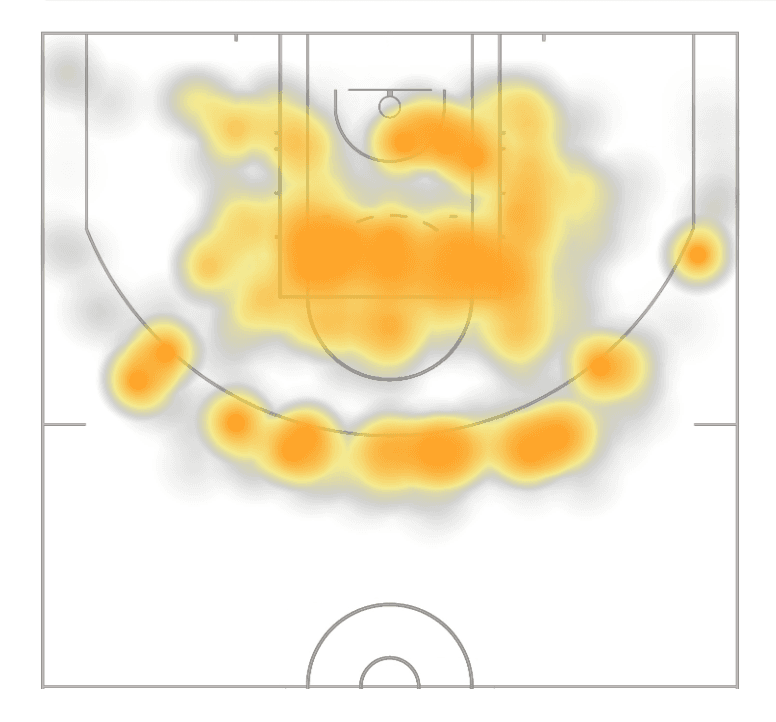
These are the exact zones where one-on-one basketball takes place. Durant would hardly have to change a thing about his game. He’d just have to check the ball and go to work.
Who wins: Durant
Quarterfinals
(1) Shai Gilgeous-Alexander vs. (25) Karl-Anthony Towns
For the third round in a row, Towns faces a point guard—but SGA is stronger than Maxey, taller than Brunson, and even better at scoring in isolation than either one of them. Gilgeous-Alexander would open this matchup with the ball, owing to his higher seed. That’s bad news for Towns, because SGA is the most prolific isolation scorer in our field and Towns is one of the least fleet of foot.
Towns and Shai have faced off six times in the past three seasons; in 40 partial possessions when Towns matched up with SGA, Gilgeous-Alexander scored 41 points and the Thunder as a team scored 67, according to NBA Advanced Stats tracking data. Head-to-head matchup data is notoriously noisy, but even if that’s overselling the mismatch, it feels safe to assume that Gilgeous-Alexander would get the better of Towns one-on-one. The odds are about 50-50 that KAT survives this game with both ankles intact.
Who wins: SGA
(4) Donovan Mitchell vs. (5) Kawhi Leonard
We’re splitting hairs at this point. Mitchell is incredible. But if there’s one reason he might struggle here, it’s because he’s accustomed to doing a large chunk of his damage in transition. Mitchell averages the second-most transition points in the entire league, just a tick behind Maxey. The deliberate pace of a one-on-one affair nudges the game in Kawhi’s direction.
Who wins: Kawhi
(11) Giannis Antetokounmpo vs. (14) Victor Wembanyama
Let’s use this space to remind ourselves of what happened the first time Wemby and Giannis played each other—the Freak vs. the Alien, Part 1, if you will. It was January 2024, midway through Wembanyama’s rookie season. Giannis did this:
Wemby did this:
It’s worth rewatching the last five minutes of that epic 2024 game in full, if only because it feels like a clash of titans who were still gauging how well their powers could work against someone else like them. Giannis won that contest, but two years later, Wembanyama has added enough muscle to his frame to allow his all-around skill set to sing. Giannis won’t be able to shove Wembanyama out of the way on battering-ram drives to the basket, and his jumper just isn’t reliable enough to draw Wemby out of the paint and open up more space to drive. Giannis may be the best finisher in the NBA, but even he would struggle to finish consistently against the league’s best rim protector. That presents a stark contrast to the flip side of the matchup; Wembanyama is shooting 39 percent on open 3s, good enough to force Giannis to play him tight. At that point, Wemby just has so much more space to work with.
Who wins: Wembanyama

(15) Kevin Durant vs. (7) Cade Cunningham
Durant and Cunningham are a fascinating study in contrasts. KD is a sniper who does most of his damage with decisive action and a lightning-quick release. Cunningham is a prober who starts the offense for himself and others just as often as he finishes it. Durant would be vulnerable defensively to small guards who can string him out and drive around him, or to physical centers who can make him battle down low. Cunningham is neither—he doesn’t have the elite first step to consistently get by a 37-year-old KD, and he doesn’t have the length to shoot over him. Cade is scoring 0.99 points per isolation possession—a respectable figure, but not the kind of bucket getting that can dispatch the sixth-highest scorer in NBA history.
Who wins: Durant
Semifinals
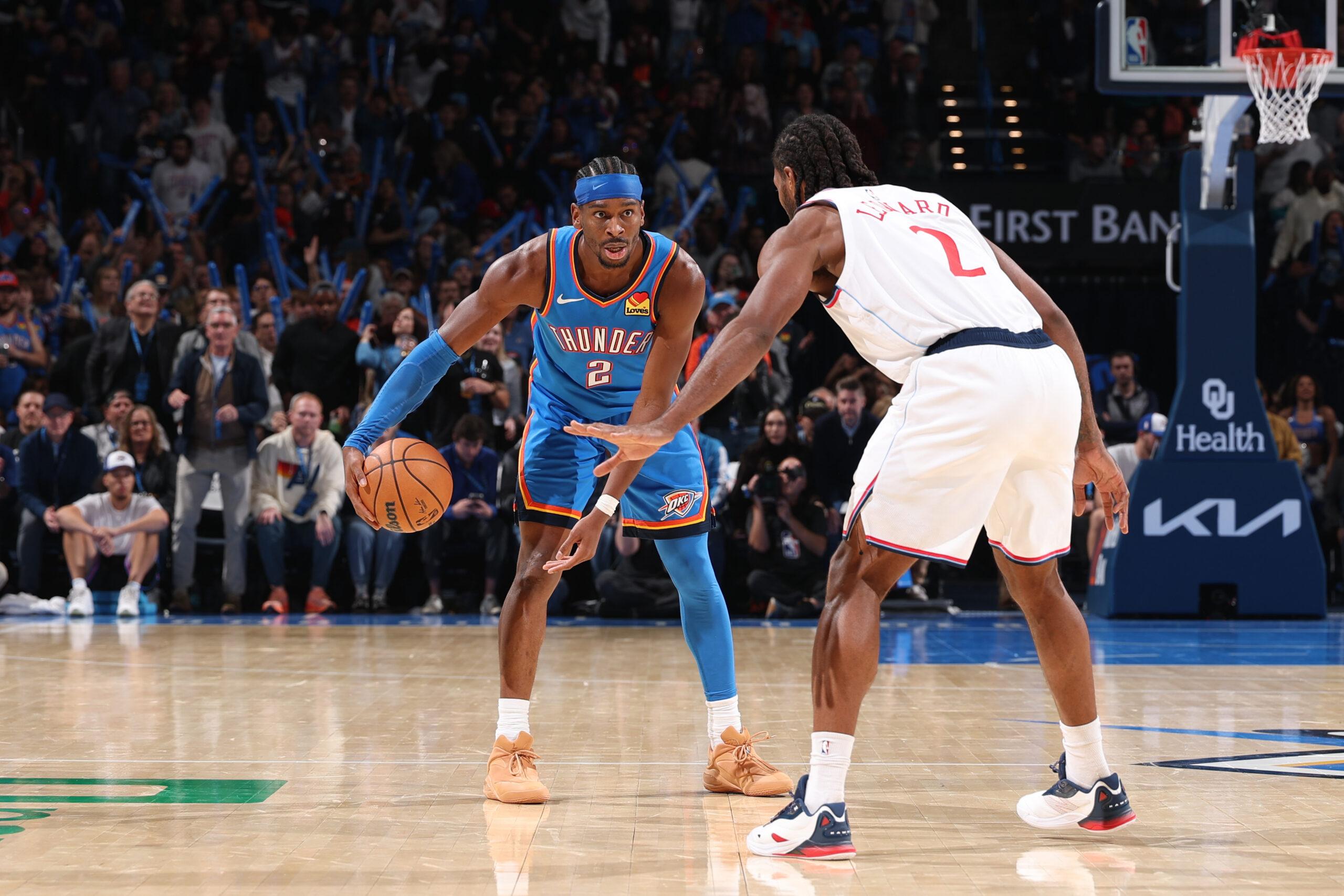
(1) Shai Gilgeous-Alexander vs. (5) Kawhi Leonard
Welcome to the Clipper Bowl, featuring the player whom L.A. mortgaged the future for against the one it would give anything to have back. And if the NBA had implemented a one-on-one tournament in time for this year, it would have even taken place under the bright lights at the Intuit Dome. SGA and Kawhi harness two extremely different styles of movement. Shai is slithery and bendy and loose. Leonard is a bolt of kinetic energy that never seems to fully uncoil. Both are highly effective at leveraging that movement to hunt their preferred shots. In a matchup between two dominant scorers, Kawhi’s defense gives him the edge. It’s almost boring to reduce such a sizzling matchup to something as straightforward as size, but Kawhi can make SGA work harder to score than the other way around. We hope it’s a comfort to Clippers fans.
Who wins: Kawhi
(15) Kevin Durant vs. (14) Victor Wembanyama
Last round, Wembanyama beat Giannis. In this round, he’ll face another lanky prototype, although one who presents a very distinct challenge. If Giannis is the preeminent driver in the modern NBA, KD is at least in the conversation as its most deadly spacer. Wembanyama beat Giannis by sagging off and absorbing his paint attacks. Against Durant, he’ll need to do the inverse: stretch all the way out to the 3-point line to protect against the 3.
This is where Durant’s age finally catches up to him. According to Cleaning the Glass, just 11 percent of KD’s shots have come at the rim this season; that’s the lowest rate of his career. It’s a testament to Durant’s shooting ability that his overall efficiency for the Rockets hasn’t suffered, but his discomfort driving the ball will hurt him at this stage of the tournament. Against Wemby, it’s imperative to be able to score at all levels of the floor. If the 7-foot-4 guy doesn’t have to worry about getting blown by for layups, he can overplay Durant’s jumper. Normally, that wouldn’t be an issue for KD, who has one of the highest release points in the NBA. But here’s the thing about release points—according to Todd Whitehead, only one player in the NBA has released a jumper from above 11 feet in the air this season. He’s in this matchup. And it’s not Kevin Durant.
Who wins: Wembanyama
Finals
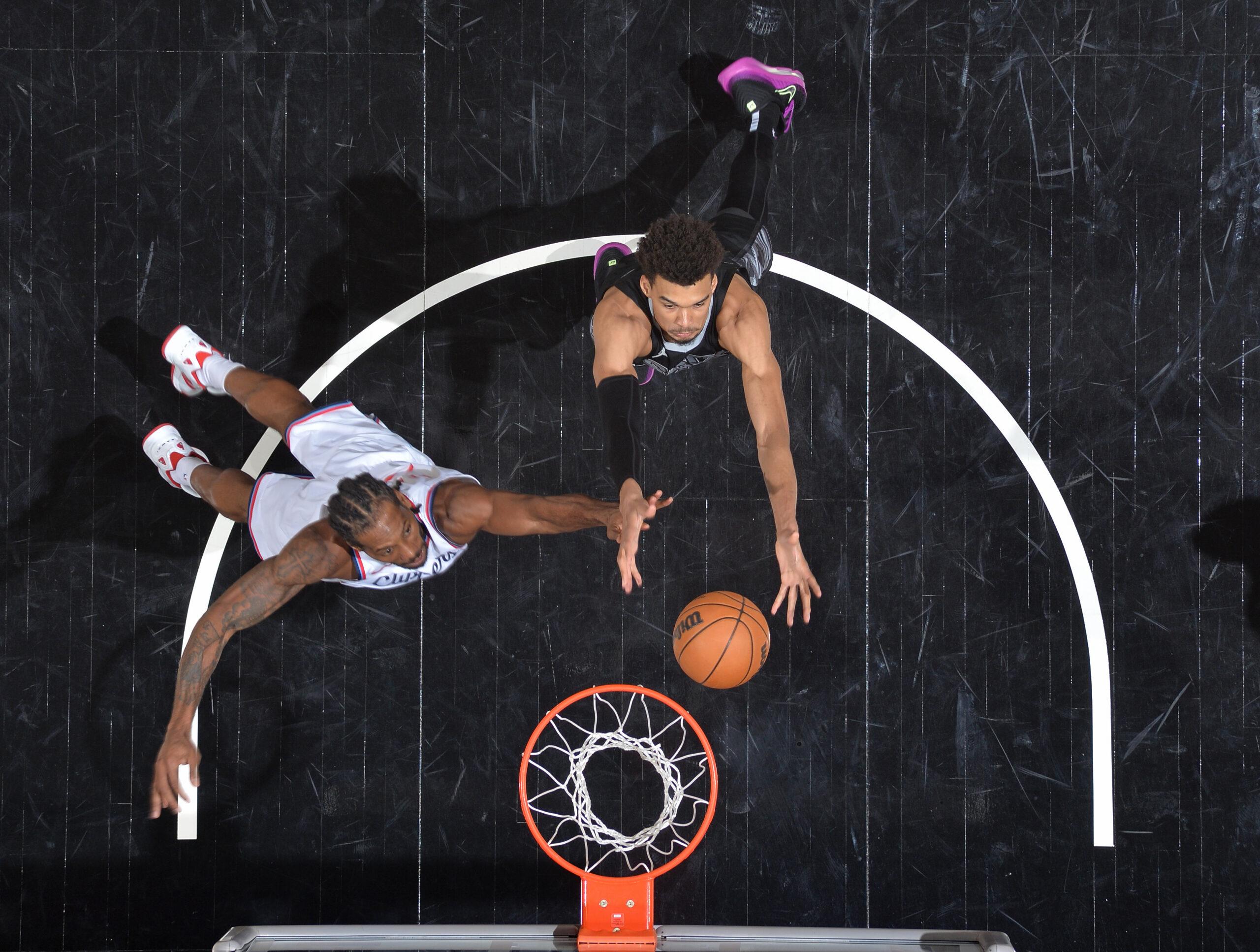
(5) Kawhi Leonard vs. (14) Victor Wembanyama
If anyone can take down Wemby, it’s Kawhi. He has range beyond the 3-point line. He’s crafty. And most importantly, he’s strong as hell. Wembanyama can’t be pushed around, but he is vulnerable to sturdy, grounded old-man strength. When Wemby has the ball, Kawhi would need to crowd his airspace and pester him with active hands. When Kawhi has the ball, he would need to harness his quickness and strength to shake free from Wembanyama or attack his body on attempts around the basket.
Leonard is up to the task. Kawhi is the ultimate three-level scorer: He’s shooting 75 percent at the rim, 50 percent from midrange, and 39 percent on above-the-break 3s. He’s the ultimate two-way player—the most feared defender of his generation turning back the clock for a supremely special season. Kawhi has been the best player in the NBA over the past three months. He is one of the greatest one-on-one players in NBA history. Like most everything else in the NBA, the one-on-one tournament trophy will probably belong to Wemby soon. But this year, with a salivating Steve Ballmer pumping his fist from the front row of Intuit, the champion can be only one man.
Who wins: Kawhi