The Quarterback Development Question That Could Be Answered by Super Bowl LX
“Pure progression” vs. “coverage-based reads” is a battle that’s been affecting the NFL for a while now. But while progression passing has gained momentum over the past decade, Drake Maye and the Patriots are proving there’s another way.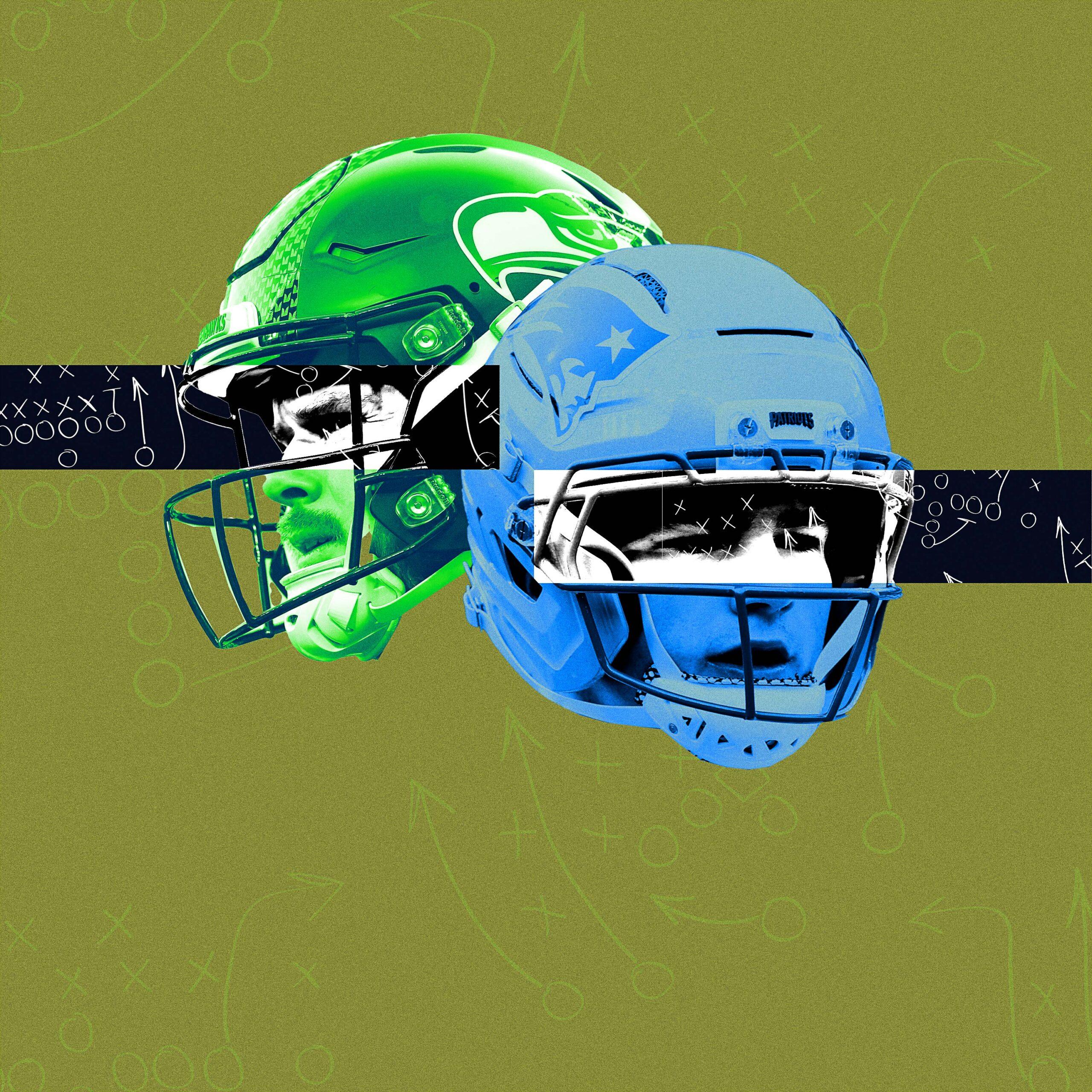

Drake Maye was having an absolutely miserable time in the fourth quarter of the AFC championship game. A pop-up winter storm had arrived in Denver just in time for the second-half kickoff, and it covered the field with a thick layer of snow. The field conditions were horrendous, and visibility was compromised by high winds blowing flurries straight into the eyes of both players and coaches. “It’s hard,” Maye told Patriots offensive coordinator Josh McDaniels on the sideline about operating in those conditions. McDaniels chuckled before responding. “It’s going to be hard,” he said. “But, look, this will be the most rewarding six and a half minutes of our lives if we can get it done.”
That interaction between Maye and McDaniels can double as a parable for New England’s shocking march to Super Bowl LX—and the young quarterback’s rise to stardom. While the 23-year-old has made things look easy this season, quarterbacking the Patriots has been hard—and not just because his offensive line kind of stinks, the run game isn’t productive, and the receiving corps is just a notch above mediocre. It’s also been hard by design. In an era when seemingly every offensive coordinator’s aim is to build a “QB-friendly” offense that reduces the mental stress placed on its quarterback, McDaniels has gotten Maye to embrace the kind of grind that would prepare him for the challenge of facing a powerhouse defense in the biggest game of the season, like he will on Sunday.
“I know there's this train of thought to take that responsibility off of [quarterbacks] and make their life simpler and they'll play better,” McDaniels said in December. “For us, we've always looked at [quarterback development] as a little bit of a mountain. You start climbing it, and as you're going up, you learn how to do more things to help you get to the top. When you get to the top and you've learned how to do all these things well, the view from the top is pretty good. Because you already know how to handle different pressures; you know how to solve your problems in protection; you know how to get out of a bad run play; you know how to read coverages when they're trying to disguise on you; you know how to deal with third down, red zone, two-minute and all those other things because you've gone through the labor and you've done the work.”
The “train of thought” McDaniels is referring to at the top of that quote has been influenced mostly by the success of 49ers head coach Kyle Shanahan and Rams head coach Sean McVay. There are myriad ways the coaches from those guys’ trees simplify things for their quarterbacks, but the way they ask them to read pass plays is perhaps the most significant. Shanahan, McVay, and many of the modern-day proponents of the West Coast offense run a “pure progression” passing system, which instructs the quarterback to look for receivers to get open in a particular order, regardless of what the defense is doing. The quarterback looks at his first option, and if that receiver isn’t open, he moves on to no. 2. If that receiver isn’t open … well, you get the idea. That’s the beauty of the approach: You don’t have to be some football savant to get it down. There’s no need to worry about diagnosing the coverage. If the defense is showing one look before the snap but switches to another, it has no bearing on how the play is read.
“In most West Coast systems, honestly, you don’t really need to know the coverage the defense is playing,” Patriots backup quarterback Joshua Dobbs, who played for Shanahan last season, told me this week. “Because your progression is going to take you where the ball needs to go. … Whether it’s [Cover] 3, [Cover] 2, or man, your eyes are gonna start in the same place. Your feet are going to start in the same place.”
The Patriots, one of the few teams that doesn’t run a West Coast offense, do things differently. While McDaniels does have some pure progression passing concepts in his playbook, they make up only a portion of the system. The offense that Maye’s Patriots are running is similar to the one Tom Brady ran throughout his career. The plays and formations have evolved to keep up with modern trends, but the core philosophy of the pass game hasn’t changed. In this system, a lot of the time the quarterback is making reads based on the coverage. If the defense is in a two-high zone, for instance, the quarterback would be expected to work one side of the field, where the receivers are running a route combination designed to attack that coverage. The other half of the play is designed to beat a different coverage, whether it’s a blitz or man. The progression is dictated by what the defense is doing, which requires the quarterback to be able to figure that out. If it’s not already obvious why that could be tougher on a quarterback, and why pure progression passing has grown in popularity in the NFL, Kirk Cousins recently offered a comprehensive explainer.
When Cousins entered the league in 2012, McDaniels’s method of doing things was preferred across the NFL. Brady and Peyton Manning were dominating thanks in large part to their ability to read a defense and get rid of the ball quickly. But defensive coaches adjusted, as they always do. If offensive coaches were going to ask their quarterbacks to diagnose the coverage, the obvious counter was to make that process as difficult as possible. “Defenses got so good at disguising it that I would be so stressed going into a game,” Cousins said. “The whole game plan is built on ‘Is it single high or split safety?’ and I can’t see if it’s single high or split safety.
“So coaches started to realize if we ask the quarterback to do that, it's going to be really hard because defenses know that's the game we're playing. And they're not going to let us play it. So then it started to become, ‘Let's just give you pure progressions, and let's just go 1-2-3-4-5.’”
That paradigm shift made quarterbacking more accessible. You didn’t need a robust understanding of coverages, blitzes, or opponent tendencies to find the open man. Quarterbacks who had failed in other systems were finding success with the style that Shanahan’s and McVay’s disciples were building their pass games around. “You have many, many examples of quarterbacks who have been Hall of Fame–level processors reading defenses, and no matter what you tried to play [defensively], they could figure those things out at a very, very high clip,” Vikings coach Kevin O’Connell said in December. “But what we don’t talk about is a lot of the other guys who weren’t able to have success doing that because they needed to have the ability to just do their jobs on a play.”
One of those latter guys is the quarterback who will be starting opposite Maye on Sunday. Sam Darnold, who struggled through the first five seasons of his career in various offenses with the Jets and Panthers, has spent the past three seasons playing in pure progression offenses, first under Shanahan as a backup in San Francisco, then in Minnesota with O’Connell during his breakout season, and now in Seattle under former Shanahan assistant Klint Kubiak, where he’s proved that his success with the Vikings wasn’t an aberration. Darnold hasn’t turned around his career by gaining a sudden mastery of the quarterback position or an advanced understanding of defense—he led the league in turnovers this season, showing he’s still got some recklessness in him. But he found an offense that worked for him, which has allowed his natural ability to shine. Pure progression passing turned a quarterback who was once dismissed as a bust into a multi-time Pro Bowler and a potential champion in just a few years.
The pure progression method works for Darnold and many of the quarterbacks around the league, but there are downsides to this approach—as there are with any philosophy in football. Hall of Fame quarterback Kurt Warner, who recently started a conversation about pure progression reads that had several quarterbacks and coaches weighing in, has been a critic of the approach and how it can stifle a quarterback’s mental development. “It really eliminates the need to process information quickly,” Warner told me this week. “So these quarterbacks are not being taught the nuances of a play and what they should be looking for.”
Warner believes that McDaniels’s way of coaching quarterbacks is better for long-term development. “He’s built a system based on finding the opening in the defense and attacking it with purpose,” Warner said. “Pure progression plays are great if they can beat every coverage. There's just not very many plays that are good that way, so you might be working all the way to your fourth or fifth option, and then you’re not playing quickly. If I know how to beat the coverage, I can skip the first, second, and third options. [McDaniels] and Tom Brady made a living off of it and became the best to ever do it. And so now he's using the same principles with Drake.”
These two concepts, pure progression and coverage-based reads, are not mutually exclusive, Warner says. He points to the Rams—with quarterback Matthew Stafford—as a team that blends the two. Ben Johnson’s Bears are another. The Patriots also use both methods, Maye told me this week. “You're trying to mix in pure progression, [and] you're trying to mix in coverage reads,” he said. “Defenses are doing such a great job with disguise and making it tough on the quarterback to pick a side pre-snap. … I think pure progression has become a more and more common theme and something that makes it easier on [quarterbacks]. But at the same time, we try to make sure we have an idea what defense is in, because that'll help us get to the right spot.”
That could be the key to Sunday’s game for the Patriots, who are playing against a Seahawks defense that rarely tips its hand before the snap and is known for its complexity after it. “It'll be a huge challenge for us,” McDaniels said this week. “Coach [Mike] Macdonald does an incredible job of connecting the entire defense. All the different calls they use, they all look the same until the ball snaps, and then all hell breaks loose.” Whether Maye is working through a pure progression or making coverage reads to speed up his process, Seattle is going to make it difficult. But if McDaniels’s vision of quarterback development is still viable against today’s defenses, Maye will be prepared for the challenge.