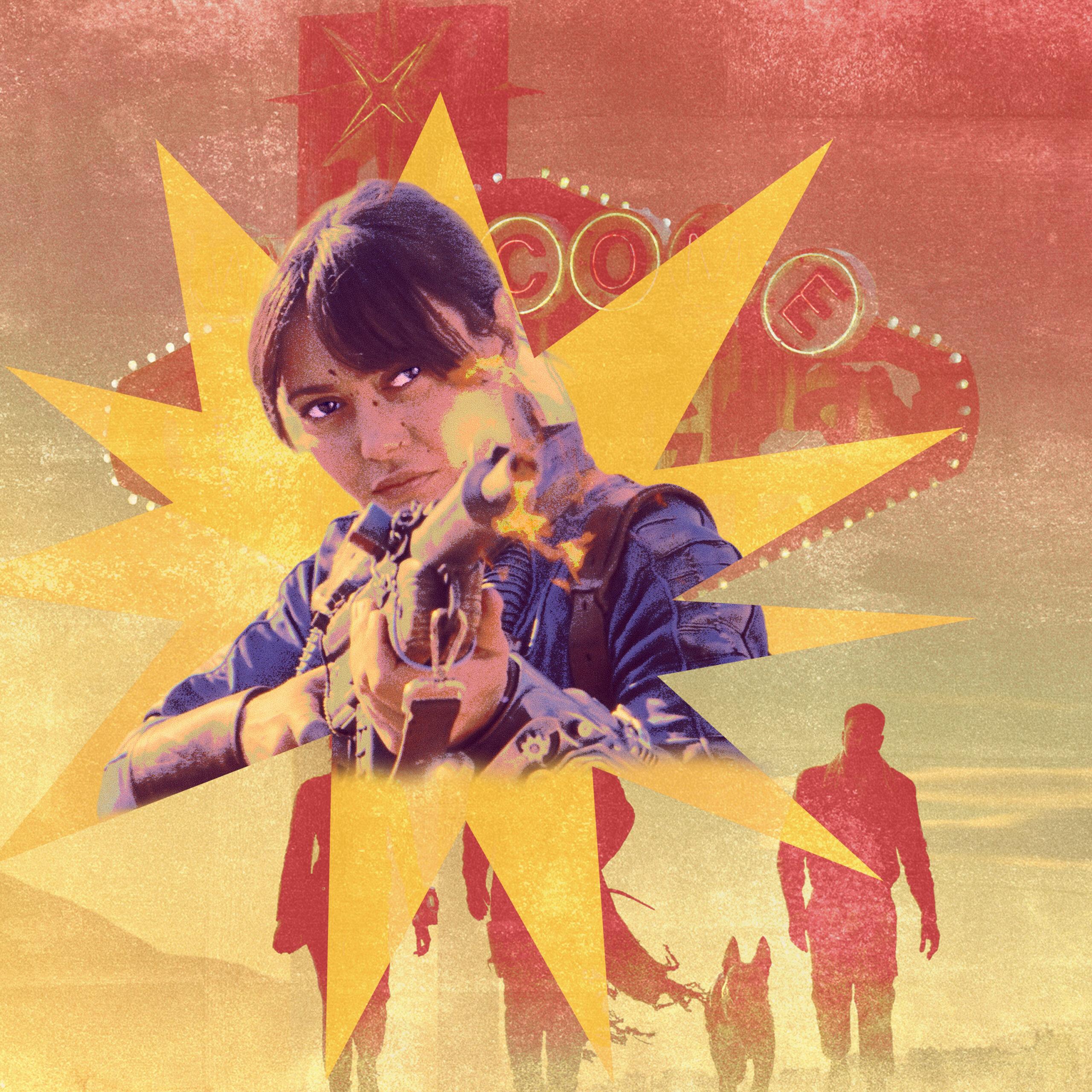


When the first season of Fallout premiered in 2024, the postapocalyptic TV series came as a pleasant surprise. Sure, the rise of good video game adaptations was already well underway by then, and Fallout had a lot of potential given the popularity of its eponymous franchise, which dates back to the late ’90s. But even Prime Video—which released the first season in a single, eight-episode drop—didn’t seem to anticipate the show’s tremendous success. Just one week after its arrival, the series was renewed for a second run.
In December, the Emmy-nominated show returned amid heightened expectations—and it raised its stakes, and ambitions, accordingly. The series switched to a weekly release model and added some big names to an already star-studded cast, including Justin Theroux, Kumail Nanjiani, and Macaulay Culkin. After Season 1 ended with Lucy MacLean (Ella Purnell) deciding to travel with the Ghoul (Walton Goggins) to New Vegas in pursuit of her father, Hank (Kyle MacLachlan), Fallout quickly expanded its scope to introduce new locations, factions, creatures, and conflicts in the ever-threatening Wasteland.
On Tuesday, Fallout’s second season concluded with a thrilling yet overstuffed finale that showcased the unique blend of action, pathos, and comedy that has made it such a standout series. Through its first seven episodes, Season 2 divided its attention among a dizzying number of plotlines scattered across three Vaults, New Vegas, and the Mojave Desert. “The Strip,” directed by Frederick E.O. Toye and written by Karey Dornetto, spreads itself a little thin by trying to tend to the season’s multitude of moving parts, but the finale prioritizes its main characters and delivers satisfying payoffs where they matter most. And Fallout also carves out ample time to set up its future and tease just how much story it has left to tell.
The first season of Fallout established the show’s trio of main characters: Lucy, the Ghoul, and Maximus (Aaron Moten). Yet in Season 2, entire episodes passed without any screen time devoted to Maximus’s life in the Brotherhood of Steel. The same was sometimes true of Hank, as his part in the show’s bigger picture was easy to elide as Lucy and the Ghoul worked their way toward finding him in New Vegas (with the occasional detour). “The Strip” finally brings all of these characters back together, and their reunion was well worth the wait.
So much of Fallout has centered on Lucy and her loss of innocence as she’s internalized the cruel, harsh reality of life on the post–Great War surface. Although it takes her many run-ins with harrowing, irradiated monsters and duplicitous, often murderous surface dwellers, Lucy slowly begins to see what it takes to survive in a lawless, dying society where resources are scarce. She finishes her traumatic education just in time to reunite with her father—who she’s discovered is not the sweet, harmless man she always believed him to be—in the closing stretch of the second season. Lucy almost buys into Hank’s the-end-justifies-the-means philosophy to reform the Wasteland, one brainwashing at a time, but she ultimately chooses to cling to her moral compass. And the result paves the way for a coming war and the loss of her father as she knows him.
In one of the most poignant scenes in the series to date, Lucy steps outside of the Lucky 38 Resort and Casino with Hank to appreciate the surface together for the first and likely final time. The elder MacLean makes one last-ditch effort to convince his daughter to join the dark side and work with him to neutralize the threat of Caesar’s Legion by using his miniaturized Black Boxes—improved versions of Robert House’s (Theroux) “automated man” mind-control devices—to rob everyone of their free will. Lucy refuses, telling him that she’ll use his technology against him instead—but not before their final conversation reveals how much Lucy still has to learn about the postapocalyptic world that her father has helped design.
“You lied to me my whole life,” Lucy says through tears.
“I know that’s how you feel,” Hank replies, fighting back tears of his own. “You think this is the real world. The surface is the experiment, not the Vaults.”
“What experiment?” Lucy asks.
“I’ve already sent my R&D out into the Wasteland,” Hank says. “Their boxes are the latest models, too. You can’t even see them. Unbeknownst to everyone, they’re following orders written for them centuries ago.”
Fallout withheld Hank’s true allegiance for much of the season, but “The Strip” finally reveals that he’s been working for the Enclave, the secretive organization that spawned from the pre–Great War U.S. government. Before he can answer any of Lucy’s follow-up questions, he leaves her with one last goodbye—“I love you, Sugarbomb”—before wiping his own memory and rendering his daughter a stranger in his eyes.
The Enclave played a small yet crucial part in Season 1 before fading into the background in Season 2. The all-important cold fusion diode emerged in Season 1 when an Enclave scientist, Dr. Wilzig (Michael Emerson), escaped an Enclave facility with it and his trusty canine companion, Dogmeat. But up until the Season 2 finale, the Enclave had been mentioned only on rare occasions. “The Strip” brings the faction back to the forefront as Fallout teases its role as the show’s primary antagonistic force heading into next season.
Hank’s Enclave connections bleed into the culmination of the Ghoul’s Season 2 story line, which reveals just how important the Enclave is to the series at large. In the show’s prewar timeline, Cooper and Barbara Howard teamed up in a valiant effort to prevent the oncoming nuclear holocaust by stopping Vault-Tec from giving the cold fusion diode to House in exchange for the bombs. (Or so they believed; House warned Cooper that his suspicions of the RobCo Industries tycoon were misguided.) They entrusted the technological marvel to an unassuming congresswoman (Martha Kelly) and the U.S. president (Clancy Brown), under the naive assumption that this tremendous source of power would be safe in the government’s hands. As House later confirms, all the Howards did was give the diode to “worse people” than him: the Enclave.
Such a revelation seems to imply that the Enclave is chiefly responsible for the start of the great nuclear war that ends the world, which could all but answer one of the Fallout franchise’s biggest long-standing questions. But the betrayal the Howards endure goes deeper still, because Cooper also gets arrested in what is likely the Enclave’s attempt to tie up loose ends. His separation from Barbara and his Hollywood blacklisting finally explain the full origin story of the Ghoul, who was ripped away from his family and spent 200 years searching for them, all while having to live with the consequences of what may have been the most costly mistake in human history. It’s a fitting, tragic fate for a character whose full evolution can now be seen with a sense of clarity.
In the present-day Wasteland, the Ghoul cuts a deal with House, whom the former movie star has revived by powering his immortalized technological consciousness with the diode. In exchange for this life-preserving power source, the Ghoul’s old adversary finally leads him to Barbara’s and Janey’s cryo-pods at Vault-Tec. But he finds them empty. For a moment, it seems as if Cooper’s centuries-long quest was all for nothing—until he finds a postcard from Colorado in Barbara’s cryo-pod, with a message scrawled to him: “Colorado was a good idea.” Although House attempts to leverage the empty time capsules to convince the Ghoul to work for him in the oncoming conflict with the Enclave, the discovery only reinvigorates the Ghoul’s search. “For the first time in 200 long-ass years, I know my family is alive,” he says.
Fallout extends the Ghoul’s search for his family as it teases a new primary setting for Season 3: Colorado. Yet it doesn’t feel like a cheap ploy by the series to simply delay the suspense for more television, thanks to the well-paced development of Cooper’s backstory across the first two seasons. Even though the wait for the Howard family reunion continues, Fallout has deepened its importance by recounting all that they’ve been through.
In Lucy’s and the Ghoul’s plotlines, “The Strip” is Fallout at its best. Along with Purnell’s and Goggins’s fantastic leading performances, a simple reason these story lines work so well is the amount of time invested in them. To a lesser extent, the same applies to Maximus, who spends the finale saving Freeside from a horde of deathclaws. The former Brotherhood knight gets to handle the lion’s share of the finale’s action as the series finally makes good on its tease of the franchise’s iconic monsters, in all of their menacing glory. And by wearing a suit of power armor to defend innocent lives from a nefarious force created by the Enclave, Maximus also brings his arc full circle.
As revealed in the heartrending opening of Episode 2, young Max couldn’t do anything to save his loving parents or the thriving community of Shady Sands from being annihilated by a bombing orchestrated by Hank. Even though his parents are gone and Freeside is a decidedly seedier town than his birthplace, Maximus proves himself to be the “good man” his father knew he’d become. He risks his life to protect people who would never do the same for him, and he inspires a select few of them in the process. Maximus’s heroism is rewarded, as he reunites with Lucy to face the chaos that awaits them in Season 3 together.
The main problem with “The Strip” and the second season of Fallout at large is that they try to do a bit too much with too little time. Beyond the climaxes of the second-season quests of Lucy, the Ghoul, and Maximus, there’s a lot more that gets squeezed into an episode whose running time doesn’t even reach the 60-minute mark. Norm (Moisés Arias) and Claudia (Rachel Marsh) conveniently emerge as the sole survivors of a radroach attack, leaving the rest of the Vault 31 dwellers to die. Stephanie (Annabel O’Hagan), who’s revealed to be Hank’s original wife and another member of the Enclave, initiates Phase 2 of the Enclave’s plan, potentially dooming the unsuspecting residents of Vaults 32 and 33 to become super mutants. The NCR parachutes into the finale to save Max from the deathclaws, and Caesar’s Legion—which hadn’t appeared since Episode 3—returns as Culkin’s Lacerta Legate rises as the faction’s new ruler and prepares to march on New Vegas. Even the Brotherhood makes a brief appearance, but its part is relegated to a post-credits scene as a vengeful Quintus (Michael Cristofer) reveals his plans to re-create a powerful weapon of destruction from Fallout lore: Liberty Prime.
Although each of these factions and characters has its own intriguing qualities, their subplots aren’t given enough narrative space and often feel rushed as a result. While these disparate parts help support the wider story’s development, they tend to resurface only to quickly heighten the show’s stakes or otherwise serve as convenient solutions to bail its primary characters out of precarious situations. Many of these groups—such as the NCR and Caesar’s Legion—will be familiar to fans of the video game franchise, but their underutilized presence in the TV adaptation has been more distracting than fruitful so far.
Certain components of the season that didn’t reemerge in the final two episodes also seem even more out of place in hindsight. Ron Perlman’s super mutant cameo was never revisited or acknowledged after the mysterious figure saved the Ghoul’s life in Episode 6. The unnamed super mutant warned the Ghoul of the coming war and the existential threat of the Enclave in a jarring sequence, yet all that really did was dull the eventual reveal of the Enclave’s sinister plan and muddle expectations for the rest of the season. Similarly, Reg (Rodrigo Luzzi) and his products-of-inbreeding support group stole a sizable amount of screen time in previous installments, yet the war over Vault 33’s snack budget didn’t prove important enough to find resolution in the finale.
Still, Fallout delivered an exciting, impactful finish to a fun second season that managed to both build on the surprise success of its predecessor and set up the story to come. Between the resurrection of (robot) Robert House, the rise of the Enclave, the imminent war between the NCR and Caesar’s Legion, the Ghoul and Dogmeat’s journey to Colorado, the Brotherhood of Steel’s civil war, and the fates of Vaults 32 and 33, there are so many—if not too many—exciting directions that Season 3 can explore. The Prime Video series can learn from the shortcomings of these past eight episodes, yet the journeys of its lead characters are getting better with time. The Wasteland may be bleak, but the future of Fallout looks as bright as ever.