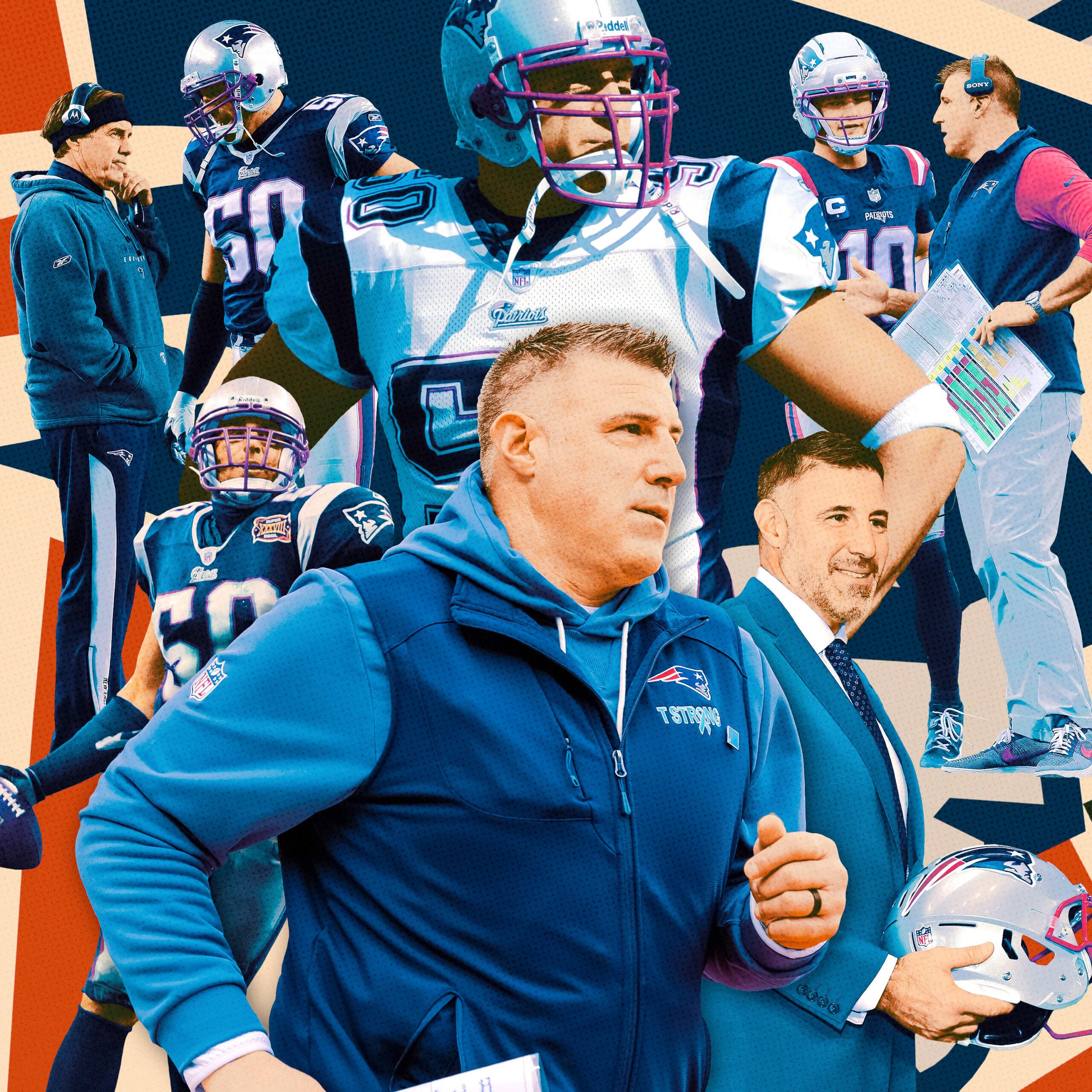
“He’s a Dude. He’s Just a Guy, Man.”
The oral history of Mike Vrabel, the player turned coach who’s dragged the New England Patriots from the depths of the AFC East back to the Super Bowl“He’s a Dude. He’s Just a Guy, Man.”
The oral history of Mike Vrabel, the player turned coach who’s dragged the New England Patriots from the depths of the AFC East back to the Super Bowl
“I don’t need a great story told about me to feel like I’ve had a good career.” —Mike Vrabel, 2007
What’s it like being chased by a 6-foot-4, 260-pound linebacker? Scott Pioli can tell you.
Back in June 2002, the Patriots held their first Super Bowl ring ceremony. Late that night, Mike Vrabel and his teammate Larry Izzo tracked New England’s director of player personnel down and got right up in his face—then launched into a comedy routine that was only half a joke. “They’re like, ‘You’re going to pay us now!’” Pioli recalls. “They’re like Abbott and Costello. They’re playing off each other. ‘Pay the man! Pay the man!’ And it was hilarious because they’re close-talking and they’re spitting.”
When they finished breaking his balls, Pioli walked back to his table. His wife looked horrified. “What happened to you?” she asked. He didn’t realize it, but there were bits of tobacco all over his clothes. “So in the next contract negotiation, I told ’em I was going to hide the cost of the suit and shirt and tie in there somewhere,” Pioli says with a laugh.
That was just Vrabel. “Vrabes is a habitual line stepper, man,” Pioli says, invoking the Rick James sketch from Chappelle’s Show. “I mean, he’s the kind of guy that would say something about your mother if he had to win an argument, right? There was nothing off-limits. But it’s been funny watching him evolve and grow.” Because Vrabel has always had another side to him. “This empathetic side that he doesn’t like to show,” Pioli says.
As the first-year head coach of the Patriots, Vrabel has leaned on both halves of his personality on the way to an AFC championship and the Patriots’ first Super Bowl berth since the 2018 season. He’s still the same hypercompetitive smart-ass he’s always been. Now he’s also the guy who gives his players weekly postgame bear hugs. “He has enough asshole in him to be a coach,” says his friend and former teammate Rodney Harrison. “But he’s such a great dude.”
“I think he has a lot of the Belichick brain,” says former Patriots cornerback Logan Ryan, who also played for Vrabel when he coached the Titans. “A lot of our strategies were similar to the New England days. But he does have that modern approach and sensibility.”
Ask anyone who’s played with him, played for him, covered him, or worked with him in any capacity over the past three decades, and they’ll tell you the same thing: He’ll do just about anything to win, including putting his body on the line. Every part of it.
Part 1: “Along With Being Smart, He Was Also a Smart-Ass”
Vrabel grew up in Akron, Ohio, as the only child of two educators. A back injury in his junior year of high school almost ended his football career, but he didn’t let that slow him down. He went on to become Ohio State’s all-time sack leader, and in 1997, the Steelers picked him in the third round of the NFL draft. As far back as people who know him can remember, he’s been an imposing figure. Uniquely so.
Logan Ryan (Titans cornerback, 2017-19): A big human being.
Tom Curran (Patriots insider, NBC Sports Boston): He would run and throw before the games. And he moved seamlessly. He did not have a rippling body, but everything was in perfect proportion. His arms were long, his shoulders were wide. He looked like a decathlete.
Christian Fauria (Patriots tight end, 2002-05): If he took his shirt off, you wouldn’t be impressed. You’d be like, “I don’t know. What’s all the fuss about?” But he was sneaky strong.
Scott Pioli (Patriots director of player personnel/vice president of player personnel, 2001-08; Chiefs general manager 2009-12): There were these stories that came out of Ohio State about him and Luke Fickell, who is the head coach of Wisconsin. They would have these wrestling matches that would be until someone tapped out. Now, mind you, Luke was a multi-time state champion wrestler in high school. And apparently they would destroy areas, and neither one would tap out, and it would just get broken up.
Matt Cassel (Patriots/Chiefs quarterback, 2005-12): I challenged him to a wrestling match at a Toby Keith concert backstage—that was a bad decision. Might’ve been a few pops involved, but he immediately was like, “You don’t want any of this.” I was like, “Oh, I want it all.” And then I just got manhandled. He put me in a headlock, and he was going to try to kill me. Thank God he let me go.
Brian Cushing (Texans linebacker, 2009-17): We played volleyball with a medicine ball. I swear to God, I think he would actually miss part of his actual coaching meetings because we had a tie game, and he could not leave without finishing the game. One time, we won a game, and I had to leave because I was literally picking my two kids up from carpool. And he was just on me, cursing me out, telling me I was scared. ... I’m like, “Mike, it’s the offseason.” This game meant nothing, but it meant the world to him.
Pioli: It was no joke. Vrabes is one of the most mentally, emotionally, physically tough people I know. And his endurance is extraordinary.
Matt Light (Patriots left tackle, 2001-11): He’s the guy that would lead practice and then go into the weight room and get on a treadmill and run another 5 miles. Kind of pissed you off, really. I’ve always found the people that are excessively hairy have a ridiculous amount of energy, and he is excessively hairy. He’s akin to a chinchilla, if you will.
Rodney Harrison (Patriots safety, 2003-08): I’m a guy that takes tremendous pride in my practice habits, OK? To the point where Belichick called me the greatest practice player he’s ever coached in over 30 years of coaching. That’s something I wear with a badge of honor. And I always would look to my right or to my left, and I would see Vrabel on the kickoff team, scout kickoff, scout kickoff return, defense, intercepting passes, blitzing, playing Ed Reed, playing Ray Lewis. And I’m like, “This dude is a pile of energy.”
Josh McDaniels (Patriots offensive coordinator, 2006-08, 2012-21, 2025): He’s got an incredible energy about him. That was the same when he was a player. It’s the same as he is as a coach.
Curran: He was somebody that was unique in the way that he interacted with Bill, the way that he interacted with us, and the way he interacted with his teammates. I once did one of those long, normal feature [stories] that we do where we call the high school coach. We talk to people. I remember the lede had something to do with Mike Vrabel being unique. I thought it was a really good story. So sometimes as you do, I said, “Hey, Mike, do you have a chance to see that feature?”
“Yeah. Boilerplate.”
I literally was like, “What the fuck?”
Hector Longo (Patriots beat writer, The Eagle-Tribune): He was just so in your face that it was attractive. He just tells you the truth whether you want to hear it or not. He told me to go eff myself several times in the locker room. He was busy. But we also talked about big horse races time and time again.
Harrison: He had enough jerk up in him, and that’s what you need. But Mike’s a very humble guy. He’s easy to talk to.
Pioli: He was human. We all have a duality of personality, and some days aren’t good. Sometimes we’re sleep deprived. Sometimes we’ve got stuff going on in our lives. Sometimes we’re a really good version of ourselves. And that’s Vrabes. He’s really normal and extraordinarily smart.
Light: He was smart about football. He’s also got a pretty large database to store facts and useless knowledge. If you made a mistake at some point in your life, Vrabel would catalog that. And at some point, if you’re going to get in a war of words with him, you’d lose because his recall is really good.
Tedy Bruschi (Patriots linebacker, 1996-2008): That’s 100 percent accurate. You always think to yourself, “Damn, how did he remember that?”
Harrison: I saw how smart he was, how he would correct the coaches.
Bruschi: Along with being smart, he was also a smart-ass.
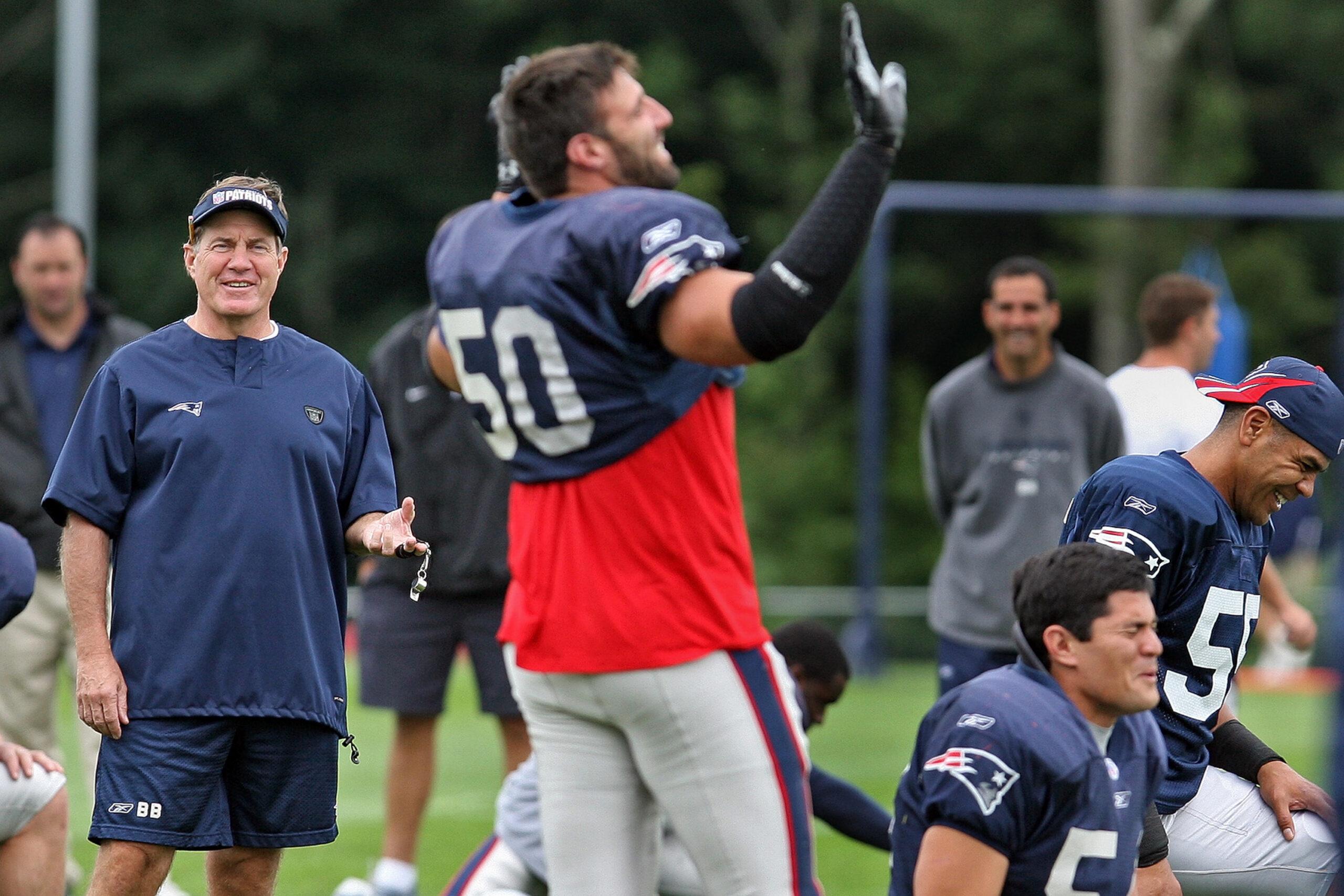
Cassel: Early on in my rookie season, we’re in a team meeting. There’s only a few guys that would ever crack a joke when Bill’s about to speak. I remember Vrabel in the back of the room popping off—and I don’t really remember what he said—but I was like, “Oh my gosh, what just happened?” And everybody starts laughing. And Bill, in a typical Bill way, said, “Just shut up, Vrabel.”
Part 2: “Eff Them; Keep Doing What You’re Doing”
After three years as a backup with the Steelers to start his NFL career, Vrabel signed with the Patriots in March 2001. Until then, his most memorable play was as a rookie in January 1998, when his strip sack of quarterback Drew Bledsoe clinched Pittsburgh’s win over New England in the divisional round of the playoffs.
Bruschi: That was my second year in the league. That was his rookie year. And I guess I started out by hating him because he was the guy that ended our season. That’s how I knew of him at first. But when we met in 2001, you just immediately started to fall in love with the guy.
Pioli: We signed 27 free agent players in that offseason. We had some good people based on a couple of good drafts prior to us getting there. Bruschi, [Willie] McGinest, Lawyer Milloy, Ty Law. I was with Bill in Cleveland when things didn’t work out, and we had a decent roster, but one of the things that we knew and we learned and planned on the four years before we got to New England was that we were going to bring in players that could fit the way Bill Belichick ran his club culturally. They had to be tough, they had to be smart, they had to be dependable. They had to really, really love the game. Vrabes hit that identity.
Longo: I always think back to the locker room in the old Foxboro Stadium. There were some seriously talented linebackers for the Patriots back then. But for years up until Mike got there, they weren’t making plays. And then he came in, and you could immediately see he was the unifying force.
Naturally, Vrabel made one of the most important plays in New England’s titanic upset win over the Rams in Super Bowl XXXVI: a hit on St. Louis quarterback Kurt Warner that led to Ty Law’s pick-six. “A game like this makes you trust in all those corny-sounding clichés,” Vrabel told Sports Illustrated afterward. “On paper you may not look as talented or as fast or as strong as your opponent, but if you get guys to buy into a system and fight to the bitter end, you can accomplish incredible things.” The title kicked off the first half of the Patriots’ dynasty and upped the ante for Belichick and newly minted Super Bowl MVP Tom Brady.
Curran: I clearly remember in 2002 Belichick talking about Vrabel at a press conference. And he was going through why the team was so good in ’01. And he’s like, “We went through the whole year, and I don’t think that Mike Vrabel had one single mental mistake.”
Bruschi: When you win so much, how do you continue to push each other? You can win a championship and just be a flash in the pan, and then boom—you’re done. We failed after we won our first. In 2002 we didn’t make the playoffs, and we didn’t want that to happen again. You’ve got to have constructive confrontation.
Harrison: When I first came to the Patriots and I was out there and I was hitting guys, Troy Brown and Kevin Faulk, we had team fights at training camp. All the guys were mad at me. Pissed off. And Mike Vrabel came up to me and said, “Eff them; keep doing what you’re doing,” and walked away. I was like, “That’s my dude right there.”
Light: Between him and Rodney Harrison, I mean, those are two guys that if they were on the other team, you’re headhunting them. But if they’re on your team, you’re high-fiving them. I mean, the number of times that he would just absolutely drive Brady up a wall at practice was legendary.
Vrabes is a habitual line stepper, man.Scott Pioli
Cassel: There’s not many people that would pop off and say anything to Brady. And so to have him out on a field just wearing Brady out, trying to intercept the ball, telling him he’s making the wrong read. … To hear those two jaw back and forth, it was relentless and awesome. It was comic relief that we always needed.
Light: The jawing is strategic for a lot of people. And then there’s the other ones that it’s not so much strategic, it’s just a way of life.
Curran: Brady is extremely intelligent, too, but in a different way. He’s seeking to make people comfortable. Mike’s seeking to make them uncomfortable.
Harrison: He can make a tough situation funny.
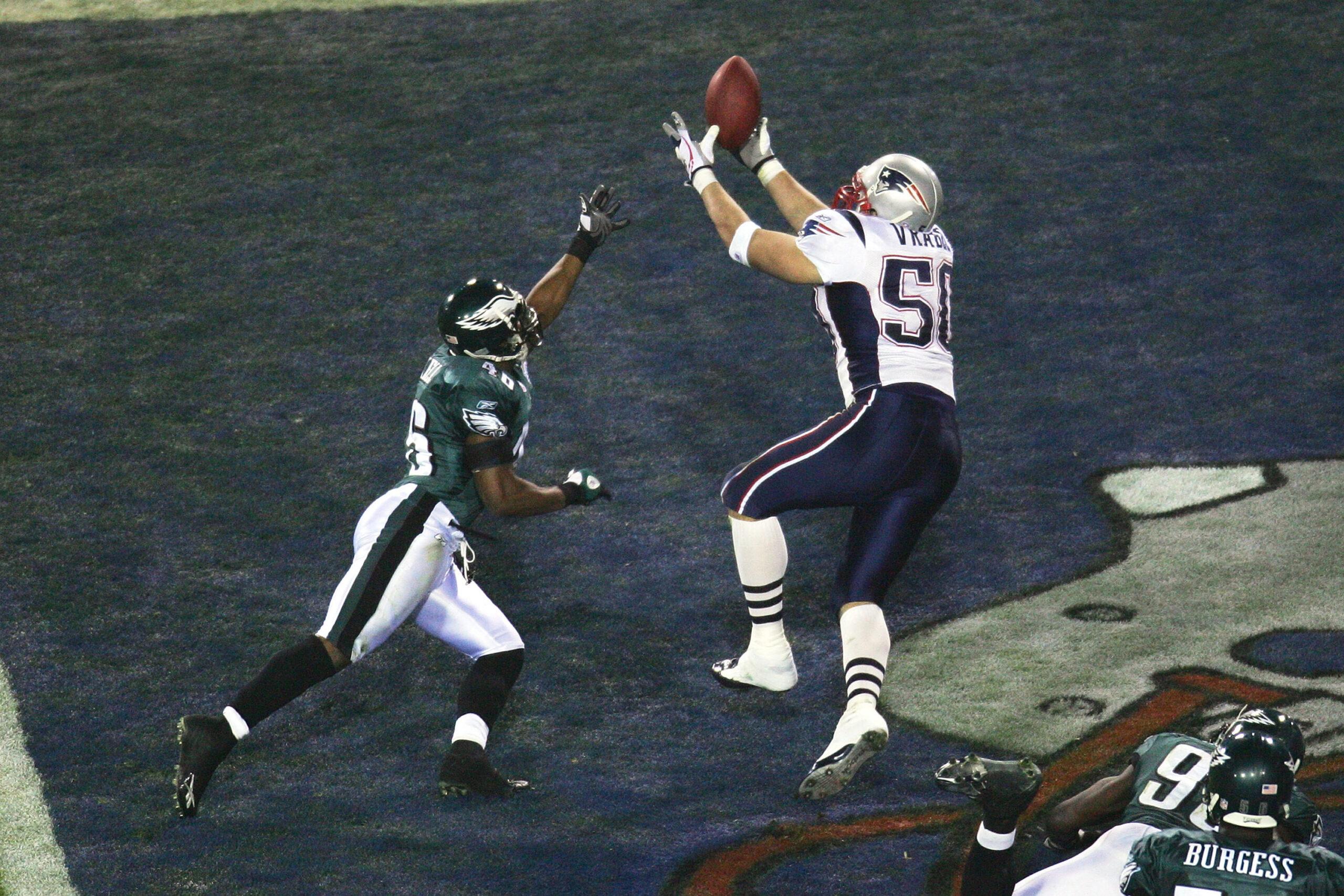
In 2002, Brady and Vrabel joined forces. That year, offensive coordinator Charlie Weis started putting the linebacker in as a goal-line tight end. It turned out he could catch. Over the next few seasons, Vrabel made the most out of the opportunities. He had 10 regular-season receptions over his career—all touchdowns. He also hauled in TDs in two Patriots Super Bowl victories.
Fauria: I remember when Bill was tinkering with this idea, and Vrabel would come into our meetings, and I was like, “Oh, great, don’t let this guy catch a touchdown. We’ll never hear the end of it.” Every now and then, Brady would throw it to him in practice.
Cassel: The cool part about Mike is that he took such pride in being on that goal-line package that he’d come over and he’d make sure that he’d get his reps. A lot of guys would be like, “Oh, look, I’m a gimmick.”
Harrison: We always talk about these two-way players. Mike is one guy that legitimately could have been a starting tight end in the NFL and also a linebacker. So we teased him. “Hey man, you supposed to be a defensive guy. Now you switching up. You don’t be giving the offensive players our calls.”
Fauria: I do remember when he caught his first touchdown pass like it was yesterday, because I was like, “Oh shit, we just created a monster.”
Mike Vrabel (on his touchdown against the Panthers in Super Bowl XXXVIII): I held it like it was my third child.
Light: He can catch, but he was getting a ball thrown to him by the greatest of all time. I mean, he wasn’t running a go route. Quite honestly, it’s a sore subject for me. I mean, I was a tight end in college. I liked to fancy myself as a skilled player, and the tackle-eligible play would’ve been a much better call versus bringing some defensive joker in to get all the praise. I mean, I would’ve been open just like he was. That’s all I’m saying.
Part 3: “We Got a Coach”
Vrabel had his best year as a player in 2007, earning All-Pro honors after piling up 12.5 sacks for the Patriots, whose hopes for an undefeated season were dashed by the Giants in Super Bowl XLII. He played one more year in New England before the team traded him and Cassel to Pioli’s new team: the Chiefs. By then, it was already clear that Vrabel was destined to be a coach.
Pioli: I was really blessed because I spent all eight years at the Patriots with him. And then when I left to go to Kansas City, they were going to cut him, from the best I could gather. And I was like, “Hey, I’d love to take him.” And I’ve got to tell you, that trade educated me on something that I hadn’t thought of until that moment. We make the trade. But Mike, he won’t take my call. I call the agent, and he goes, “Scott, he’s pissed.” I’m pissed. I was so excited to have him.
He showed up for the physical, and he showed up for the offseason [program], and he asked for a meeting. I can’t figure out what’s up. And he comes into my office, and I give him the handshake and the hug, but I could feel he’s being rigid. And Mike is very intentional about sending signals. I’m like, “What is up? What’s going on?” He goes, “I’ve got to tell you, Scott, I’m pissed.” He said, “After eight years together, all the success we had together, I get an opportunity at this point in my career to be a free agent again. I’m at the point in my career where I feel I should have the opportunity to play wherever the hell I want to play. And you traded for my rights.” I lost my breath. I never considered that.
And it was one of those moments where it really made me check the power of the position. It felt gross all of a sudden. I was so excited to get back with Vrabes: It’s going to be great. He’s going to probably be our captain. And he says, “I just want to let you know this’ll pass.” He was honest about it. “We’re too good of friends,” he said. “I’ll get over it. But right now I’m pissed off at you, and I don’t really want to talk.”
Mike was one of the reasons we won the AFC West our second year out there. And he was a captain. But it was one of those moments where he helped me. I felt like I was always dialed in to the human portion. That one reminded me that I wasn’t.
Cassel: We were a package deal. When we went to Kansas City, we were neighbors. Three houses down from each other. We’d commute to and from games. His kids would come over, ride their bikes at my house. To have Mike—especially a guy as established as he was—be there with me to navigate through new waters was great.
Light: He was a vocal guy. I think he did a good job of communicating things. The thing that people don’t talk a lot about is that he understood the business side of the game, as well. You’re talking about a guy that was a player rep forever, was on the executive committee for the NFLPA. It went beyond just the X’s and O’s. It was understanding what the coaches were doing, what the players were doing, what your rights were. I mean, if there was a guy that was in trouble or needed something, Mike let him know that, “Hey, man, here’s what you can do. Here’s the rights you have, and don’t back down from it.”
I think there were people that thought that maybe his role as a player rep is what got him moved to Kansas City. I don’t know that there’s any validity to that, but I think it speaks to the fact that if you take on a role like that, you’re putting a target on yourself. But Mike wasn’t worried about that. Mike was willing to outwork and earn his position every day and then also do what he thought was in the best interest of the guys in that locker room. And he did that for a long time.
Cassel: He was a coach on the field even when he was a player. People gravitated toward him. He’d hold people accountable. He wasn’t shy about sharing his opinion. You’re going to know where you stand with Mike Vrabel. And that’s a good quality to have as a coach.
Harrison: He was just always so smart, so inquisitive. Tedy used to tease him about Ohio State. “When are you going to go coach Ohio State?” So everybody pretty much knew that Mike Vrabel was destined to be a coach.
After retiring in 2011, Vrabel did become a coach at his alma mater. He spent three years in Columbus as an assistant before heading back to the NFL. The Texans hired him as linebackers coach in 2014 and moved him up to defensive coordinator in 2017. A year after that, the Titans made him their head coach.
Cushing: There were probably a couple years where Mike was internally battling if he was still a player or not. But it helped his coaching because he was always willing to show physically what he was talking about. And for the visual learners and guys that needed to see it, myself included, it helped tremendously. And when it was a drill where he put a pad on and asked you to hit the shit out of him, he really meant it. And he’d get mad if you didn’t.
Ryan: You knew right away it was a coaching upgrade from what we had. There was this urgency of now that I was used to in New England that he brought to Tennessee, and things started churning really quickly for us.
Teresa Walker (Titans beat writer, The Associated Press): I mean, let’s be honest. I like to use the phrase “How can you tell if a coach is lying? His lips are moving.” Whatever the reason, they’re not telling us everything. But Mike Vrabel came as close to telling us what he could when he could. He had the longest game in NFL history for his first game as an NFL head coach, in Miami. Not only did they lose, but Marcus Mariota got hurt. The left tackle [Taylor Lewan] got knocked out. On that Monday, Vrabel says, “Well, he’s not going to play this week. I told him, ‘You’re not playing this week because you got the concussion.’” And it’s like, “OK, that’s a guy who’s been a player.” You got the feeling that he was going to take care of his players.
Ryan: He said, “Logan, my office is always open if you guys want to come in.” And I’m like, “Vrabes, you’re the principal. Ain’t no one going in there.” I think he took that to heart, and he made it more of a thing to come out of his office and invite people in. Every day I came to work, Vrabel was leaving the weight room. A bunch of coaches were working out with him at 4 in the morning. He was lifting weights, running sprints. When I was coming in at 5:30, the first player in the building, Vrabel was finishing his workout.
Fauria: The lifestyle sucks. I don’t know why anybody would want to do it, so you really have to love it. You have to love the challenge of it, the camaraderie of it, the development of players young and old, and have a warped sense of humor.
Ryan: We started winning games that we would lose previously right away. We had a game against the Jets in his first year there, where they were in four-minute [offense]. Essentially, they needed a first down or two to win the game. And on first down, they got a 9-yard gain. So it was second-and-1. And if they bled the clock down and got that first down, the game was essentially over. So Vrabel purposely put a 12th man on the field. We’re freaking out. “We have too many! We have too many!” Oh my God. They get a first down, we’re going to lose. And Vrabel just shook his head like, “Nah, we got the 12th-man penalty.” It gave them an automatic first down, but it didn’t take any time off. So we reset the chains without using the time. And then we stopped them on three downs, they punted, and we ended up coming back and winning the game. And I’ve never seen that. That moment right there, I was like, “Oh, we got a coach.”
The high point of Vrabel’s time in Tennessee came on January 4, 2020, the night the Titans upset the Patriots in the wild-card round of the playoffs—Tom Brady’s last game in New England. With his team clinging to a 14-13 lead in the fourth quarter, Vrabel used a rule book loophole to run almost two minutes off the clock.
Walker: He out-Belichicked Belichick. He may not have been steaming, but it felt like he was because Vrabel was beating him at the thing that we thought Belichick did better than anybody: finding all the edges, all the margins, and all the rules to get yourself any advantage that you can.
Longo: It was such a good vibe in that locker room. And then I walked out into the hall, and there he was. No coaches go down there. And Mike was there, and he was introducing his family to everybody and anybody he knew.
Ryan: I had the pick-six to end the game. Two minutes before half, I dropped an eerily similar interception. And Vrabel, at halftime, was like, “Our best players need to make the plays in order for us to win this game.” And I knew exactly what was directed at me. And I stood up, and I’m like, “I’m going to make the next one. You don’t have to worry about me.” He’s like, “All right, make it then. That’s what we pay you for.” I’m like, “All right, cool.” I ended up making the next one, which was the last one, because Vrabes was challenging me at halftime to make the plays I’m supposed to make.
Part 4: “Never Forgets, Always Good Timing, and Never Afraid”
Coach Jerry Glanville’s quote about the NFL standing for “not for long” has become a cliché for a reason. After back-to-back losing seasons and amid signs of organizational chaos, the Titans fired Vrabel in January 2024. A year later, the Patriots let head coach Jerod Mayo go after one rough season at the helm. There was one obvious candidate to fill the role.
Ryan: I played with Jerod. I was like, “Man, that’s an unfair shake.” I didn’t really agree with that. But I thought, in my heart, the only person that could make that right—or that could make sense for it—would be Mike Vrabel.
Bruschi: Out of those first three early championships, there’s a lot of us that have gone into coaching. And there’s only one of us that could have pulled this off.
Light: I always thought that Mike Vrabel was going to end up being the head coach at Ohio State. This is maybe a notch above that.
Christian Elliss (Patriots linebacker, 2023-present): He came out there, and he was working drills with us. Not a lot of head coaches do that. Most of the time they just kind of hover. But Vrabes got in there, and he was helping us, and he was even doing special teams drills with us. Most coaches are kind of just like, “OK, let’s let the special teams guys do that.” No, he hopped right in there, and he showed exactly what he wanted. I remember we gave him a few shots, but I don’t know if anyone laid him out. I was like, “Gosh, that’s a big boy.”
Morgan Moses (Patriots right tackle, 2025): He preaches an identity built for our football team.
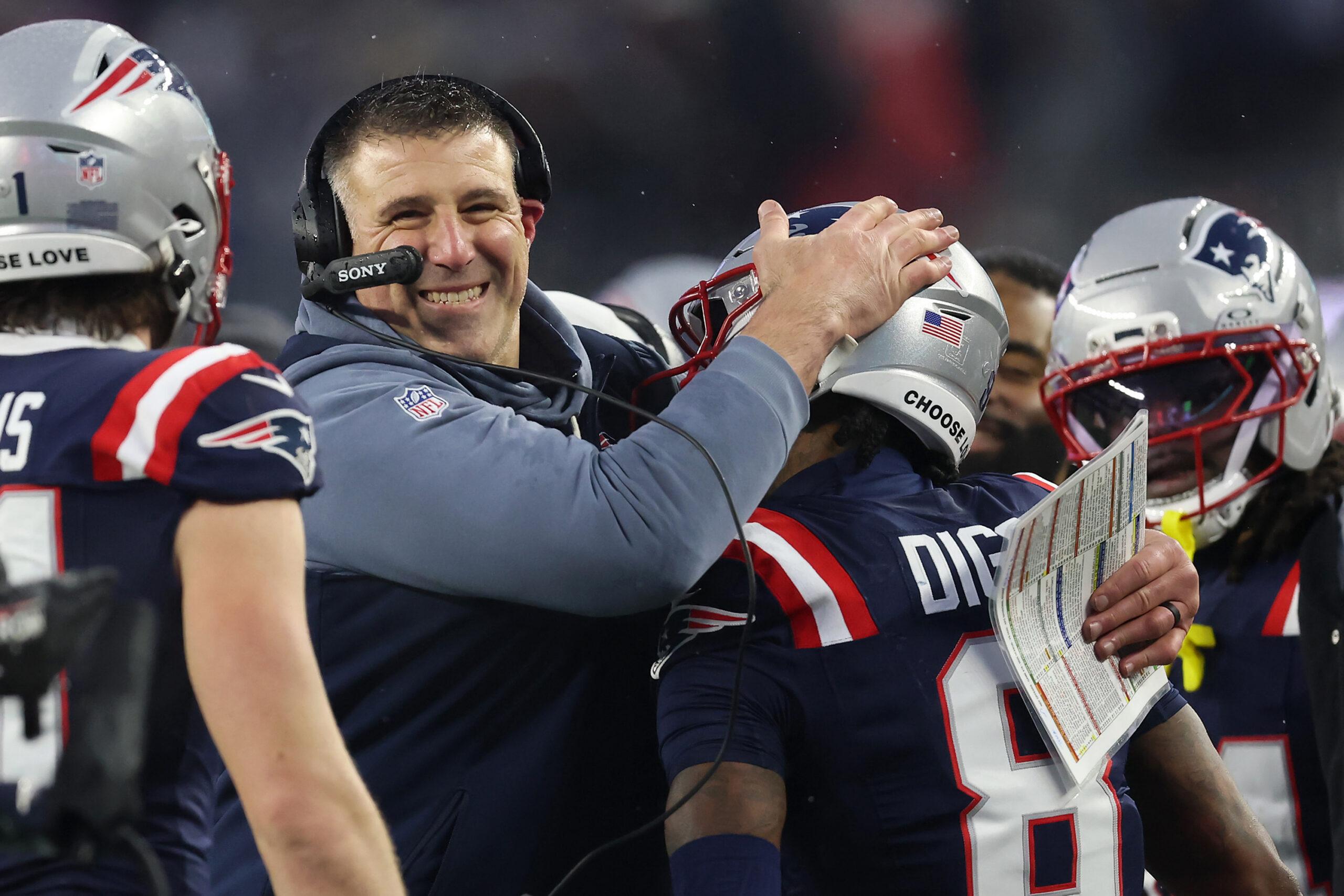
Harrison: Vrabel was a freaking dog as a player. And the intensity, the participation that you see, him as a coach getting in the drills with the pads—do you understand players love that?
Just ask 6-foot-3, 290-pound defensive tackle Milton Williams, who was so excited after sacking Justin Herbert late in New England’s wild-card win over the Chargers last month that he headbutted his coach.
Milton Williams (Patriots defensive tackle, 2025): It was just pure emotion. I kind of forgot he didn’t have his helmet on. Vrabes is still a big guy. He’s out there in the drills going with us. It was just hype, man. Just hype. Just pure emotion. I didn’t know [he was bleeding] until I came to the sidelines. They said, “Hey, man, you bloodied him up.”
Cushing: He’s a dude. He’s just a guy, man.
Harrison: Players are not hugging coaches and showing that level of affection to a guy like Vrabel if they don’t care about him. Those dudes are willing to do whatever for him.
He was a coach on the field even when he was a player.Matt Cassel
Bruschi: He has great timing. Timing on what’s best to be said to not only get the upper hand verbally, but also to reach someone and to relate to his players. “What do they need right now from me?” He has great discretion with that.
Light: My favorite Vrabel moment was when he was at a fundraiser for the Light Foundation in my hometown early in my career, and the mayor of my hometown—which is akin to, I don’t know, Mayberry—gets up and is reading a proclamation to declare some day Matt Light Day in my hometown, of which I would’ve never allowed if I knew. But he was trying to say the word “matriculate” at one point, and he stumbled over it several times. That was early in the program. Toward the end of this event, Vrabel is listening to our emcee trying to auction off items, and people weren’t bidding. So Vrabel decided to grab the mic and said, “Listen, we’re here to raise money. I’ll give anybody $1,000 if they can get the mayor of Greenville to spell ‘matriculate.’” And when I say it brought the house down. That embodies everything that he is. Never forgets, always good timing, and never afraid.
Cassel: We were out at the Kentucky Derby. We got in an argument, and we both were being stubborn, and neither one of us could let it go. Finally, the guy that was our security was like, “Will you guys please shut the fuck up?” That’s the beautiful part about Mike Vrabel. He’s one of a kind.
Bruschi: He knew exactly what I needed to hear when I came back from my stroke. I was down in the dumps, and I couldn’t deal with it. And the media kept asking me about my stroke, my stroke, my stroke. “How can you come back?” And I came into the meeting room, and he saw me. I was just discouraged. And he said, “What’s wrong, bro?” And I said, “Man, I just can’t keep talking about this. Why can’t I just move on from this?” And he looks at me and says, “Bro, you’re never going to live this down.” Finally, somebody freaking just finally told me straight up: Stop running from it, man. Just embrace it and accept it. That’s basically what he was telling me. And that’s exactly what I needed to hear. And he’s one of the players that I credit greatly for helping me feel normal again.
Pioli: Another player that we brought from the Patriots to the Chiefs is Ryan O’Callaghan. In 2011, he came out to me that he was gay. He didn’t come out publicly for another six years. He had told me, “Scott, I need you to keep this secret.” The day that that article came out in Outsports by Cyd Zeigler, I heard from two former players from the Chiefs: Ryan Lilja, one of the offensive linemen, and Mike Vrabel. Mike said, “Is he OK? Can I please get his contact information? I need to check on him.” Now, everyone sees Mike Vrabel, tough guy. And he is tough to the death, and he’s a man’s man and all of that crap. But Mike just wanted to make sure Ryan was OK. That’s Mike Vrabel.
Moses: When you have a coach out there that you see flying around and taking hits and doing the things that, you know, some people laugh at—for us, it’s ammunition. Guys look at that like, “He’s one of us, man.”
Interviews have been edited and condensed. Additional reporting by Ringer senior editor Lindsay Jones.