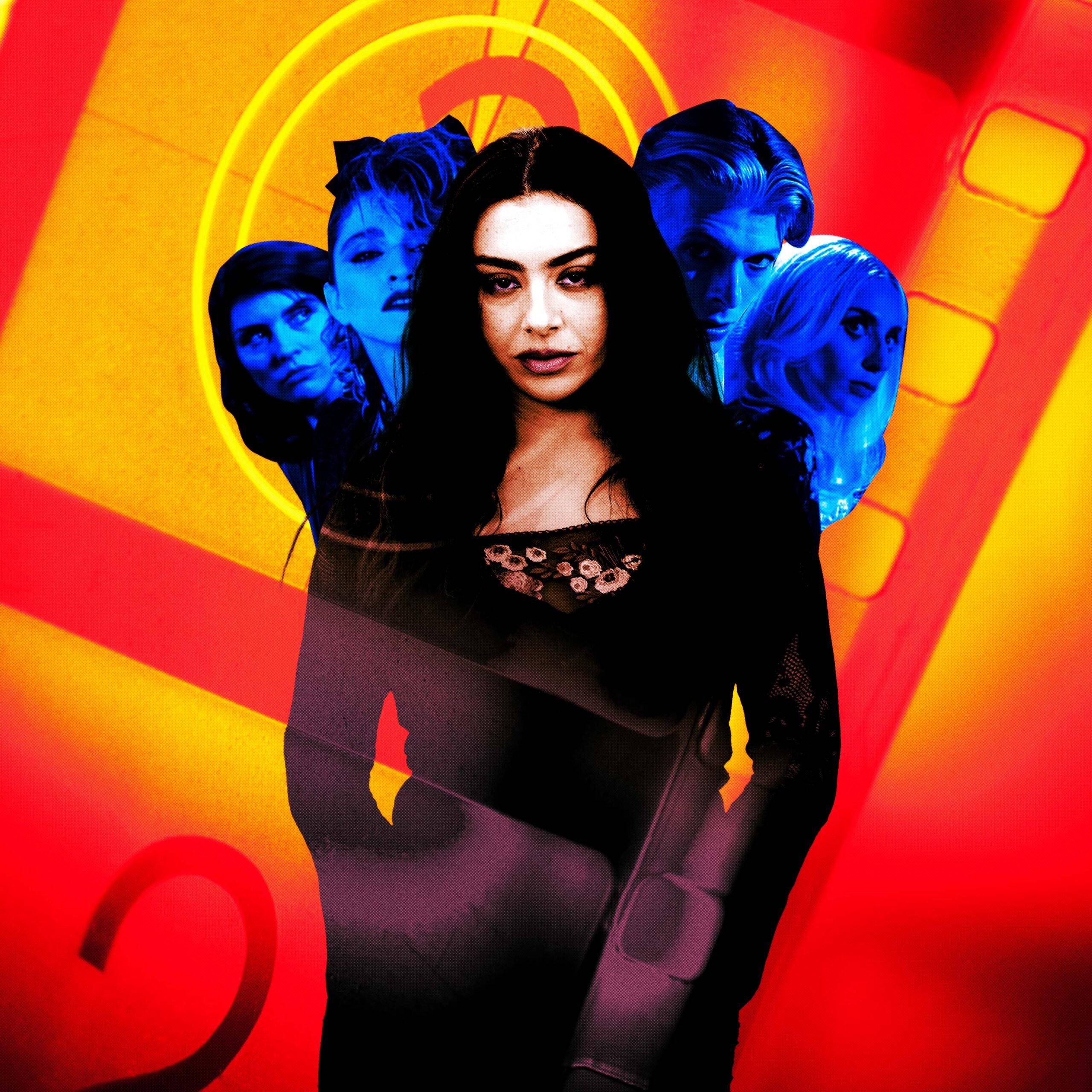
Between her auteur-friendly video screenings and recent visit to the Criterion Closet—where she name-checked David Cronenberg and waxed rhapsodic about the beguiling, late-stylin’ brilliance of The Shrouds—it would seem that [extreme Lonely Island voice] Charli xcx is a major cinephile. She is, at least, probably the most world-famous person whose Letterboxd is actually worth following; her top four on the site currently includes titles by Cronenberg, Abel Ferrara, and Paul Thomas Anderson, as well as Jacques Rivette’s exhilarating, labyrinthine 1973 masterpiece, Celine and Julie Go Boating, which Charli has described as taking place in a “Through the Looking Glass–type world.”
That last phrase is a pretty apt summation of a movie that plays like a surrealist riff on Lewis Carroll. Meanwhile, Charli’s new film and multi-hyphenate showcase The Moment goes through the iPhone screen darkly. It’s a paranoid fantasy about the perils of being placed (or else willingly wriggling) underneath the social microscope—of disappearing down a rabbit hole (or maybe k-hole) of one’s own making.
It’s a thin line between authentic, off-putting solipsism and calculated self-deprecation, and The Moment—directed by the savvy Scottish photographer turned Chalamet whisperer Aidan Zamiri—serves nicely as a display for Charli’s burgeoning acting talents. “[She] may not have much movie experience,” wrote The New Yorker’s Richard Brody of her performance last year in the underseen indie Erupcja, “but she dominates the action with classical canniness, her energetic yet poised performance showing keen awareness that movie acting favors minimal strain, because the camera can transform thought into action.” The point about less being more also applies to her work in The Moment; the highest compliment I can pay to her performance is that she’s credible as a somnambulist, sleepwalking her way through a circle of handlers, sycophants, and frenemies who all claim to be acting in her best interests (whatever those are). In one corner: Charli’s longtime (fictional) collaborator and tour designer, Celeste (Hailey Benton Gates), a figure of thoughtful, cigarette-burned solidarity excited to try out as many alienation effects as possible onstage. In the other, the repellent, expertly passive-aggressive interloper Johannes Godwin (Alexander Skarsgard), a hired-gun documentary director given plenty of ammunition by executives hoping for their own version of the Eras Tour.
The latter is an avatar of clueless, expedient, corporate-backed compromise, flaunting his aesthetic insecurities and trying to manipulate his star like she’s a Cocaine Barbie. Ever a game comedian, Skarsgard is credibly pathetic in the part, although by the time Johannes reveals that his revamped set design includes a 15-foot-high cigarette lighter representing the immolation of fame, the film has drifted—deliberately—into caricature, splitting the difference between This Is Spinal Tap and Popstar: Never Stop Never Stopping, which it resembles as a behind-the-scenes satire dotted with cameos by industry A-listers.
There are worse places to be, and the most interesting thing about The Moment is how it connects to a long tradition of movies attempting to thread the needle between pop stardom and cinematic credibility. For instance, the presence of Rosanna Arquette as a callous, bottom line–minded record exec slyly invokes Susan Seidelman’s 1985 film, Desperately Seeking Susan, a madcap comedy made under the sign of Celine and Julie Go Boating and featuring a pre-superstardom Madonna in a role that channeled her shape-shifting sensibility. In a 2024 interview with Vanity Fair, Seidelman recalled how she had to lobby her studio to let her cast the singer as the film’s eponymous woman of mystery; Madonna supposedly did her part by jokingly propositioning an Orion executive in her office. (“How do you know unless you try?” the singer supposedly replied when the older woman explained that she was heterosexual.) The gambit paid off: Madonna is brilliant in Desperately Seeking Susan as an obscure object of desire who attracts not only lovers but also copycats; we understand instinctively why Arquette’s bored housewife, Roberta, would want to live vicariously through such a magnetic figure, to the point of stalking Susan through New York and adopting her seductive, neo-bohemian lifestyle as her own.
The Moment is very much a comedy of identity crisis: Call it Desperately Seeking Charli. Or maybe Truth or Dare, since either way the implication is that what its star-slash-subject really wants is to cosplay as Madonna. “Truth or Dare is incredible,” Zamiri told Interview, and the echoes in The Moment of Alek Keshishian’s 1991 documentary—shot during Madonna’s 1990 Blond Ambition World Tour—are unmistakable, especially in its shared focus on image maintenance and making. The risks embedded into the project were real—by granting Keshishian entry into her inner circle, Madonna was ostensibly at the mercy of the same camera lens she’d made her name mesmerizing on MTV. At the same time, Truth or Dare was designed to call attention to its own construction, tracing a sly convergence of artistic agendas; the question was whether Keshishian was lifting the veil on his subject’s process or accessorizing her penchant for artful obfuscation. Warren Beatty—who’s perhaps the biggest control freak in showbiz, and whom Madonna was dating at the time—objected to his appearances in the film, threatening a lawsuit unless certain scenes were excised. In the final cut, he’s seen scowling at the crew and bemoaning his partner’s narcissism. “Why would you say something if it’s off camera?” he snarls sarcastically. “What point is there existing?"
The only A-lister who comes off worse than Beatty in Truth or Dare is Kevin Costner, whom Keshishian uses ruthlessly as a straight man, scoring points off his nonplussed response to Madonna’s polymorphous perversity. “Anybody who says my show is ‘neat’ has to go,” says Madge after a postshow meetup, sticking a finger down her throat; Costner was famously hurt by the behind-the-back diss, and gratified when Madonna proffered an onstage apology years later. Costner’s cameo as the squarest guy in the greenroom may have been mortifying, but it helped to contextualize his performance a year later in The Bodyguard, in which he played a former Secret Service agent hired to protect Whitney Houston’s chart-topping superstar from a crazed stalker. “Her life as a pop star means that everything is set to her requirements, which is totally different from what happens when shooting a film,” said director Mick Jackson of Houston, who’s serviceable enough in a part that’s stitched together out of clichés (by the time she appeared in Waiting to Exhale, she’d more sufficiently honed her chops).
The greatest performances by pop stars are the ones that retain an element of surprise or else find a way to weaponize stage presence. Think of Mick Jagger’s sinister self-portrait in Nicolas Roeg and Donald Cammell’s Performance, a tour de force in decadent menace topped off by the diabolical proto–music video performance “Memo From Turner,” delivered with all the satanic majesty (and sympathy for the devil) he could muster. Or David Bowie in Roeg’s subsequent—and even more spectrally beautiful—sci-fi allegory The Man Who Fell to Earth, in which Bowie recalibrates his Ziggy Stardust persona to play an extraterrestrial who becomes increasingly alienated the longer he lingers on earth. Or a de-platinumed and deadpan Debbie Harry as the kinky TV psychotherapist and BDSM enthusiast Nicki Brand in David Cronenberg’s Videodrome, staring down James Woods—and the audience—from the other side of the all-seeing TV Eye. More recently, Lady Gaga tried to go dark in Joker: Folie à Deux, a movie that so successfully undermines the appeal of its predecessor that it’s almost brilliant, or at least strangely bracing.
On a rewatch, Gaga’s stubborn refusal to lean into the aura-farming appeal of her work in A Star Is Born—another movie whose DNA is swimming around in The Moment’s bloodstream—seems worthy of grudging respect. Like Madonna, Gaga is a great conceptualist who recognizes the power and necessity of putting on the mask and taking it off: They’re both mothers of reinvention. Charli has a ways to go on that front, at least as far as filmmaking is concerned (and “360” isn’t quite “Like a Prayer,” either), but she’s a quick study who’s making the most of playing catch-up. The Moment’s ending, which isn’t worth spoiling here, manages to conjoin defiance and deference; it’s a salvage operation disguised as a cautionary tale, sweetly bleak and sincerely cynical. The Moment is brat, and it also isn’t. That ambiguity is the mark of an artist who’s determined to work on her own terms, even as she figures out what they are.