
The Super Bowl is the ultimate small-sample-size theater in sports. Especially for quarterbacks, whose careers can be made by memorable showings or forever tarnished by poor play—or even just one regrettable moment. Eli Manning could be headed for Canton based almost entirely on what he did in two games. Cam Newton didn’t jump on that fumble, which went down as the defining play of his career. For better or worse, quarterbacks are judged on what they do in the biggest games, and there’s no bigger game than the Super Bowl.
There have been 25 Super Bowls played this century, so we’ve seen 50 quarterback performances in the modern era of the league. Some have been historic, some have been tragic, and we’re here to rank them all. The methodology we’ll use is different from The Ringer’s quarterback rankings, which are based solely on the performances and not statistical or team results. Results matter in the Super Bowl. Moments matter, too. A game-changing play in crunch time can make up for a mediocre stat line, and costly mistakes can drag down a quarterback who lit up the box score. Degree of difficulty is also a factor here. A quarterback who took down a top defense or played well under unrelenting pressure will get a boost. We’ll also use more advanced metrics to help us stack these performances. With all that out of the way, let’s get to the rankings.
50
Super Bowl XXXV, Giants vs. Ravens (2000 season)
Kerry Collins
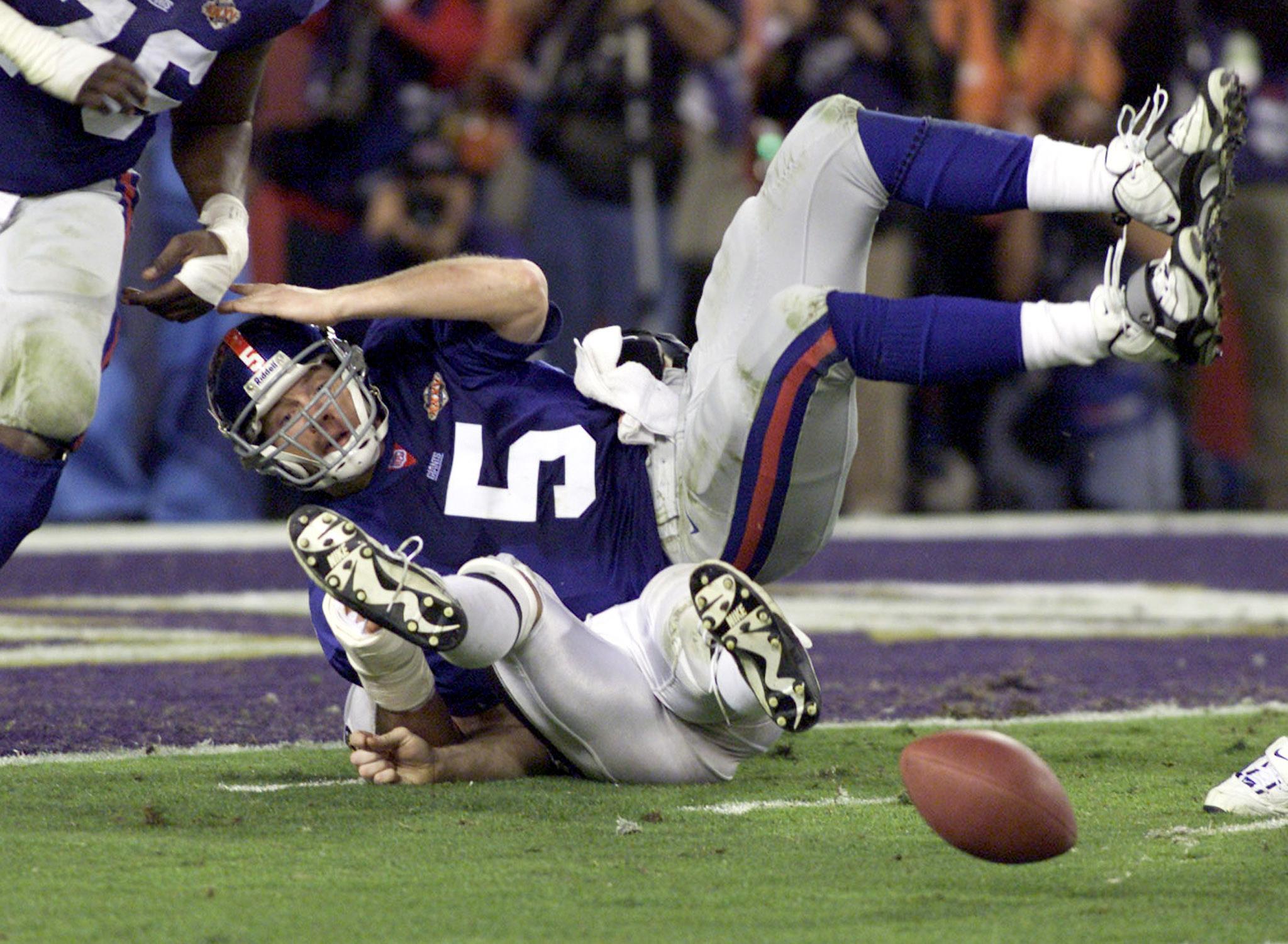
Result: Lost 7-34
Stat line: 15/39, 112 yards, 0 TDs, 4 INTs
EPA per dropback: –0.74 (50th among 21st-century Super Bowl QBs)
Success rate: 18.6 percent (50th)
Yards per dropback: 2.0 (50th)
Opponent defensive ranking: 1st
Rewatching this game was a surprisingly enjoyable experience. There’s just something about seeing a powerhouse defense flatten an opposing quarterback. The Ravens made Kerry Collins look as if he had never played the position before. He ended the game with four interceptions, but that number could have been so much worse. Baltimore had its hands on three of Collins’s passes in the opening minutes of the game but couldn’t finish off the plays. When Collins wasn’t throwing it directly to Ravens defenders, he was missing his receivers high and lobbing hospital balls into the teeth of Baltimore’s unforgiving defense—all while a young Sean Payton, then the Giants offensive coordinator, looked on helplessly.
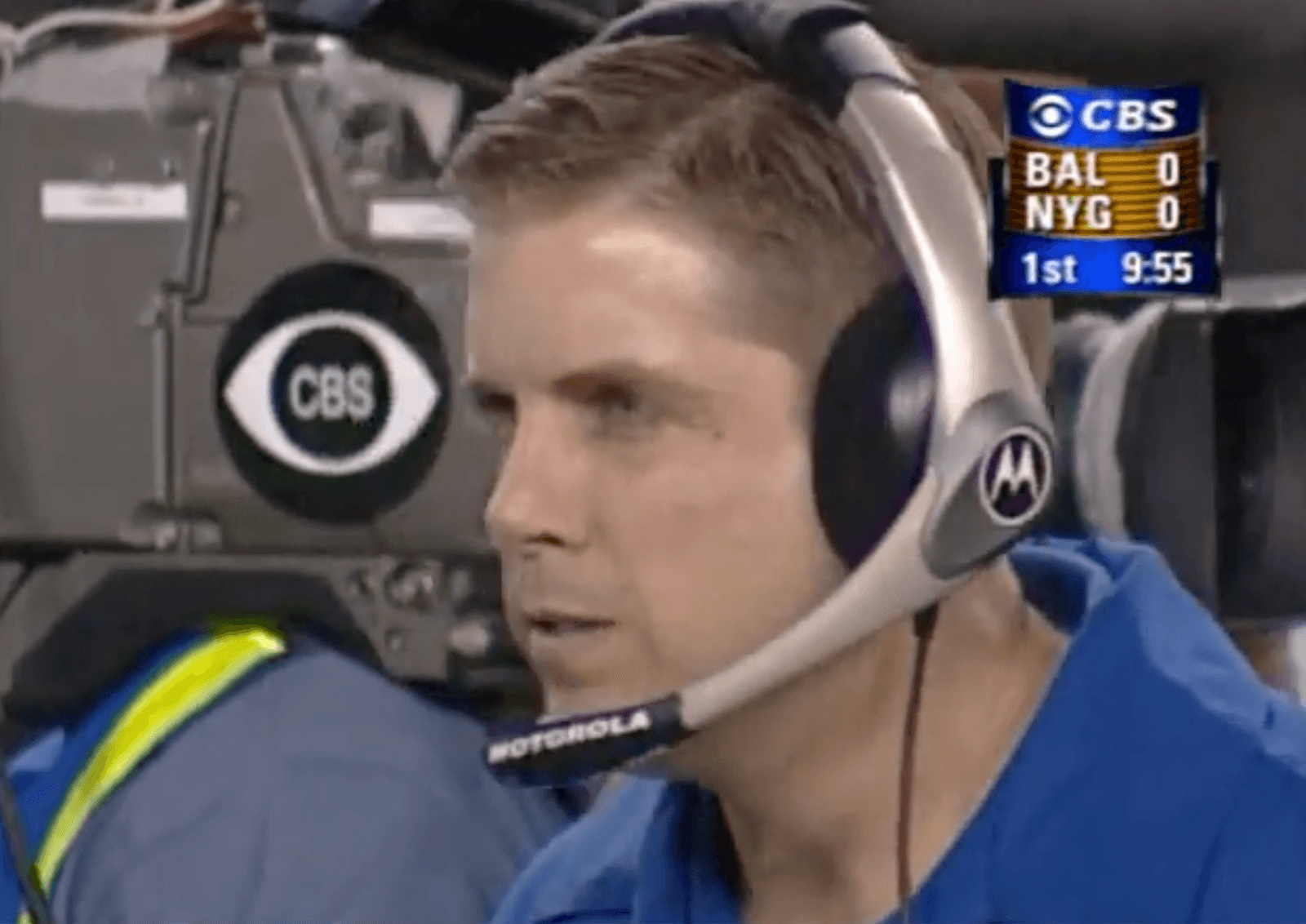
No, that’s not Frankie Muniz doing a screen test for Home Team. It’s a 37-year-old Payton who has no clue how to help his quarterback in this situation.
Collins was an easy pick for the worst Super Bowl performance of the century. He ranks 50th out of these 50 quarterbacks in EPA, success rate, and yards per dropback. New York’s lone touchdown of the game came on a kickoff return. The Giants gained more than 10 yards on only two drives. One ended with a punt, and the other with a Collins interception. It was probably the worst offensive performance in all of Super Bowl history, highlighted by the worst quarterback play the game has ever seen.
49
Super Bowl XXXVII, Raiders vs. Buccaneers (2002)
Rich Gannon
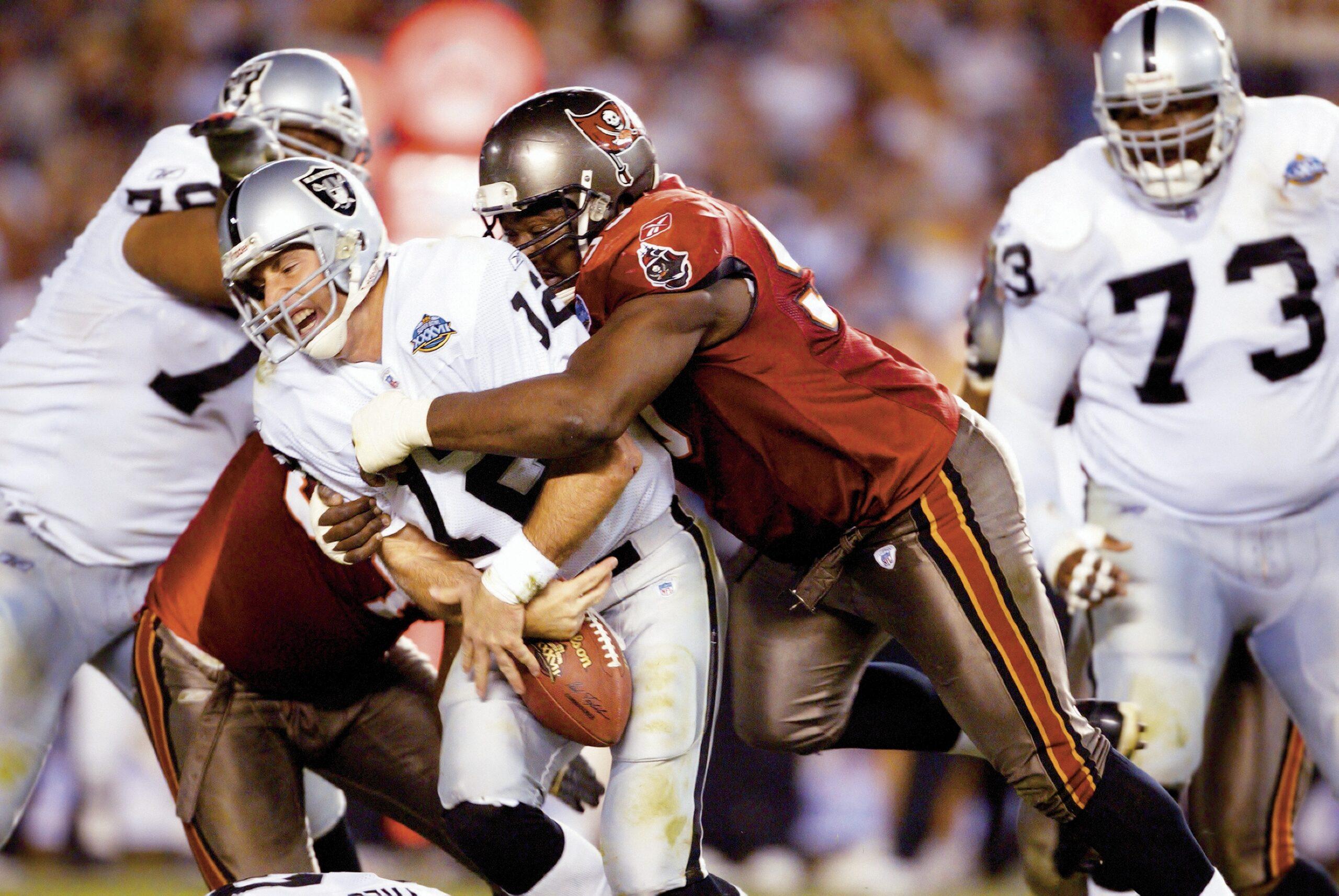
Result: Lost 21-48
Stat line: 24/44, 272 yards, 2 TDs, 5 INTs
EPA per dropback: –0.51 (48th)
Success rate: 39.2 percent (38th)
Yards per dropback: 5.0 (42nd)
Opponent defensive ranking: 1st
Gannon was another quarterback who got sacrificed to a god-level defense. The Buccaneers annihilated quarterbacks all season, so there was no shame in getting stuffed in a locker by Warren Sapp and the guys. Look at these numbers, via the broadcast:
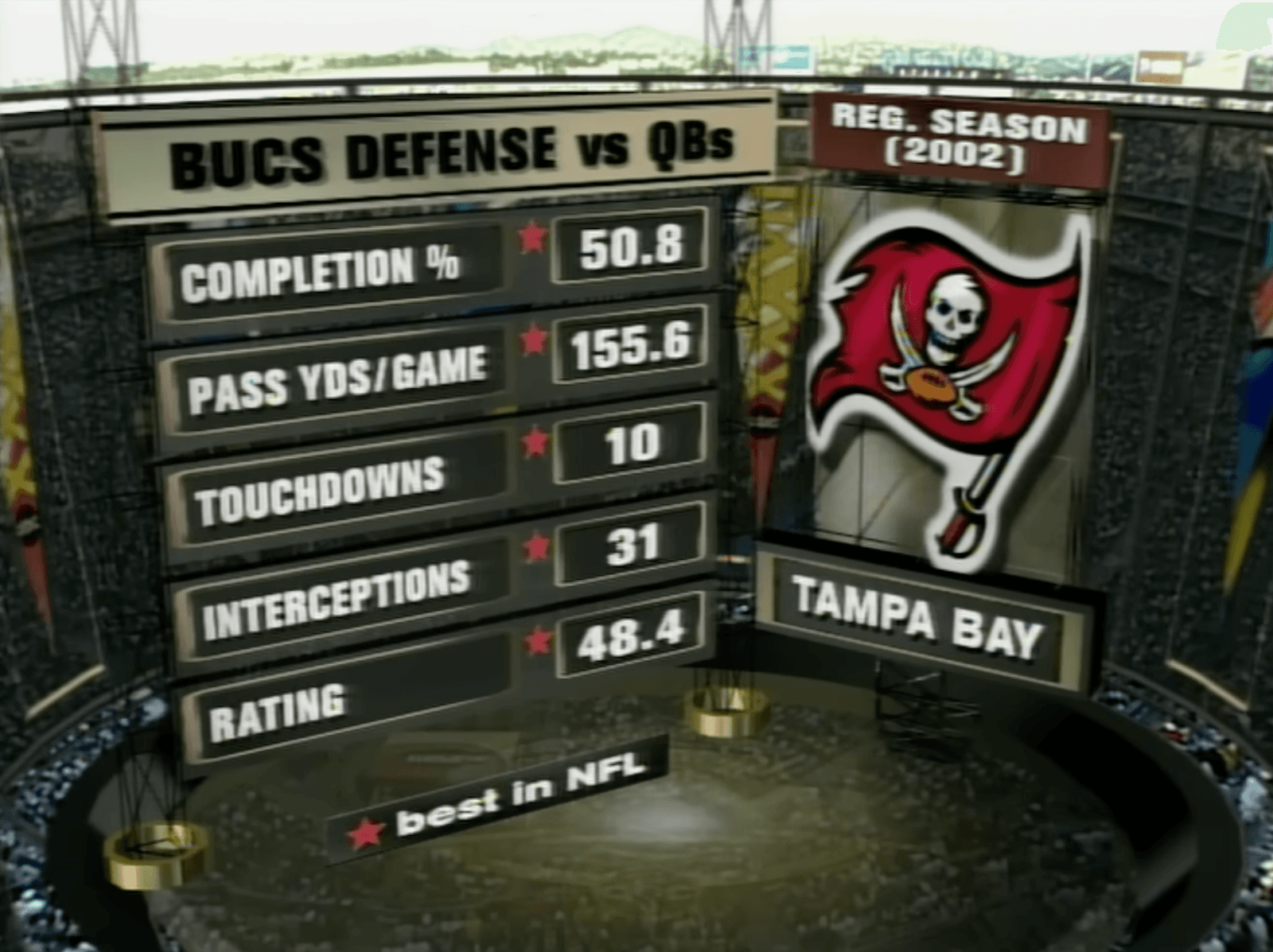
Gannon never stood a chance of winning this game, but it would have been nice to see the league’s MVP put up a better fight. His five interceptions are still a Super Bowl record. Even if you account for the fact that Tampa Bay knew all of Oakland’s offensive signals, which hadn’t been changed after Jon Gruden left the Raiders for the Bucs the previous offseason, that doesn’t fully explain any of these Gannon mistakes.
48
Super Bowl LIII, Rams vs. Patriots (2018)
Jared Goff
Result: Lost 3-13
Stat line: 19/38, 229 yards, 0 TDs, 1 INT
EPA per dropback: –0.31 (44th)
Success rate: 39.0 percent (39th)
Yards per dropback: 4.8 (45th)
Opponent defensive ranking: 7th
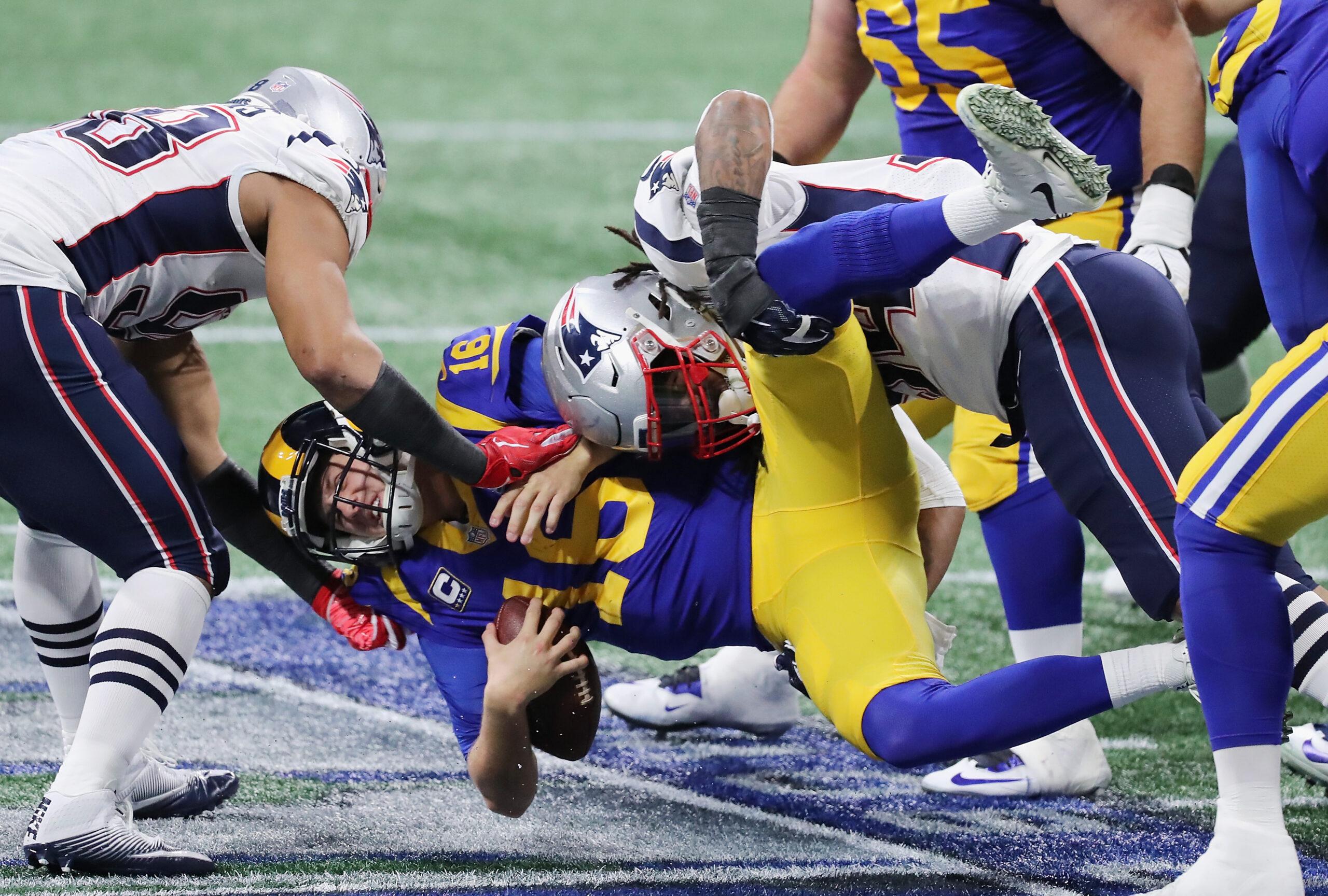
You can’t appreciate how poorly Goff played in Super Bowl LIII by just looking at the stats. You need to watch the All-22 tape to fully understand this stinker. Even with Bill Belichick and Brian Flores pantsing Sean McVay—who after the game copped to being out-coached—there were plenty of plays to be made, but Goff just didn’t have it in him to make them. The Patriots did a good job of changing the picture on Goff, and he responded like a toddler playing a game of peek-a-boo, full of confused wonder without a clue as to what he was looking at. Before the game, NFL Network’s Mike Girardi said that a Pats player had told him they wanted to put the game on Goff, saying, “If we show him some of the looks we’ve [shown] so far to some of these other quarterbacks, he’ll bleep in his pants.”
I’ve always wondered if that bleep was a no. 1 or no. 2. But either way, the prediction came true.
47
Super Bowl 50, Broncos vs. Panthers (2015)
Peyton Manning
Result: Won 24-10
Stat line: 13/23, 141 yards, 0 TDs, 1 INT
EPA per dropback: –0.58 (49th)
Success rate: 35.7 percent (44th)
Yards per dropback: 3.7 (49th)
Opponent defensive ranking: 2nd
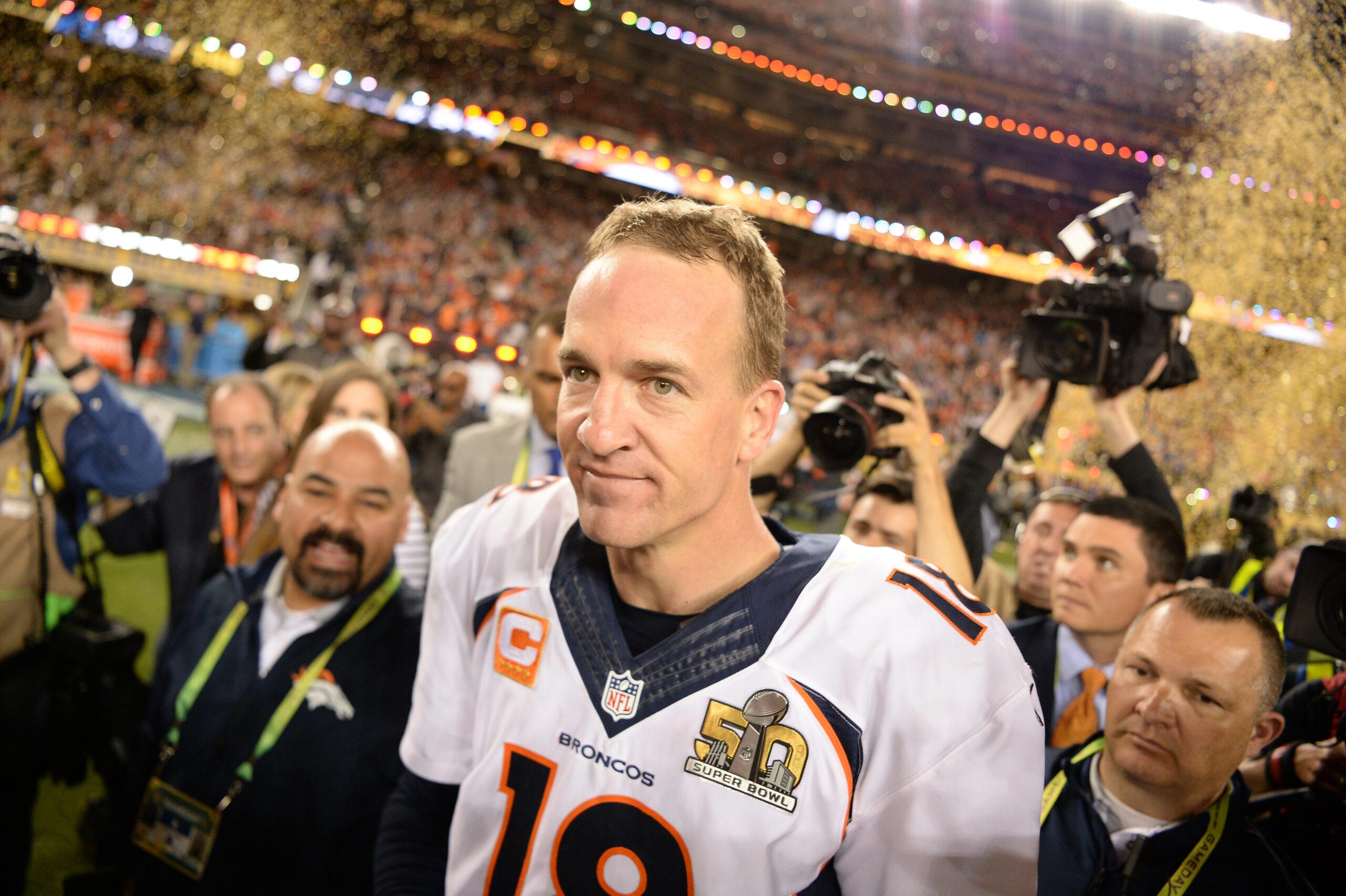
I’d love to show more respect to Manning for winning his second Super Bowl, but this was a truly dismal game from one of the best to ever do it. Just look at those numbers! And what you don’t see there is that Manning lost 37 yards on five sacks. His 28 dropbacks netted just 104 yards. He threw one of the worst interceptions in Super Bowl history, to a 275-pound defensive lineman. Only one of his 10 third-down dropbacks resulted in a first down. Manning played like a quarterback who had been benched for Brock Osweiler just a few months earlier. He deserved a second ring to cap off his career, but it was tough to watch him struggle through the 2015 season and then labor through the Super Bowl win over Carolina.
46
Super Bowl XLI, Bears vs. Colts (2006)
Rex Grossman
Result: Lost 17-29
Stat line: 20/28, 165 yards, 1 TD, 2 INTs
EPA per dropback: –0.46 (47th)
Success rate: 44.8 percent (30th)
Yards per dropback: 5.3 (39th)
Opponent defensive ranking: 31st
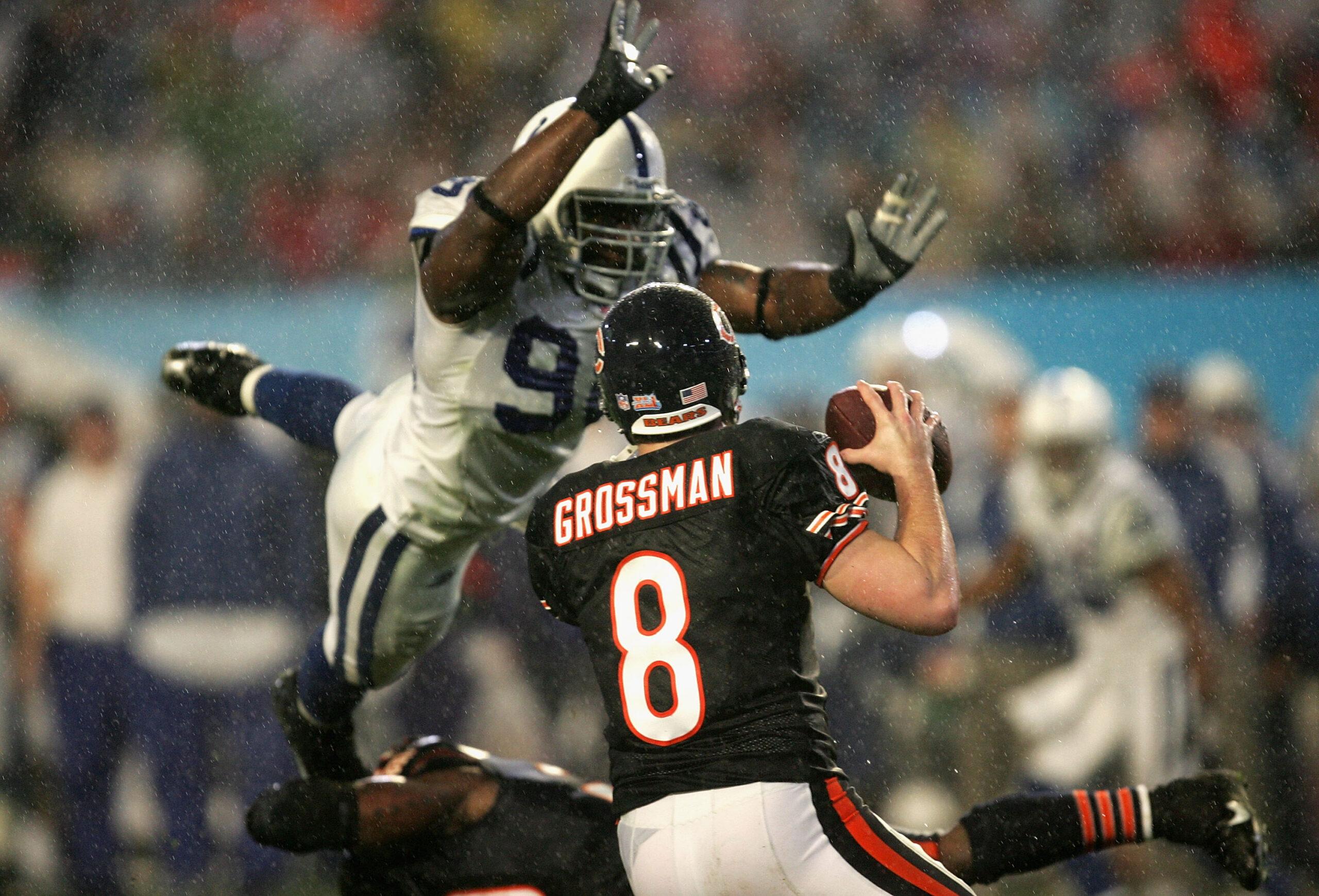
Grossman was more meme than quarterback entering Super Bowl XLI, and rainy conditions in Miami brought out the goofiest parts of his game. Even taking the snap and getting into his dropback seemed to give Grossman issues. He fumbled multiple snaps, including this one where he comically tries to scoop up the ball off the wet turf.
But thanks to Devin Hester’s touchdown on the game’s opening kickoff and a valiant effort by the Bears defense to slow down Peyton Manning and a juggernaut Colts offense, Chicago was still in the game early in the fourth quarter. Then Grossman decided it was time for “Sexy Rexy” to take over … and he promptly threw Chicago out of it. The big blow came on a failed “slant and go” double-move that did not fool cornerback Kelvin Hayden at all. Grossman flung the ball downfield anyway, and it was easily picked off and returned for a touchdown.
Grossman threw another downfield pick later—the rain was not going to stop him from chucking the ball deep—and that put the Bears away for good. He finished with three turnovers—two interceptions and a lost fumble—and let a very winnable Super Bowl get away.
45
Super Bowl XLVIII, Broncos vs. Seahawks (2013)
Peyton Manning
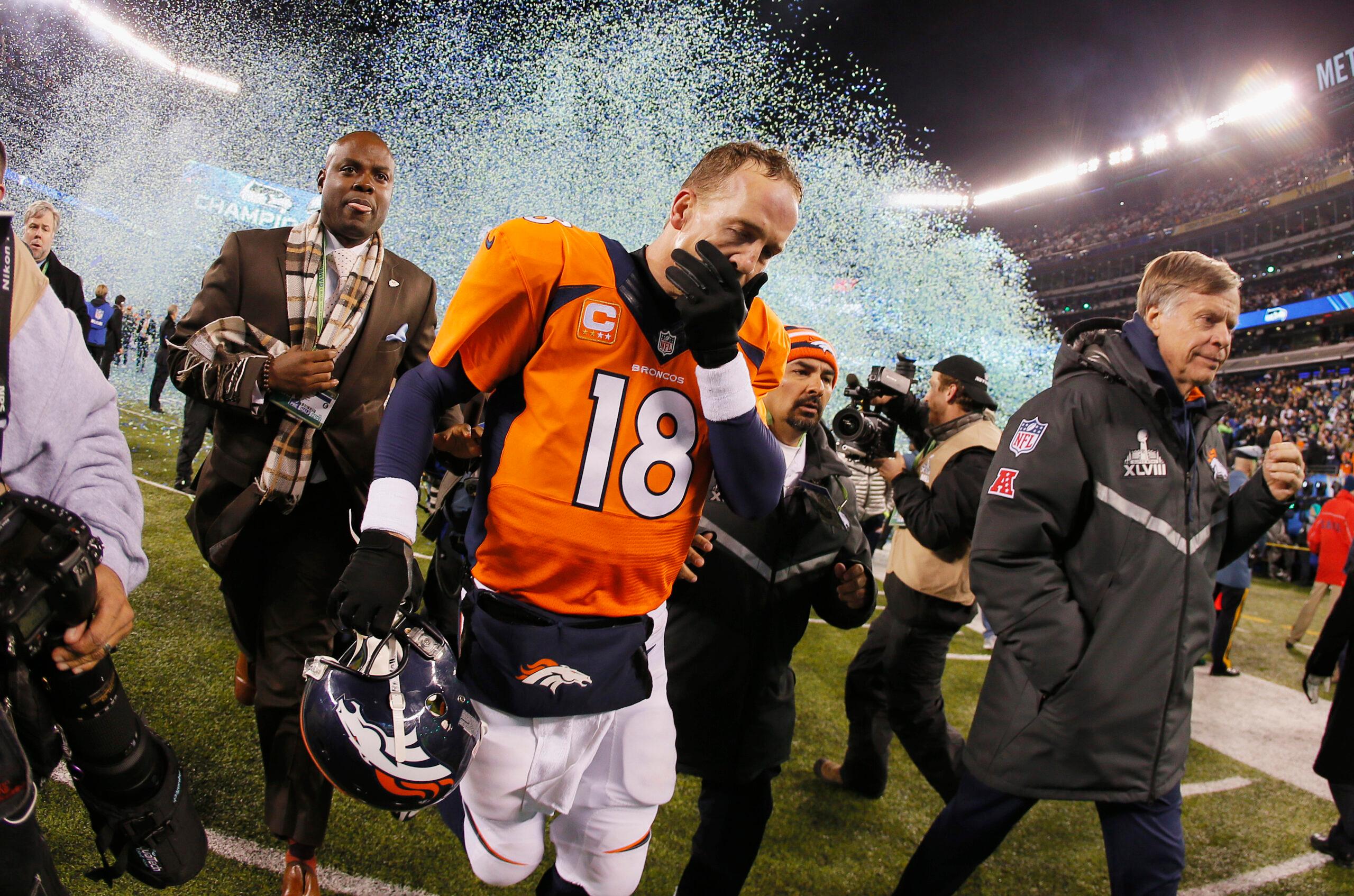
Result: Lost 8-43
Stat line: 34/49, 280 yards, 1 TD, 2 INTs
EPA per dropback: –0.34 (45th)
Success rate: 40.0 percent (36th)
Yards per dropback: 5.6 (37th)
Opponent defensive ranking: 1st
We’re only six spots in, and Peyton Manning has already been in here twice. He’s undoubtedly one of the best to ever do it, but he was abysmal across four Super Bowls, averaging –0.15 EPA per dropback and under 6 yards per play. He played especially poorly in Super Bowl 50, but Super Bowl XLVIII may have been the worst game of his career based on people’s expectations coming in. Manning threw 55 touchdowns during the 2013 regular season, and his team set a regular-season record for points scored. Even up against a historic Seattle defense, Denver was a slight favorite. But the Seahawks stomped Denver out from start to finish. Manning tried dinking and dunking his way downfield as the Seattle pass rush walloped the Broncos offensive line, but that just played into the hands of the Legion of Boom. When Manning tried to hang onto the ball a little longer, the rush typically got home and forced him into some egregious mistakes. Manning didn’t find the end zone until deep into garbage time, and he needed 49 attempts to throw for 280 yards.
44
Super Bowl 50, Panthers vs. Broncos (2015)
Cam Newton
Result: Lost 10-24
Stat line: 18/41, 265 yards, 0 TDs, 1 INT
EPA per dropback: –0.25 (41st)
Success rate: 28 percent (49th)
Yards per dropback: 4.5 (47th)
Opponent defensive ranking: 1st
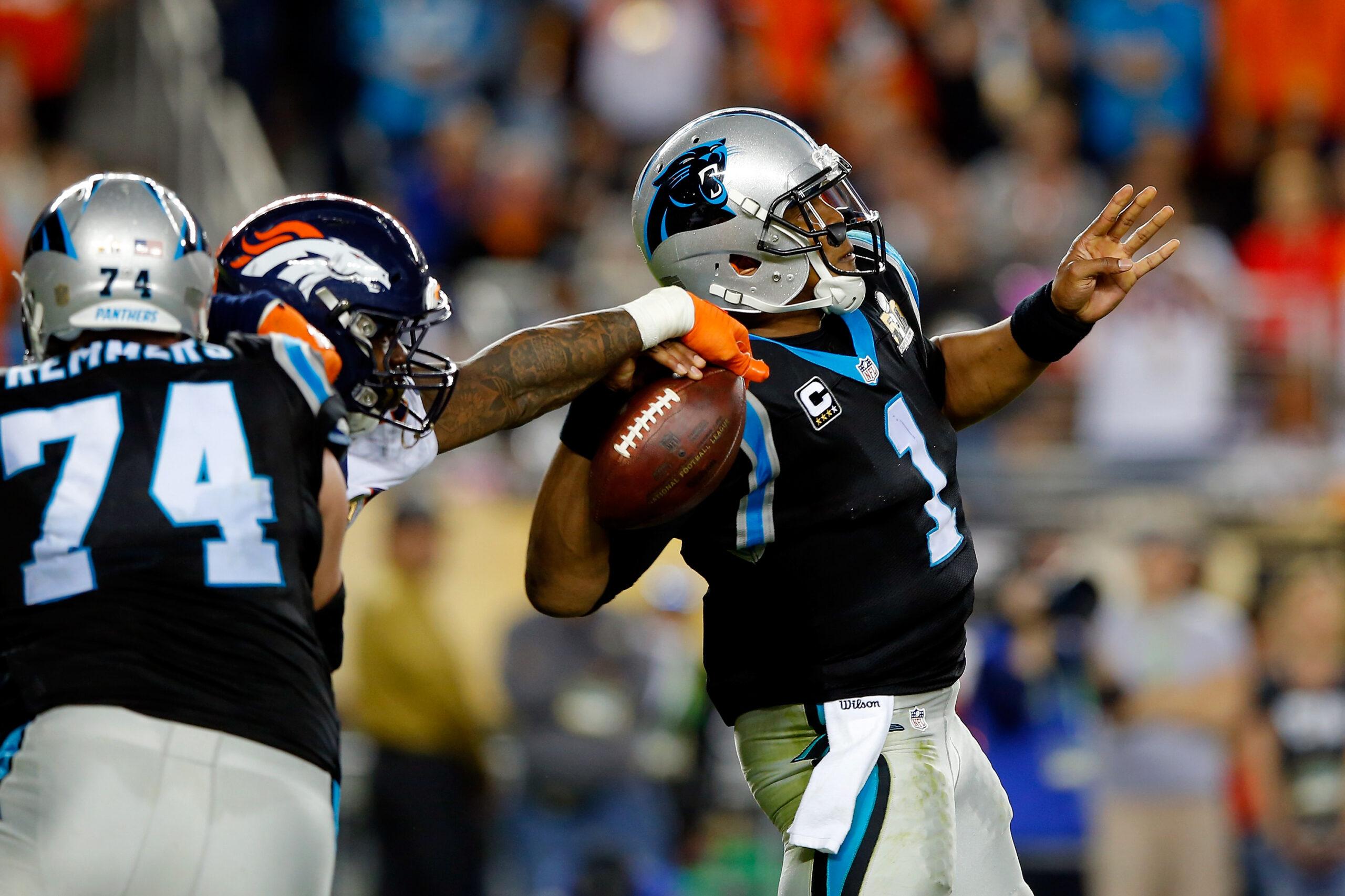
Newton picked a bad time to play his worst game of the 2015 season. It’s not a coincidence that it came against a Broncos defense that had laid waste to every quarterback it faced, including Tom Brady in the AFC championship game. The Panthers didn’t have the offensive tackles to block DeMarcus Ware or Von Miller (who took home Super Bowl MVP honors), or the receivers to separate from Aqib Talib or Chris Harris Jr. Newton was pressured on 47 percent of his dropbacks. He was sacked six times and was stripped twice, including the play Newton will never live down.
As a Panthers fan and Newton apologist, I’m obligated to point out that his initial hesitation worked out. The ball popped out from under Ware, giving Newton another shot at a recovery.
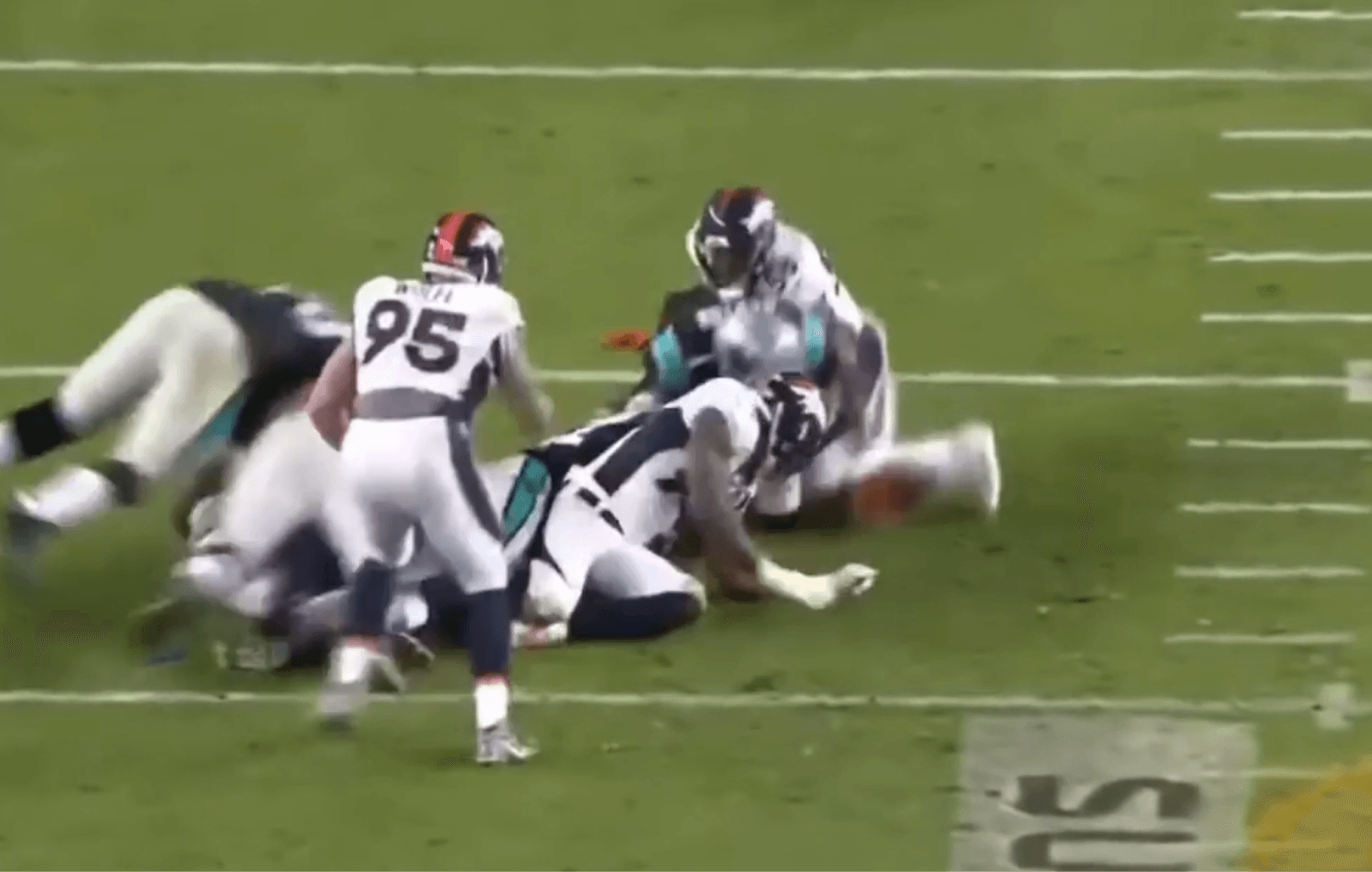
But that second failure to secure the ball is what really cost the Panthers. Carolina didn’t look like they had another touchdown in them by the fourth quarter. Newton had been inaccurate, his pass protection had been poor, his receivers had dropped multiple passes, and even his trusty fullback Mike Tolbert had lost a fumble. Everyone had a share in this loss. But Newton’s fuckups led directly to Denver points on a night where the Broncos offense couldn’t move the ball either. If he had just played a cleaner game, he would have a ring to go along with his league MVP award. And his mentions wouldn’t be flooded with the same GIF every time he offers up a take.
43
Super Bowl LIX, Chiefs vs. Eagles (2024)
Patrick Mahomes
Result: Lost 22-40
Stat line: 21/32, 257 yards, 3 TDs, 2 INTs
EPA per dropback: –0.26 (42nd)
Success rate: 35.7 percent (T44th)
Yards per dropback: 6.0 (35th)
Opponent defensive ranking: 2nd
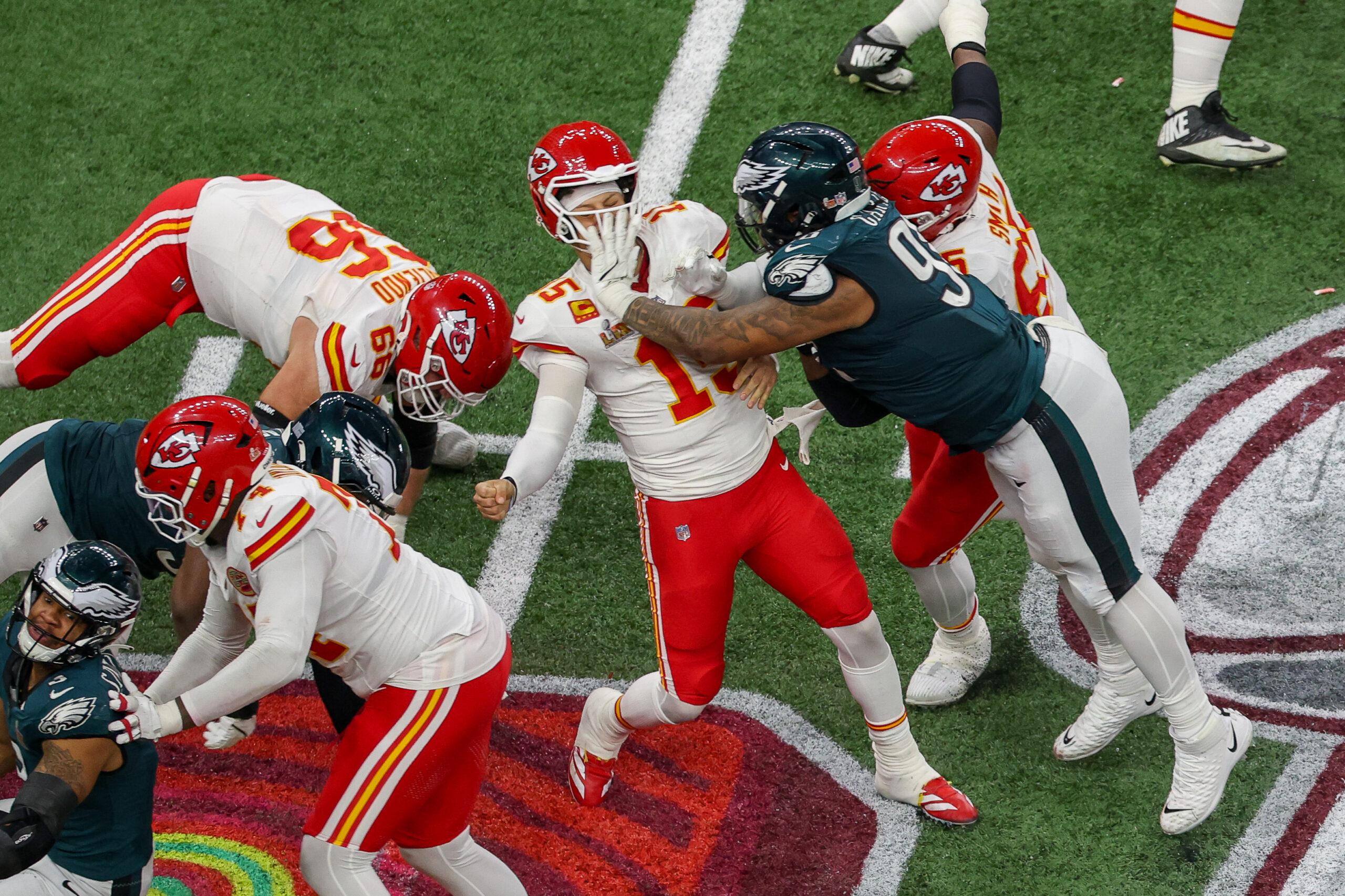
If not for some exceptional stat-padding in garbage time, this would have gone down as the worst performance of Mahomes’s brilliant career. The Chiefs quarterback was averaging –0.69 EPA and 4.4 yards per dropback before the game hit TruMedia’s definition of garbage time, and he had committed the two turnovers that allowed the Eagles to run away with the game early. The Cooper DeJean pick-six stands out as Mahomes’s worst play of the night.
Mahomes throws late back across his body over the middle of the field, and if DeJean hadn’t picked it off, Quinyon Mitchell probably would have.
The Chiefs supporting cast—consisting of a battered offensive line and an unimposing receiving corps—made Mahomes’s job nearly impossible that night in the Superdome, but the superstar quarterback didn’t put forth his best effort. He was jittery in the pocket, he made poor decisions, and he was inaccurate. While the result was similar to Mahomes’s first Super Bowl loss to Tampa Bay, he was much better individually in that game.
42
Super Bowl XL, Steelers vs. Seahawks (2005)
Ben Roethlisberger
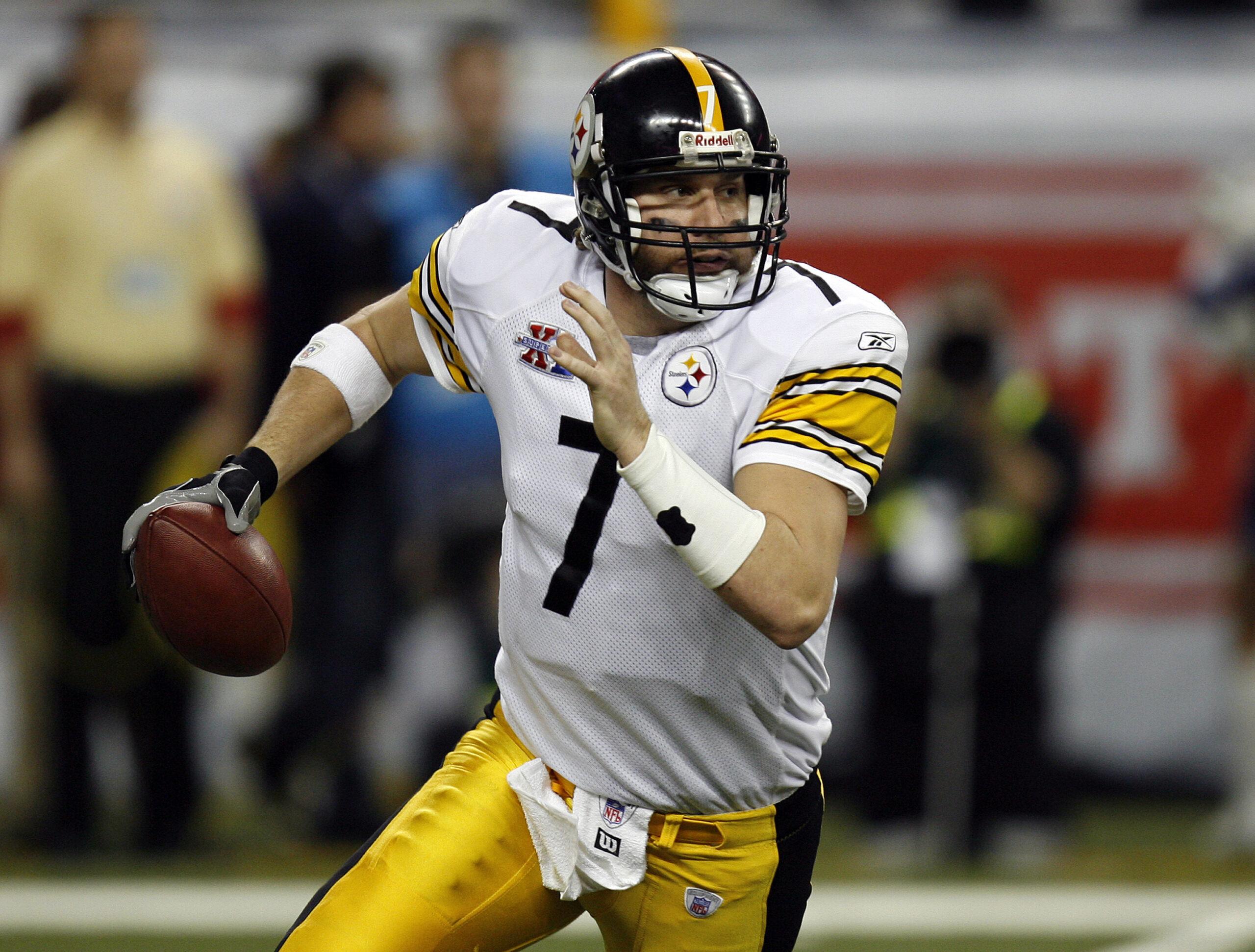
Result: Won 21-10
Stat line: 9/21, 123 yards, 0 TDs, 2 INTs
EPA per dropback: –0.38 (46th)
Success rate: 36.4 percent (43rd)
Yards per dropback: 5.2 (40th)
Opponent defensive ranking: 12th
This was a few years before Roethlisberger earned his “Real QB” badge and he was still mostly winging it in the pocket. He was truly dreadful as a passer against the Seahawks and would have been much lower on this list if it was based solely on that. Roethlisberger didn’t complete half of his attempts and threw two bad interceptions, but he made just enough plays with his legs to get Pittsburgh over the line—with a big push from Hines Ward and Willie Parker, whose 75-yard touchdown run broke the game open.
41
Super Bowl XXXV, Ravens vs. Giants (2000)
Trent Dilfer
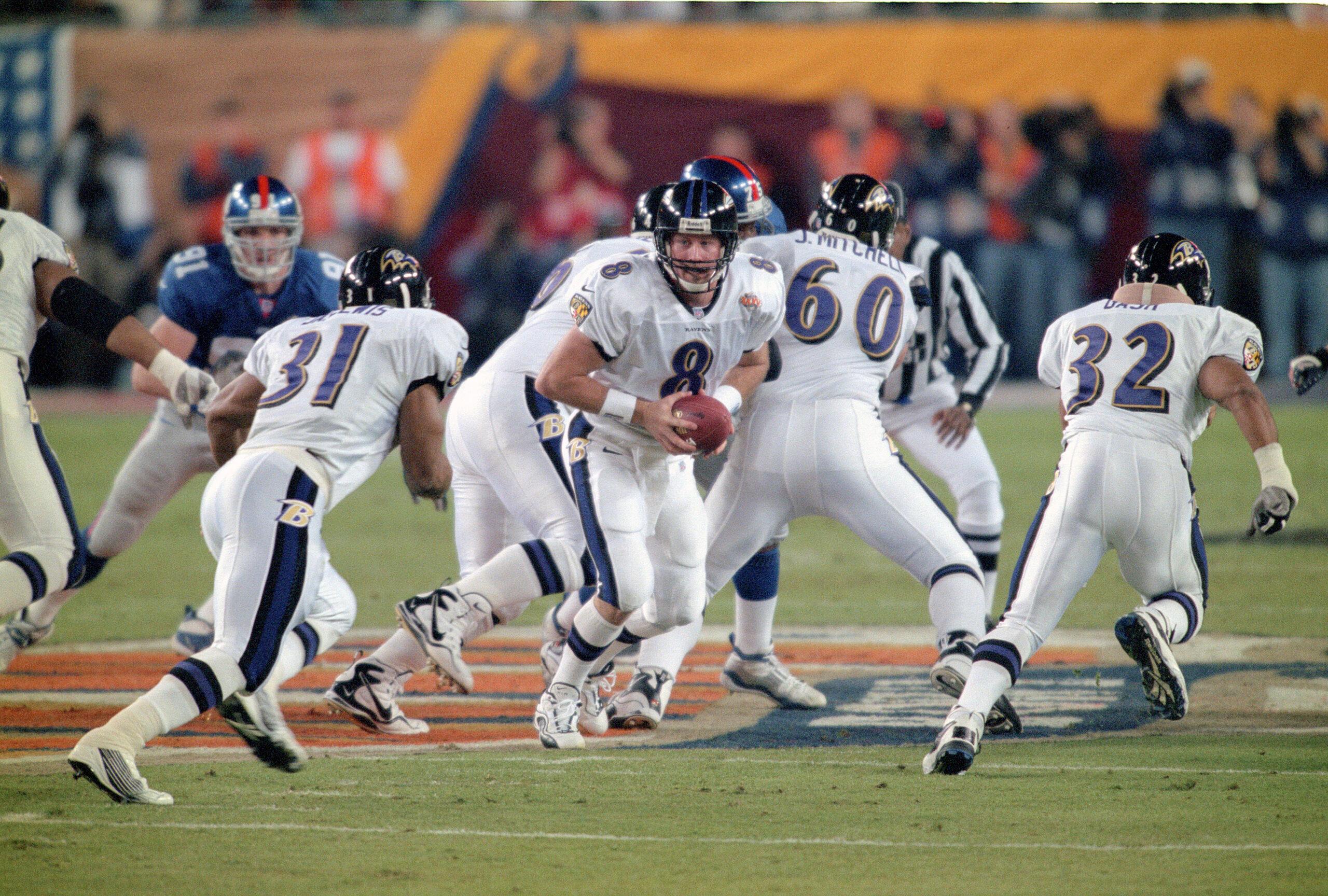
Result: Won 34-7
Stat line: 12/25, 153 yards, 1 TD, 0 INTs
EPA per dropback: –0.21 (40th)
Success rate: 28.6 percent (48th)
Yards per dropback: 4.8 (46th)
Opponent defensive ranking: 11th
Dilfer didn’t have to do too much with the Ravens defense ragdolling Kerry Collins and the Giants offense. As you can see, 153 yards passing and no turnovers was enough for Baltimore to blow out New York. But this highlight reel of Dilfer’s performance starts with a short completion to the flat that went for five yards, which tells you how unremarkable he was in the game.
Still, Dilfer did chip in with two legitimately impressive throws. He hit Brandon Stokley up the seam for a deep touchdown that opened up the scoring and connected with Qadry Ismail on a tight-window throw down the sideline to spark the Ravens’ second scoring drive. Those two plays accounted for more than half of Dilfer’s passing yards on the day.
40
Super Bowl XL, Seahawks vs. Steelers (2005)
Matt Hasselbeck
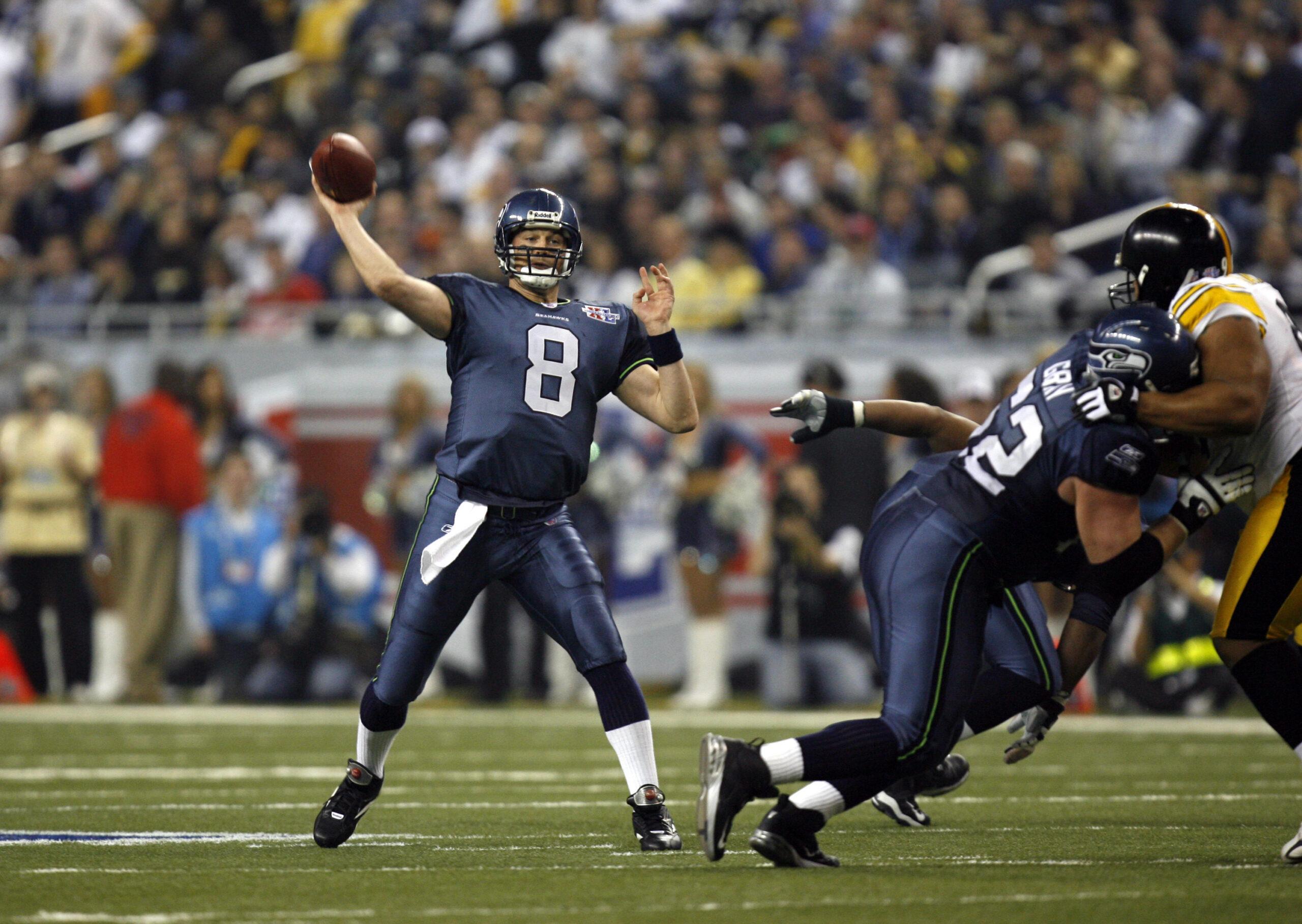
Result: Lost 10-21
Stat line: 26/49, 273 yards, 1 TD, 1 INT
EPA per dropback: –0.10 (35th)
Success rate: 37.3 percent (42nd)
Yards per dropback: 5.1 (41st)
Opponent defensive ranking: 5th
This is one of the most forgettable Super Bowl performances of any quarterback ever. I couldn’t recall a single play, good or bad, that Hasselback made before I watched it back. And, honestly, I’ve forgotten again just a few days after my rewatch. The game is remembered for Pittsburgh’s trick plays and some truly atrocious officiating, which might have cost Seattle a chance to make the game competitive. Hasselbeck was mostly fine. When the Seahawks gave him time in the pocket, he typically found an open receiver and made an accurate throw. But when the pocket broke down, he looked helpless. He didn’t lose this game for Seattle, but obviously he didn’t win it, either.
39
Super Bowl XXXVII, Buccaneers vs. Raiders (2002)
Brad Johnson
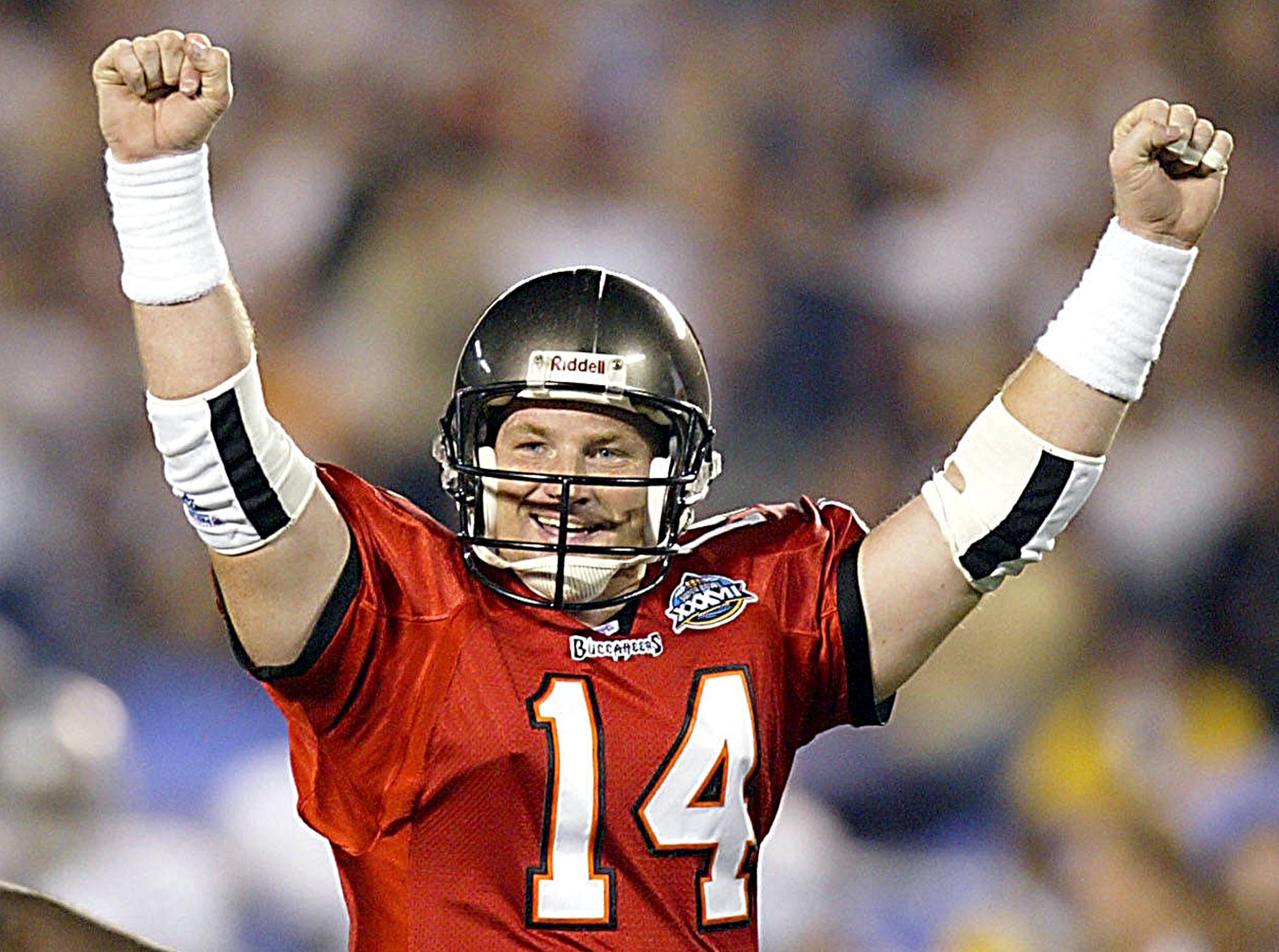
Result: Won 48-21
Stat line: 18/34, 215 yards, 2 TD, 1 INT
EPA per dropback: 0.29 (14th)
Success rate: 48.6 percent (27th)
Yards per dropback: 6.4 (29th)
Opponent defensive ranking: 13th
Don’t let those numbers fool you. Johnson did not play nearly as well as they imply, and he was the primary reason Tampa Bay didn’t completely blow this game open in the first half. He was nearly picked off on the very first play of the game before ending the opening possession with a poorly thrown ball that was intercepted. The major theme early in the game was Johnson looking out of his depth and putting his dominant defense in tough spots. Eventually, though, Jon Gruden got the Bucs’ run game going and Johnson settled into his role as a game manager.
38
Super Bowl XXXVI, Rams vs. Patriots (2001)
Kurt Warner
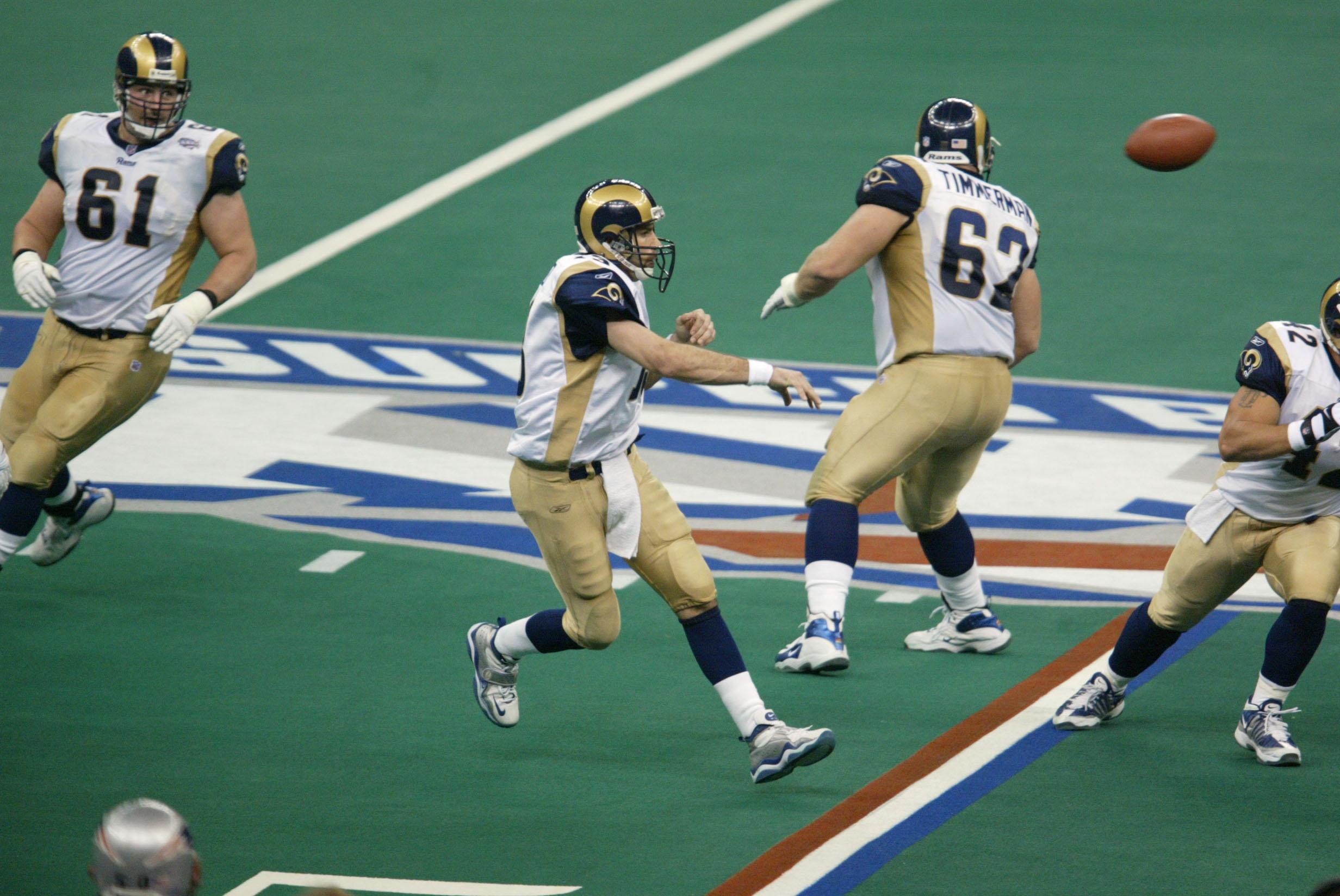
Result: Lost 17-20
Stat line: 28/44, 365 yards, 1 TD, 2 INTs
EPA per dropback: –0.11 (37th)
Success rate: 48.9 percent (25th)
Yards per dropback: 7.2 (16th)
Opponent defensive ranking: 9th
Bill Belichick gave Rams coach/play caller Mike Martz a noogie for most of this game, and Warner was put in some uncomfortable situations. He fared well considering the circumstances, but he was forced to move a lot, which wasn’t really his thing. He was more of a hit the back of your drop and get rid of the ball kind of quarterback, and the Patriots roughed up St. Louis’s receivers enough to throw off his timing. Warner had to earn all of his 365 passing yards—and I don’t fully blame him for the two interceptions. On Ty Law’s pick-six, future Super Bowl coach Mike Vrabel was given an unblocked lane to the quarterback and hit Warner as he threw.
Then, on Warner’s second interception, Torry Holt lost his balance while fighting off press coverage and fell down as the ball arrived, allowing Otis Smith to haul in the pick.
Warner played an efficient game outside of the two turnovers, averaging 0.19 EPA per dropback with a 51.1 percent success rate, per TruMedia. And he may have been too efficient on the game-tying drive, which left over a minute on the clock and set Tom Brady up for his first moment of glory.
37
Super Bowl XLII, Patriots vs. Giants (2007)
Tom Brady
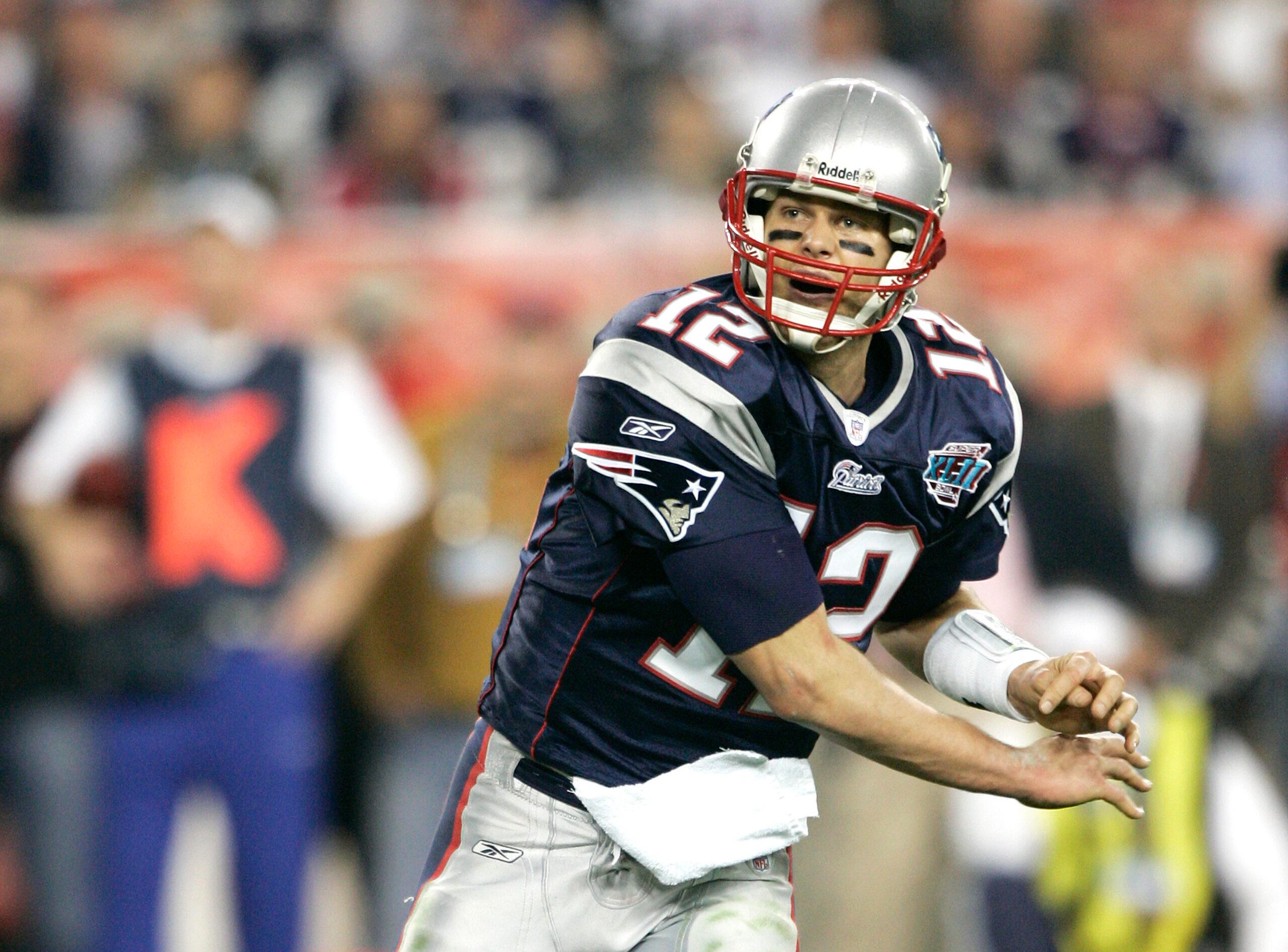
Result: Lost 14-17
Stat line: 29/48, 266 yards, 1 TD, 0 INTs
EPA per dropback: 0.01 (34th)
Success rate: 45.3 percent (29th)
Yards per dropback: 4.3 (48th)
Opponent defensive ranking: 9th
I’m not sure there was a Super Bowl result that pleased neutral fans more. The most explosive passing season in NFL history, and a bid for the perfect season, ended with a 4.3-yards-per-dropback whimper from Tom Brady. The Giants defensive line got a lot of credit for slowing Brady down. New York sacked him five times, and while some of those came via a four-man rush, defensive coordinator Steve Spagnuolo also put Brady in a blender. He sprinkled some timely blitzes and three-man rushes throughout the game to get in Brady’s head, and we never really saw the 2007 MVP get in the rhythm he had been in all season. The coverage on the back end was also giving Brady issues. It was shocking to see how often he just chucked the ball up deep to a covered receiver. That’s not a bad strategy when you have Randy Moss on the perimeter, but Brady and his all-world receiver didn’t connect on a single long ball. Brady almost hit Moss on a miracle, 70-yard throw in the dying seconds of the game, but Corey Webster and Gibril Wilson intervened.
Don’t let anyone tell you Brady didn’t have a strong arm.
36
Super Bowl LIV, 49ers vs. Chiefs (2019)
Jimmy Garoppolo
Result: Lost 20-31
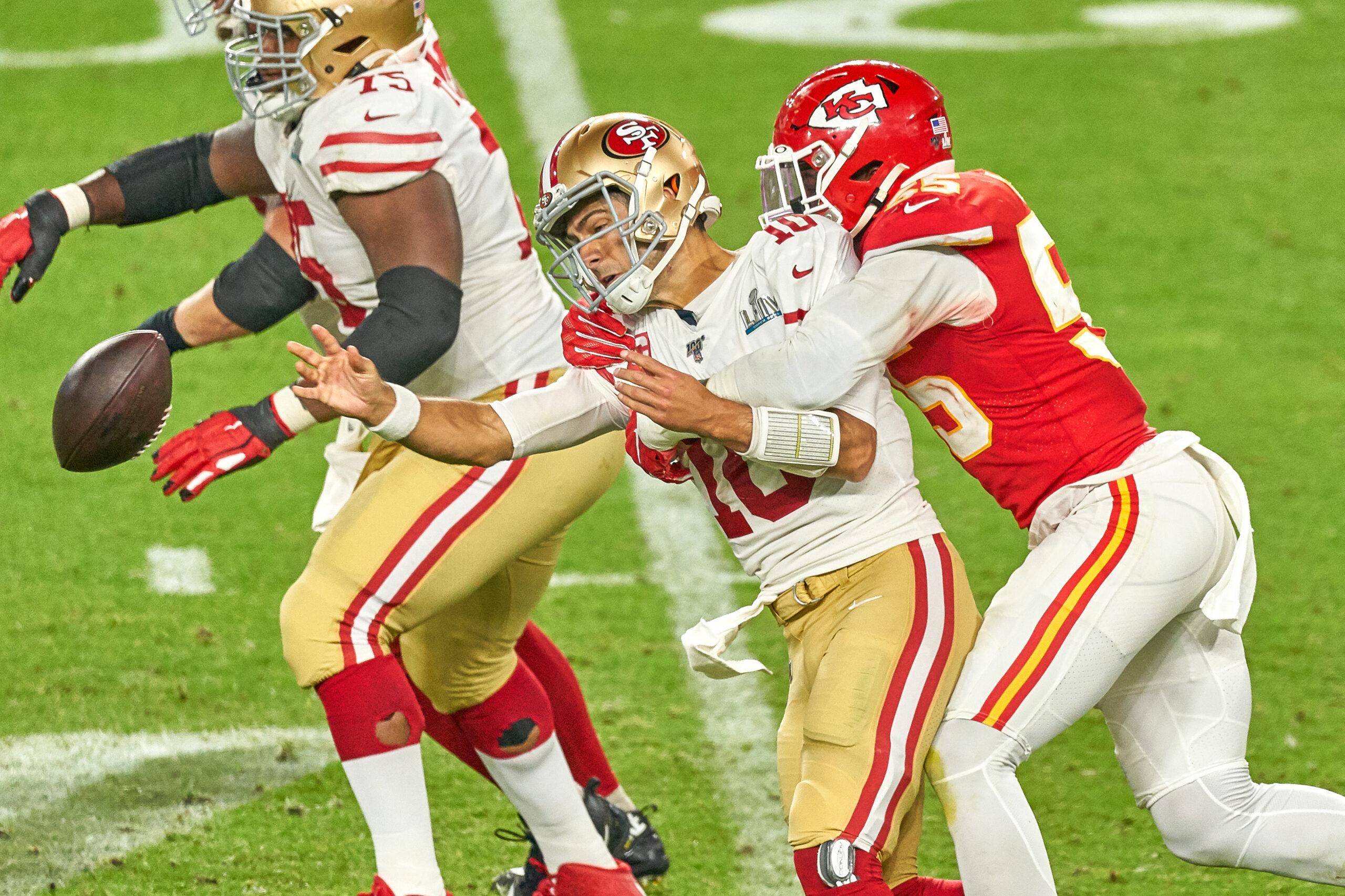
Stat line: 20/31, 219 yards, 1 TD, 2 INTs
EPA per dropback: 0.07 (30th)
Success rate: 48.5 percent (28th)
Yards per dropback: 6.5 (26th)
Opponent defensive ranking: 18th
After three quarters, Garoppolo was cruising toward the Super Bowl MVP award and one of the most efficient performances in the game’s history: he was averaging 9.2 yards per dropback with a 65 percent success rate. Now, most of that production was a result of Kyle Shanahan’s play calling. Garoppolo was mostly asked to dump the ball off—typically after a play-action fake—and let San Francisco’s playmakers do the work after the catch. Fifty-six percent of his passing yardage was gained after the catch and his average completion traveled just 4.7 yards downfield. The 49ers didn’t need much from Garoppolo in the fourth quarter to put the game away—even with Mahomes leading a furious comeback down the stretch. But even that proved too big an ask of the game-manager QB. Garoppolo melted under the pressure and missed several throws that could have flipped the result in San Francisco's favor. The most notable miss came on a deep pass to Emmanuel Sanders, who had beaten the Chiefs secondary to get open, but Garoppolo sailed the throw.
Shanahan caught most of the shit for the 49ers’ collapse, but with even serviceable play from Garoppolo, the 49ers coach would’ve won his first ring and his quarterback would have cemented his status as the team’s franchise quarterback—which likely would have saved San Francisco from the Trey Lance trade that led to Garoppolo’s exit a few years later.
35
Super Bowl XXXIX, Eagles vs. Patriots (2004)
Donovan McNabb
Result: Lost 21-24
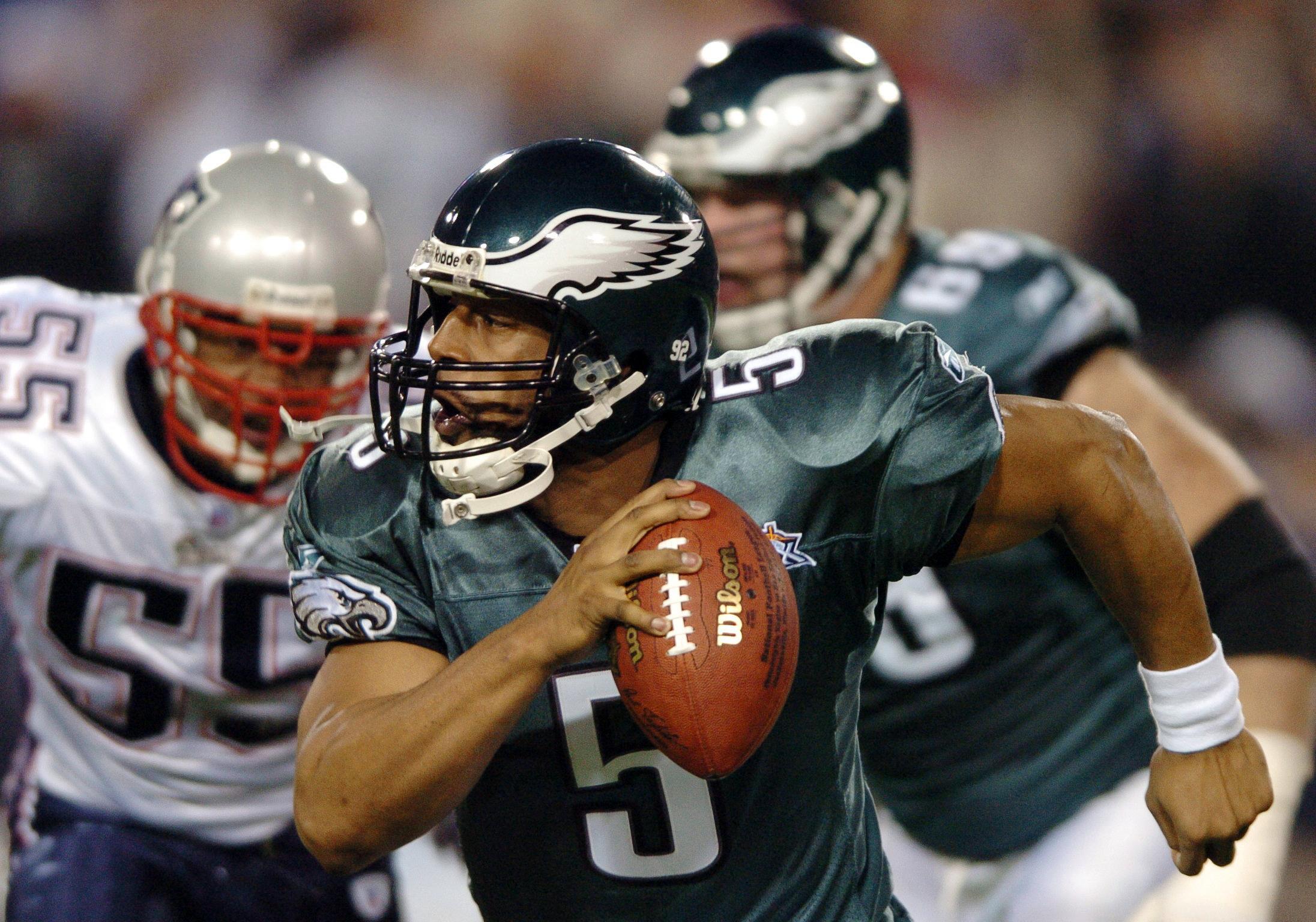
Stat line: 30/51, 357 yards, 3 TDs, 3 INTs
EPA per dropback: 0.15 (24th)
Success rate: 50.9 percent (22nd)
Yards per dropback: 5.9 (36th)
Opponent defensive ranking: 6th
McNabb got off to a horrid start in Super Bowl XXXIX but eventually locked in and finished the game with a respectable stat line. Even though he threw three costly picks, his advanced efficiency numbers suggest this was an above-average performance—against a superior New England team. Andy Reid deserves just as much criticism as McNabb for the slow start. It took Reid far too long to adjust to New England's aggressive game plan built around blitzing linebackers, and his quarterback was under duress for most of the night. Still, the lasting image of the Eagles’ failure in this game is McNabb throwing up on the field while leading a painfully slow touchdown drive that took up a big chunk of the fourth quarter—all while Philadelphia needed two scores to get back in the game.
34
Super Bowl XLVI, Patriots vs. Giants (2011)
Tom Brady
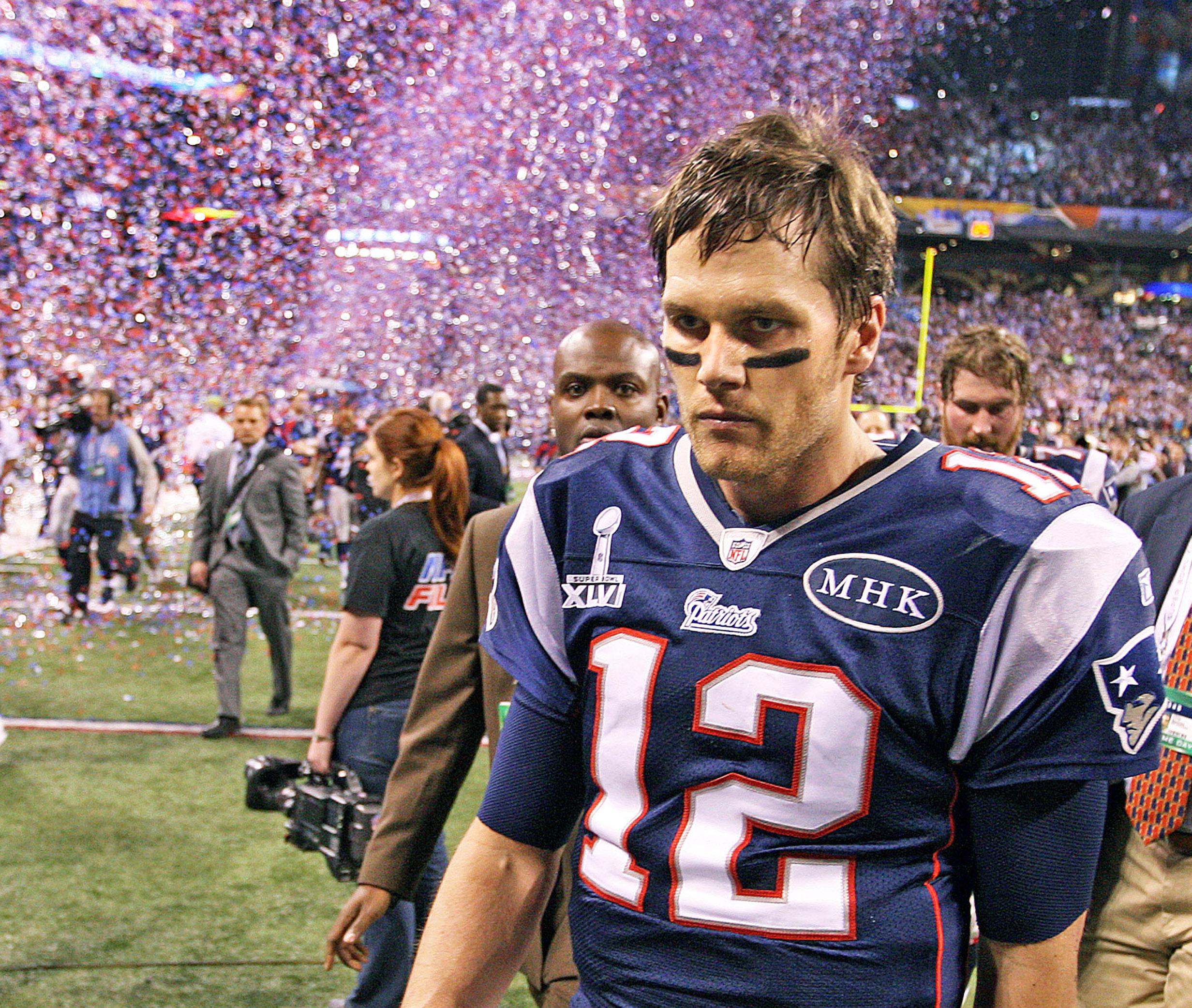
Result: Lost 17-21
Stat line: 27/41, 276 yards, 2 TDs, 1 INT
EPA per dropback: 0.19 (21st)
Success rate: 57.1 percent (7th)
Yards per dropback: 6.3 (30th)
Opponent defensive ranking: 26th
Drops by Patriots pass catchers may have robbed Brady of another Super Bowl–winning drive, and as Brady’s then-wife Gisele Bündchen said after the game, he “cannot fucking throw and catch the ball at the same time.” What Brady could have done was not take a safety in the first quarter, which helped the Giants get out to an early 9-0 lead. Brady coolly pulled the Patriots out of that hole and eventually pushed them back into the lead, but the fourth quarter drops and that throw by Eli Manning were too much to overcome. Brady nearly led a miraculous comeback drive with under a minute to go, one highlighted by a fourth-and-16 conversion that would have become Super Bowl lore if New England could have found the end zone.
But Rob Gronkowski—who lost a 50-50 deep ball to linebacker Chase Blackburn on Brady’s lone interception—couldn’t get under a Hail Mary and the Giants beat the Patriots in the Super Bowl for the second time in four years.
33
Super Bowl LVI, Bengals vs. Rams (2021)
Joe Burrow
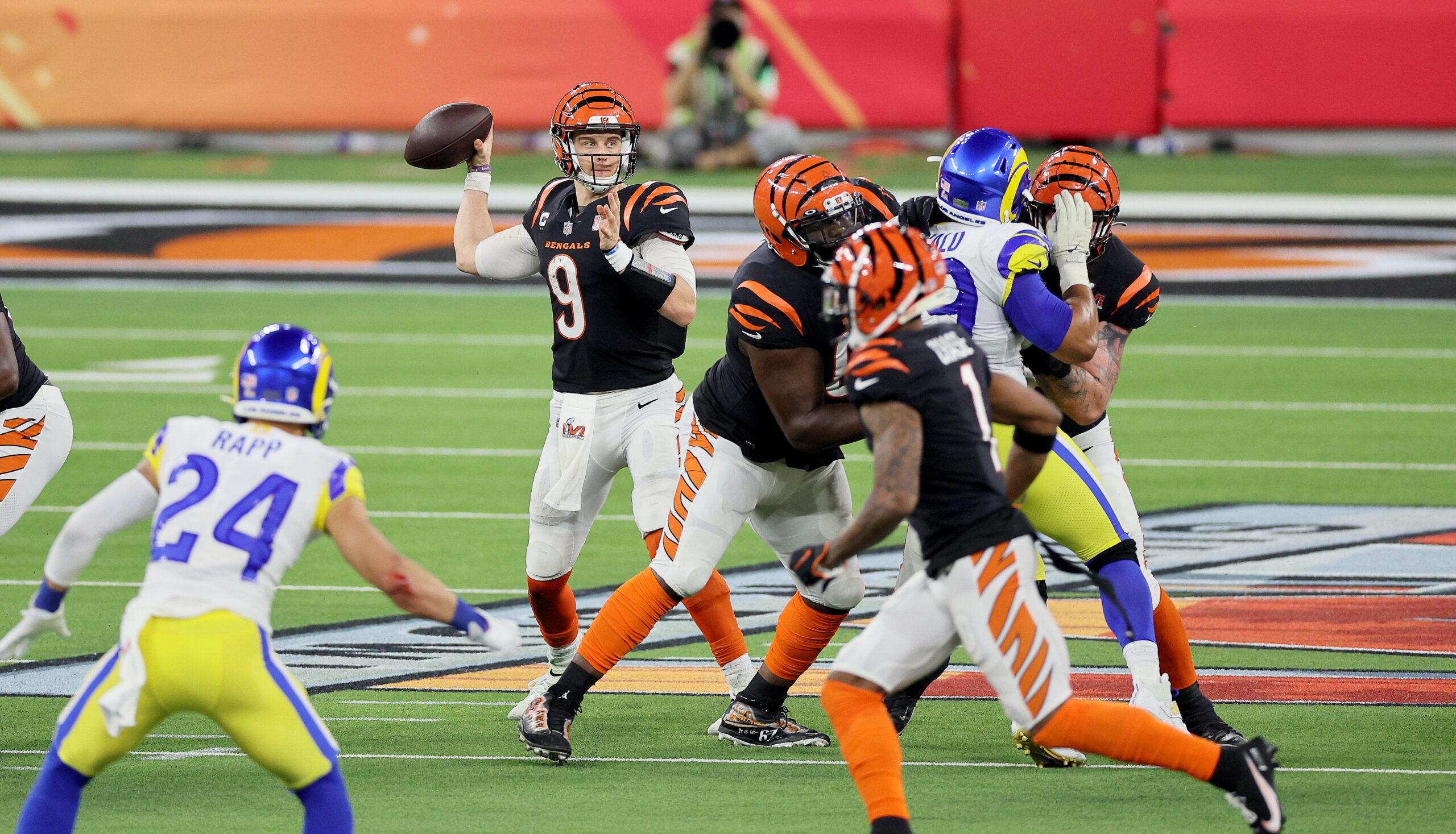
Result: Lost 20-23
Stat line: 22/33, 263 yards, 1 TD, 0 INTs
EPA per dropback: –0.15 (39th)
Success rate: 34.1 percent (47th)
Yards per dropback: 5.5 (38th)
Opponent defensive ranking: 11th
Burrow’s first Super Bowl experience was one to forget. Outside of two deep passes to Ja’Marr Chase and Tee Higgins—which went for 46 and 75 yards, respectively—he threw for just 142 yards on 31 attempts, or 4.6 yards per. And that doesn’t account for the 43 yards lost on seven sacks. Burrow was under siege for most of the game, facing pressure on 43.9 percent of his dropbacks. Only five quarterbacks have faced a higher pressure rate in a Super Bowl since 2000, per TruMedia. Aaron Donald took up residence in Burrow's pocket and finished off the game by shedding a feeble block attempt and taking the Bengals quarterback to the ground after he just barely got a pass away. Burrow didn’t have much of a chance on the game-deciding play—or most of his pressured dropbacks, for that matter—but he also missed a few key chances he did have. A misread on a fourth-and-short ended a promising opening drive near midfield. And Burrow also skipped a throw to an open Chase beyond the first-down marker on third-and-13, halting a late third-quarter drive.
32
Super Bowl XLV, Steelers vs. Packers (2010)
Ben Roethlisberger
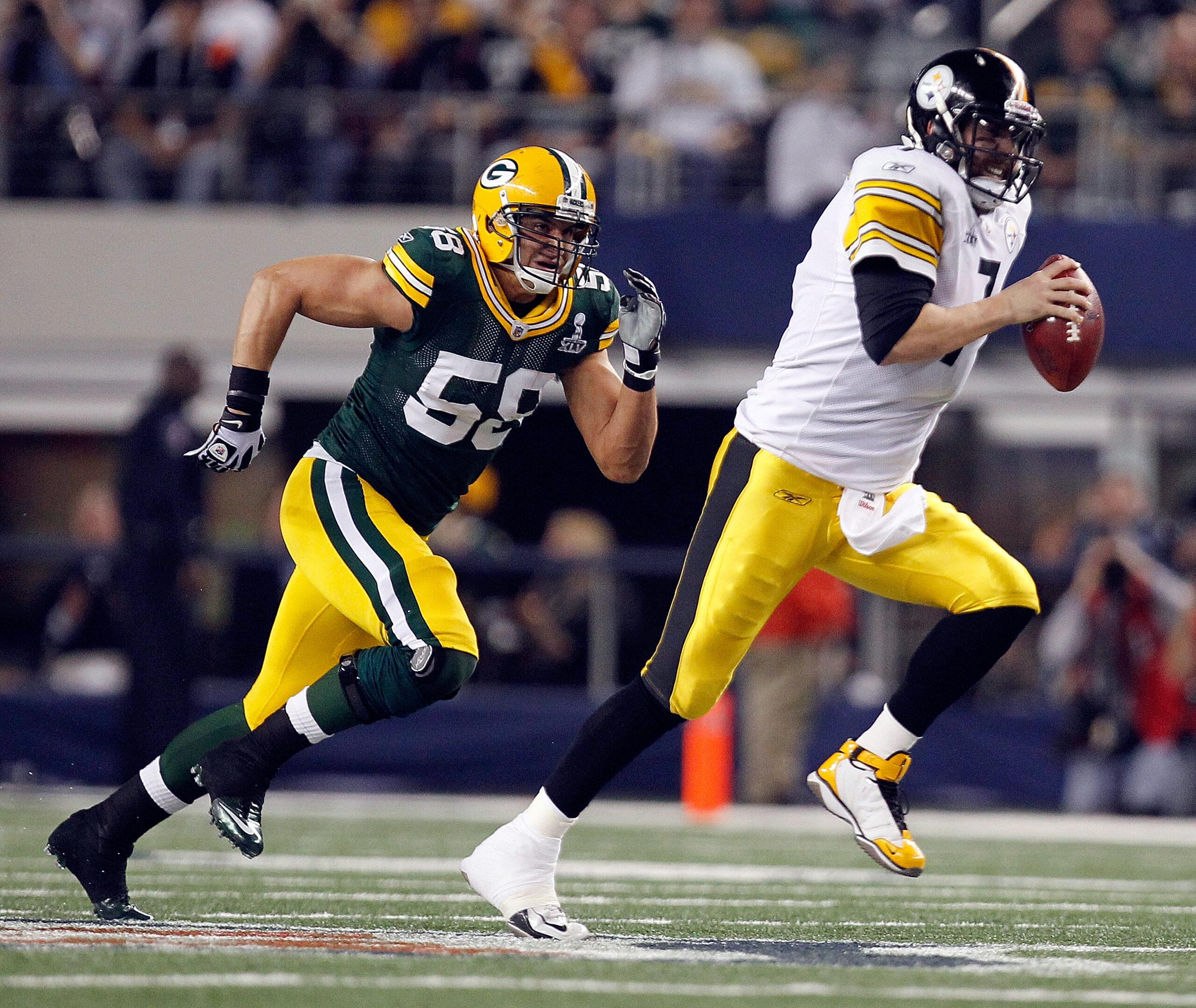
Result: Lost 25-31
Stat line: 25/40, 263 yards, 2 TDs, 2 INTs
EPA per dropback: 0.05 (32nd)
Success rate: 44.4% (32nd)
Yards per dropback: 6.5 (25th)
Opponent defensive ranking: 3rd
Roethlisberger was playing for his third ring in this game, which would have put him level with Tom Brady at the time and pushed his Super Bowl record to 3-0. He was just two years removed from orchestrating a championship-winning drive against the Cardinals and he got a chance to do it again at the end of this game. This time, though, the drive fizzled out after a couple first downs and that ended Pittsburgh’s bid for what would have been the biggest comeback in Super Bowl history at the time. The Steelers fell behind 21-3 in the first half before Roethlisberger and the offense woke up. The QB made play after play with his arm and legs, but he only had to do that because he made a mess of things early on. His two first-half interceptions, including an early pick-six, helped the Packers build their lead and eliminated any margin for error the Steelers had against the favored NFC champs. This ended up being Roethlisberger’s last trip to the Super Bowl. Instead of going down as one of the all-time great winners, he finished his career with a 2-1 record and a 3-to-5 touchdown-to-interception ratio.
31
Super Bowl LIII, Patriots vs. Rams (2018)
Tom Brady
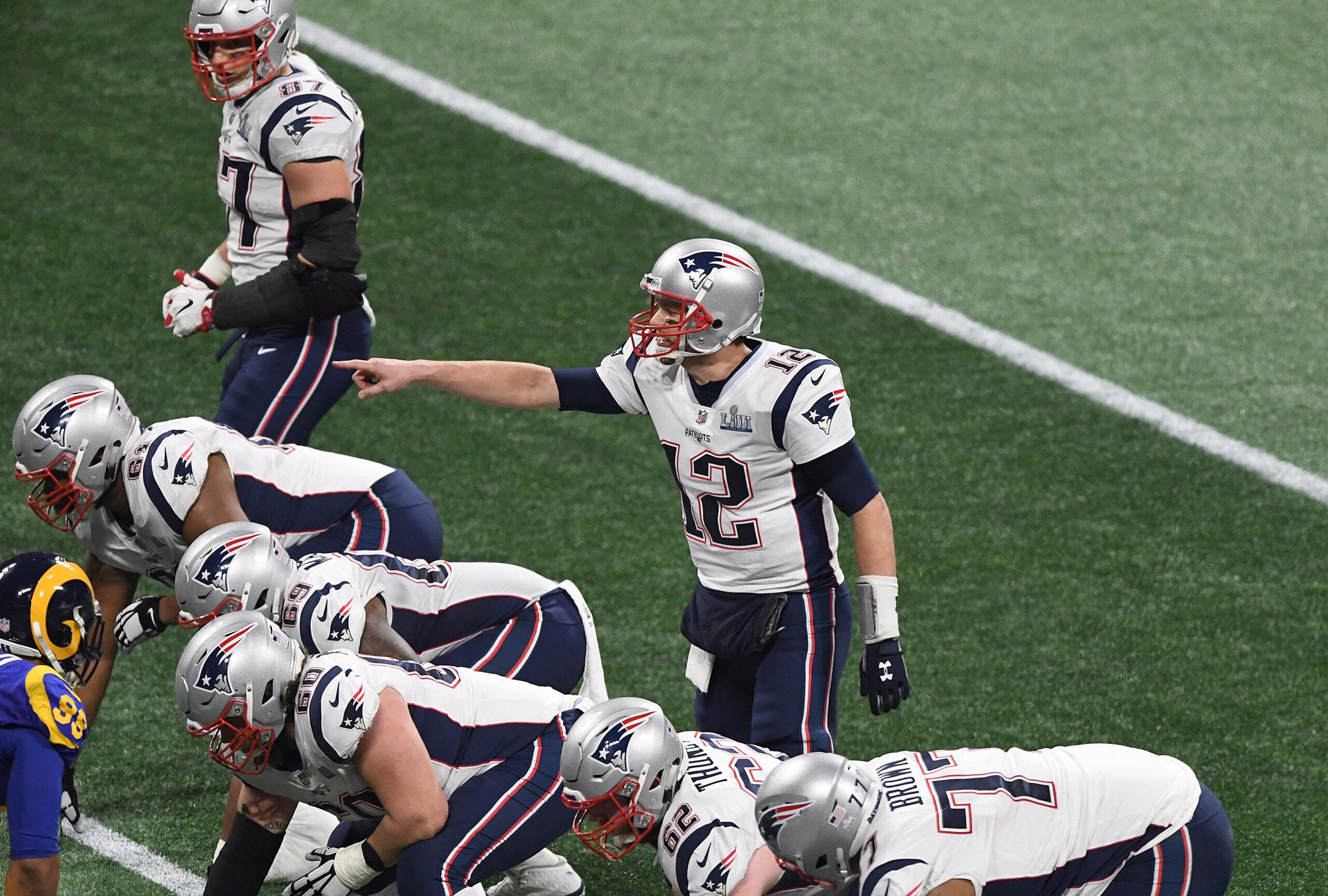
Result: Won 13-3
Stat line: 21/35, 262 yards, 0 TDs, 1 INT
EPA per dropback: –0.15 (38th)
Success rate: 50 percent (23rd)
Yards per dropback: 7.0 (17th)
Opponent defensive ranking: 13th
With Bill Belichick and the Patriots defense pushing around Sean McVay and Jared Goff, this was a relatively light lift for Brady compared to his other Super Bowl triumphs. The GOAT took his time putting away the Rams, and, statistically, this was the worst championship performance of his career. But his work on the game-winning drive was enough to push this performance up the rankings despite his ugly stat line. With the game tied at 3-3 with just under 10 minutes remaining, Brady led the Pats on a ruthlessly efficient 69-yard drive for the game’s only touchdown. And he did it by spamming the same play—”Hoss Y Juke,” as it’s called in New England’s playbook. It had been in the playbook for all of Brady’s career and by this point, he had mastered reading out the concept. That mastery was on full display here, as he hit Julian Edelman on the “juke” route over the middle, Rex Burkhead on a hitch, and Rob Gronkowski on a seam route with one of the best throws of Brady’s career.
30
Super Bowl LV, Chiefs vs. Buccaneers (2020)
Patrick Mahomes
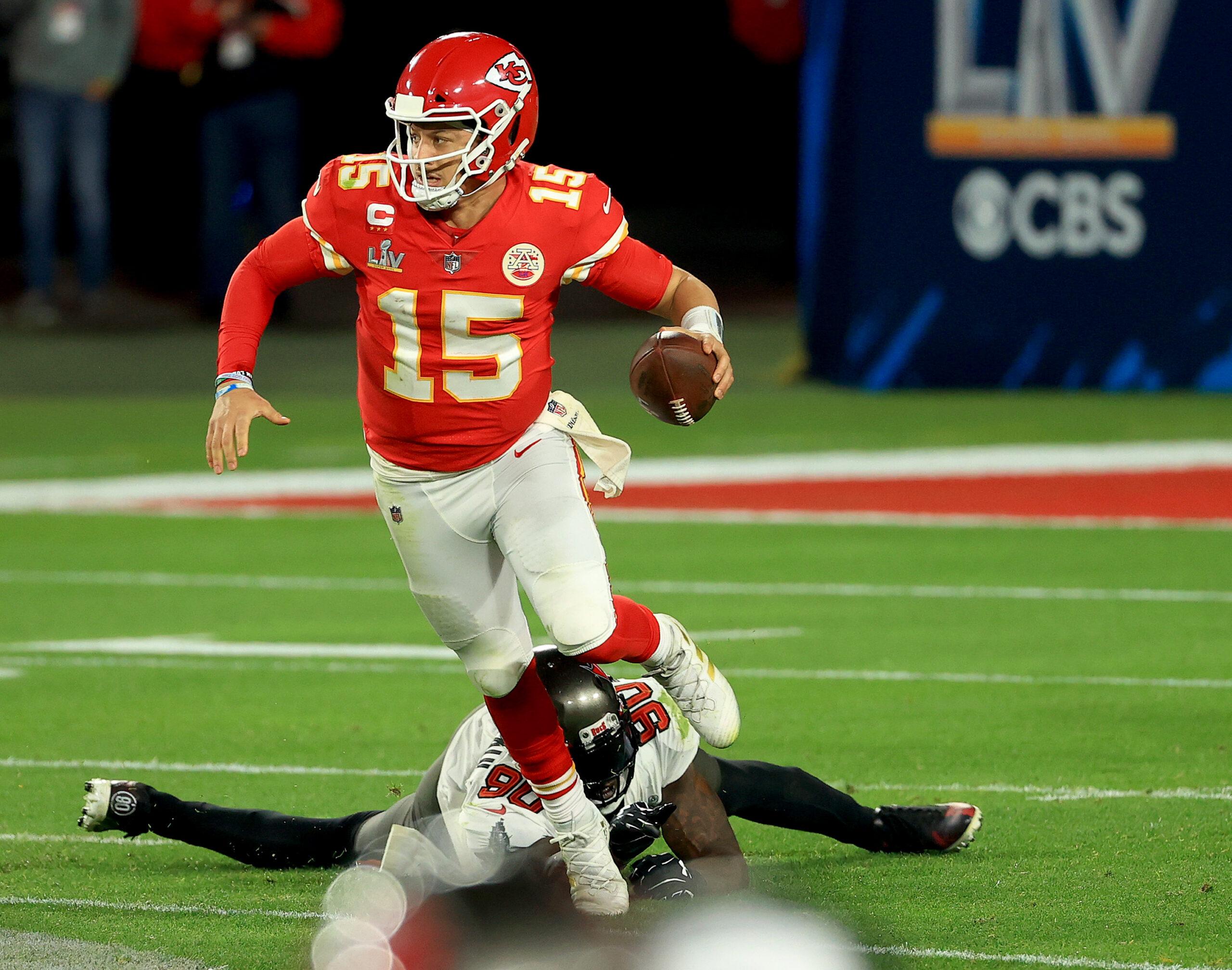
Result: Lost 9-31
Stat line: 26/49, 270 yards, 0 TDs, 2 INTs
EPA per dropback: –0.29 (43rd)
Success rate: 35.7 percent (44th)
Yards per dropback: 4.9 (43rd)
Opponent defensive ranking: 8th
This may have been the best bad game for a quarterback in NFL history. I’m sure I’ll get accused of running PR for Mahomes after putting a zero-touchdown, multi-pick game in the top 30, but we’re ranking individual performances here, and that stat line is more of a reflection of the impossible degree of difficulty he faced in the game than any failing on his part. The Buccaneers pressured Mahomes on 55.4 percent of his dropbacks, and they did it without sending a true all-out blitz. Tampa Bay played a two-high zone to take away deep shots to Tyreek Hill, all while sticking tight to Travis Kelce and taking away Mahomes’s pressure relief valve. With Andy Reid’s system failing him, Mahomes’s only recourse was to ad-lib. While he probably missed a few opportunities to throw a checkdown—which the Chiefs quarterback later admitted—he also made plays that had the Bucs sideline in awe.
Mike Evans and Chris Godwin were watching the worst game of Mahomes’s career and he still had them fanboying. Maybe I’m overrating a handful of highlight throws, but almost every memorable play from Super Bowl LV was made by Mahomes—and style points are a factor in these rankings.
29
Super Bowl XLIX, Seahawks vs. Patriots (2014)
Russell Wilson
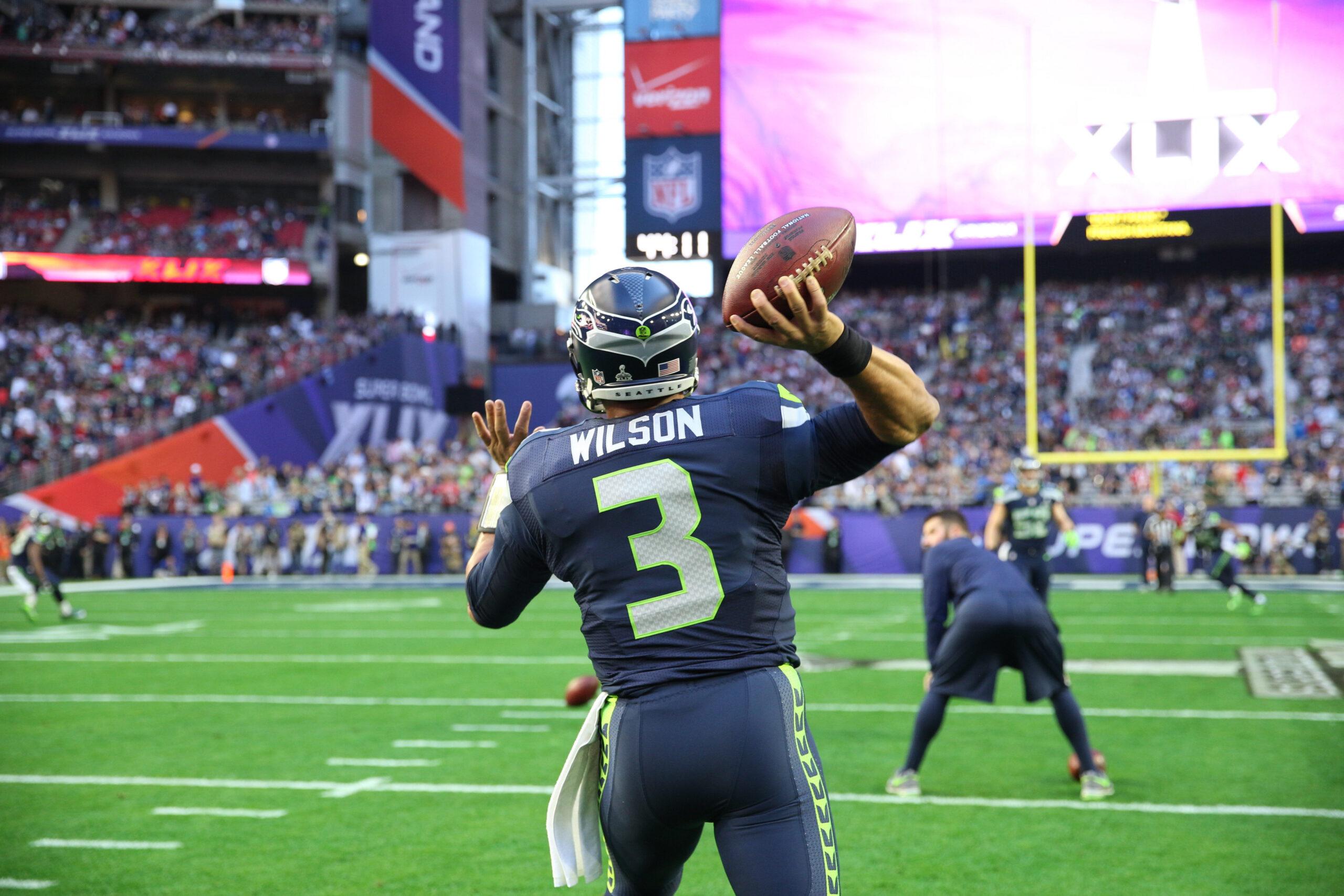
Result: Lost 24-28
Stat line: 12/21, 241 yards, 2 TDs, 1 INT
EPA per dropback: 0.35 (9th)
Success rate: 53.8 percent (14th)
Yards per dropback: 9.8 (2nd)
Opponent defensive ranking: 14th
If we could have set aside the most infamous interception in Super Bowl history, this would have been a top-10 performance. Wilson averaged over 10 yards per attempt, and only eight quarterbacks have averaged more EPA per dropback in a Super Bowl this century. Wilson didn’t complete his first pass until late in the second quarter, but once he caught fire, the Patriots couldn't put him out. Well, until that last play, which we can’t just ignore, unfortunately. You may want to scroll past the rest of this, Seahawks fans.
I’m fine with the decision to throw the ball there. It made sense situationally—with only 21 seconds remaining and one timeout, Seattle would have needed to throw at least once if it had wound up needing all three plays left in the series to score. And with New England matching a three-receiver set with its goal line defense, that was the perfect time to do it. Even if you don’t agree with the choice, Pete Carroll’s logic makes sense.
The choice to run the play for Ricardo Lockette, though, the Seahawks WR3, is much harder to explain. Wilson got the man coverage look he wanted with a pick play called for Lockette. He made the right decision to throw it, but the lack of urgency in Lockett’s route gave Malcolm Butler time to beat him to the ball. Still, it’s difficult to fully blame Lockette, or even Wilson, who threw the ill-fated pass. It was a fine decision. Butler just made an unreal play.
28
Super Bowl XLIV, Colts vs. Saints (2009)
Peyton Manning
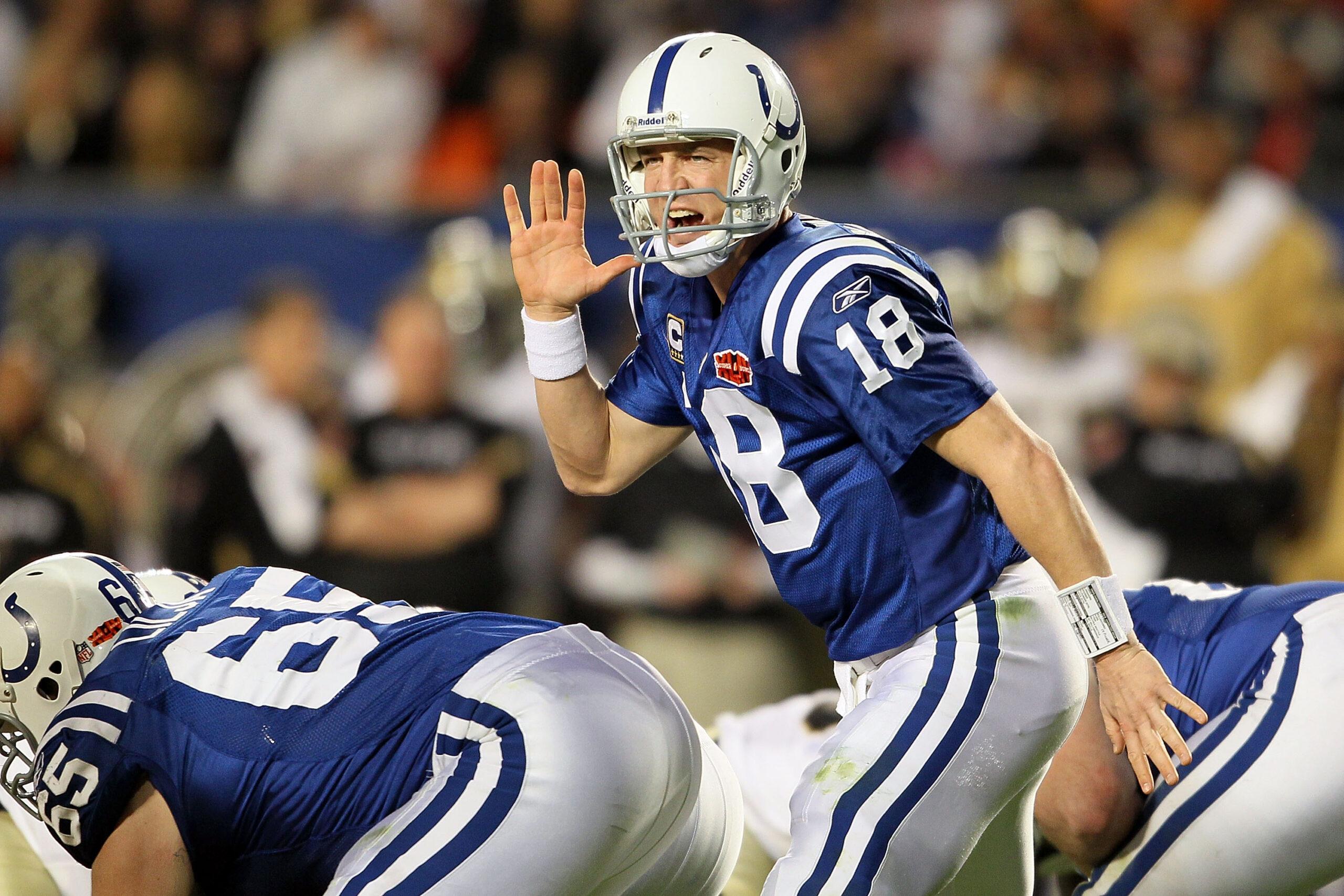
Result: Lost 17-31
Stat line: 31/45, 333 yards, 1 TD, 1 INT
EPA per dropback: 0.15 (23rd)
Success rate: 55.6 percent (9th)
Yards per dropback: 7.4 (13th)
Opponent defensive ranking: 13th
This was easily Manning’s best Super Bowl from a statistical standpoint, but it also featured the most costly interception of his career, which kind of spoils things. His dropbacks generated six times the EPA they did in his first Super Bowl appearance against the Bears, per TruMedia. He improved on his success rate by 12 percentage points and his yards-per-dropback average increased by over a full yard. Of Manning’s four times playing on the sport’s biggest stage, the loss to the Saints was the only game where he met the lofty standard he set throughout his career.
Manning was closing in on what would have been just the second game-winning drive of his career when Tracy Porter jumped in front of Reggie Wayne’s route on the cusp of the red zone.
Like Butler’s interception of Wilson, it’s difficult to fully blame Manning or Wayne for the pick. Manning and Wayne had run that same play a few times earlier in the game with some success. The Saints cornerback recognized it and got an amazing jump on Manning’s pass. The fact that Wayne slipped at the top of his route made Porter’s job even easier, but he would have likely beaten Wayne to the ball either way.
27
Super Bowl LVIII, 49ers vs. Chiefs (2023)
Brock Purdy
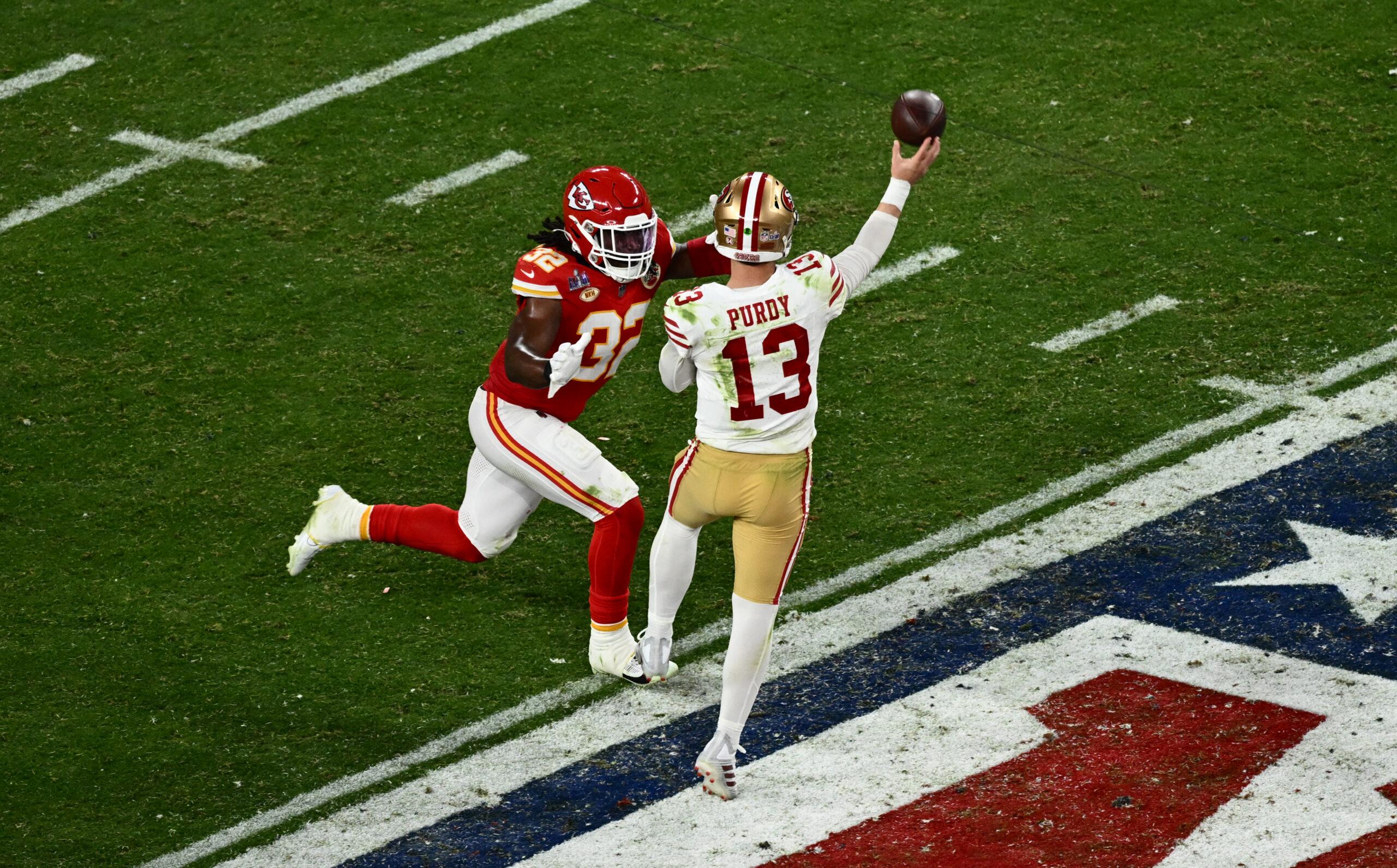
Result: Lost 22-25
Stat line: 23/38, 255 yards, 1 TD, 0 INTs
EPA per dropback: 0.12 (27th)
Success rate: 41.5 percent (34th)
Yards per dropback: 6.4 (28th)
Opponent defensive ranking: 5th
Even though Purdy failed to lead a stacked 49ers offense to a title, he held his own against a very good Chiefs defense that featured a fantastic game plan from defensive coordinator Steve Spagnuolo—which is an admirable feat on its own. Purdy was far from perfect in this game. He missed a few throws and Kansas City‘s blitzes had his head spinning. But Purdy made his share of plays in the face of intense pressure and was never goaded into a game-changing mistake. It probably wasn’t the game Purdy or Kyle Shanahan were envisioning, but sometimes you get Spags’d. If it can happen to Brady, it can happen to anyone.
26
Super Bowl XLI, Colts vs. Bears (2006)
Peyton Manning
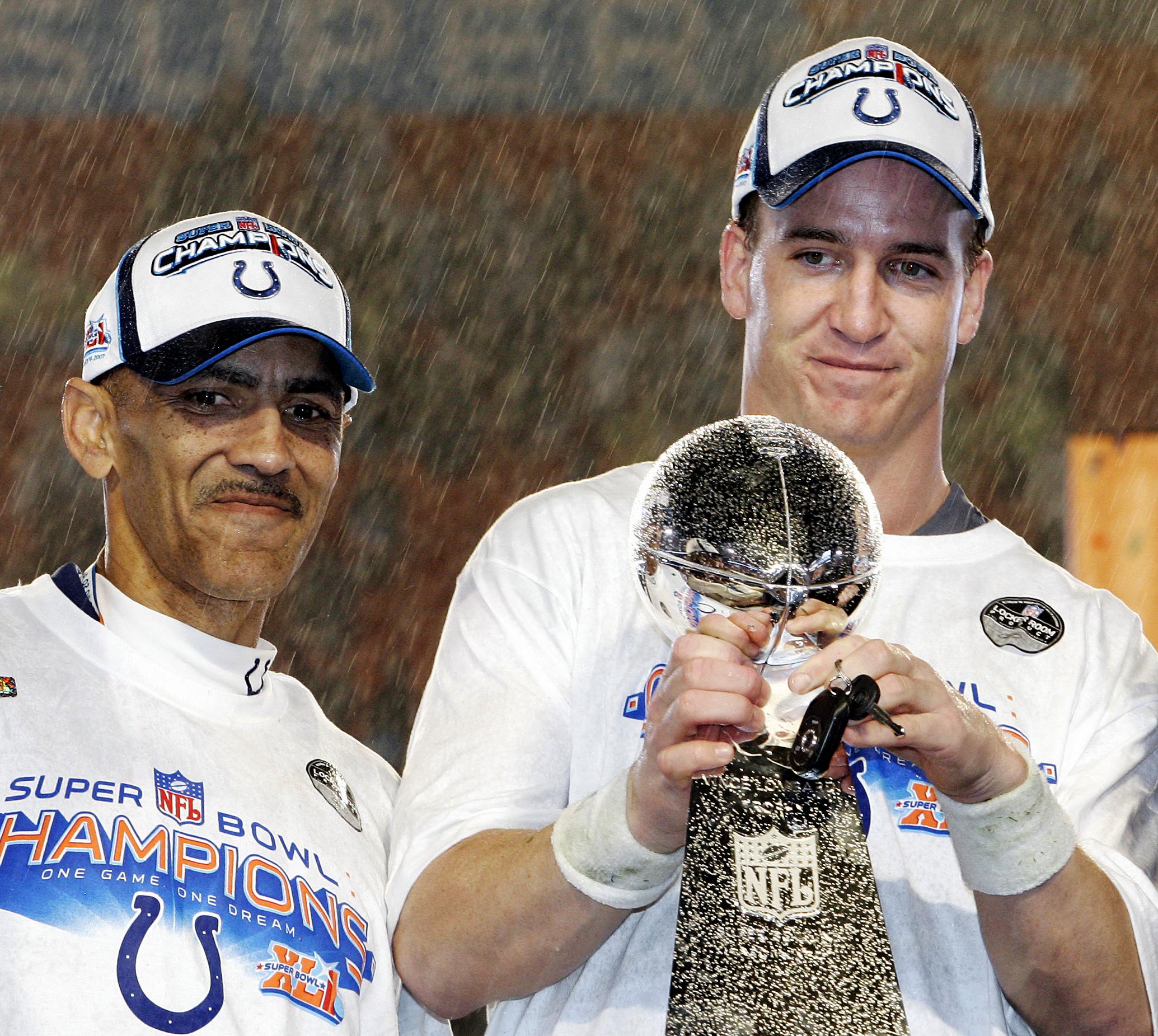
Result: Won 29-17
Stat line: 34/49, 280 yards, 1 TD, 1 INT
EPA per dropback: 0.03 (33rd)
Success rate: 43.6 percent (33rd)
Yards per dropback: 6.1 (33rd)
Opponent defensive ranking: 2nd
I’m definitely grading Peyton Manning’s first Super Bowl on a curve. He was up against a nasty Bears defense and playing in lousy weather. Escaping with an average stat line was impressive considering what other top quarterbacks had done against Chicago that season. Manning didn’t put up gaudy numbers, but he was excellent in high-leverage situations. Particularly on third down, where he went 8-of-12 for 104 yards and 0.49 EPA per dropback. His only touchdown pass of the game also came on third down and may have been the best play of his Super Bowl career. After escaping a sack with some nifty footwork, Manning found Reggie Wayne open downfield for a 53-yard touchdown and made the throw while in the clutches of a man so big and strong he went by the name Tank.
But that was the only memorable Manning pass from the game. With Rex Grossman melting down on the other side of the field, the Colts didn’t need an exceptional performance from their star quarterback.
25
Super Bowl XLII, Giants vs. Patriots (2007)
Eli Manning
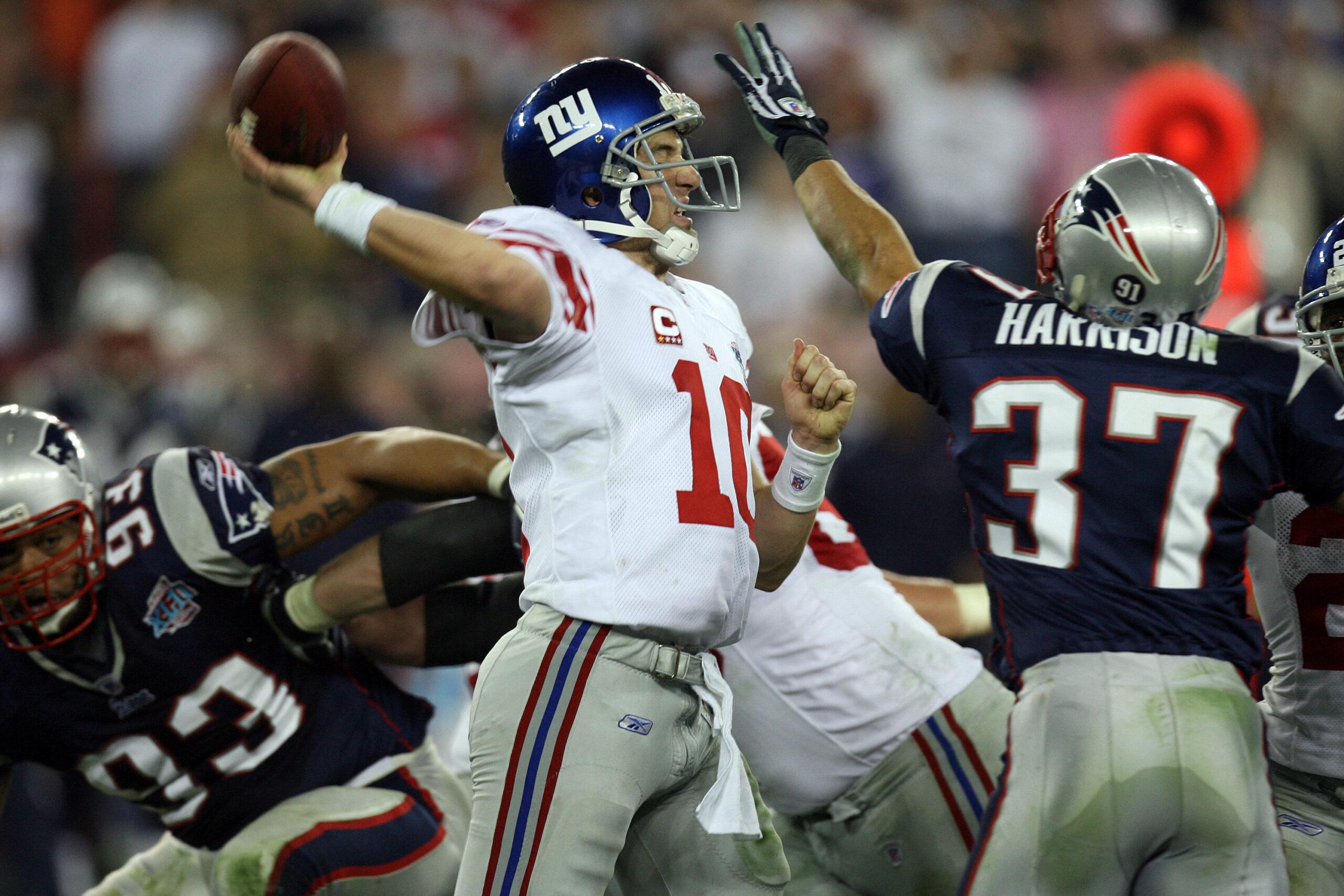
Result: Won 17-14
Stat line: 19/34, 255 yards, 2 TDs, 0 INTs
EPA per dropback: 0.21 (18th)
Success rate: 39.5 percent (37th)
Yards per dropback: 6.6 (21st)
Opponent defensive ranking: 8th
Even if we’re setting aside Manning’s escape from the clutches of Hall of Famer Richard Seymour, and David Tyree winning an aerial duel with another incredible player in Rodney Harrison by pinning the ball against his helmet, the Giants’ game-winning drive was still absurdly lucky. By my count, Patriots defenders got their hands on three Manning passes on that drive alone, including Asante Samuel’s infamous drop along the sideline.
Regardless, Manning was genuinely brilliant down the stretch of this game. Only three quarterbacks have generated more dropback EPA in the fourth quarter of a Super Bowl this century, per TruMedia. He averaged 9.8 yards per dropback and threw two touchdown passes, which ties him for the most in the Super Bowl’s final quarter. He also gave us one of the best plays in football history with the Helmet Catch. Manning was both lucky and good in crunch time of one of the biggest upsets in league history.
24
Super Bowl XLVII, 49ers vs. Ravens (2012)
Colin Kaepernick
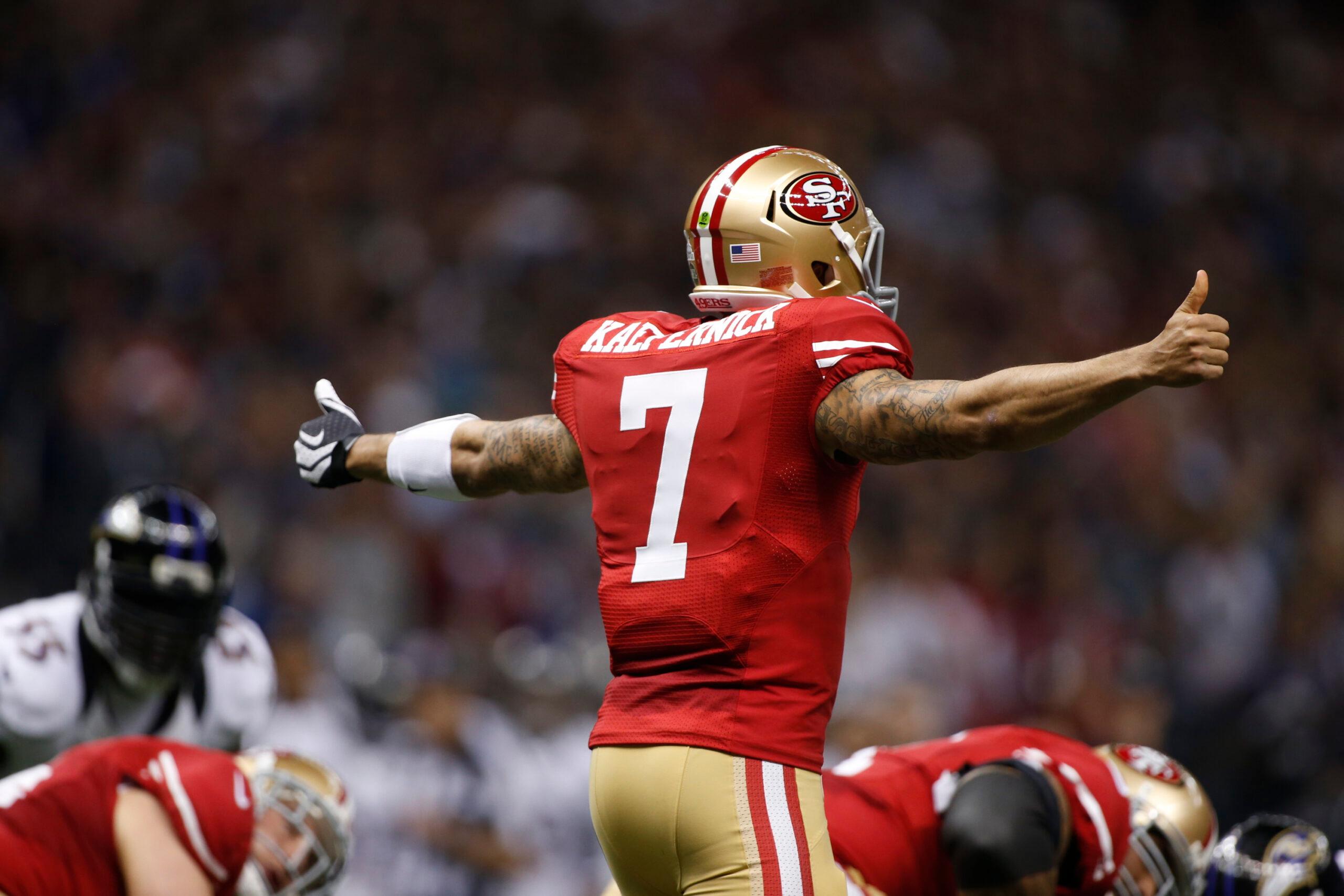
Result: Lost 31-34
Stat line: 16/28, 302 yards, 1 TD, 1 INT
EPA per dropback: 0.30 (10th)
Success rate: 55.6 percent (9th)
Yards per dropback: 9.3 (3rd)
Opponent defensive ranking: 11th
I had forgotten how electric Kaepernick was at his peak. He was still a raw passer, but that javelin throwing motion of his was capable of making some damn throws. The 49ers coaches let him show off that electric arm in this game. He finished with an average depth of target over 14 yards, and completed six passes over 15 air yards, tied for the second most of any quarterback in a Super Bowl this century, per TruMedia. Kaepernick had the 49ers moving up and down the field on an old and slow Ravens defense—he also racked up 62 yards and a touchdown with his legs—but his accuracy issues became a problem in the red zone, where the windows are tighter and close quicker. Kaepernick’s inability to convert in tight spaces prevented him from finishing off a comeback from down 28-6 and stopped this from going down as one of the best-ever Super Bowl performances by a quarterback.
23
Super Bowl XXXVI, Patriots vs. Rams (2001)
Tom Brady
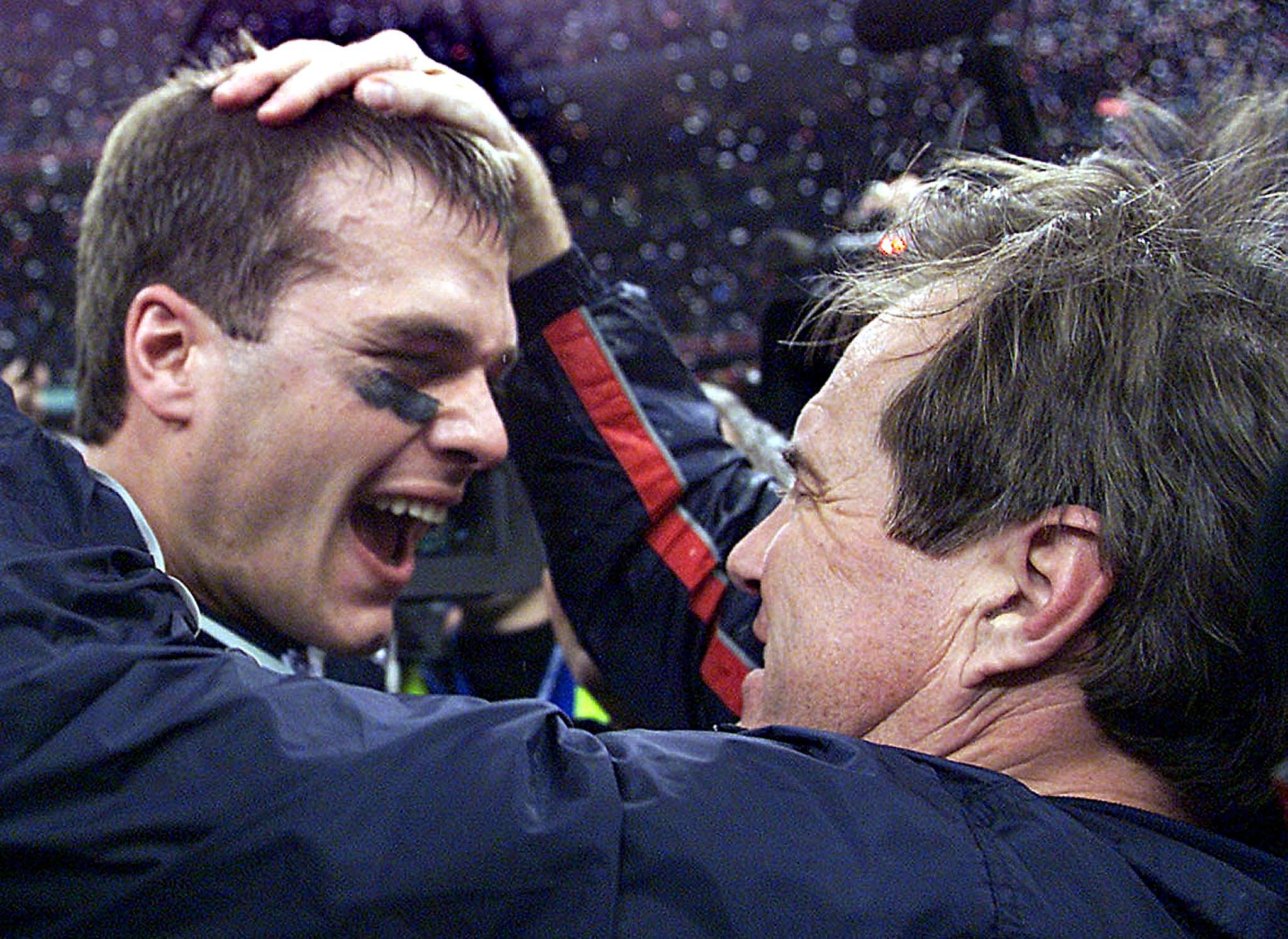
Result: Won 20-17
Stat line: 16/27, 145 yards, 1 TD, 0 INTs
EPA per dropback: –0.11 (36th)
Success rate: 44.8 percent (30th)
Yards per dropback: 4.9 (44th)
Opponent defensive ranking: 3rd
Brady was on his way to a disappointing Super Bowl debut when he took the field for the final time in this game. He had thrown for just 92 yards on 19 attempts and was averaging just over 4 yards per dropback with a 33.3 percent success rate. That would have been the fourth-worst mark for a Super Bowl quarterback since 2000, per TruMedia. Bill Belichick and offensive coordinator Charlie Weis didn’t want to expose their young quarterback to a Rams pass rush that had finished with 45 sacks during the regular season. So Brady was handcuffed by the play calling for the most part. But over the last 1:21, Belichick had no choice but to let him loose. The game-winning drive was a vintage Brady display, and earned him a spot in the top 25 despite his unimpressive stat line. He looked 10 feet tall standing in the pocket, calmly surveying the defense and finding open receivers. He led the Pats into field goal range one chunk at a time. It just looked so easy for him.
The first play of the drive isn’t discussed enough. If Brady doesn’t escape pressure and dump the ball off for a positive gain, Belichick almost certainly decides to just take things to overtime. It was Brady’s best play of the game, and it’s probably one of the most important plays of the 21st century considering what followed that Patriots win. New England could have won it in overtime, but the Rams offense was rolling and they would have needed just a field goal to win back when overtime was still sudden-death rules. The start of a decades-long dynasty could have been delayed—or completely altered—by a coin flip if not for Brady’s slick pocket movement.
22
Super Bowl XLIII, Cardinals vs. Steelers (2008)
Kurt Warner
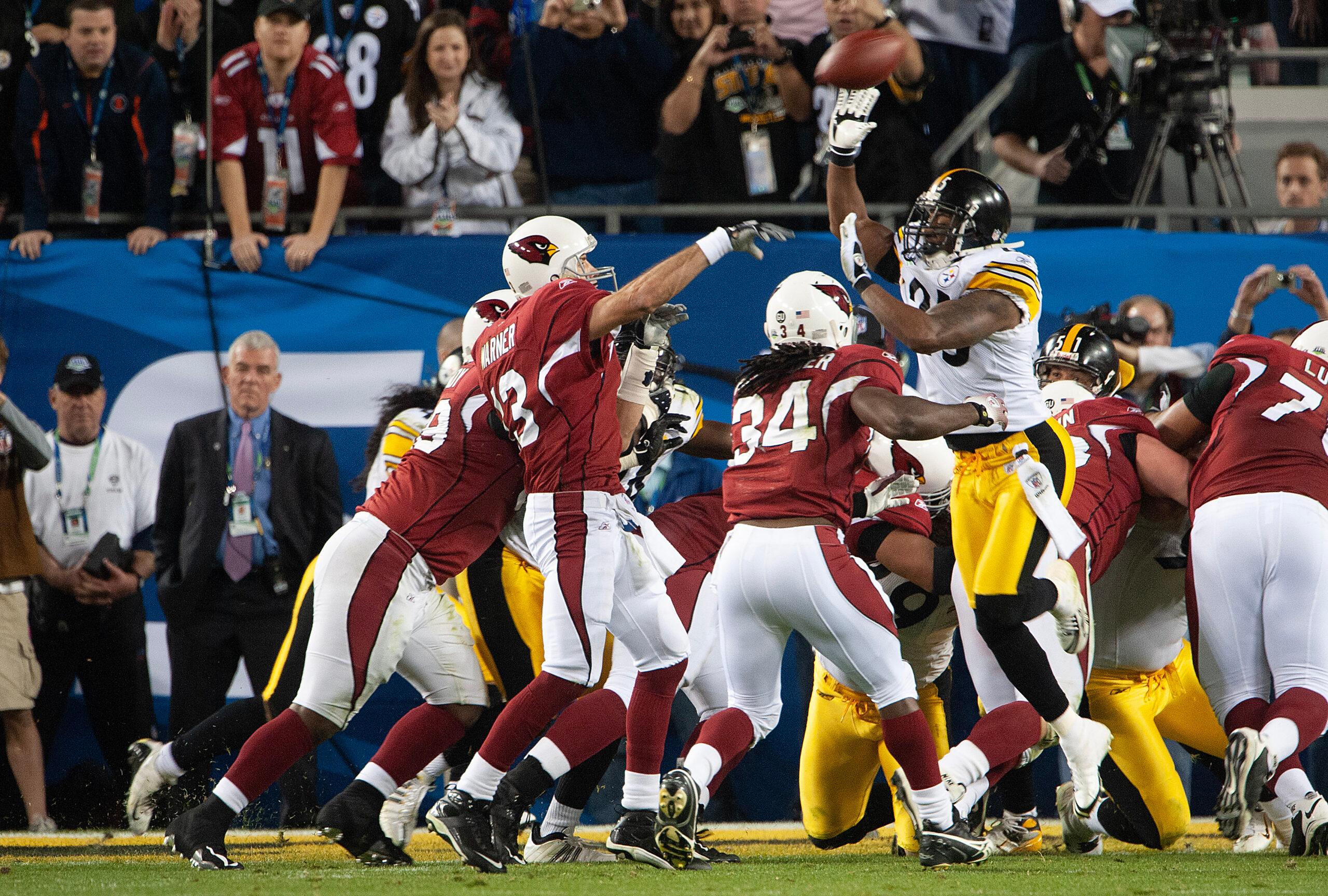
Result: Lost 23-27
Stat line: 31/43, 377 yards, 3 TDs, 1 INT
EPA per dropback: 0.23 (15th)
Success rate: 57.8 percent (6th)
Yards per dropback: 8.3 (8th)
Opponent defensive ranking: 2nd
A double-gloved Warner cooked what may have been the best Steelers defense of the century in this game and would have cracked the top 10 if he wasn’t to blame for the single most costly play in modern Super Bowl history.
James Harrison’s goal-line interception of Warner, which he returned 100 yards for a touchdown as the first half expired, cost Arizona 12.5 expected points, per TruMedia. That’s the biggest loss of EPA in one play in a Super Bowl since 2000, and it’s the fifth-biggest loss on any play over that same span. Warner nearly overcame the mistake and gave the Cardinals a late lead with a 64-yard Larry Fitzgerald touchdown. But the Steelers stole it late, so Warner didn’t get his second ring, and his colossal mistake before the half has overshadowed all of the good work he did in Super Bowl XLIII.
21
Super Bowl LI, Falcons vs. Patriots (2016)
Matt Ryan
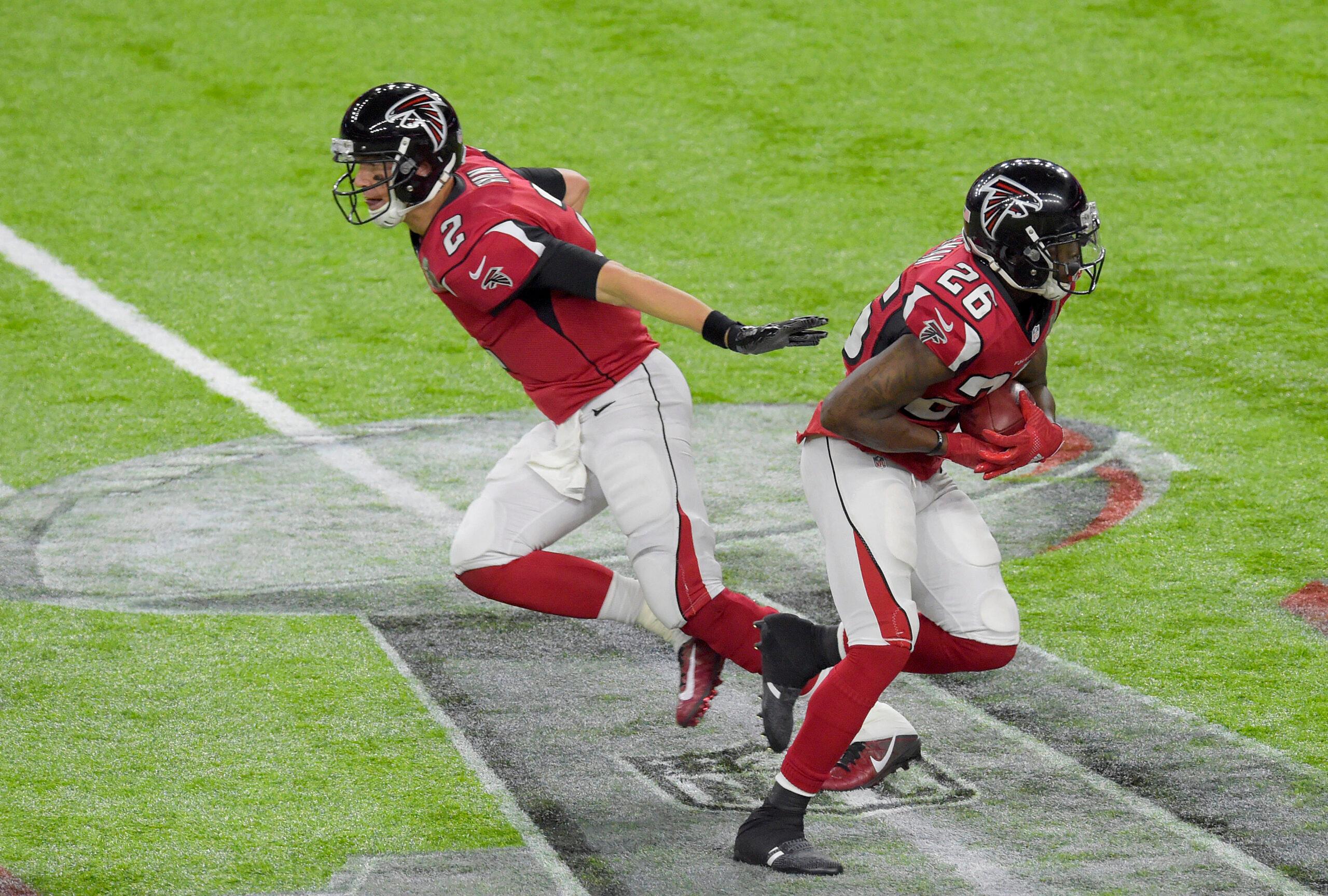
Result: Lost 28-34
Stat line: 17/23, 284 yards, 2 TDs, 0 INTs
EPA per dropback: 0.07 (31st)
Success rate: 55.6 percent (9th)
Yards per dropback: 8.9 (5th)
Opponent defensive ranking: 6th
This was another stellar performance spoiled by one mistake. While Ryan’s sack fumble in the fourth quarter wasn’t nearly as catastrophic as Kurt Warner’s pick-six in Super Bowl XLIII, it was the worst play of the day for Atlanta based on EPA, losing five expected points.
A conversion would have allowed the Falcons to burn more time off the clock and pushed them into range for a field goal that would have extended their lead to 19 with half a quarter remaining. Putting the fumble on Ryan is harsh. Devonta Freeman’s whiff in pass protection gave Dont’a Hightower a clean path to the quarterback. And Atlanta had trouble protecting Ryan all night. The 55.6 percent pressure rate he faced is the highest any QB has faced over the past 25 years of Super Bowls, per TruMedia. That sort of environment would have broken most quarterbacks much earlier in the game. Ryan had been thriving up until the mistake that gave Tom Brady the opportunity to pull off the greatest comeback in Super Bowl history.
20
Super Bowl XXXVIII, Panthers vs. Patriots (2003)
Jake Delhomme
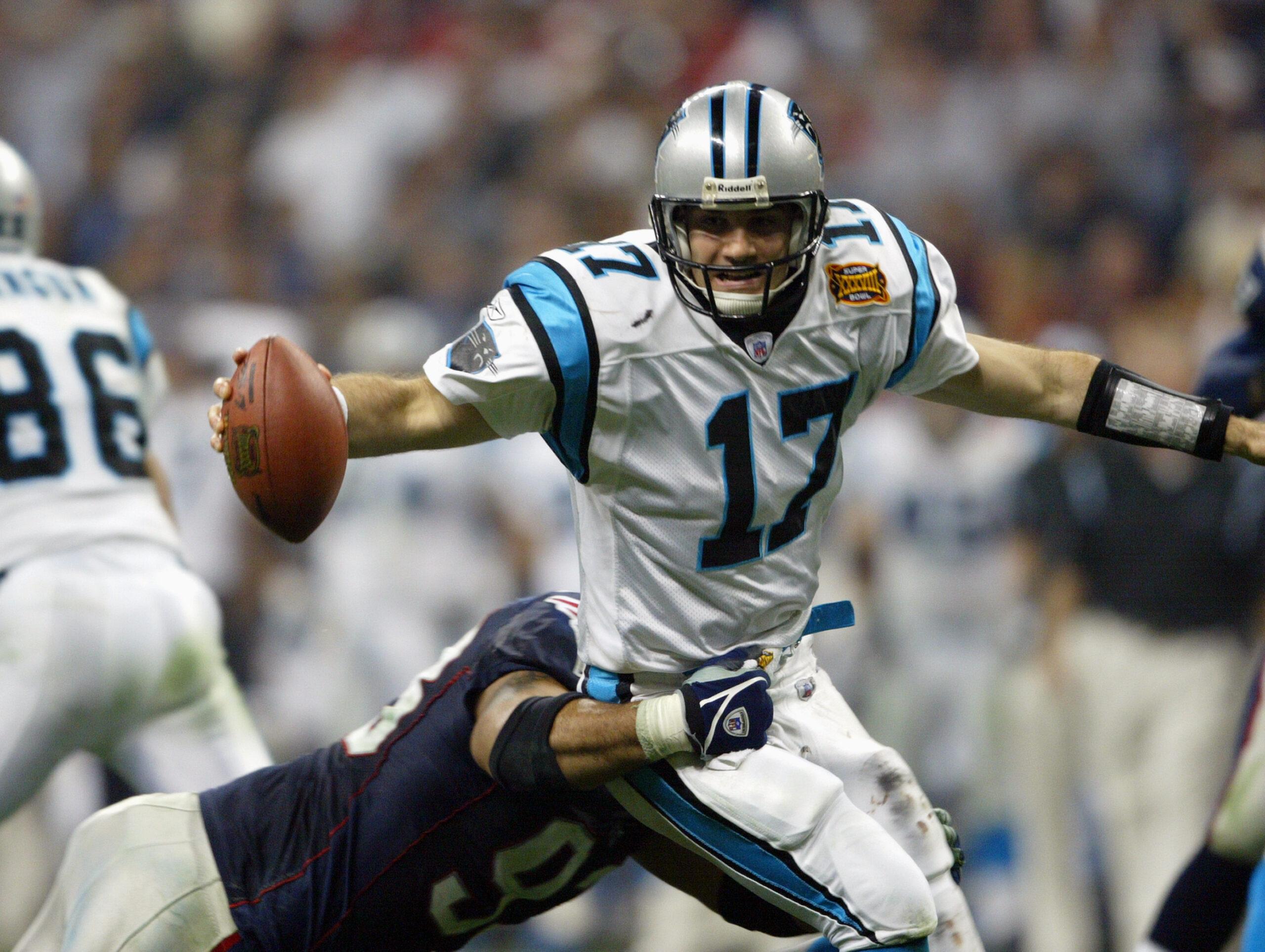
Result: Lost 29-32
Stat line: 16/33, 323 yards, 3 TDs, 0 INTs
EPA per dropback: 0.22 (17th)
Success rate: 37.8 percent (41st)
Yards per dropback: 8.0 (9th)
Opponent defensive ranking: 2nd
Delhomme’s first and only Super Bowl experience got off to a horrid start. He completed just one pass for a single yard through the first 25 minutes. He was also sacked three times in that span, meaning he was averaging –2.2 yards per dropback. His success rate was sitting at 0.0 percent. Delhomme was headed for one of the all-time worst performances in Super Bowl history when he took the field a few minutes before halftime. But he was like a great volume shooter in basketball—he was generally inefficient but could play with anyone when he caught fire. And not a single Panthers fan was surprised by what happened over the final 35 minutes of the game. A deep touchdown pass to Steve Smith Sr. down the left sideline lit the flame for Delhomme, who matched a young Tom Brady throw for throw down the stretch. With just under 10 minutes remaining, he connected with Muhsin Muhammad on an 85-yard touchdown, the longest reception in Super Bowl history at the time.
That score gave the underdog Panthers a lead that Brady quickly erased. Delhomme answered again, leading a long touchdown drive that was capped off by a blitz-beating throw to Ricky Proehl on third-and-8 with just over a minute remaining. But that proved to be too much time for Brady.
19
Super Bowl XXXIX, Patriots vs. Eagles (2004)
Tom Brady
Result: Won 24-21
Stat line: 23/33, 236 yards, 2 TDs, 0 INTs
EPA per dropback: 0.21 (20th)
Success rate: 51.4 percent (19th)
Yards per dropback: 6.3 (32nd)
Opponent defensive ranking: 15th
I hope you aren’t sick of reading about Brady’s Super Bowl exploits yet. We’re just now getting to the halfway point of covering his 10 title game appearances. His third Super Bowl win is the least memorable of his seven career wins. The Patriots were in control throughout, so there was no need for late-game heroics, and Brady didn’t even win MVP. That went to Deion Branch, who set a Super Bowl record for receptions. This game may have been short on memorable Brady moments, but it was a meaningful win for him. It established him as one of the very best quarterbacks in the NFL and started the GOAT conversation.
18
Super Bowl LIV, Chiefs vs. 49ers (2019)
Patrick Mahomes
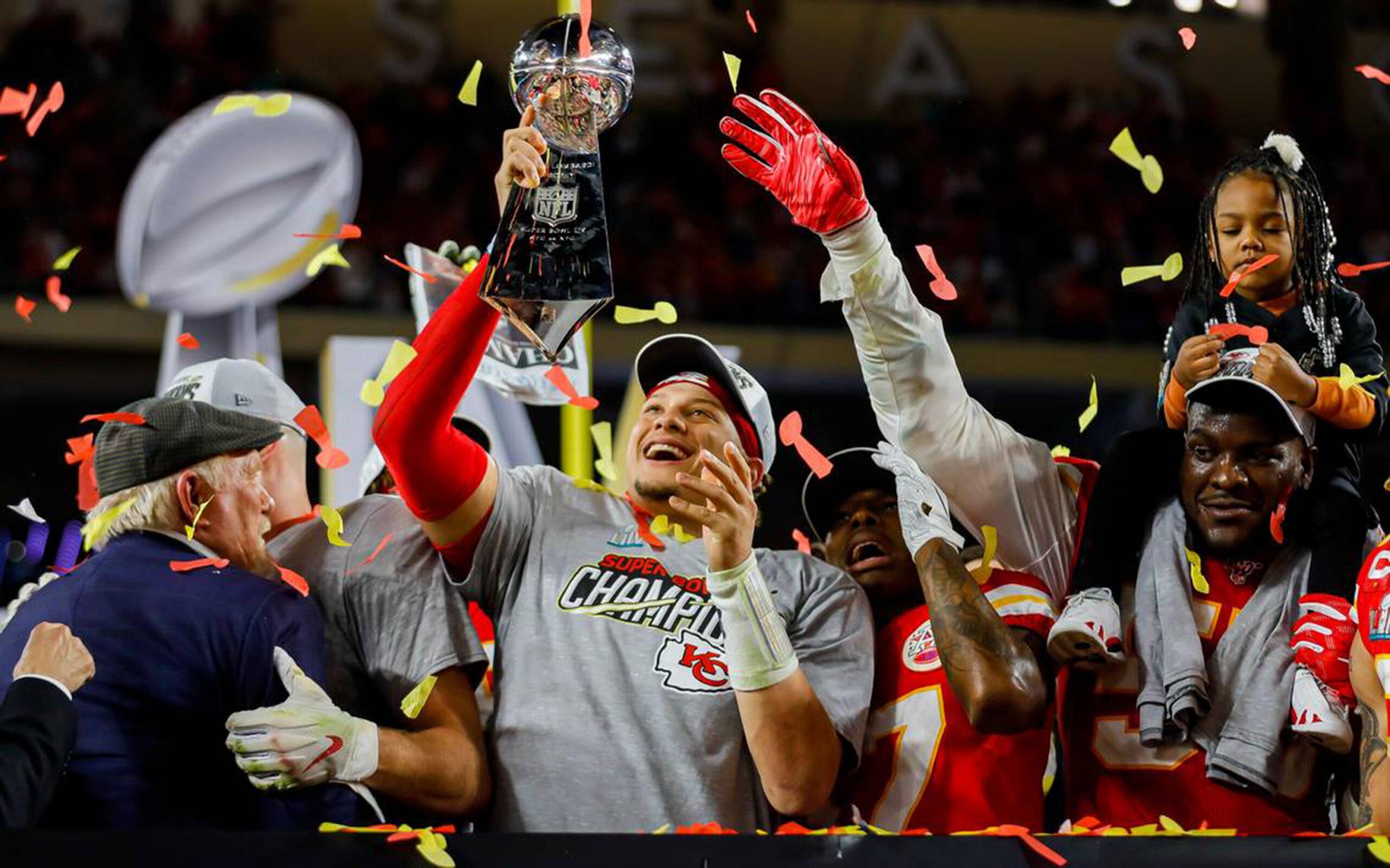
Result: Won 31-20
Stat line: 26/42, 286 yards, 2 TDs, 2 INTs
EPA per dropback: 0.12 (28th)
Success rate: 51 percent (21st)
Yards per dropback: 6.1 (34th)
Opponent defensive ranking: 2nd
Mahomes’s first Super Bowl was rigorous. The 49ers beat the hell out of him, pressuring him on over 40 percent of his dropbacks and sacking him four times. San Francisco also picked him off twice. The first interception was fully on Mahomes, who made a desperate throw on third-and-12. The second pick was thrown slightly behind Tyreek Hill, who couldn’t handle the pass and tipped it to a 49ers defender. With Kansas City trailing by 10 in the fourth quarter, Mahomes had no margin for error down the stretch. He didn’t really need one, though. He made throw after throw, including one of the most memorable plays in Super Bowl history: his 44-yard heave to Hill to convert on third-and-15.
The play call, “Wasp,” was Mahomes’s idea. NFL Films’ cameras captured the quarterback asking Andy Reid whether the Chiefs could hold up in protection long enough to run the play. The answer would have been no for most quarterbacks, but Mahomes bought a few extra seconds by fading away in the pocket and getting the throw off just as Nick Bosa made contact. Mahomes wasn’t at his best against the Niners, but he had just enough magic to earn his first ring.
17
Super Bowl XLVIII, Seahawks vs. Broncos (2013)
Russell Wilson
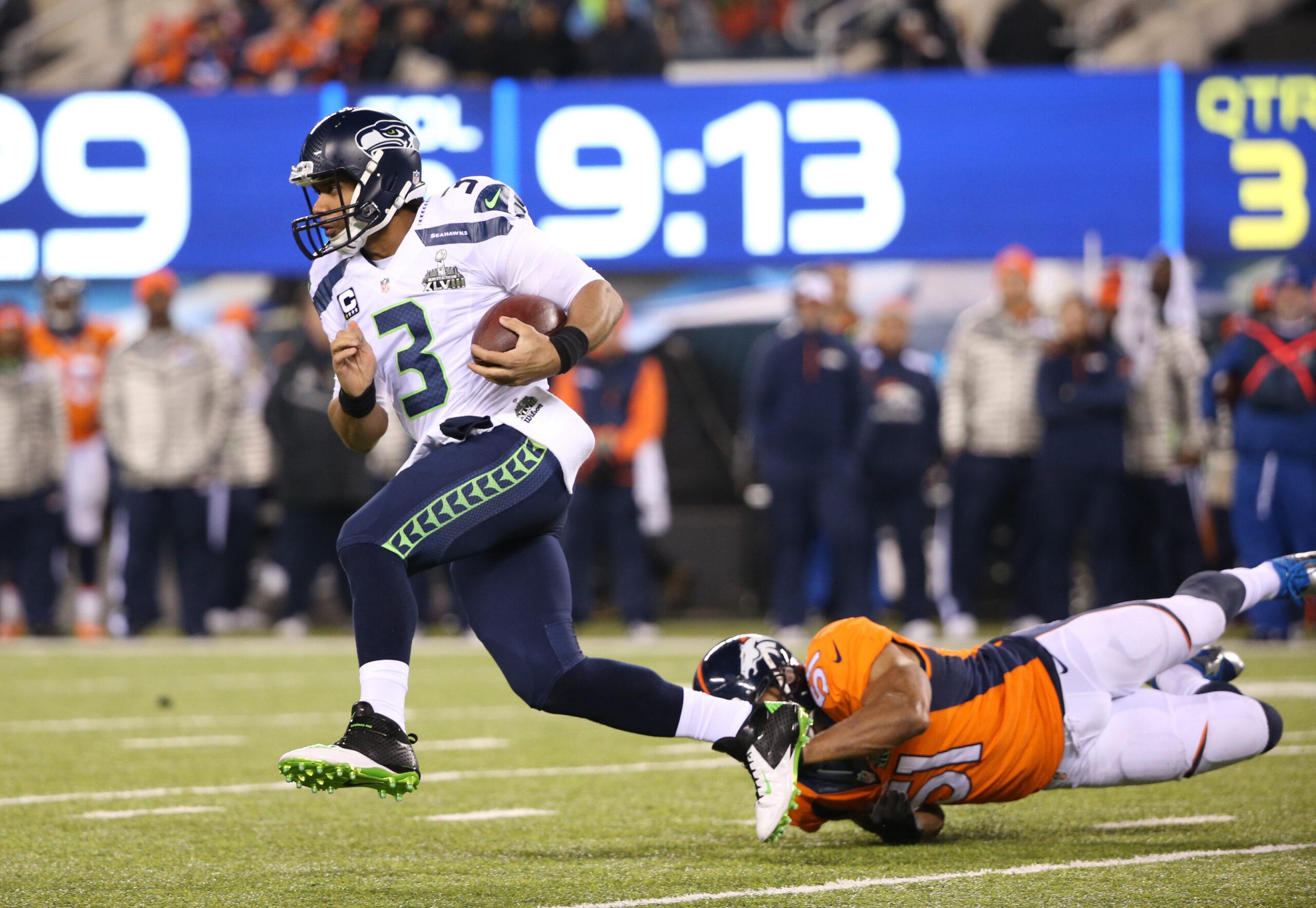
Result: Won 43-8
Stat line: 18/25, 206 yards, 2 TDs, 0 INTs
EPA per dropback: 0.45 (5th)
Success rate: 51.9 percent (17th)
Yards per dropback: 8.4 (7th)
Opponent defensive ranking: 23rd
With Seattle’s Legion of Boom defense wrecking Peyton Manning and the Broncos offense, Wilson could have stayed on the sideline all night and still come away with a win. The defense outscored Denver on its own, with a safety and a pick-six. But Wilson still turned in one of the more efficient performances we’ve seen in a Super Bowl. Only eight quarterbacks generated more EPA on dropbacks in a Super Bowl this century, and Wilson did it with the fourth-fewest dropbacks. Wilson’s first title game performance was awfully similar to his second—with a number of explosive passes and timely scrambles—only this one didn’t include the most devastating interception in the history of the sport.
16
Super Bowl XLVII, Ravens vs. 49ers (2012)
Joe Flacco
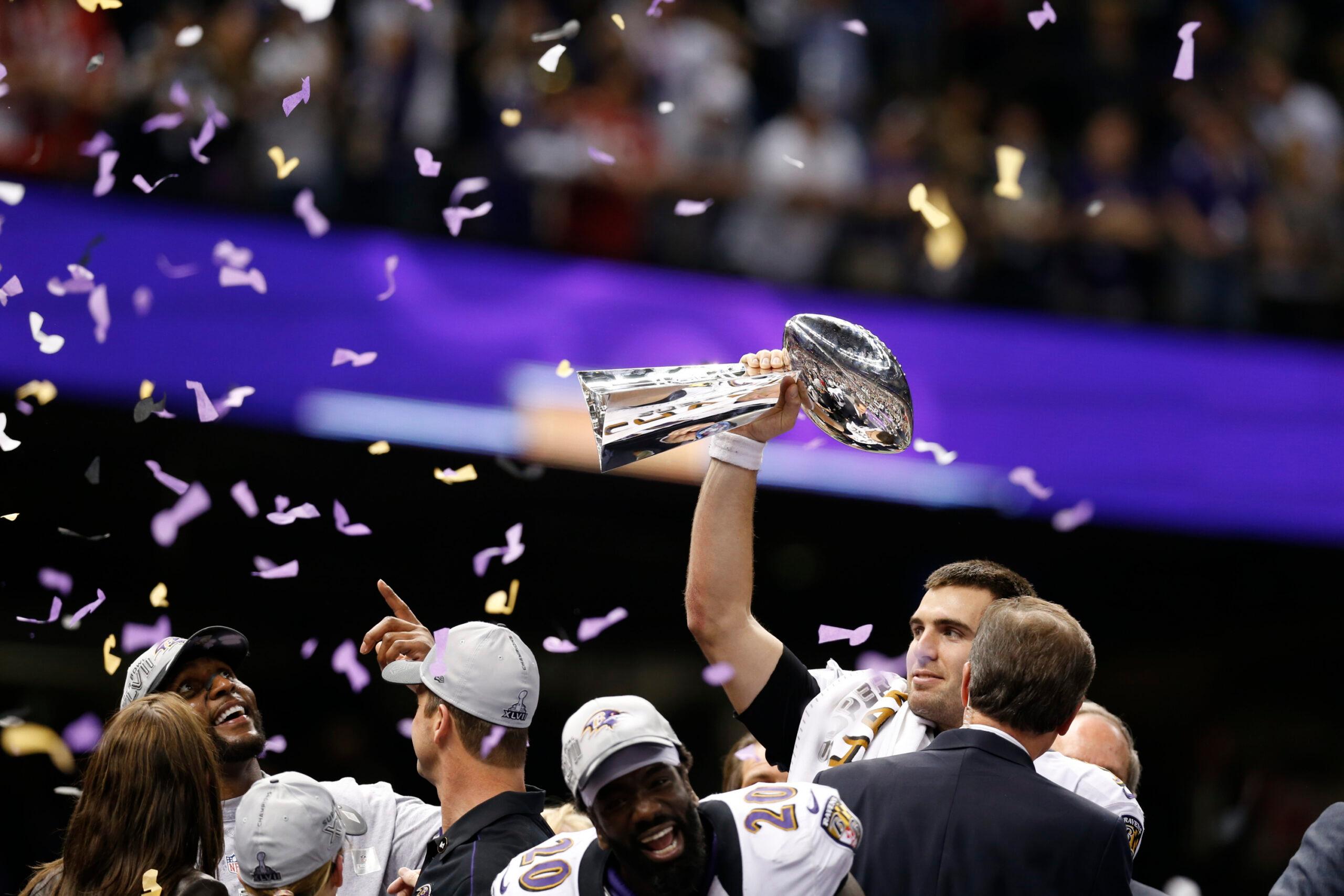
Result: Won 34-31
Stat line: 22/33, 287 yards, 3 TDs, 0 INTs
EPA per dropback: 0.30 (11th)
Success rate: 51.4 percent (19th)
Yards per dropback: 7.8 (10th)
Opponent defensive ranking: 5th
This was a $120 million performance for Flacco, who became the highest-paid player in NFL history after leading the Ravens to their second Lombardi Trophy in franchise history. It was also the culmination of the single greatest playoff run we’ve ever seen from a quarterback. Flacco’s three touchdown passes against an elite 49ers defense helped him finish the 2012 postseason with a perfect 11-to-0 touchdown-to-interception ratio, and he outplayed both Peyton Manning and Tom Brady (on the road!) en route to the Super Bowl, where he took home MVP honors. That run launched the “Is Flacco elite?” meme, which was mostly an unserious question. But for one month, the answer was yes. Flacco’s performance would have ranked higher if it had more memorable moments, but the post-halftime blackout at the Superdome and Jacoby Jones’s kickoff return that broke the game open have largely overshadowed Flacco’s big game.
15
Super Bowl XXXVIII, Patriots vs. Panthers (2003)
Tom Brady
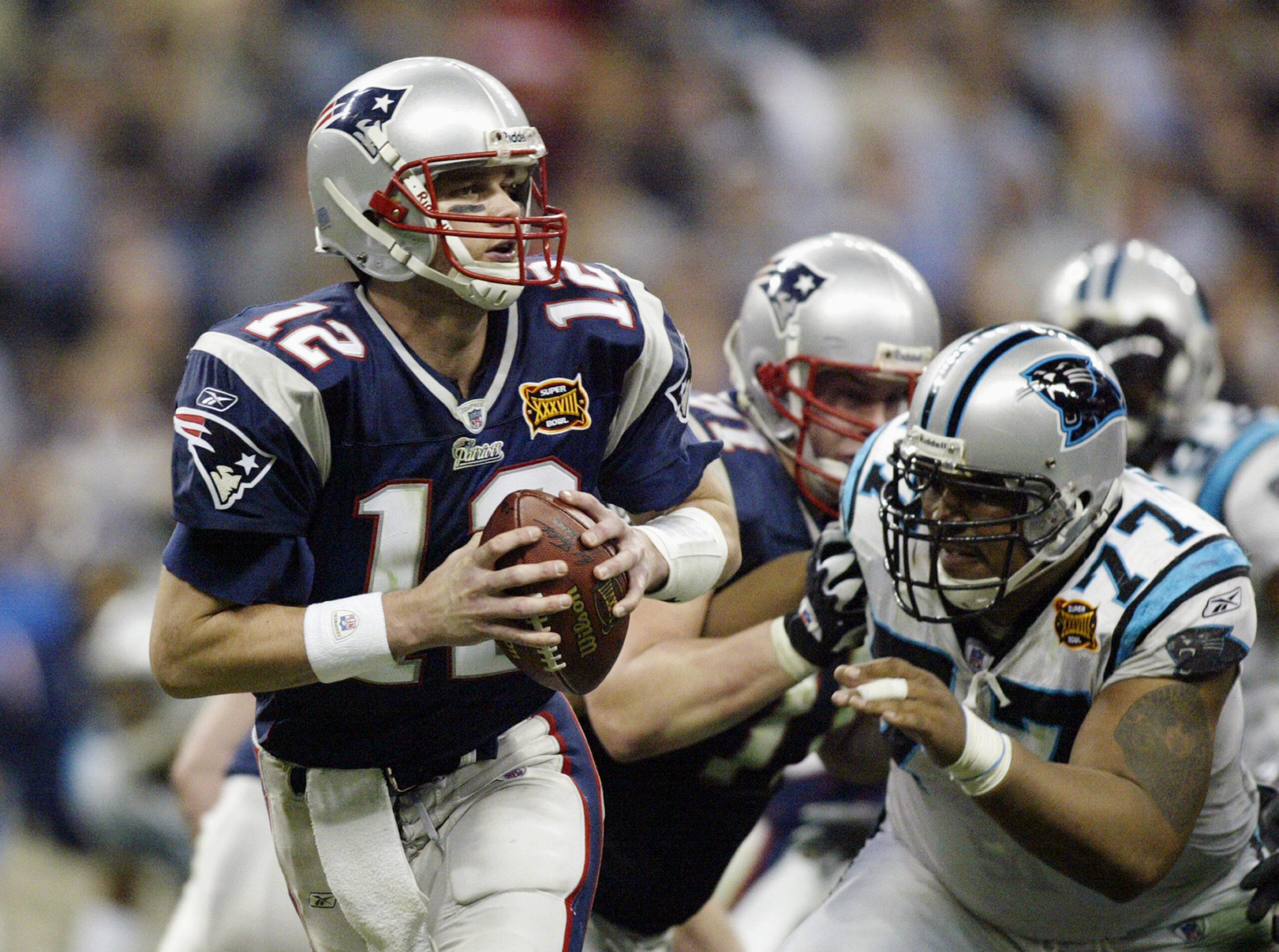
Result: Won 32-29
Stat line: 32/48, 354 yards, 3 TDs, 1 INT
EPA per dropback: 0.38 (7th)
Success rate: 54.2 percent (12th)
Yards per dropback: 7.4 (14th)
Opponent defensive ranking: 9th
This was Brady’s first truly great Super Bowl performance. The Panthers defense set out to stop New England’s passing game with tight man-to-man coverage and two safeties deep. The Patriots had early success moving the ball with play-action fakes and other designs to slow down Carolina’s dominant defensive line, but the misdirection plays weren’t so effective in the red zone. Issues in the kicking game—Adam Vinatieri missed a chip shot and had another kick blocked—kept the scoring low early. New England eventually opened up the passing game, giving Brady more pure dropback plays. And he eventually grew comfortable with a Panthers defense that he called the most complex he had seen to that point in his career, according to commentator Phil Simms. That gave us the first glimpse of the quarterback Brady would become. After an ugly red zone interception got Carolina back into the game in the fourth quarter, Brady was nearly perfect down the stretch, leading two touchdown drives, including the second game-winning drive of his Super Bowl career.
Panthers kicker John Kasay shanking the kickoff out of bounds lowered the degree of difficulty on that final drive considerably, but Brady still had to make a few big throws to get Vinatieri in range for the game-winning kick.
14
Super Bowl LVIII, Chiefs vs. 49ers (2023)
Patrick Mahomes
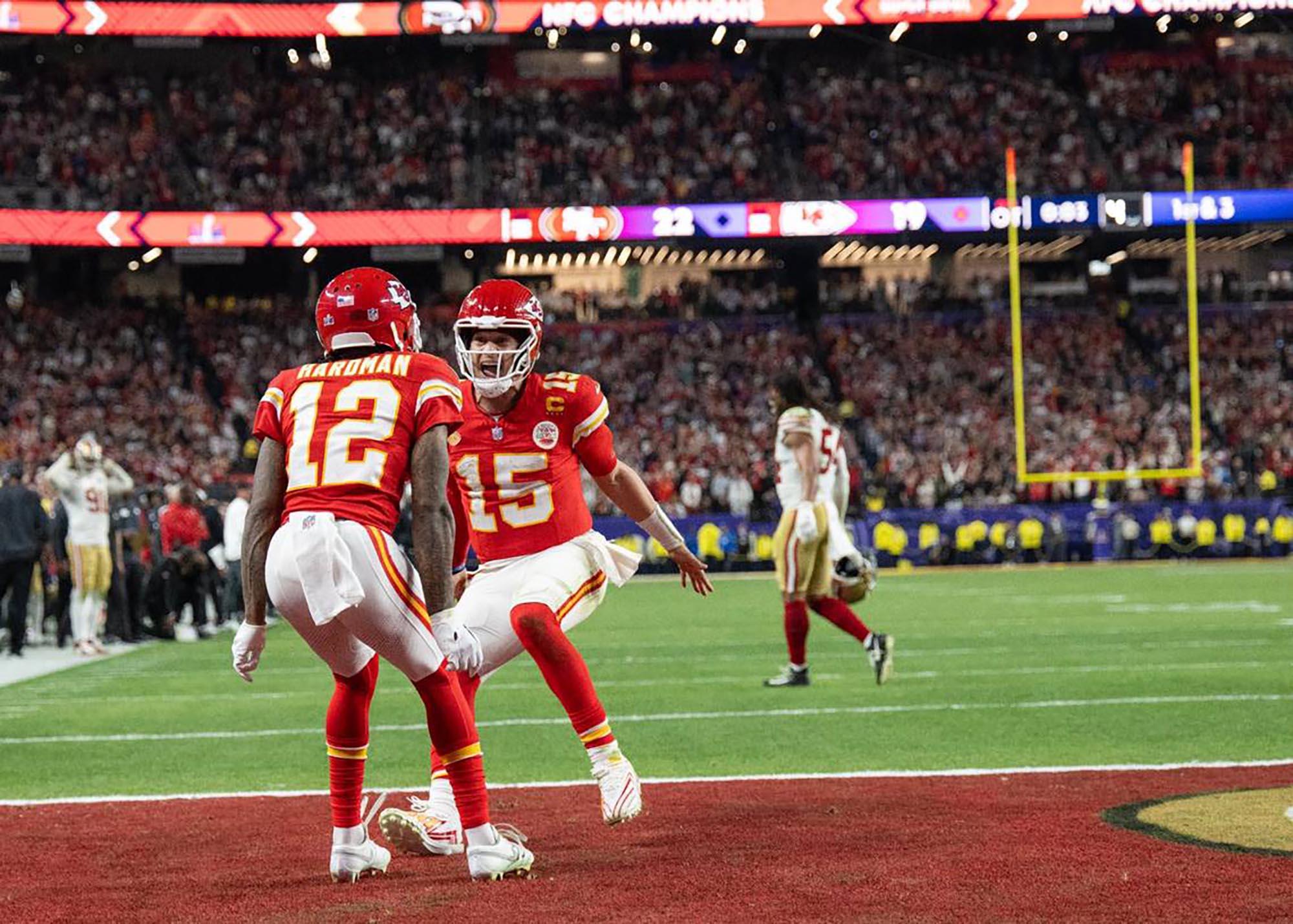
Result: Won 25-22
Stat line: 34/46, 333 yards, 2 TDs, 1 INT
EPA per dropback: 0.09 (29th)
Success rate: 49.1 percent (24th)
Yards per dropback: 6.6 (22nd)
Opponent defensive ranking: 12th
The Chiefs are seemingly incapable of providing Mahomes with good pass protection in a Super Bowl. We have pressure rates for the past 15 Super Bowls—that’s 30 individual QB performances—and his five appearances all rank in the top 13. He was under pressure on a healthy 43.6 percent of his dropbacks in his second Super Bowl matchup with the 49ers, so his mobility was the driving factor in the overtime win. Mahomes scrambled six times in the game and picked up three first downs with his legs. The Chiefs had no run game to speak of outside of those improvised carries by Mahomes. The offensive line lost a lopsided battle in the trenches. And Mahomes was working with a thin pass-catching corps that featured Travis Kelce and a bunch of undersized speedsters with questionable hands. It was a one-man show and a brilliant display of playmaking. Kansas City needed every bit of Mahomes’s magic to outlast a 49ers team that was far superior on paper.
13
Super Bowl XLIII, Steelers vs. Cardinals (2008)
Ben Roethlisberger
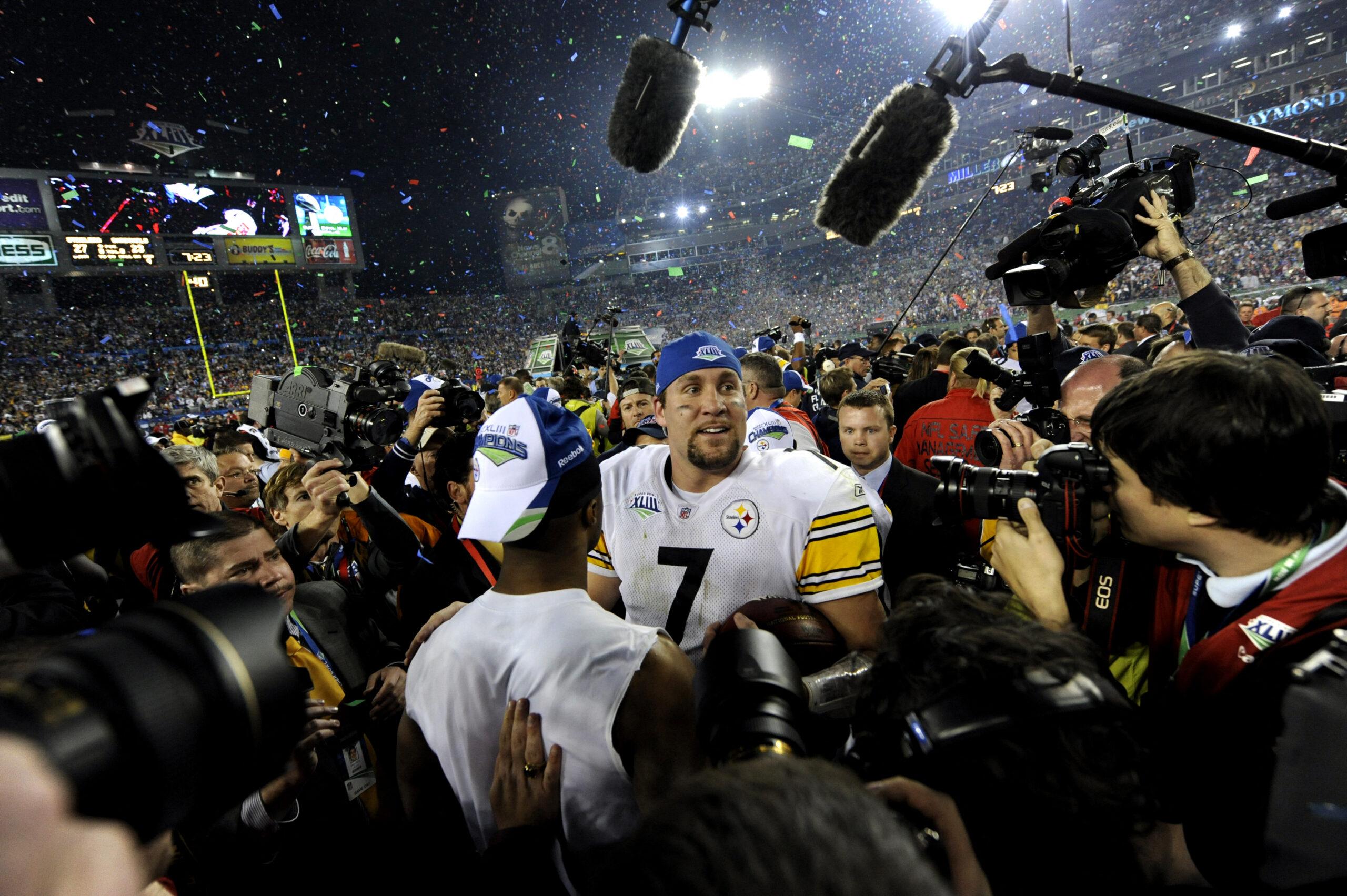
Result: Won 27-23
Stat line: 21/30, 256 yards, 1 TD, 1 INT
EPA per dropback: 0.30 (13th)
Success rate: 52.9 percent (16th)
Yards per dropback: 7.0 (18th)
Opponent defensive ranking: 23rd
I’d argue Roethlisberger’s game-winning drive to beat the Cardinals was the best we’ve ever seen in a Super Bowl. After a holding penalty set the Steelers back 10 yards on the first play, he led them 88 yards down the field in just eight plays and capped it off with an incredible throw to Santonio Holmes in the back corner of the end zone.
Bruce Arians, who was calling plays for Pittsburgh’s offense at the time, gave all the credit for the drive to Roethlisberger. “At this time, Hines Ward could barely run, [and] Nate Washington had a separated shoulder, so there were two guys he couldn’t throw to,” Arians said last October. “He had Santonio, the running back, and Heath Miller, and Ben was lights out. … I got to put it all on Ben because calling the plays is easy. What he did, especially that last throw—I know Santonio gets all the credit for the catch, but the pump, the pump, the pump, and then that throw, only about five guys in the world can make that throw.”
12
Super Bowl XLIX, Patriots vs. Seahawks (2014)
Tom Brady
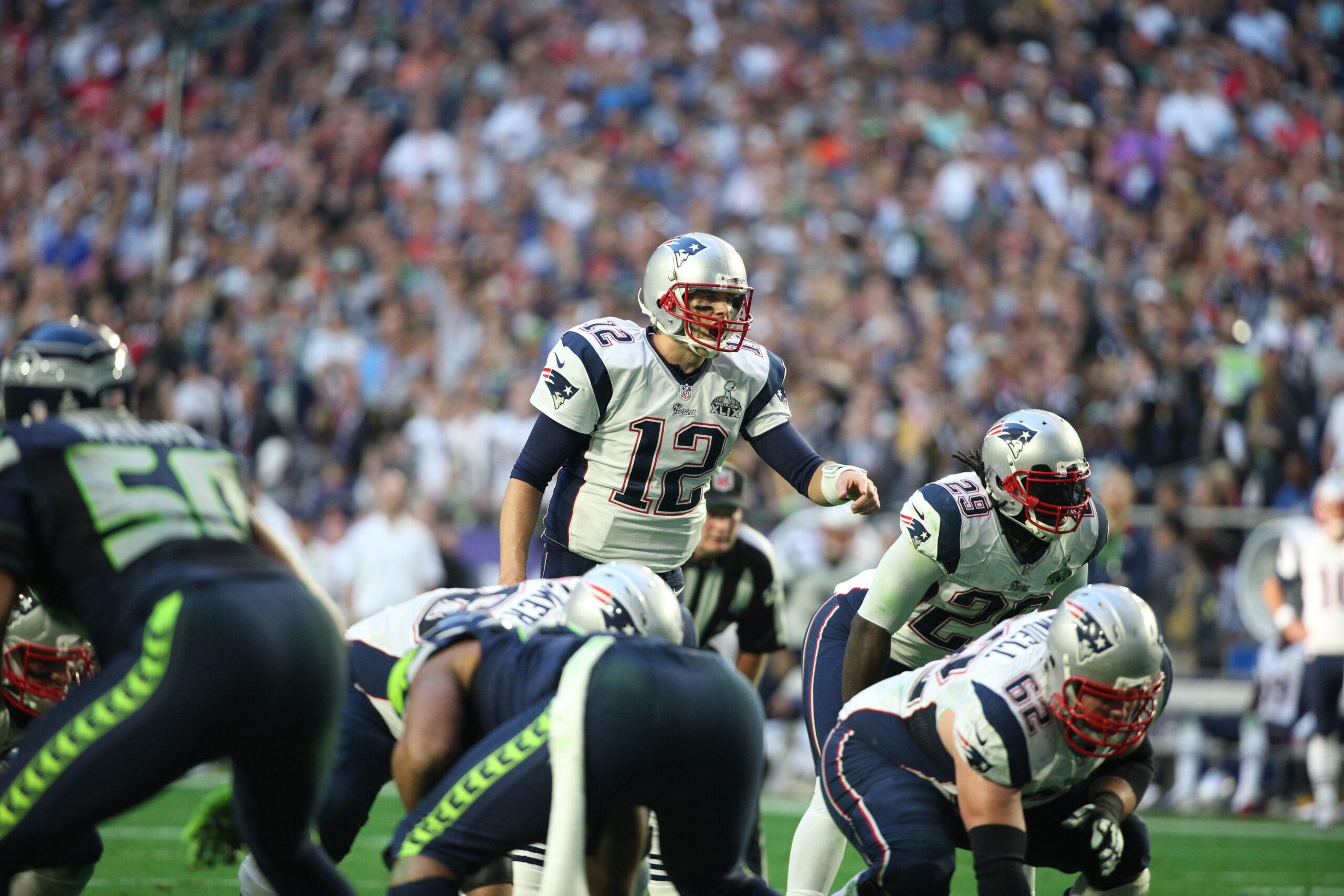
Result: Won 28-24
Stat line: 37/50, 328 yards, 4 TDs, 2 INTs
EPA per dropback: 0.36 (8th)
Success rate: 58.8 percent (3rd)
Yards per dropback: 6.3 (31st)
Opponent defensive ranking: 3rd
This was Brady’s only multi-interception game of his 10 Super Bowl appearances, and the mistakes were costly. The first pick was thrown in the end zone and took at least three points off the board for New England. Brady’s second gave the Seahawks a short field and set up the touchdown that pushed the lead to double digits. But that just set the stage for more Brady heroics.
Seattle’s defense had the GOAT flustered throughout the first three quarters. The pass rush was getting home consistently, and the Legion of Boom secondary had no trouble sticking tight to New England’s underwhelming receiving corps. But once Brady found the matchups he liked—Rob Gronkowski against linebacker K.J. Wright and Julian Edelman against backup nickel corner Tharold Simon—Seattle couldn’t do much to stop him. Brady led his third Super Bowl–winning drive, and Malcolm Butler’s interception ended the team’s 10-year title drought.
11
Super Bowl LV, Buccaneers vs. Chiefs (2020)
Tom Brady
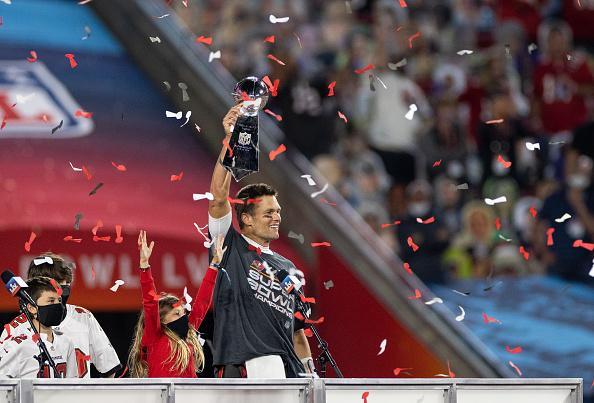
Result: Won 31-9
Stat line: 21/29, 201 yards, 3 TDs, 0 INTs
EPA per dropback: 0.14 (25th)
Success rate: 53.3 percent (15th)
Yards per dropback: 6.5 (24th)
Opponent defensive ranking: 19th
Oh look, another Brady game—and we still have two more to cover. I’m sure Brady cherishes all of the Super Bowls he won in New England, but this victory had to be the most satisfying of his career. At 43, Brady became the oldest player to ever win a Super Bowl and proved he could do it without the backing of the greatest coach of all time. He also exacted some revenge on Chiefs defensive coordinator Steve Spagnuolo, the mind behind the Giants’ upset of the undefeated Pats team. On top of all that, Brady got a Super Bowl win over Patrick Mahomes, giving him a trump card over the top challenger to his title as the greatest quarterback ever. Brady didn’t have to lead a thrilling comeback or orchestrate a clutch drive to win this one, but it’s still a major contribution to his lore.
10
Super Bowl LVI, Rams vs. Bengals (2021)
Matthew Stafford
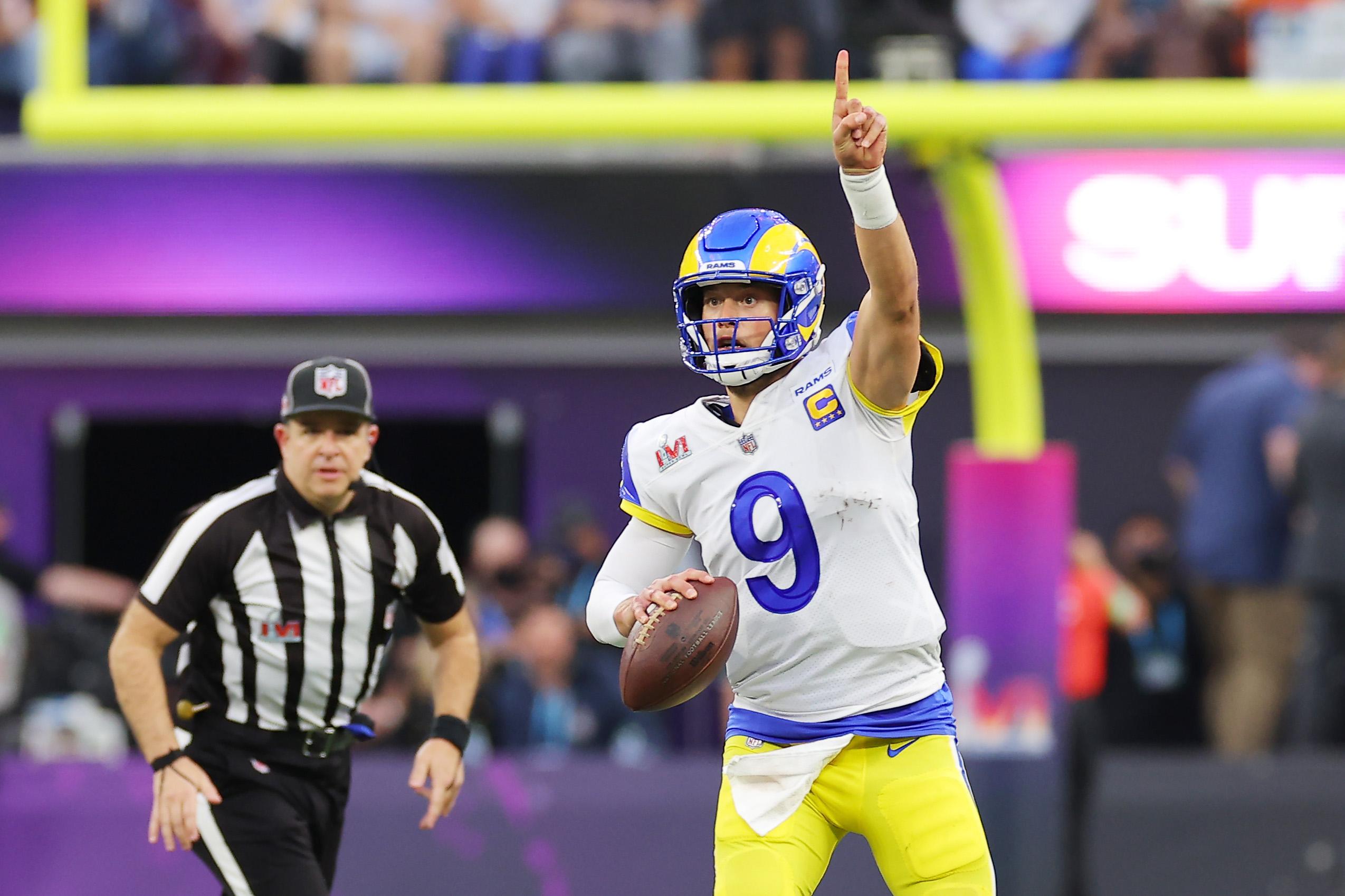
Result: Won 23-20
Stat line: 26/40, 283 yards, 3 TDs, 2 INTs
EPA per dropback: 0.13 (26th)
Success rate: 48.8 percent (26th)
Yards per dropback: 6.4 (27th)
Opponent defensive ranking: 10th
Stafford put up pedestrian numbers against the Bengals, but he cracked the top 10 based on his game-winning drive, which featured the coolest throw in the history of the Super Bowl—his no-look dime to Cooper Kupp.
Most quarterbacks would have panicked in that situation when they saw their intended receiver covered that deep into the play. But with the pass rush closing in and no time to move on in his progression, Stafford created his opening with the greatest no-look pass ever. I’m choosing to ignore the statistical evidence and am invoking the “rule of cool” to justify his ranking.
The numbers are somewhat misleading, anyway. While the two interceptions look like blemishes in the box score, one was effectively a third-and-14 arm punt from midfield that resulted in a touchback, and the other was an accurate pass that bounced off his receiver’s hands.
9
Super Bowl XLIV, Saints vs. Colts (2009)
Drew Brees
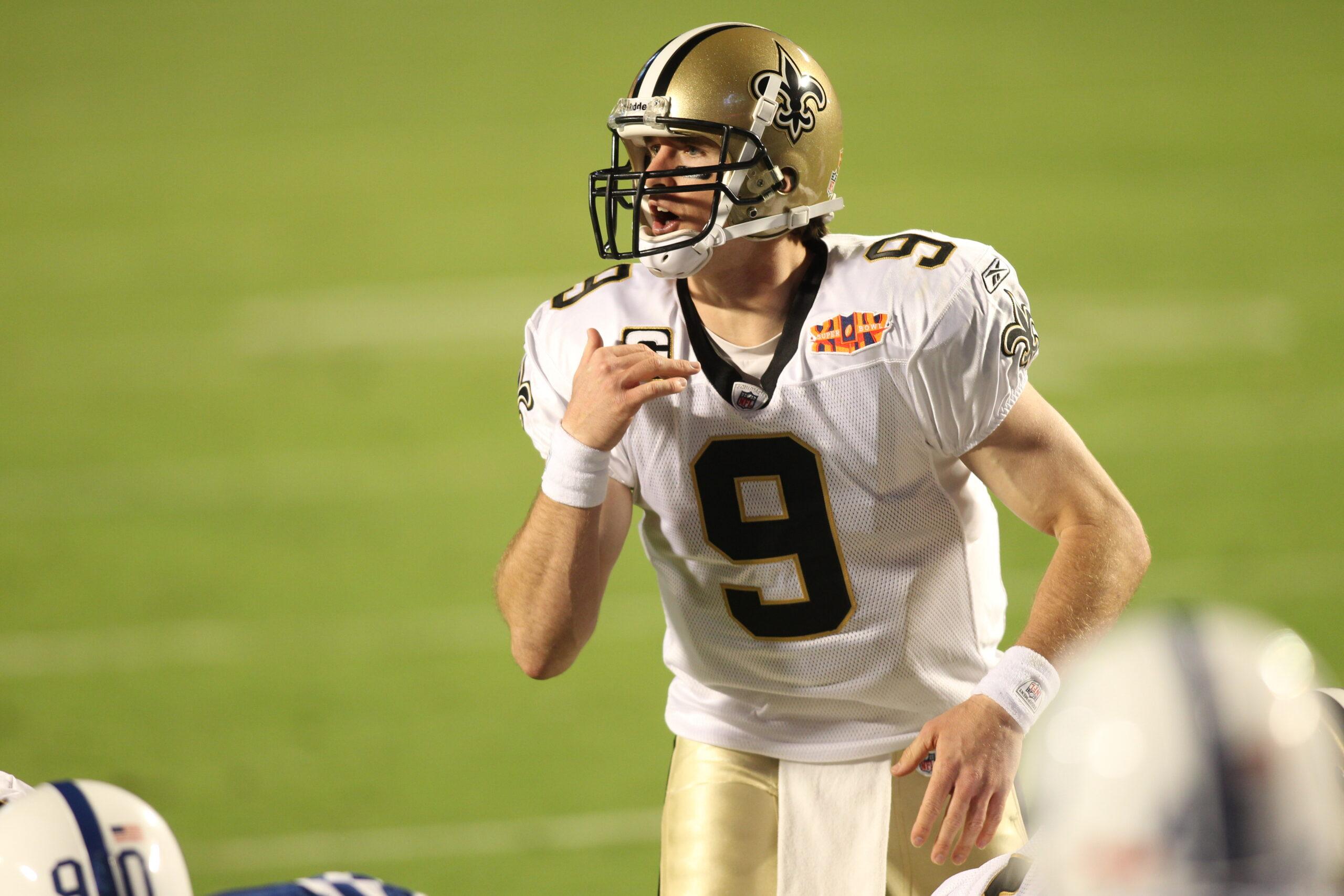
Result: Won 31-17
Stat line: 32/39, 288 yards, 2 TDs, 0 INTs
EPA per dropback: 0.40 (6th)
Success rate: 71.8 percent (1st)
Yards per dropback: 7.2 (15th)
Opponent defensive ranking: 13th
The Saints’ ambush of the Colts with a surprise onside kick coming out of the half and Tracy Porter’s game-sealing pick-six were the two most notable plays of this Super Bowl, but Brees quietly put together an incredible display of efficient quarterbacking. He completed 82.1 percent of his passes, the second-highest mark for a starting quarterback in any Super Bowl. His 71.8 percent success rate is the highest mark in a Super Bowl this century, and it’s five full percentage points clear of second place. This showing would rank a few spots higher if Brees had made even one memorable play, but posting video game–like efficiency numbers while outplaying Peyton Manning at the peak of his powers is worthy of a top 10 spot.
8
Super Bowl XLVI, Giants vs. Patriots (2011)
Eli Manning
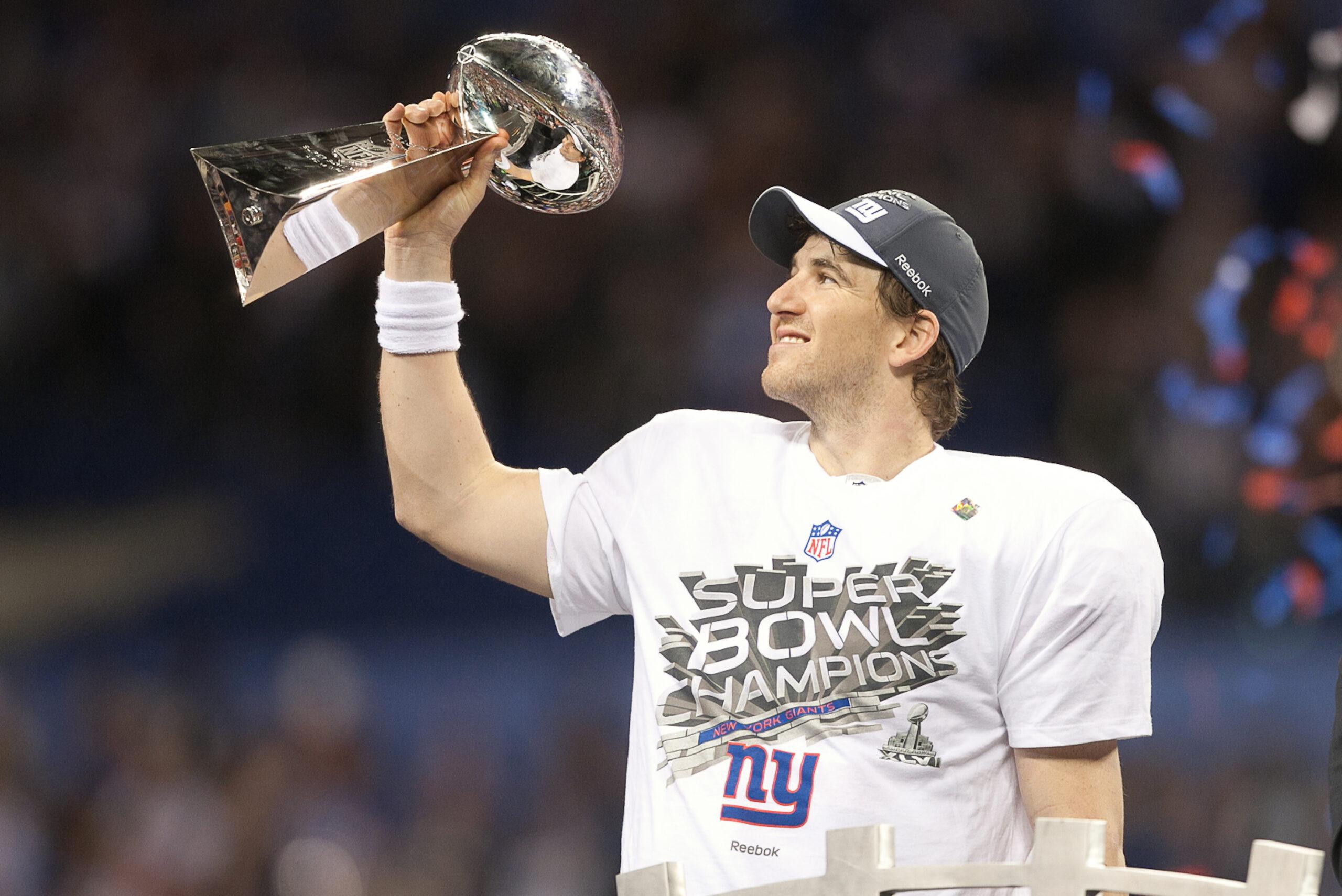
Result: Won 21-17
Stat line: 30/40, 296 yards, 1 TD, 0 INTs
EPA per dropback: 0.22 (16th)
Success rate: 58.1 percent (5th)
Yards per dropback: 6.6 (23rd)
Opponent defensive ranking: 28th
Manning made the best throw in Super Bowl history—and maybe the greatest throw of all time—when he hit Mario Manningham in an impossibly tight window down the left sideline and sparked the game-winning drive for the Giants.
The throw was obviously sick, but don’t discount the work Manning did leading up to it. Manningham was not his first option on the play. The QB first looks to his right and sees that the Patriots have the route combination to that side covered. So Manning slides to his left, and with Vince Wilfork bulldozing the Giants center into him, he finds Manningham and drops the pass into a thimble 38 yards downfield. The play Manning made on the Helmet Catch was more improbable, but this was better. It certainly required more skill.
Manning also played a hell of a game besides the memorable throw to Manningham. He was asked to drop back 43 times, and he responded with the fifth-best success rate in a Super Bowl this century. He also outplayed Tom Brady for the second time and established himself as the chief antagonist for the greatest team of that era.
7
Super Bowl LVII, Eagles vs. Chiefs (2022)
Jalen Hurts
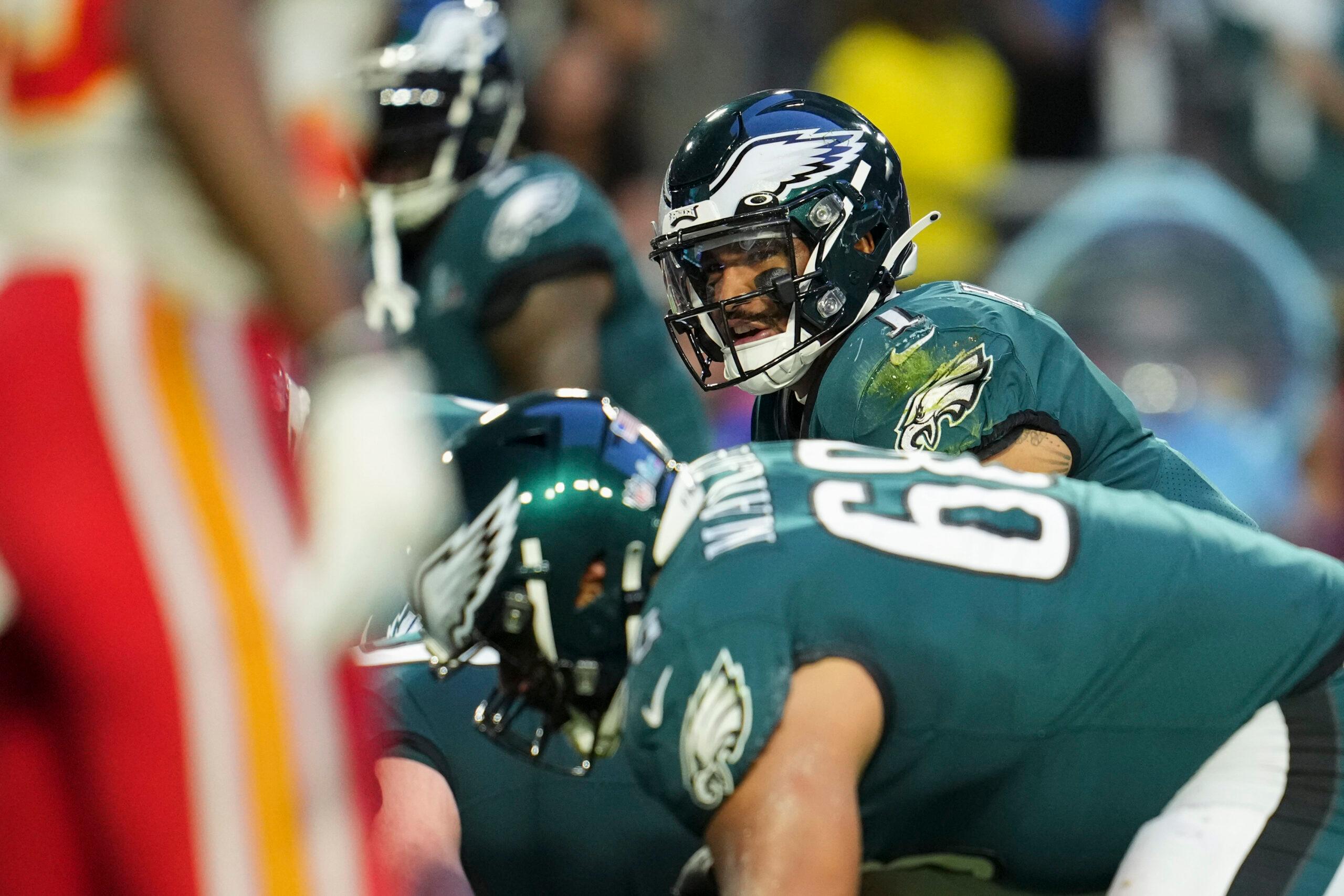
Result: Lost 35-38
Stat line: 27/38, 304 yards, 1 TD, 0 INTs
EPA per dropback: 0.30 (12th)
Success rate: 38.1 percent (40th)
Yards per dropback: 7.5 (12th)
Opponent defensive ranking: 18th
This is one of two losing efforts that made it into the top 10, and it would have ranked even higher if Hurts hadn’t coughed up the ball on Nick Bolton’s scoop and score. Outside of that mistake, the Eagles quarterback was brilliant in his Super Bowl debut. He dominated the first half with his arm, connecting on several passes downfield, including a completion of over 40 air yards. Then he relied on his legs in the second half and finished with 70 running yards, the Super Bowl record for a quarterback. His contribution in the run game played a major role in Philadelphia’s offensive success. With Kansas City selling out to stop the run by loading up the run box, the Eagles spread things out, cleared out the backfield, and ran Hurts behind a pulling Jason Kelce. The Chiefs didn’t really have an answer for Hurts, whether he was putting the ball in the air or pulling it down to run.
6
Super Bowl XLV, Packers vs. Steelers (2010)
Aaron Rodgers
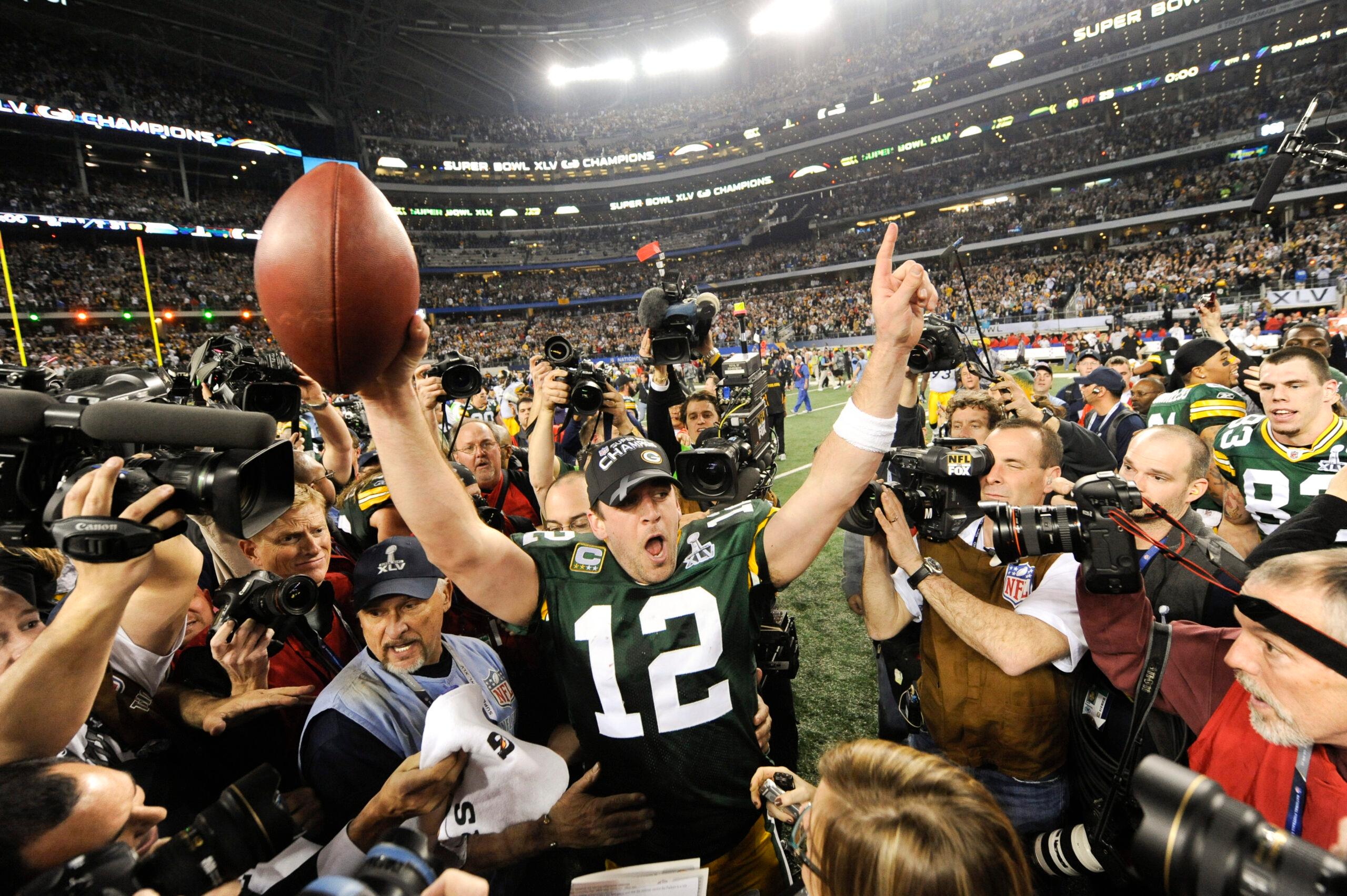
Result: Won 31-25
Stat line: 24/39, 304 yards, 3 TDs, 0 INTs
EPA per dropback: 0.21 (19th)
Success rate: 40.5 percent (35th)
Yards per dropback: 6.9 (19th)
Opponent defensive ranking: 1st
The advanced numbers aren’t overly impressive, but that’s why we watch the games. In his only Super Bowl appearance, Rodgers put on an awesome throwing display against the league’s best defense.
The tight-window touchdown to Greg Jennings, the cold-blooded throw to Jennings down the seam on third-and-10, the perfectly timed go ball to Jordy Nelson for the opening score—it’s difficult to pick out the best throw Rodgers made that night. And that game capped off a stunning playoff run that thrust the Packers’ passer into superstardom and had many wondering whether he was the most talented quarterback in league history.
5
Super Bowl LII, Patriots vs. Eagles (2017)
Tom Brady
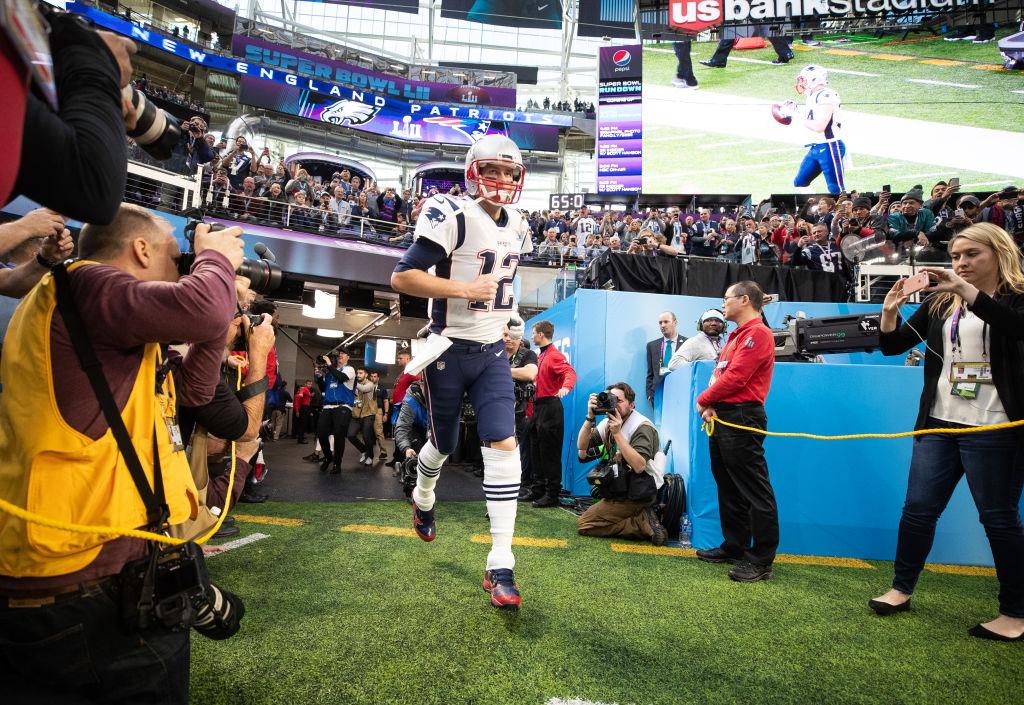
Result: Lost 33-41
Stat line: 28/48, 505 yards, 3 TDs, 0 INTs
EPA per dropback: 0.47 (2nd)
Success rate: 54.2 percent (12th)
Yards per dropback: 10.5 (1st)
Opponent defensive ranking: 4th
I’m not totally convinced this isn’t the best individual effort in Super Bowl history and maybe the most impressive game of Brady’s incomparable career. But #QBWinz are a factor here, and Brady’s game-ending fumble also knocks him down a few spots. Had Brady avoided that fumble and led the Patriots on a game-tying drive, his performance in Minneapolis would have gone down as the best ever. Alas.
Regardless: 505 freaking yards! That set a new Super Bowl record, and it wasn’t merely a product of Brady throwing the ball 48 times. He was also efficient that night, averaging 10.5 yards per dropback, the highest mark for any Super Bowl quarterback since 2000. Brady was known for dinking and dunking throughout his career, but he pushed the ball downfield against the Eagles. His 11.5-yard aDOT was the highest of his 10 title game appearances, and he completed five passes of over 20 air yards. Not to mention he did that while facing pressure on 41.7 percent of his passes. Even under all that pressure, and even though he was holding on to the ball longer to hunt for big plays, Brady took just one sack on 48 dropbacks. Unfortunately, that lone sack is the main reason this game didn’t take the top spot in these rankings.
4
Super Bowl LIX, Eagles vs. Chiefs (2024)
Jalen Hurts
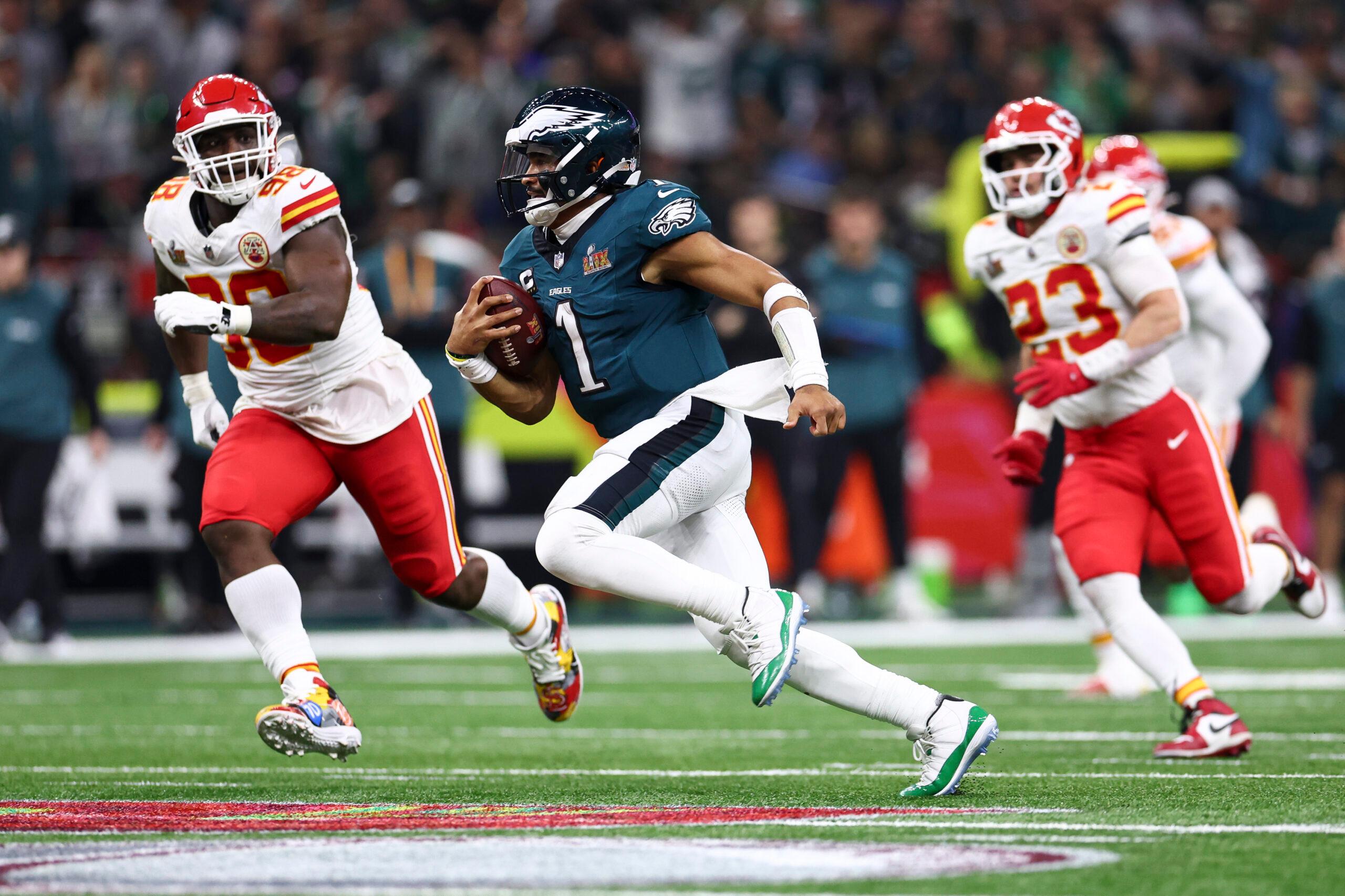
Result: Won 40-22
Stat line: 17/22, 221 yards, 2 TDs, 1 INT
EPA per dropback: 0.52 (1st)
Success rate: 58.6 percent (4th)
Yards per dropback: 9.3 (4th)
Opponent defensive ranking: 15th
Hurts’s counting stats would have been more impressive if not for the Eagles’ dominance. His 46-yard bomb to DeVonta Smith put Philadelphia up 34-0 at the end of the third quarter, and he attempted only two more passes after that point. More than half of Hurts’s 22 attempts went for either a first down or a touchdown. He picked up three more first downs and 60 rush yards on five scrambles. This was a dominant game for the entire Eagles roster—other than Saquon Barkley, who seemed to be the focal point of Kansas City’s defensive game plan—but the game’s MVP was obvious.
With two exceptional showings in the Super Bowl, Hurts has established himself as one of the NFL’s best big-game players. He has the highest completion percentage of any passer who’s played in multiple Super Bowls. He also set the Super Bowl record for rushing yards by a quarterback (70) in his first appearance and then broke it in his second with 72 yards. Hurts will need a few more appearances (and wins) to enter the discussion for the greatest Super Bowl player ever, but he’s already the greatest dual-threat quarterback in the history of the sport’s biggest game.
3
Super Bowl LI, Patriots vs. Falcons (2016)
Tom Brady
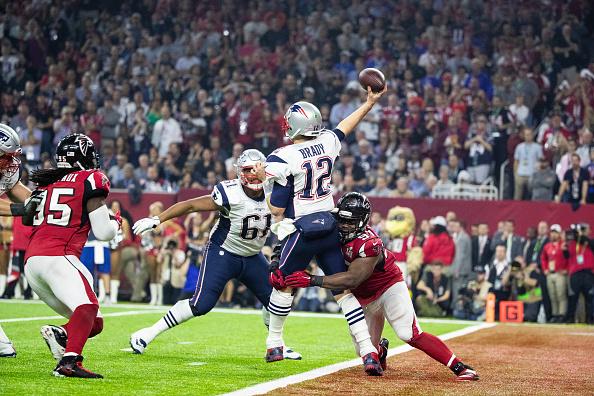
Result: Won 34-28
Stat line: 43/68, 466 yards, 2 TDs, 1 INT
EPA per dropback: 0.16 (22nd)
Success rate: 51.5 percent (18th)
Yards per dropback: 6.7 (20th)
Opponent defensive ranking: 25th
Leading the greatest comeback in Super Bowl history and setting a new record for passing yards in the process wasn’t enough for Brady to land the top spot on this list. And my explanation is simple: He is partly responsible for digging the 28-3 hole he eventually pulled the Patriots out of. Brady’s pick-six was the worst play of the game by either team, based on EPA lost (9.4). Only Kurt Warner’s pick-six against the Steelers was a worse Super Bowl play based on that metric.
Brady more than made up for that mistake in the second half—and we’ll just ignore the near pick on his game-tying drive at the end of regulation, which turned into the miraculous Julian Edelman catch. He threw for 282 yards on 27 completions and generated 15.9 EPA on 40 dropbacks after halftime. Only 20 quarterbacks have thrown for more yards in a full Super Bowl this century.
The Falcons were already cooked by the time the game reached overtime. But Brady did treat us to a thrilling late-game drive in regulation to send the game into OT.
If it wasn’t already clear before that performance that we were watching the greatest quarterback of all time, there was no question after it.
2
Super Bowl LII, Eagles vs. Patriots (2017)
Nick Foles
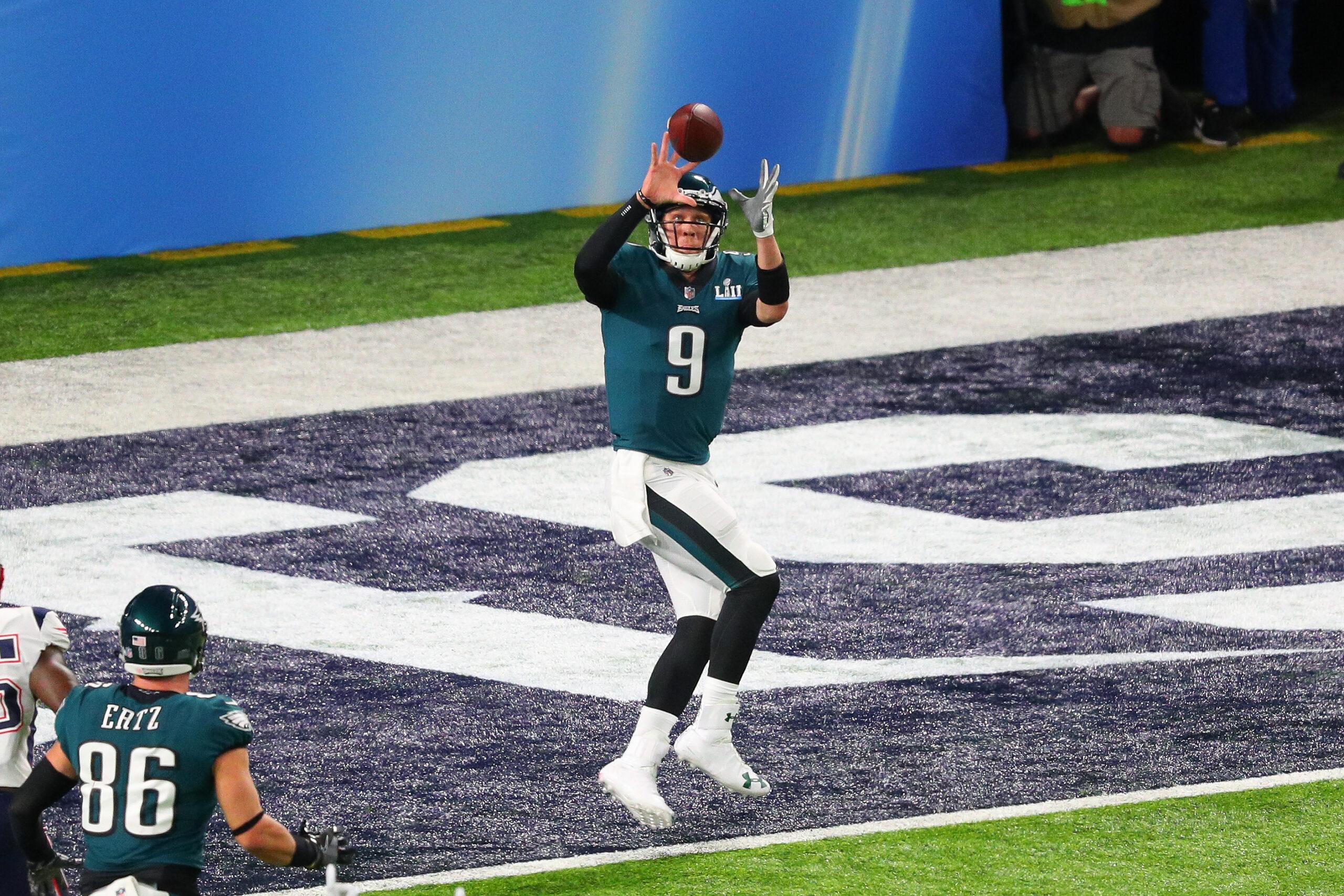
Result: Won 41-33
Stat line: 28/43, 373 yards, 3 TDs, 1 INT
EPA per dropback: 0.47 (third)
Success rate: 55.8 percent (8th)
Yards per dropback: 8.7 (6th)
Opponent defensive ranking: 27th
There’s only one performance on this list that’s been commemorated with a statue. That alone makes it worthy of a high spot, but Foles also earned his placement here with one of the most truly stunning performances in the history of the sport. The Eagles backup went throw for throw with the greatest to ever do it and then played a role in the most famous play call ever made in a Super Bowl. Sure, many quarterbacks have thrown game-winning touchdowns, but Foles is still the only one to ever catch one.
Foles made plenty of impressive throws, too. He finished the game with 11 completions of at least 10 air yards, tying him with Tom Brady (in the same game) for the most in a Super Bowl since 2000. And Foles made that happen with a solid but unspectacular receiving corps led by Alshon Jeffery, Nelson Agholor, and Torrey Smith. With Brady playing a nearly perfect game, the Eagles needed the journeyman backup to carry them. He did just that.
1
Super Bowl LVII, Chiefs vs. Eagles (2022)
Patrick Mahomes
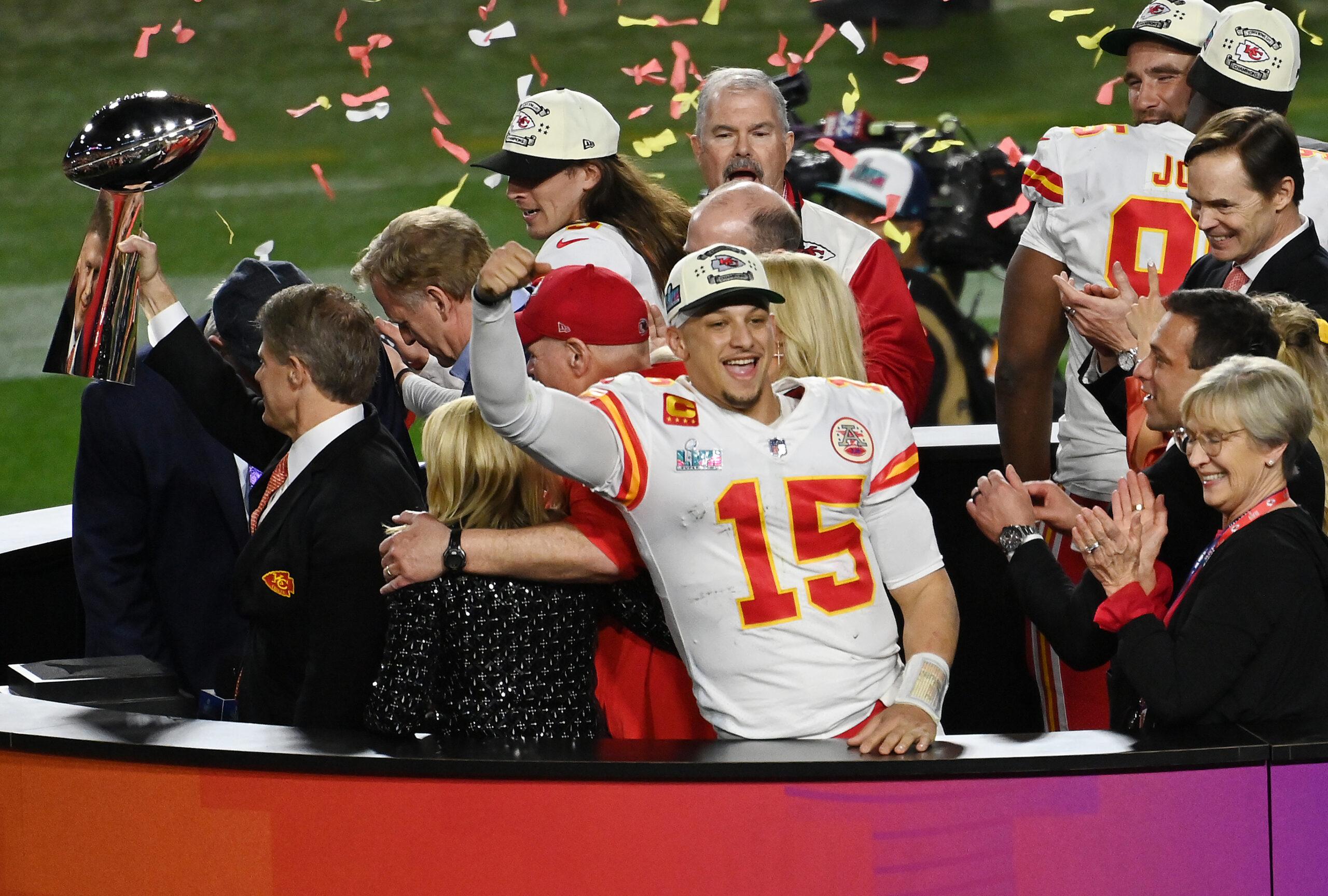
Result: Won 38-35
Stat line: 21/27, 182 yards, 3 TDs, 0 INTs
EPA per dropback: 0.45 (4th)
Success rate: 66.7 percent (2nd)
Yards per dropback: 7.7 (11th)
Opponent defensive ranking: 6th
There are plenty of quarterbacks who have thrown for more yards and touchdowns in a Super Bowl, but we have never seen a passer carry a team like Mahomes did against the Eagles in this game. Mahomes finished with the second-highest success rate of any QB on this list, with nearly half of his dropbacks resulting in a first down, and only three quarterbacks have averaged more EPA per dropback in the Super Bowl this century.
The performance is even more impressive if you consider the context. Mahomes had suffered a high ankle sprain just two weeks prior in the AFC championship game, and he aggravated the injury in the second quarter against Philadelphia. Raising the degree of difficulty even higher, Mahomes was under pressure on 36.7 percent of his dropbacks and was staring down the Eagles pass rush, which had set the single-season record for sacks. The rush was getting to Mahomes, but it couldn’t bring him down despite his limited mobility. He wasn’t sacked once, and he averaged 6.4 yards per play when under pressure. That’s more yards than Brady averaged on all dropbacks in three of his Super Bowl wins. Mahomes made several “wow” throws, but the most iconic play, from his most iconic title game performance, was a scramble. With just under three minutes left in a tied game and the Chiefs driving around midfield, he escaped the pocket and weaved through Philly’s defense on that bad ankle, picking up 26 yards and setting Harrison Butker up for the game-winning field goal.
Whether he was throwing the ball, scrambling, or a little bit of both, nothing was going to stop Mahomes on that night.