


“An ex-boss told me an anxiety-relief thing once,” fintech worker Hayley Clay (Kiernan Shipka) tells her new supervisor, Yasmin Kara-Hanani (Marisa Abela), in the latest episode of HBO’s London-based power drama Industry. They’re in a high-rise elevator heading all the way down to Floor 0, but both women are professionally ascendant. Yasmin has just been named head of communications at Tender, the rocket-shippy digital payments company where her husband, Henry (Kit Harington), is the newly installed CEO. And Hayley has just been promoted—right here, in this elevator—to work beneath her.
“Breathing exercises?” Yasmin asks. “No,” Hayley chuckles. “No. He said: ‘Haley, baby, when it all gets too much, just remember—not a single one of us gets out of this alive.’”
In “1000 Yoots, 1 Marilyn,” the fourth episode of Industry’s fourth season, we glimpse all the ways that a job can kill ya if you let it. The stress and the power struggles. The lucrative erosion of principles. The existence and erasure of sexual harassment. The pure rush of power and, in the words of Eric Tao (Ken Leung) last week, the “nerve-jangling desire to enshrine it.” The endless need for more: more respect, more money, more data, more ways to escape.
“We are all just trying to secure our future,” disgraced former trader Rishi Ramdani (Sagar Radia) says to his newfound drug buddy, James Dycker (Charlie Heaton), in the episode’s final scene. These two men’s trajectories are very different from Yasmin’s and Hayley’s: Rishi is a coke dealer and widower who has lost custody of his young son, while Dycker has just been fired from FinDigest for a “fatal fucking error of judgment.” They’re high and getting higher—but they’re also about to hit new lows.
In Industry, characters have always excelled at elbowing their way forward. But “1000 Yoots, 1 Marilyn” is a reminder that given a long enough time horizon, there’s no beating the benchmark. In the end, everyone converges into the same crowded trade.

The Bottom Line
So, what happened in this episode?
In the opening scenes of “1000 Yoots, 1 Marilyn,” we see that Dycker has a lot going on. The guy’s got a baby, first of all—the outcome of a one-night stand with another reporter. He also has a growing paranoia that he’s being followed. A sketchy car has been parked outside his flat for days, and the kitchen window lock looks like it’s been jimmied open. “You realize,” the baby’s unmoved mother snaps when she realizes that she’ll be staying on kid duty for the foreseeable future, “absolutely no one knows you exist, right?”
That’s not entirely true. That night, Dycker’s editor calls: The good news is that a suspiciously huffy legal communiqué from Tender has inspired him to change his tune about sending Dycker on a reporting trip to Accra, Ghana! The bad news is that Tender alleges that Dycker has been working in cahoots with short sellers, which Dycker admits is “tangentially” true. His editor implores him to knock it off ASAP.
The next day, when Dycker confronts the car parked on his block, a stoner inside takes umbrage and spits on his shoe. And that’s not even the biggest indignity of Dycker’s morning. On the phone, a bossy Harper tells him to hurry up with his next Tender article (while calling his last one “a nonevent”) to help drive the stock lower and benefit SternTao’s short position. “I think you fundamentally misunderstood my ethics here,” Dycker says.
At SternTao, Eric frets. Harper’s big trade idea hasn’t gotten off to a very promising start. Tender’s share price keeps rising and rising, thanks to consensus Wall Street optimism about the company’s upcoming app. And with no new FinDigest article imminent, that momentum isn’t going to reverse anytime soon. Harper floats the idea of self-publishing their findings from their trip up to Sunderland. Sweetpea (Miriam Petche) and Kwabena (Toheeb Jimoh) suggest hedging the portfolio a little to mitigate risk. Harper isn’t having it: “Then we’d be like any other run-of-the-mill long/short [fund],” she fumes.
As ever, it’s Sweetpea, high-agency queen, who actually advances the ball. She’s been messaging Jonah Atterbury (Kal Penn), former Tender CEO, and it’s impossible to do justice to the way Petche delivers the line “Oh, he’s replying.” We’re left to imagine the synergies this could yield.
Over at Tender HQ—where, according to some cryptic neon lettering on the wall, THE STARS ARE REAL—it’s wall-to-wall meetings for the inner orbit. Henry critiques a mock-up of the highly anticipated new app: “Wipe the fucking crypto component off it!” he rages. “I've given that note three fucking times!” (Henry, which memecoin rug pull hurt you?) He particularly dislikes a graphic that says, “Pierpoint, powered by Tender,” instead of the other way around—the result of a Whitney-brokered partnership with Al-Miraj Pierpoint’s wealth management business. (I wonder whether the app lets you DM Celeste.)
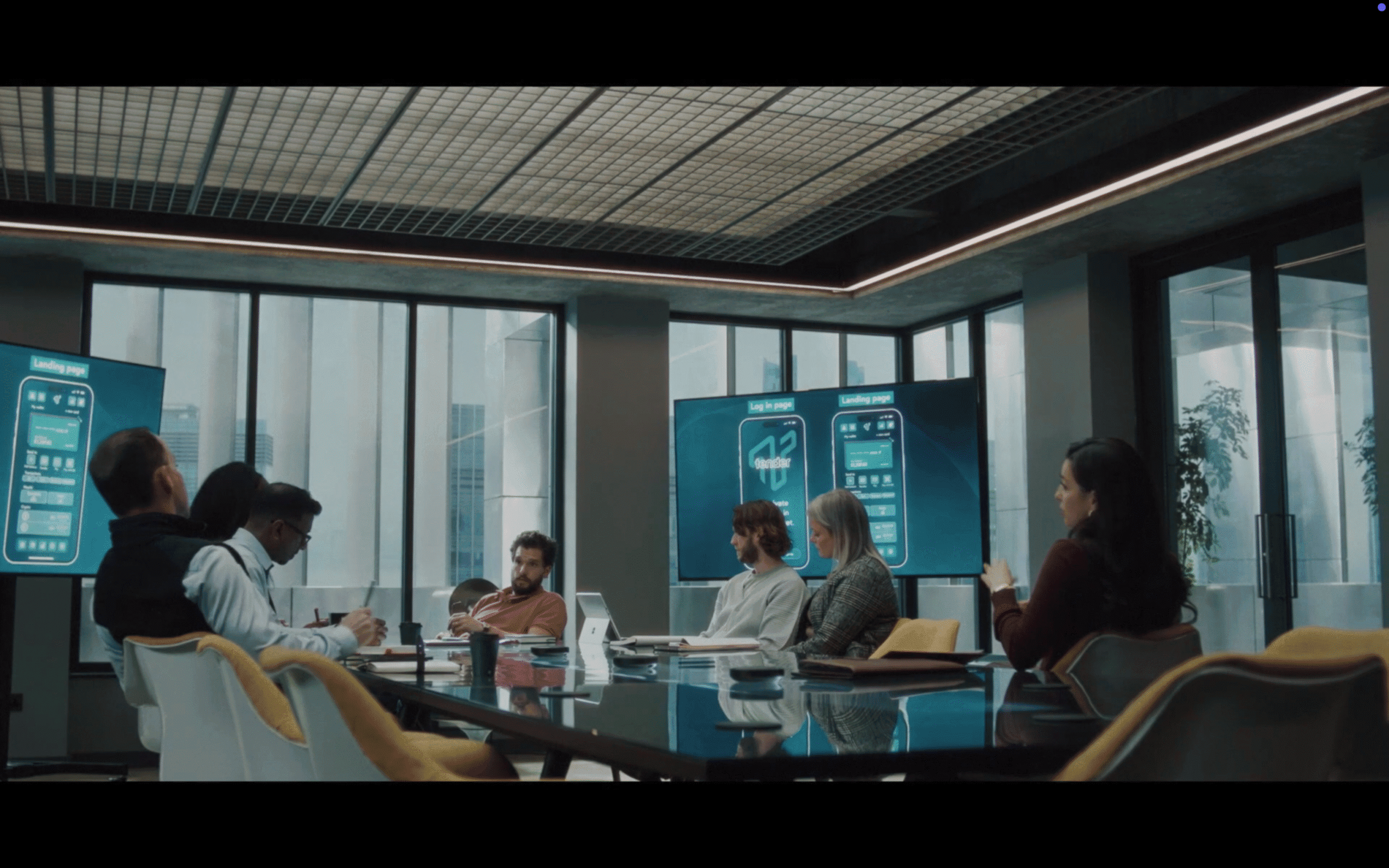
Yasmin and Robin the comms guy chat about how to best position the app launch in the press. Robin wants to play the hits—TechCrunch, Wired, the Breaking Banks pod—but Yas envisions something “buzzier,” which leads to this exchange:
Robin [sneering]: Charli xcx expounding on the virtues of a digitized spending report to track her nocturnal trips to the ATM?
Yasmin [brightening]: Yeah. Yeah!
In another conference room, Whit (Max Minghella) and Ferdinand (Nico Rogner) are meeting with Pierpoint. Hey, if it isn’t Wilhelmina Fassbinder (Georgina Rich), the muckety-muck who personally strapped Eric into his golden parachute in the finale of Season 3! The smirking Tender twosome calls Pierpoint a “dinosaur,” chants “scoreboard!” about the relative directions of the two companies’ market caps, and then leans on Wilhelmina to “solidify the partnership with a further billion-dollar investment.”
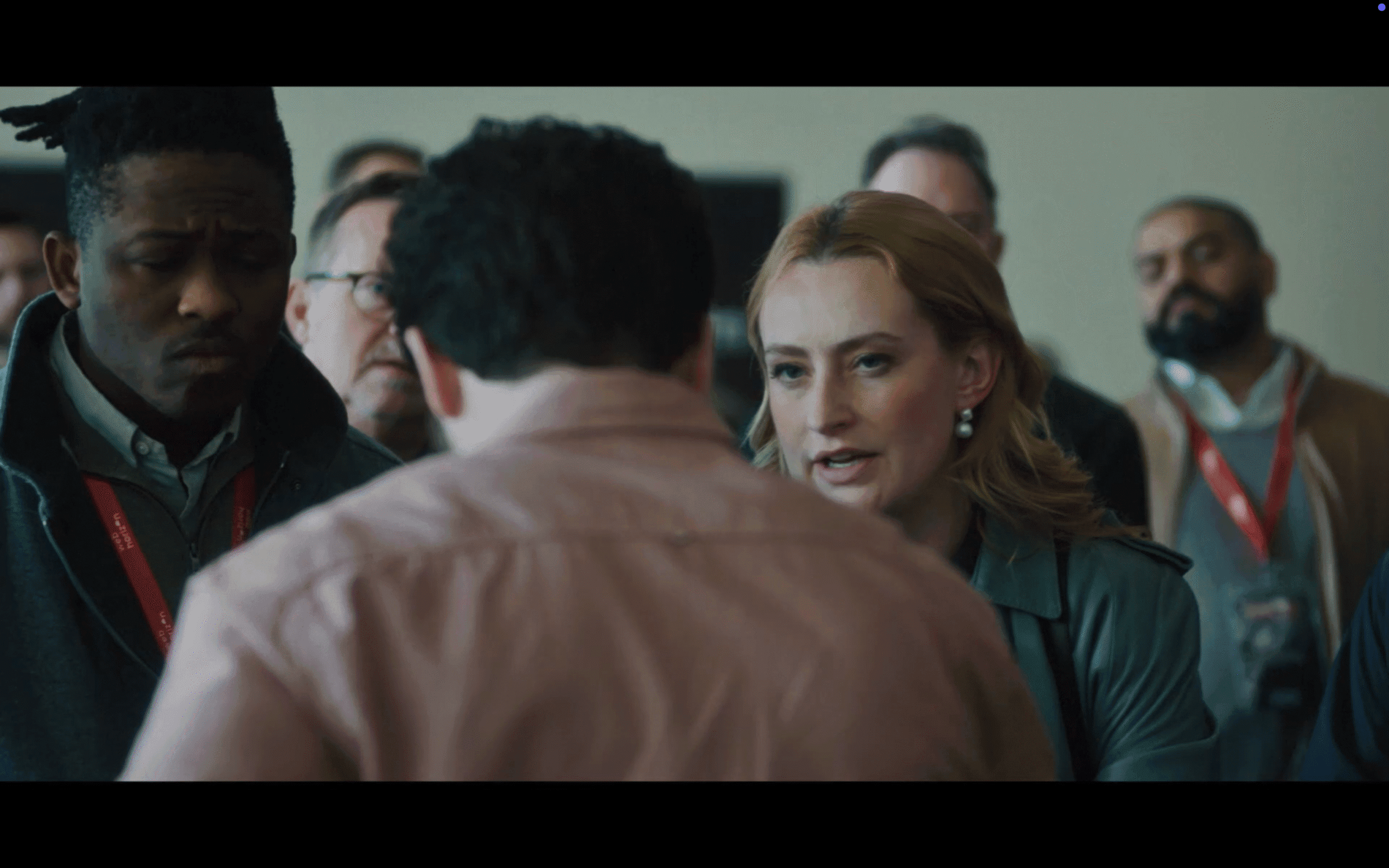
Whit isn’t the only one trying to jostle the chessboard. It’s Yasmin who spends almost every waking minute in this episode wheeling and dealing, ensconced in turtlenecks and conspicuous shoulder pads that resemble battle armor. She finagles promotions from Whit both for herself (sorry, Robin; all those quarter zips were too analog for Tender 2.0!) and for Hayley. She bulldozes Henry’s way onto the stage at a “WebHorizon” conference and gets a grumpy Lisa Dearn (Chloe Pirrie) to introduce him. When she learns from Whit that SternTao is probably shorting Tender, she chuckles with game-recognize-game appreciation—then immediately springs into action to bury her best frenemy in the Norton press and at Tender HQ. “She's probably being spurred on by her former boss,” she tells Whit about Harper and Eric. “They're sort of a poisonous double act. They like to enable each other's worst instincts just ’cause—well, ’cause they’re fucking insecure.”
It takes one to know one, I guess. “You always force me to chase the most egoistic part of myself,” Henry protests to his wife when she informs him that he’ll be speaking at WebHorizon, one episode after he referred to her as an “enabler.” (“You get the feeling,” Harington told me last month about Henry, that “there's a whole story line, which you never see, where he’s sort of in therapy, talking about all of this.”)
As Henry battles nerves before his speech, Whit gives him a pep talk. “You are more; I am less,” Whit tells him, practically breathing down his neck. “You’re a man … I’m incapable of lying to.” Like Yasmin, Whit is stoking Henry’s most egoistic part, too. Unlike Yasmin, though, Whit’s figured out how to do so without making Henry feel small. After Henry successfully delivers his presentation—which isn’t that great, but which everyone in the show considers a rousing success—he barrels straight past his wife in the wings and into Whitney’s celebratory embrace.
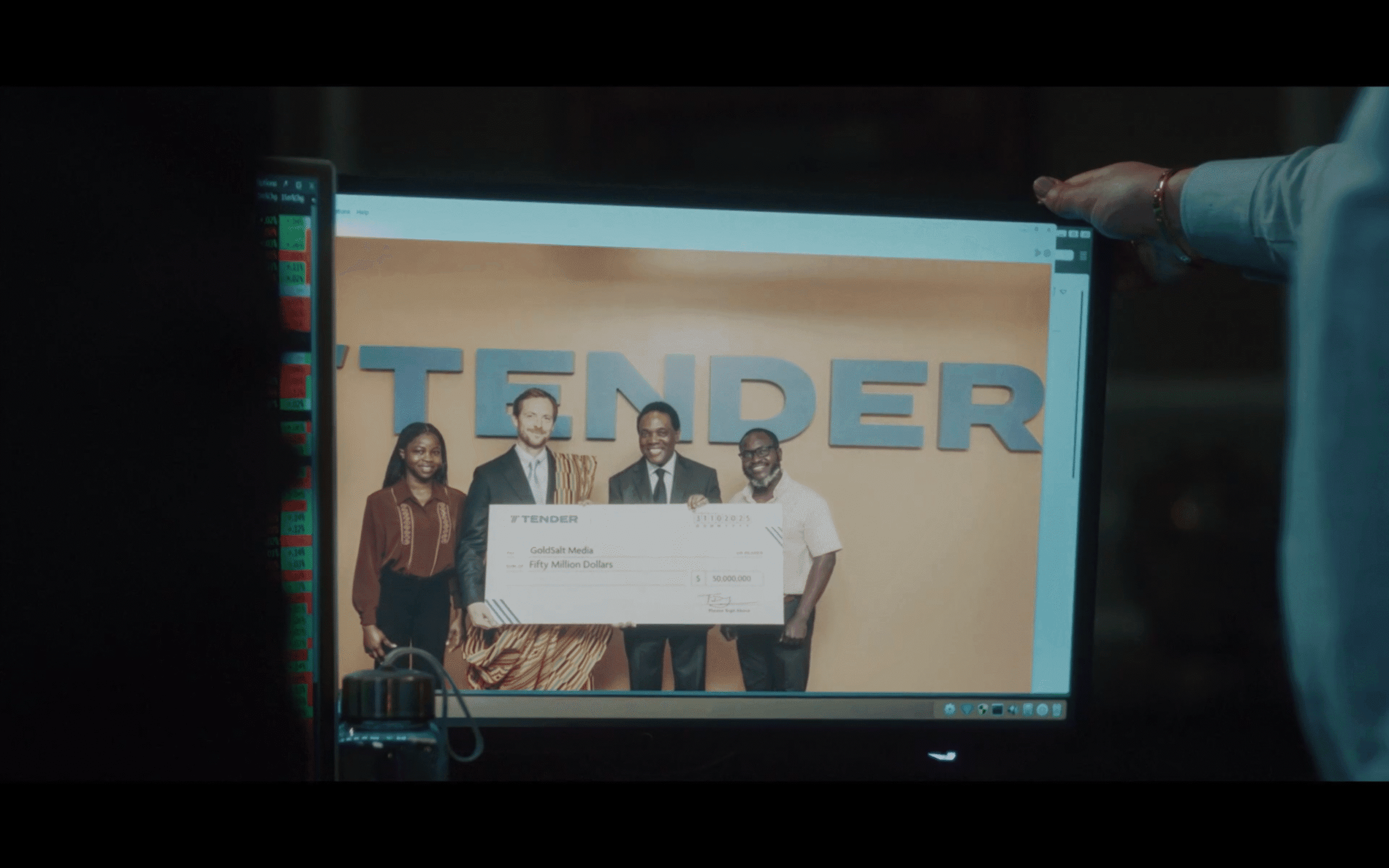
As Tender grows ever stronger, so does the conviction of its biggest skeptics. Sweetpea finally gets on the blower with Jonah while he’s in the middle of getting a lap dance. His wounded anger at Whitney—“I loved him,” he says—is stronger than his annoyance with Sweetpea’s bait and switch, and not only does he dish on his former business partner’s ways and means, but he also emails Sweetpea all the discovery documents from a defamation lawsuit he’s filed. They contain a photo of a Tender business acquisition in Ghana that was closed with one of those giant novelty cheques, as well as the red flag–strewn résumé of Tender’s head honcho in Africa, a serial failure named Tony Day. “He looks like the hated chairman of a lower-league football team, not the CFO of a multinational payment processor,” Sweetpea observes. “I wonder if anyone’s flown to Accra and knocked on their door,” Harper replies.
And at a brief press conference following Henry’s speech at WebHorizon, journalist Dycker isn’t subtle with his lines of inquiry. “Tender: What does it do?” he asks. He brings up the sketchy facility in Sunderland. As Yasmin and Harper glare at each other from across the room, Dycker tells Whitney: “You see, I think your fixation on the future is a smoke screen for the lies of your past.”
Unfortunately for Dycker, these bars are his high-water mark. The man is obviously onto something, but by the end of “1000 Yoots, 1 Marilyn,” all he is is on something, buried in a faceful of cocaine. Instead of finally punching his ticket to Accra, he gets fired from FinDigest. (His chats with Harper and his stalking of Hayley and his reputed drug use were too much for even his seen-it-all editor to overlook.) Ultimately, he winds up in one of the grimmest places imaginable: a dank bar bathroom, next to freakin’ Rishi, who has turned into such a pariah that now even Harper isn’t returning his calls.
Never follow a hippie to a second location, the great Jack Donaghy once advised. Rishi and Dycker do something worse: They bring a drifter home with them from the bar. Is he a goofy rando? A nefarious spy? I assume the latter, but either way, the guy loves loud music the way Rishi and Dycker love drugs, and soon everyone turns up the volume. “Obviously it’s a lot of cocaine-y nonsense,” co-showrunner Konrad Kay told me in December about the ensuing conversation, which includes digressions about World War II bomber plane nose art (and also gangbang porn). “But embedded in it is a little bit of a critique of certain aspects around commodification of personhood through capitalism and how everybody's identity is now monetizable.”
Then, suddenly, the cops are at the door, and Dycker is slumped on the floor and not breathing, and Rishi is jumping from his balcony railing out into the night. (The mystery man from the bar, conveniently, has just left to “buy more beer.”) As the episode ends and the camera pans across Rishi’s terribly injured body on the pavement, his expression is somehow serene. He must know Hayley’s former boss’s anxiety-relief trick.
Turns of Leverage
On Industry, characters love borrowing trouble—and are always up to double down. Whose bets are paying off big-time this week, and who is in the midst of a downward spiral?
Leveling up: The first time Hayley nervously brings up the ramifications of what went down at the Bauer family’s castle in Austria, Yasmin is manipulative, dismissive, dissembling, and sickly sweet. Which is probably why the next time Hayley brings it up, she opts for an unexpected and far more effective tactic: reading Yasmin for filth. By the end of “1000 Yoots, 1 Marilyn,” Hayley has grasped that she may have the Muck family by the balls. Exactly how she’ll twist ’em in the second half of Season 4 is an excellent question.
“The most fun scenes to watch back-to-back,” Shipka told me earlier this month, are “the scene at the fintech conference, where I'm like a scared little deer in headlights talking to Yasmin about how uncomfortable I am about what we did, and I'm appearing to be so naive and innocent and conflicted and tortured,” and “the elevator scene, [where] you go: Oh my God, girl is wicked, she's psycho in the best way possible; she's absolutely deranged!” When you work at Tender, you learn from the best in those fields.
Credit crunched? Not since Jesse Bloom got convicted for insider trading has an Industry character had such a reversal of fortune as Rishi. It wasn’t long ago that Rishi had lucrative employment, a posh wife, and the best trading-floor banter that Industry had to offer. By “1000 Yoots, 1 Marilyn,” though, he’s been brought so low that he’s leaping off tall buildings to escape the consequences of his actions. “You sort of see that very slight smirk on his face,” Radia told me about the episode’s final shot. “I think he is at ease with where he has landed. No pun intended. All his actions over the past few seasons, they've caught up to him.”
On the watch list: At the same time that Yasmin is flexing her power—usurping a top role at Tender, working her Norton connections—she’s also growing increasingly vulnerable on all sides. Hayley is beginning to see through her. Henry bristles at her approach. SternTao is on to something. And not only does Whit allude to Yasmin behind her back when he tells Henry, “There's a few things more toxic in this world than privileged people who are intellectually insecure,” but he also makes loaded entendres about loads right to her face.
Tender Offers
Is that a “private banker in your pocket,” or are you just happy to see me? Here’s the latest haps at Tender, the most ambitious “bank killer” in Canary Wharf.
Near the end of the episode, there’s a conversation between Henry, Whit, and Ferdinand in which we learn that Pierpoint has decided to invest that cool billion in Tender—with a lot of small print involved. They want to structure it as a “CoCo bond,” shorthand for a contingent convertible bond, which suggests that Pierpoint wants a built-in rip cord in the event that Tender ever starts to tailspin. Henry has an idea for a countermeasure of sorts: deploy some of Tender’s cash to quietly buy up enough Pierpoint stock that “it gives us leverage in the partnership longer term.” All of this is probably setting up some high-finance contretemps to come.
Mergers and Acquisitions
Activist investor? I hardly know’r! This is a judgment-free zone to discuss emerging corporate synergies in Industry and do our due diligence on who’s doin’ it.
As Industry episodes go, this one was downright chaste—which of course means that it still featured Rishi getting (super sloshy) front-seat satisfaction; Dycker’s baby mama talking about her sex trends reporting and her grand unified Bonnie Blue theories; and Hayley silencing Yas with her elevator cock talk and farewell ass flash.
In that spirit, I ask: Which of the relationships between the four featured Tender employees—Whit, Henry, Hayley, and Yas—constitutes the biggest workplace violation? I’m not talking about safety goggles or tripping hazards here—this is Industry, with its own relevant version of OSHA.
O for ORG CHART: Is there a power imbalance at work?
S for SOCIOPATHY: Is there some fucked-up mental manipulation going on?
H for HORNINESS: Any weird sex stuff?
A for AFTERMATH: How destructive would it be if things went south?
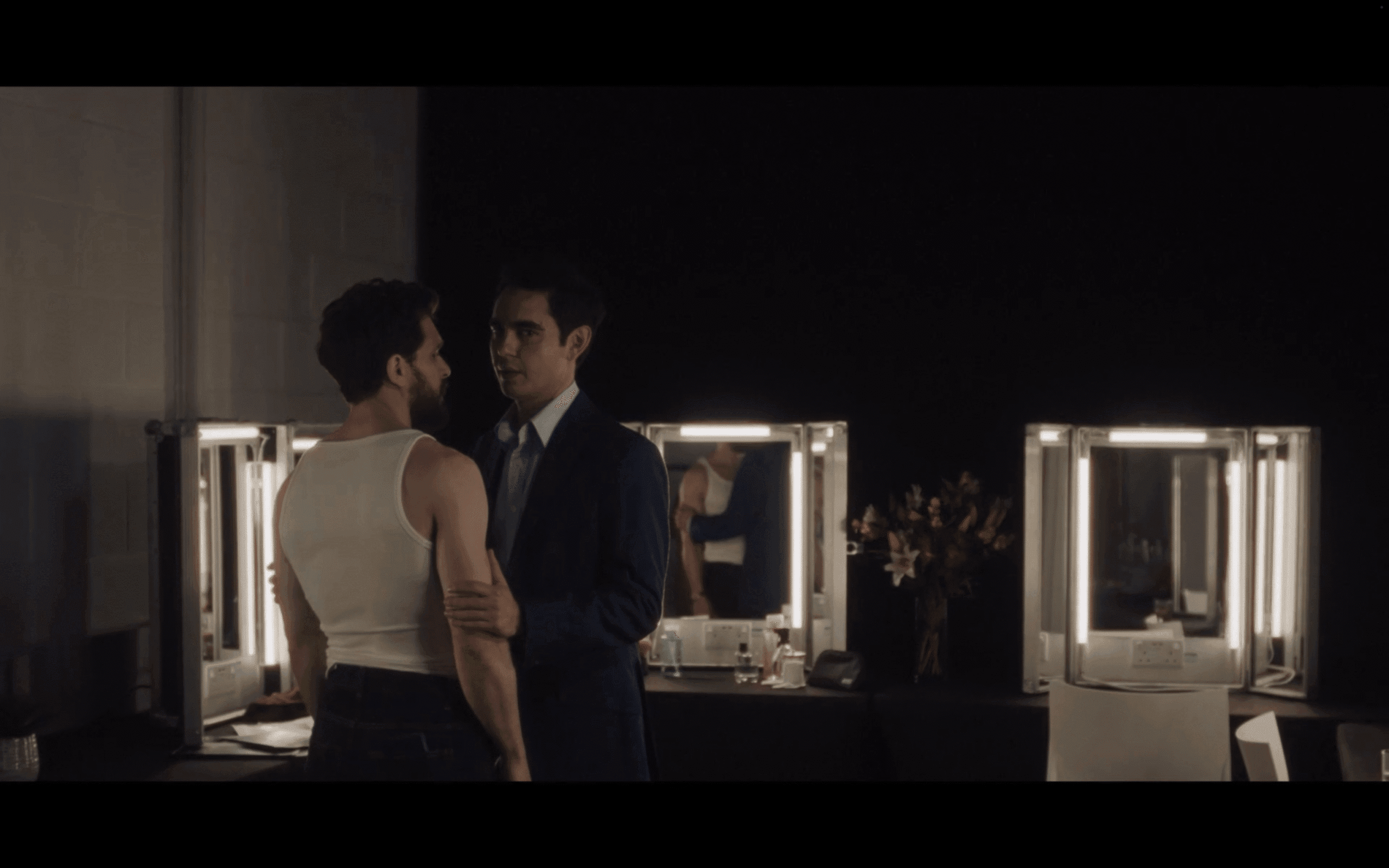
Assigning 0, 1, or 2 points for each factor, here’s my back-of-the-envelope ranking of the Tender coworker matrix, sorted from the most benign to the most fireable.
Whit + Yasmin: It’s telling that these two master baiters have the most normie office relationship. A little scheming here, a little comms strat there—all in a day’s work.
OSHA violation score: 1 + 0 + 0 + 1 = 2
Whit + Hayley: Similarly, these two seem to keep it pretty professional, in a hothead boss–willing minion kinda way. Still, that whole mystery about Hayley’s predecessor’s sudden early retirement does remain unsolved. Also, are we to understand that Hayley told Whit about the ménage à trois in Vienna? Talk about a performance report!
OSHA violation score: 2 + 0 + 0 + 1 = 3
Henry + Whit: There’s clearly some sort of psychosexual tension going on inside this C-suite relationship, even if no funny business (that we know of) has taken place. Maybe Whit’s demonstrated ability to get inside Henry’s head will lead Lord Muck to greatness! I’m not so sure.
OSHA violation score: 0 + 2 + 1 + 1 = 4
Henry + Yasmin: Now we’ve reached the truly toxic tranche. Yes, Henry’s a big boy who can make his own choices, but he’s also a broken soul whom Yasmin—spurred on by Henry’s own uncle—has learned how to exploit. Privileged yet insecure, these two are a dangerous combination: One is accustomed to nothing but the best, and the other insists that she just wants what’s best for him.
OSHA violation score: 0 + 2 + 2 + 1 = 5
Henry + Hayley: On the one hand, at least Henry doesn’t seem interested in playing ongoing mind games with Hayley. And that business trip threesome? Totally Yasmin’s idea! On the other hand, Henry is Hayley’s direct boss—and the potential ramifications of that one wild night could easily cost him everything.
OSHA violation score: 2 + 0 + 1 + 2 = 5
Yasmin + Hayley: [Every fire alarm, police siren, and emergency broadcasting system from London to Calabasas activates simultaneously.]
OSHA violation score: 2 + 2 + 2 + 2= 8 out of a possible 8, Mommy!
Watch Watch
Time is a flat circle, ideally powered by quartz. Here, we examine Industry’s tick-tocking timepiece(s) of the week.
As Rishi sat across the table from his grieving “cow-in-law” discussing his child’s future, I found myself thinking: “Hey, nice watch!” This happened again during his late-night coke binge with Dycker. Which felt a little confusing: He’d already surrendered his Rolex Sea-Dweller to a loan shark in the harrowing Rishi-driven episode “White Mischief” last season. And his financial situation had only worsened since then.

Of course, the creative minds behind Industry were already on top of this—which is why Rishi’s latest timepiece is a dupe. Or, as the show’s costume designer, Laura Smith, wrote in an email, an “homage brand” called Fawler, an in-house label from a Danish menswear e-tailer called Trendhim. “It’s all part of Rishi’s story,” Smith added. “He would have got rid of his past watches. It was a deliberate choice to give him a watch that appeared to the untrained eye like a watch he might have had in the past.”
Unfortunately for Rishi, “1000 Yoots, 1 Marilyn” concludes with a different kind of metal being fastened around his wrist. Something tells me this man’s time is about to be measured in years.
Get Me the Comps!
On the one hand, past performance neither guarantees nor predicts future results, as the SEC requires investment firms to remind clients. On the other hand, plus ça change! Here are some of the real-world stories that might be relevant to Industry’s fictional realm.
On Industry: Harper says that Sweetpea should just self-publish her findings, à la “Hindenburg, GlassHouse, that sort of beat.”
IRL: The Wall Street Journal once described Hindenburg Research as “Wall Street’s pre-eminent short seller”; the firm’s targets ranged from Nikola to Super Micro Computer. (“Someone once told me that at a certain point a successful career becomes a selfish act,” wrote Hindenburg’s founder in January 2025, when he closed down the shop.) As for GlassHouse: The enemy of my enemy is my friend, and so anyone clowning on Soho House is a-OK in my book.
On Industry: Whit negs Wilhelmina and the Pierpoint gang by describing the firm’s brand thusly: “It’s sun-bleached font on signage. Gym bags on eBay. Ironic fincore. Tombstones for a once great thing now dead.”
IRL: Choose your fighter: Bernard L. Madoff Investment Securities boat ’n’ tote; Bear Stearns 11th Annual Technology Conference 2000 messenger bag; or Lehman Brothers banker bag? Me, I’m more of a Drexel Burnham archivist.
On Industry: “I started working on an air-gapped computer, so it can't be hacked,” an increasingly paranoid Dycker tells Harper.
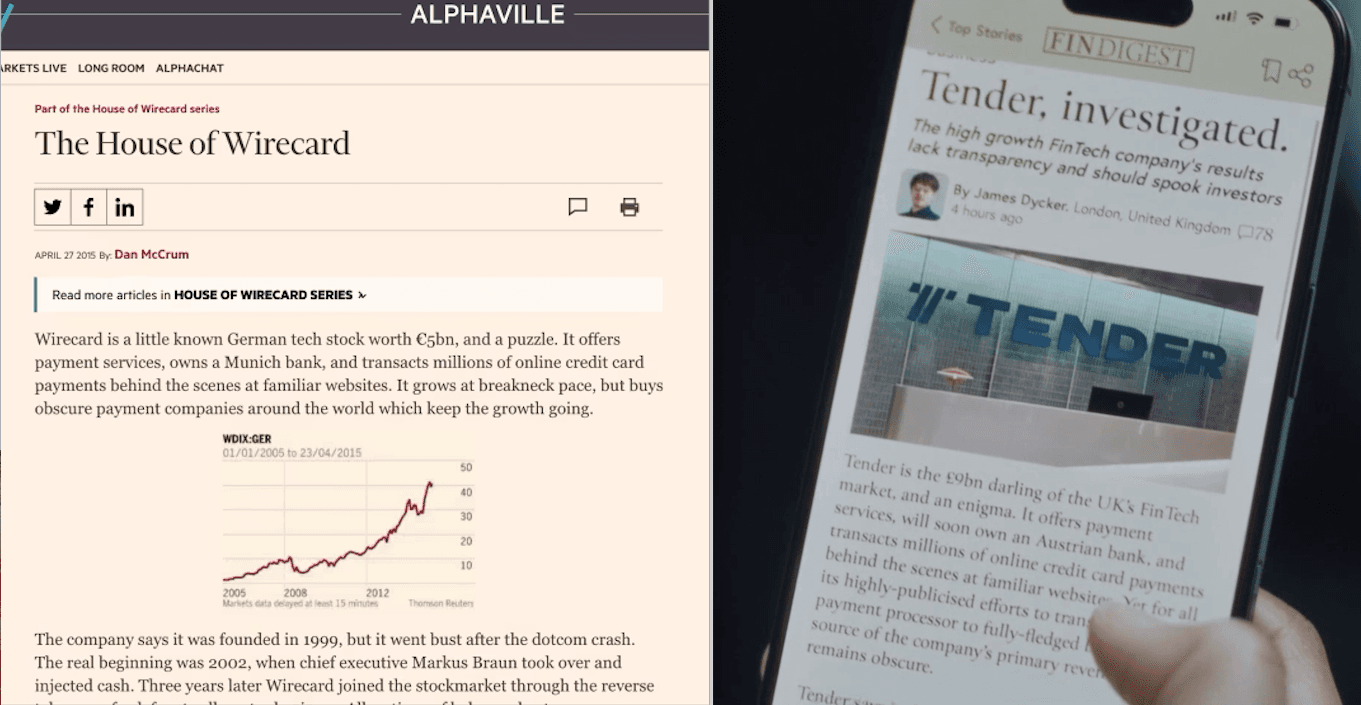
IRL: After Financial Times journalist Dan McCrum began his yearslong investigation into hotshot German fintech business Wirecard, the company accused him of market manipulation—and started surveilling him. By 2018, McCrum recalled, “it was decided I would spend the next three months in a small windowless office by the FT’s main newsroom, working on a so-called air-gapped computer, off-grid.”
On Industry: The song “Forever Young” by the German band Alphaville plays over the Episode 4 closing credits.
IRL: Alphaville is also the name of the FT blog where McCrum first published his “House of Wirecard” series. Both the band and the website derived their names from the 1965 Jean-Luc Godard film Alphaville, in which a secret agent named “Lemmy Caution” infiltrates the city of Alphaville to bring down its computer-ruled technocracy. Anyway! Looking at the text of McCrum’s very first Alphaville post, I couldn’t help but notice the similarities to Dycker’s article that we glimpsed last episode.
Open Interest
What are we left wondering?
- Did Rishi actually break into Dycker’s flat, or was that just the coke talking? He doesn’t strike me as the cat burglar type, but getting ghosted by Harper can do things to a person …
- Is Harper good at her job? It can be hard to tell! So much of the key information that’s been revealed about Tender thus far has originated from the efforts of other people: Rishi, Dycker, Sweetpea. Harper’s Top Skills on LinkedIn would be things like “bullheadedness,” “extreme unsentimentality,” and “avoiding charges for trading on inside information.” Which, when I put it that way, suggests that maybe she is pretty good, after all.
- Who is Whitney working with to obtain those paparazzi-style photos of Harper and Dycker? (I hope it’s some colleague of the reporter “Vivian Poulet-Magasin”—which translates to Vivian Chicken-Shop—who is played by Amelia Dimoldenberg of Chicken Shop Date fame.)
- What if Robin was Dycker’s reticent in-house source? And now that he’s been fired, he’s ready to crow? Just in time for Dycker to be out of print?
- “If the stock climbs higher, we’ll face a margin call,” Eric warns Team SternTao. We learn that the fund raised $250 million in capital—$10 million from Eric, $100 million from lead investor Pierre, and a cumulative $140 million from others—and also secured a $250 million margin loan overseen by Kenny at Deutsche Bank. Will Kenny wind up making the call that puts Eric out of a job, the way Eric once did to him?
Finally, to echo Henry’s frustrated Q: Why the fuck is Whitney in Africa again?! Hopefully someone will get to take that trip to Accra soon and find out. Shoulda been you, Dycker.