‘A Knight of the Seven Kingdoms’ Episode 3: The Targaryen State of Affairs
It’s yet another complicated era of history for Westeros’s royal family. Let’s break it all down.


The secret is out! If you noticed that Dunk’s young squire was suspiciously educated and headstrong for a peasant boy, well, you may not be as thick as a castle wall or as slow as an aurochs. Egg is no ordinary Westerosi child—he’s a Targaryen.
Episode 3 of A Knight of the Seven Kingdoms, “The Squire,” served as our transition point in the story. What started as a simple tale of a young hedge knight trying to prove his worth in a joust is now a story of royalty, authority, and justice. Dunk will have to face consequences for striking Prince Aerion—and Dunk’s very lucky to have made a friend who can vouch for him, or his life would already be forfeit. I hope you soaked up those last moments of banter and connection between Dunk and Egg before their dynamic changed forever. The stakes are now much higher and the tone a bit more serious.
Safe to say, the Targaryens are going to feature heavily in this story going forward. So who do we have? As always with these “incestuous aliens,” there is a complicated family tree. And at this time in Westerosi history, it’s a big family tree. The current king of Westeros is Daeron II, and in The Hedge Knight, Dunk notes that “the line of the dragonkings had almost died out during [Daeron’s] father's day, but it was commonly said that Daeron II and his sons had left it secure for all time.”
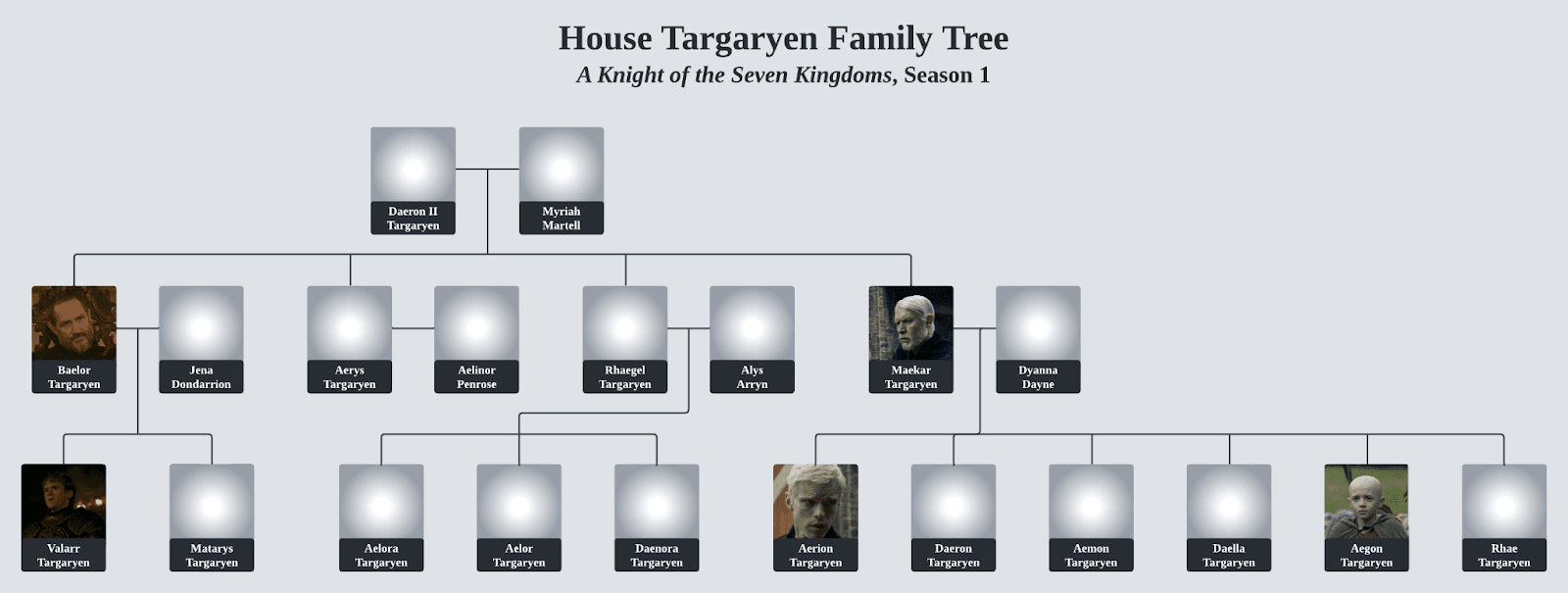
Here’s where that family tree stands as of now:
We haven’t seen Daeron II on-screen, but his presence can be felt not just in his offspring but in the state of Westeros as a whole. Daeron is often called Daeron the Good. His crowning achievement is bringing Dorne into the realm through marriage, finally uniting all the kingdoms in Westeros under one ruler. He also put down the Blackfyre Rebellion (more on that in a bit). His Westeros is one of general peace and prosperity—by Westerosi standards.
And, of course, Daeron has four sons, three of whom have had children of their own. Daeron’s middle two sons go unseen—Aerys is a bookish shut-in, and Rhaegel is sickly and weak—but Daeron’s eldest and youngest sons are both here in Ashford for the tourney. Prince Baelor, the oldest, is heir to the Iron Throne and also serves as hand of the king. Maekar, the youngest, is ill-tempered but competent in military matters. He’s also the Prince of Summerhall, meaning that he lords over the Targaryen summer palace.
Baelor’s oldest son, Valarr, has made the journey to Ashford. He’s the young, brunette Targaryen we see jousting a bit in Episodes 2 and 3. Valarr is dubbed “the Young Prince” because he’s third in line to the throne. Baelor’s other son, Matarys, known as “the Even Younger Prince,” hasn’t made the trip.
Then, swinging all the way over to the other side of the family tree, there are Valarr’s cousins—Maekar’s sons. The two we’ve seen are Aerion and Egg (who we now know is actually Aegon, but there are enough Aegons in Westerosi history that, for the purposes of this column, we’ll continue to call him “Egg”). We’ve heard mention of Daeron (not to be confused with King Daeron II)—one of Maekar’s two sons who have gone missing. Egg was one of those sons, but Daeron has yet to be identified.


The likes of Aerion, Egg, and even Maekar are way down the line of royal succession. We won’t go into detail about all the other names, but the laundry list of Daeron II’s sons and grandsons puts Maekar at seventh in line to the throne—so Prince of Summerhall is about as high on the royal ladder as he can expect to be. Aerion is eighth in line, and Egg is 11th. And once some of these other princes start having sons of their own, these guys will be pushed even further down. Maekar and his lot are well on their way to becoming a cadet branch of the Targaryen family tree.
Maekar is rude, and Aerion seems like he’s been stricken with a classic case of Targaryen madness, but you can understand to a degree why they’re lashing out. It must damage the psyche to know that, just a few generations ago, your ancestors flew in the heavens on winged, fire-breathing beasts, exercising their will on all who stood before them. Yet now, you’re destined to live not only in their shadow but also in the shadows of every uncle and cousin who came before you in the line of succession. Aerion is on the path toward becoming a footnote in Targaryen history—you can at least forgive some of the frustration.
There is one other name I have to point out—Egg’s older brother Aemon. Know any other Aemon Targaryens? Yes, that’s the very same Maester Aemon from Game of Thrones. The events of A Knight of the Seven Kingdoms take place roughly 90 years before Thrones, and Aemon is very, very old by the time Jon Snow meets him up on the Wall. When Aemon dies in Thrones, his last words are “Egg, I dreamed that I was old.” It’s Aemon who actually gives young Aegon his nickname—and maybe he’ll even show up in the future Dunk and Egg novella(s) George R.R. Martin has planned.
But Aemon’s time at Castle Black is well in the future. In the present, he’s just a boy a few years older than Egg, and his grandfather Daeron is king. And Targaryen power is actually somewhat weak—at least compared to just a few generations prior.
Take a look at that family tree again. The Targaryens are famous for their incestuous marriages, to keep the bloodline pure, but there’s not a single one to be found in this era of the family. That’s because, without dragons, the incentives have been turned upside down—where there once was a need to keep “the blood of the dragon” within the family to maintain exclusive use of the most powerful force in Westeros, there is now a need to build and consolidate power through good old-fashioned alliances. Daeron himself is married to a Martell—that’s how he brought Dorne into the realm. It wasn’t through conquest; it was through Daeron’s successful and fruitful marriage to a Dornish princess.
Similarly, Baelor is married to a Dondarrion (of the Stormlands), Aerys is married to a Penrose (also of the Stormlands), Rhaegel is married to an Arryn (of the Vale), and Maekar is married to a Dayne (of Dorne). The grandchildren aren’t married yet, but we should expect similar arrangements for them. It’s been a long time since dragons flew over Westeros—and some are starting to wonder why this foreign family continues to exercise absolute power over the continent. One way to keep that power is to get the other noble lords invested in it.
In fact, some are beginning to do more than just wonder. I mentioned the Blackfyre Rebellion above—Westeros is actually currently recovering from an uprising against the crown.
Technically, this was more of an interfamily dispute, somewhat similar to House of the Dragon, rather than a Westerosi uprising against Targaryen rule. It begins with Daeron’s father, Aegon IV, commonly known as “Aegon the Unworthy.” He was a gluttonous and lustful ruler, and in addition to having two trueborn children, he also sired numerous bastards. Bastard Targaryens aren’t new to the realm (recall the ones who are being recruited to become dragonriders on HotD), but Aegon IV legitimized all his bastards on his deathbed, setting up a succession crisis. These bastards came to be called “Great Bastards,” and Aegon had taken a great liking to one in particular—a boy named Daemon. He knighted Daemon himself and gave him the Valyrian steel sword Blackfyre, which Daemon then made his last name. Blackfyre was the sword of Aegon the Conqueror, and to many it symbolizes the monarchy.
It didn’t help that Aegon IV frequently feuded with his son and heir, Daeron. Aegon circulated rumors that Daeron was actually a bastard, sired by a different father, and Aegon frequently threatened to name one of his other bastards as his heir if Daeron didn’t fall in line. When Aegon died, though, Daeron ascended the throne and did what he could to keep his bastard half brothers close. But he couldn’t stave off the rumblings forever. Many great houses in the Dornish Marches—the area that connects Dorne with the rest of Westeros—were displeased with the concessions Dorne had gained as part of its entry into the Seven Kingdoms. This was compounded by the fact that Baelor, Daeron’s son and heir, looks more Dornish than Targaryen. Many lords in Westeros had grown accustomed to treating the Dornish as enemies after centuries of conflict. Now the Dornish were closer to the crown than just about anyone. Meanwhile, the bastard Daemon was said to be the spitting image of Aegon the Conqueror, with silver hair and purple eyes.
It took Daemon 12 years to finally declare rebellion, but he eventually did in 196 AC, 13 years before the events of A Knight of the Seven Kingdoms. His rebellion lasted only a year. There were several battles and skirmishes during this time, but the main conflict happened at the Battle of the Redgrass Field, near King’s Landing. In the popular telling of this story, it was Daeron’s sons Baelor and Maekar pulling a “hammer and anvil” maneuver with their respective forces that crushed Daemon and the Blackfyre pretenders. In reality, the battle was already mostly won before that by Brynden Rivers—another of Aegon IV’s bastards, but one aligned with Daeron—and his forces, which rained hails of arrows on the Blackfyres. Daemon Blackfyre and his sons were already dead by the time Baelor and Maekar arrived, but, being royalty, they get the credit.
Egg sings all about this in the first half of this episode. These lyrics should make a bit more sense now, knowing how events unfolded at the Redgrass:
Prince Baelor was the firstborn
Prince Maekar sprang out last
Daemon was the bastard
So they kicked his bastard—
Grass is green in summer
Green grass I adore
But grass is red all over
When you kill a rebel—
Horses die in battle
This battle was the front
Blackfyre’s not a trueborn
He came from the wrong—
Country was in peril
The anvil was a rock
The hammer smashed the bastard
With his giant veiny—
Host of Dornish spearmen
In the aftermath of the rebellion, Daeron stripped lands and titles from nobles and knights who supported the Blackfyres. But some other sons of Daemon’s escaped to Tyrosh, so even more than a decade after Daemon’s uprising, the specter of future Blackfyre rebellions still looms.
This explains—but, of course, does not justify—why Aerion is so quick to take action against Tanselle in this episode. Her play wasn’t even about the Targaryens—it was about Serwyn of the Mirror Shield, a legendary figure in Westeros who slayed the dragon Urrax by tricking him with a polished shield. Serwyn’s story predates the Targaryens by many millennia, but it doesn’t matter. To Aerion, any depiction of violence against a dragon is seen as an act of treason.
(Fun fact: Martin hadn’t yet conceived of the Blackfyre Rebellion when writing The Hedge Knight. The word “Blackfyre” does not appear, nor does “Redgrass.” But it’s a retcon that works perfectly—and plays a larger role in the subsequent novellas—so it makes total sense that the writers for the show would want to pull some of it into this season.)
And this is also why a gaggle of princes has come to Ashford to begin with. Ashford isn’t exactly some great house, and this isn’t a very lavish tourney. But the Targaryens need eyes and ears everywhere right now. They need to curry loyalty from lords all over, and they need to flex their might.
And now, Duncan has been pulled into all of this, at least to some extent. He struck a prince at a time when the royal family was feeling particularly vulnerable. Even with another prince on his side, there will be consequences.