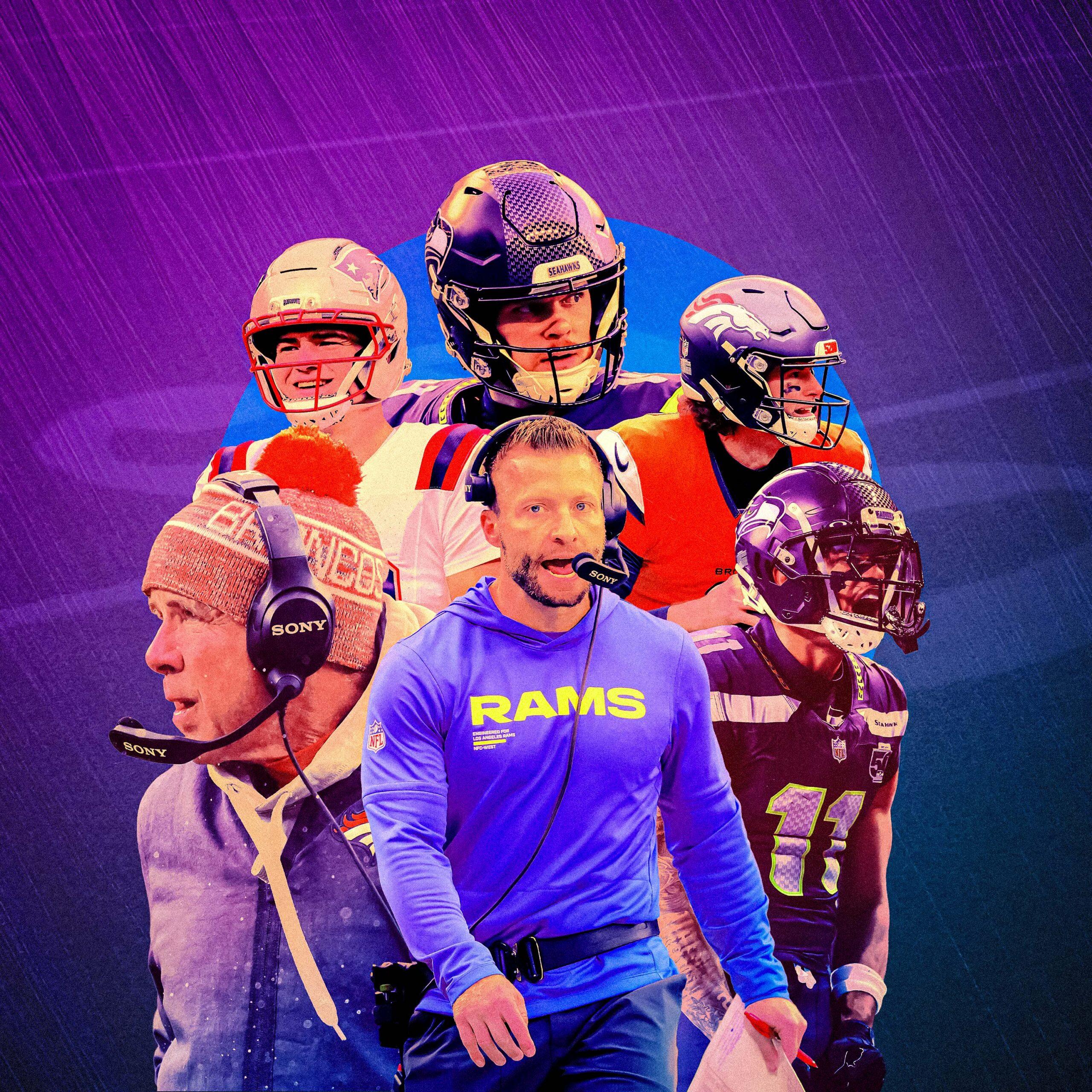

Every week this NFL season, we will break down the highs and lows—and everything in between—from the most recent slate of pro football. On conference championship Sunday, the Patriots outlasted the Broncos (and a snowstorm), while the Seahawks and Rams traded haymakers until Seattle emerged victorious. Welcome to Winners and Losers.
Winners: Sam Darnold and Jaxon Smith-Njigba
We’ve got two weeks to prepare ourselves for Sam Darnold to start a Super Bowl. You wouldn’t think it would be that hard to accept, having watched the guy win 28 regular-season games over the past two seasons, but even through all that winning, it’s still difficult to shake the feeling that Darnold is liable to revert back to the quarterback who failed in New York. The fact that he led the NFL in turnovers in 2025 only reinforces the feeling. But no quarterback has improved their reputation as much as Darnold has this month. He made quick, efficient work of the 49ers in the divisional round, getting that first playoff win out of the way before a genuinely and thoroughly impressive performance against the Rams, who had triggered some of his worst tendencies in past meetings.
Los Angeles sacked Darnold three times but couldn’t land a blow that shook the Seahawks quarterback and knocked him off his game. Darnold hit Rashid Shaheed on a deep ball in the first obvious passing situation of the game, which was an early sign of how the game would go for the Rams secondary.
Darnold was efficient across any split on Sunday, but his play on third down stood out. A lot of his success this season has come on play-action passes on early downs, while he’s been just OK in pure dropback situations. That’s why there was still some lingering skepticism about his franchise-quarterback status heading into the playoffs. Darnold’s game against the Rams answered some of the questions. He had a 60 percent success rate on third-down dropbacks on Sunday. He was even better down the stretch, converting four of his last five third downs.
The Rams made it difficult, too. They sold out to stop Jaxon Smith-Njigba on third down and were actually successful at doing so. After catching one third-down pass in the first quarter, Smith-Njigba was shut out on that down for the rest of the game. Darnold was obviously still looking for his star wideout, but L.A. was able to push him beyond his first read. That’s been a problematic situation for Darnold in the past. It’s when we see his sack and interception rates spike. But Darnold calmly worked through his progressions and located the correct options to move the chains.
Finding the correct option was a little easier on early downs with Smith-Njigba running circles around Rams cornerbacks, whether they were in man or zone coverage. He caught nine passes for 144 yards on early downs. Smith-Njigba burned L.A. on a deep route, he burned them on crossing routes, he won on the perimeter, he won out of the backfield. The third-year star can run any route, at any depth, from any alignment. If he’s not the best receiver in the game, he is certainly the most versatile.
Loser: Sean McVay
You can make a reasonable argument that McVay is the NFL’s best coach, but I’m not sure he’d make the top-10 list of coaches you’d trust to manage a big game. And after another shaky performance in a 31-27 loss in the NFC championship, I’d push him lower down the list.
To be fair, McVay did a fine job calling plays for the offense, which averaged 8.3 yards per play with a 52 percent success rate. The run game was productive enough, and Matthew Stafford shredded Seattle’s coverage, averaging 0.40 EPA per dropback with a 62 percent success rate, per TruMedia. Against a defense that is the league’s best at limiting explosive plays, Stafford hit seven passes of more than 20 air yards. The veteran made a few outrageous throws, but McVay supplied him with plenty of open receivers.
But play calling is just one aspect of McVay’s job on game days—and it’s more of a bonus thing, as not every NFL head coach is expected to call plays. They are all expected to manage the game, though. And they’re expected to do so in a way that maximizes their team’s chances of winning, whether it’s through clock management, timeout usage, fourth-down decisions, personnel adjustments, or any of the small strategic decisions that can pop up during a football game. That’s still a weak spot for McVay. Because he doesn’t have many weaknesses as a head coach, it sticks out—especially in games that can be swung by a few high-leverage decisions.
McVay didn’t make any egregious decisions on Sunday, but he did not maximize his team’s chances in a road game against the NFC’s top seed. He passed on a chance to cut Seattle’s lead down to three with a two-point conversion late in the third quarter, which necessitated a fourth-down conversion attempt (which failed) on the next red zone trip. And with the Seahawks trying to run out the clock, McVay burned a timeout to decide whether to challenge a third-down spot instead of just throwing the challenge flag, in which case the only potential drawback would have been losing the timeout he used anyway. It was a no-risk decision; based on the replay, McVay may have won the challenge and kept his timeout.
Even if McVay deserves criticism for his management of Sunday’s game, these decisions didn’t lose the Rams the game. The secondary getting torched by Smith-Njigba lost the game. The front seven missing tackles against Kenneth Walker III lost the game. The special teams mistakes lost the game. But that doesn’t make it any less frustrating to see that McVay still hasn’t addressed what’s been the most glaring weak spot in his coaching skill set.


Loser: The Rams Special Teams
I will give Sean McVay this: He tried to rectify his squad’s special teams problem before it cost the Rams in the playoffs. But he may have been too late, waiting until late December to fire special teams coordinator Chase Blackburn after a season full of mistakes that cost the Rams at least two critical games. There was the debacle in Philadelphia, where the Eagles blocked two L.A. kicks in the fourth quarter, including one that was returned for a walk-off touchdown. Then in Week 16 in Seattle, the Rams missed a field goal and gave up a punt return touchdown, sparking a Seahawks comeback that ultimately decided the NFC West and gave Seattle home-field advantage in the playoffs. In Sunday’s rubber match, it was a muffed punt by Xavier Smith that may have cost the Rams the win and a trip to the Super Bowl.
That was Smith’s second muff of the game, which will open McVay up to more scrutiny in the days that follow this loss. There are some coaches who would have reflexively pulled Smith after the first screwup, but McVay said after the game that Smith had been so reliable throughout the season, he didn’t think to make a move. But it wasn’t surprising to see the young returner fumble his second opportunity. Seahawks punter Michael Dickson launched the ball into orbit with a booming punt and sent Smith backpedaling toward his goal line to track the ball through the lights. It would have been more shocking if he managed to field the punt cleanly. That he didn’t was hardly a surprise given how the Rams’ season played out.
The Rams’ special teams unit has messed up in a variety of ways this season, which should have been a sign of the Chekhov’s gun potential at play here. L.A.’s special teams had so many ways it could mess things up. They ranked 26th in special teams DVOA during the regular season, per FTN. The unit was 30th in value added on field goals and extra points, 28th in value added on punts, and 20th in punt returns. Outside of kickoff coverage, the unit wasn’t good at anything. But even with special teams costing the Rams in key spots, it was still easy to overlook the issue when weighing the team’s Super Bowl chances. We rarely consider the potential impact of special teams when doing so, and Los Angeles had championship-level units on offense and defense. It had the right coach and an MVP favorite at quarterback. It had every box checked, except one, and sometimes football games come down to a guy kicking a ball in a straight line, or covering a kick return, or even just making a clean fair catch. For all of the Rams’ strengths as a team, they never could figure out how to master those seemingly easy tasks, and it cost them a chance at a championship.
Winner: Establishing the (Quarterback) Run
With heavy snow smothering both passing games in the second half, the AFC championship was not a game suited for high-level quarterback play. But I’m not sure we would have gotten to see it in clear conditions, either. The Patriots couldn’t keep the Broncos’ pass rush out of Drake Maye’s pocket, and Jarrett Stidham couldn’t get out of his own way. The two quarterbacks combined for just 167 net passing yards, and just 46 of those came after the snow started falling at the start of the third quarter.
In theory, that sort of passing environment could be an equalizer for the team starting a backup quarterback with no passing attempts on the season, but the Broncos were kind of screwed once the snow came. Denver’s base run game has been mostly useless since running back J.K. Dobbins was lost midseason, but Sean Payton has been able to drum up some ground production by getting Bo Nix involved with read-option concepts. With no Nix, Payton couldn’t push that button on Sunday, and his run game collapsed. Stidham did catch the Patriots off guard with an early zone-read keeper that went for 8 yards, but Denver never went back to it. His other three run attempts came on scrambles, and only one of them moved the chains. His legs were largely a nonfactor, and his arm wasn’t all that useful once the wind and snow picked up. With Denver out of ways to move the football, the three-point lead the Pats took into the fourth quarter felt insurmountable.
New England’s offensive coaches didn’t have many more answers. We probably should have known offensive coordinator Josh McDaniels would be ill-prepared for the game based on his decision to rock a visor in a snowstorm.
Some of New England’s game plan choices were just as confusing. McDaniels dialed up a lot of early-down runs that the Broncos predictably blew up for short gains, which inevitably exposed Maye to Denver’s rush in obvious passing situations. Testing Patrick Surtain II on deep passes also seemed to be a major part of the plan, and that also didn’t work. Even McDaniels’s most successful call of the day, a flea flicker that went for 31 yards, was a questionable decision considering the weather—and because the play didn’t really spring Mack Hollins open, he needed a perfect throw from Maye to beat the coverage.
That was one of the six explosive plays that New England’s offense generated on Sunday, per TruMedia. The first came on a third-and-long conversion in the first quarter on another pass to Hollins. One was a 12-yard run by Rhamondre Stevenson in the third quarter. And the remaining three came on Maye scrambles, which went for 13-, 16-, and 28-yard gains. The last one pushed the Patriots into range for the go-ahead field goal and was the play that essentially decided the game.
Maye also scored New England’s only touchdown on the ground. It came on a run-pass option, where he could make a quick pass out to his left or keep the ball on a quarterback draw. With Denver putting four defenders over three receivers on the outside, Maye knew he had a blocker for every defender in the box and kept it on the draw.
The Patriots quarterback scored the touchdown that tied the game, got them in position for the go-ahead score, and then sealed the game with another bit of improv. On third-and-6 with under two minutes remaining and the Broncos needing a stop to extend the game, McDaniels decided to take the ball out of his MVP candidate’s hands and give it to Stevenson on an off-tackle run. “I hit my block, and all the defenders started running the other way,” center Garrett Bradbury said after the game. “I’m like, What? Oh my God.” Bradbury said he expected to look up and see Stevenson hitting the hole but turned his head and saw Maye skating past a tackler for the first down. Maye had taken the game into his own hands.
There’s no need to go overboard with praise for Maye’s performance. He managed just 65 net passing yards, tied for the second-lowest mark for a winning quarterback in a playoff game since 2000. As a passer, it was a miserable day for the 23-year-old. But his legs were the only reliable source of productive offense for either team and ultimately the reason New England is headed back to the sport’s biggest stage after a seven-year absence. On a day when Maye wasn’t at his best, he still found a way to be the best—and most important—player on the field.
Maye is completing just 55.8 percent of his passes in the playoffs. He’s taken 15 sacks, and he’s turned the ball over four times in three games. This isn’t the breakout run you would have expected from Maye if you had heard that the Pats made it to the Super Bowl. But Maye has kept the Patriots alive, and has kept the offense viable, against three of the best defenses in football, and he’s got another one waiting for him in the biggest game of the season. If Maye wins his first ring two weeks from now, he will have earned it.

Loser: Sean Payton’s Fourth-Down Decision-Making
Several days before the AFC championship game, Sean Payton was asked how his previous experience game-planning and calling plays for backup quarterbacks would impact his process in this game with Jarrett Stidham. Payton’s answer then was twofold: He said he’d try to call the plays that Stidham liked best, and as the head coach, he’d try to prepare a game plan for the type of fight his team was in.
But when Payton faced the first critical decision on Sunday—when his team was forced into a fourth-and-1 in the red zone early in the second quarter—Payton was thinking about momentum.
“I think the feeling was, Man, let’s be aggressive,” Payton said.
His team was already up 7-0 after an impressive first-quarter touchdown drive led by Stidham ended with a touchdown pass to Courtland Sutton. And Denver’s defense was suffocating its opponent. The Patriots had –2 net yards in the first quarter. So maybe Payton got greedy.
Instead of sending kicker Wil Lutz out for a chip-shot field goal that would have extended Denver’s lead to 10 points, Payton gambled. He called a pass play for rookie running back RJ Harvey in the flat. The Patriots immediately got pressure on Stidham as the quarterback attempted to run a bootleg to his right. Stidham had defensive tackle Milton Williams’s hands in his face as he dumped the pass off toward Harvey, who was covered by two Patriots defenders. Safety Craig Woodson got in front of Harvey and nearly intercepted the pass.
“There are always regrets,” Payton said.
It was the last good scoring chance the Broncos would get. Lutz missed two long field goal attempts later in the game—one before halftime, and one in the fourth quarter that was tipped at the line of scrimmage. And in a three-point game in which the Patriots’ only touchdown drive came on a short field, that fourth-down decision will haunt the Broncos into the offseason. —Lindsay Jones
Loser: Stidham-Mania
For a brief time Sunday afternoon, before the snow started falling and the wind began swirling, Jarrett Stidham had the crowd in Denver believing that a backup quarterback was really going to lead the Broncos to a Super Bowl.
Stidham was thrust into the starting job after Bo Nix broke his ankle late in Denver’s divisional round win over Buffalo last week, and missed his first two throws of the game. But on a third-and-long on Denver’s second series, he took advantage of a busted coverage and launched a deep pass for Marvin Mims Jr., who had gotten a step ahead of Patriots cornerback Christian Gonzalez. The completion went for 52 yards and set the Broncos up in the red zone. Two plays later, Stidham found receiver Courtland Sutton in the end zone to give Denver a 7-0 lead. It was Stidham’s first touchdown pass since January 7, 2024. He jogged to the sideline to chants of “Stid-dy! Stid-dy!” from a Mile High crowd that seemed drunk on the possibility of Stidham actually pulling this off.
The buzz would be short-lived. As the Patriots’ defensive front increased its pressure, Stidham showed why he was the backup quarterback. With blitzing linebacker Christian Elliss bearing down on him on a third down in the second quarter, Stidham backpedaled and pumped the ball like he was going to dump it off to running back Tyler Badie. But with the ball still in his hands, rather than taking a sack (even one for a 15-yard loss), he did something worse: an awkward shovel pass that was scooped up and taken to the end zone by New England linebacker Elijah Ponder. The officials initially ruled it an incomplete pass, with a flag on Stidham for intentional grounding. Only upon review was it determined to be a backward pass, and a fumble recovery for New England. (If Maye hadn’t scored easily two plays later, the NFL would be dealing with yet another officiating controversy in Denver in consecutive weeks.)
“He just got up on me real fast, and I was trying to get rid of it,” Stidham said after the game. “I can’t put the ball in a position like that, so that was completely on me.”
It was exactly the type of mistake you’d expect from a quarterback making just his fifth career start. The Patriots pressured Stidham on 17 of his 37 dropbacks, per TruMedia, and he completed just three of 12 attempts for 58 yards and one interception while under pressure. No, Stidham wasn’t going to be another Jeff Hostetler or Nick Foles. But for a fun few minutes, he made Broncos fans believe. —Jones