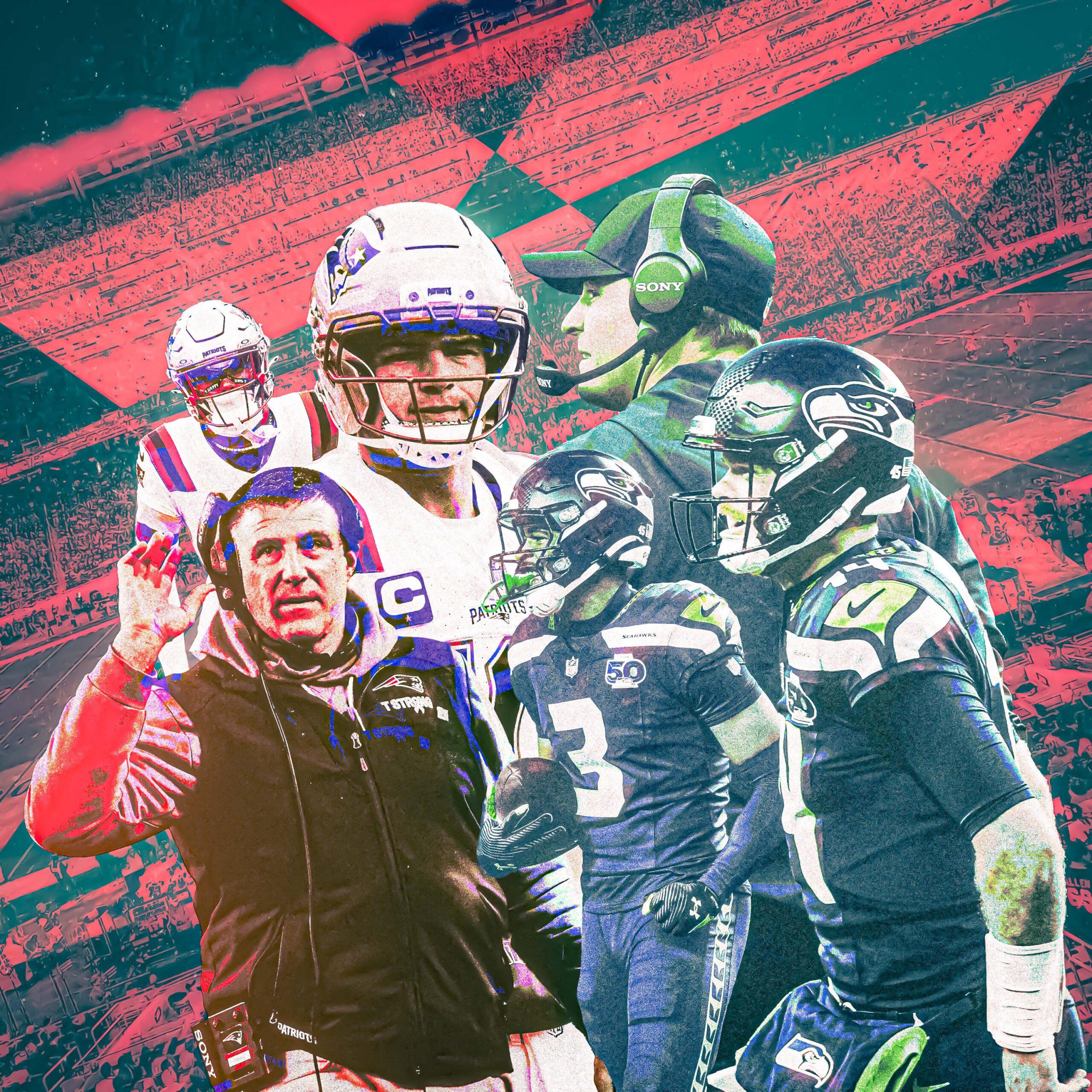

As wild and unpredictable as our journey through this NFL season has been, we find ourselves in a familiar place heading into Super Bowl LX: the New England Patriots vs. the Seattle Seahawks—11 years after Malcolm Butler snatched a championship away from Russell Wilson and Marshawn Lynch. This time around, we’re getting a matchup of one of the league’s best young quarterbacks, New England’s Drake Maye, against the league’s best defense.
Now that the conference championship games are over, let’s take a quick look at how New England and Seattle got here, how these teams measure up against each other, and the important questions that will determine who wins this Super Bowl.
Can Sam Darnold actually do this?
Yes, Darnold is really heading to the Super Bowl—and it’s not a fluke. The Seahawks had the third-highest-scoring offense in the regular season; their passing game averaged 8.5 yards per attempt in their 19 games, including in the postseason; and they hung a combined 72 total points on the 49ers and Rams in the playoffs. If “Ginger Cuz” was ever going to turn into the proverbial pumpkin, it would’ve been on Sunday against the Rams defense, which had forced him into eight turnovers and 19 sacks over the past two seasons. Instead, Darnold put up a masterpiece, with 346 passing yards and three touchdowns.
“You can’t talk about this game without talking about our quarterback,” Seahawks head coach Mike Macdonald said after Sunday’s win. “He just shut a lot of people up tonight, so I’m really happy for him.”
But as soon as that euphoria wears off, the Darnold doubt will undoubtedly return. And for good reason. Two consecutive seasons of above-average play aren’t nearly enough to completely wash away the stench of Darnold’s early-career struggles with the Jets and Panthers. Only a Lombardi Trophy will do that. Beating the Patriots in two weeks would make him the most improbable Super Bowl–winning quarterback since Nick Foles in Super Bowl LII, and he’d have traveled the most winding road for a championship quarterback since Brad Johnson in 2002. Most quarterbacks don’t get to fail as many times as Darnold has before a Super Bowl breakthrough.
If he’s going to finish the job and deliver Seattle its second championship, it’ll be because he plays a clean game against New England. That means no turnovers, no drive-killing sacks, and no long stretches in which he allows New England’s defense to dictate how many times he’s able to target receivers Jaxon Smith-Njigba or Rashid Shaheed. It won’t be easy for Darnold to thread that needle in the Super Bowl against the New England defense, which has improved throughout the playoffs, but Darnold has to check those boxes if the Seahawks want to operate efficiently.
Those downfield passes that Darnold loves take time to develop, and the Seahawks lead the league in explosive play rate on passes that take 3.0 to 3.5 seconds. That handful of extended dropbacks (usually off play-action) will determine how we’ll feel about Darnold and the passing offense in Santa Clara. In this particular matchup against New England’s defensive line, those opportunities could be there.
On dropbacks in which the quarterback holds the ball 3.0 to 3.5 seconds, the Patriots ranked 29th in quarterback hit rate (combined sacks and knockdowns) during the regular season. New England pressured Denver quarterback Jarrett Stidham on 17 of his 37 dropbacks on Sunday, the most pressures on any of the quarterbacks in the championship round, but it’s unclear how much of that’s a reflection of Stidham’s inexperience and the sloppy weather conditions of that game. And New England’s defense was susceptible to the deep ball when it didn’t get pressure, as we saw on Stidham’s 52-yard completion to Marvin Mims over the head of cornerback Christian Gonzalez, which set up Denver’s only touchdown of the game.
When Darnold isn’t under duress, he is a dangerous quarterback, and the Seahawks were first in the league on yards per unpressured attempt this year. Given how explosive Seattle’s top receivers are and how generally unimpressive New England’s pass rush is, I wouldn’t be surprised if Darnold’s explosive passes are the deciding factor in this matchup, just like they were in the NFC championship game.
OK … that sounds ominous for New England. What’s its potential answer on defense?
If there’s hope for New England’s defense, it’s turnovers.
The Patriots have been great at forcing them this postseason. Turnovers have carried this team throughout its postseason run. It has had eight takeaways in its three postseason games so far against the Chargers, Texans, and Broncos—three more than any other team in this postseason field. Of all the defenses that have played in at least three playoff games since the 2005 season (which means at least a conference championship game appearance), the Patriots have gained the third-most EPA per game on takeaways. That’s better than last year’s Eagles defense, the peak Legion of Boom teams in 2013 and 2014, and the all-time great 2015 Broncos. Only the 2015 Panthers and 2009 Saints benefited more from turnovers than this New England defense has.
New England forced Stidham into two turnovers on Sunday, and in the Super Bowl, it’ll be facing another quarterback who tends to be generous with his giveaways. Darnold sometimes plays as though he believes everyone should have a chance to touch the football, the defense included. The Seahawks lost the second-most expected points on turnovers this season, behind only the Bengals offense, which started both Jake Browning and Joe Flacco. While Darnold’s interceptions and ball security issues haven’t cost his team a win since the Week 11 loss to the Rams, a messy Super Bowl game from him could shrink the margins just enough to swing things in the Patriots’ favor.
How the turnover battle plays out in Santa Clara could be a matter of regression: Either the Patriots’ turnover luck will come to an end against the most competent offense it’s played all season, or Darnold’s current run of clean play will end and the Seahawks offense will come undone as a result. I don’t have a lean in either direction just yet, but the idea that Darnold can stay totally out of harm’s way for a month’s worth of playoff football seems a bit dubious to me.
That brings us back to that ever-present Darnold doubt, which is equal parts unfair and unshakable. Several times in his career, he’s had stretches without a turnover like his current run of three or more games. He did it over three games with the Vikings late last season and over four games with the Panthers in 2022. For any other quarterback, that might inspire optimism that a polished QB was always somewhere deep within him. But in Darnold's case, I'm always wondering whether the two-interception version of the QB is ready to jump out of his body like Buddy Love in Nutty Professor II.
New England’s defense might have forced some lucky turnovers against inexperienced (Stidham), frazzled (C.J. Stroud), or depleted (Justin Herbert) quarterbacks on the way to the Super Bowl, but I’m more willing to give that unit the benefit of the doubt than I am to give it to Darnold. This will be the game within the game during the Super Bowl. There’ll come a moment when Darnold gets a little antsy in the pocket and decides he’s throwing to Smith-Njigba no matter what. If the Patriots DBs can get their hands on those passes like they did on Sunday in Denver, the game could swing in a major way.


But can we trust Drake Maye either?
Had this question come up at any point before the playoffs, I would’ve answered yes in a heartbeat. Maye is an MVP finalist, and this season he made a case that he’s maybe the best quarterback in the league outside of the Big Four (Patrick Mahomes, Josh Allen, Lamar Jackson, and Joe Burrow). In just his second season, he carried this team on his back throughout the regular season.
And then the playoffs happened. Instead of a magical run for one of the league’s brightest young stars, Maye’s had one disappointing passing performance after another this postseason. The Patriots’ 35 percent passing success rate this postseason is tied with the 2015 Broncos for the worst we’ve seen from any offense that advanced to the conference championship game (or beyond).


Maye’s regular-season excellence and New England’s consistent winning masked some of the personnel issues they have along the offensive line and at receiver, but the level of competition in the playoffs has made it harder to avoid. There’s no question that the quality of the opponents New England has faced in January has changed the way we view Maye’s offense. The Patriots earned the right to be here, but beating up on the Jets, the NFC South, the Titans, and the Browns didn’t do much to prepare this offense for what they’ve faced the past three weeks against the Chargers, Texans, and Broncos, each of whom ranked in the top 10 in defensive DVOA this season. Both Houston and Denver were in the top five.
But it’s not just a matter of playing difficult opponents. Maye has caused some of these problems on his own. He has six fumbles and has lost half of them in this postseason—the continuation of a trend we’ve seen throughout his young career, with 23 fumbles in 32 starts. Simply put, New England cannot win a title if he puts the ball on the ground against Seattle like he did against Houston.
But I’m hoping Maye can hold on to the damn ball in the Super Bowl, because there’s still a chance we get a fun matchup between him and the league’s best defense. As we covered ahead of the NFC championship game, the Seahawks love to play with two deep safeties. The Patriots were first in the league in success rate against Cover 2, Cover 4, and Cover 6 looks in the regular season. Maye is an ambitious passer, and he can drill passes into holes in coverage the moment he sees them, like he did here against the Chargers’ Cover 2 defense in the wild-card round.
Maye also has a Mahomes-esque knack for making back-breaking scrambles, especially when defenses play with two deep safeties. Maye leads all quarterbacks in scrambles this season and ranks third in yards when he tucks the ball and runs. If the Patriots win this game, I’d be willing to bet that it will be because Maye’s legs got his offense out of bad situations, especially if his receivers can’t consistently get separation against Seattle’s defensive backs. A couple of runs like the clip below could be part of a career-defining performance.
We’ve covered the quarterbacks. What’s an X factor that could swing this game?
I don’t have any special coverages or rushing concepts for us to nerd out over today, but I do have a simple request of the kickers and punters in this game: don’t be cowards. Let the returners have an impact on this game.
I’m begging the coaches in this game to indulge us with a couple of opportunities on special teams, because the Patriots and Seahawks both have game-breaking playmakers fielding kicks and punts. Shaheed has already returned a kick for a touchdown this postseason, and Patriots returner Marcus Jones is consistently one of the league’s best punt returners.
The Super Bowl itself needs to make new history, anyway. We still haven’t seen a punt return touchdown in the game’s history, and the longest one, by (Kadarius Toney in Super Bowl LVII) was electric. We haven’t had a kick return touchdown since Percy Harvin did it for the Seahawks 12 years ago, the last time Seattle won a title.
There’s never been a time that a long return made the viewing experience worse! The people need this. I need this. Touchbacks and coffin corner kicks are for losers. Let the real athletes decide the game.