
Every week this NFL season, we will break down the highs and lows—and everything in between—from the most recent slate of pro football. In the divisional round of the playoffs, the Bears’ late-game magic finally ran out, New England evoked postseasons past, the Bills suffered another heartbreak, and Seattle’s defense squeezed the life out of San Francisco. Welcome to Winners and Losers.
Loser: Caleb Williams’s Legacy Moment
Chicago’s run came to an end Sunday night against the Rams, but the Bears are leaving this year with something after Caleb Williams pulled another game-saving play out of nowhere on fourth down with the season hanging in the balance. A week after making that throw in the cathartic win over the Packers, the second-year quarterback made this Looney Tunes–ass play to put Sunday’s game into overtime.
The line of scrimmage was the 14. Williams retreated to the 40 before uncorking the throw to Cole Kmet, who was standing right on the NFL logo in the Bears end zone. It was undoubtedly a lucky result for Williams, who just threw the ball up for grabs, but that his tight end even had a chance to score required a tremendous throw while fading away from pressure. And based on this angle, which shows that Williams had no receivers open downfield, surrendering ground in order to buy time was the option that gave Williams the best chance to make anything happen.
Williams also had his share of lowlights in the loss to the Rams. He threw an early interception on an overthrown ball on fourth down—his third interception on a fourth down in the last two weeks alone. He had another fourth-down pass knocked away in the end zone, and his final pass of the season was an interception in overtime, though receiver DJ Moore deserves most of the blame for this turnover after giving up on his route mid-play, which allowed Rams defender Kam Curl to beat him to the ball.
Williams also missed a few layups, as he’s wont to do, and didn’t make enough plays on high-leverage downs to beat a team as good as the Rams. He completed just over half of his passes and averaged only 6.1 yards per carry as a rusher. It wasn’t a bad performance by any means—as evidenced by his 72.2 QBR (out of 100)—but he left a few game-changing plays on the field.
In the end, 2025 was a major success for Williams. The 24-year-old 2024 no. 1 pick made a lot of progress during his first season playing under Ben Johnson. He’s looked the part of a franchise-altering player at times. He’s also shown flashes of inconsistent accuracy that had some wondering whether he was a generational bust during a dreadful rookie season. It’s at times been a maddening experience for Bears fans, but this team is never boring with Williams. Even the losses can provide exhilarating moments.


Winner: The NFC Championship Game
The two best teams in football will play for the NFC title next Sunday after Los Angeles survived a scare from Chicago in overtime. Fans of the Seahawks and Rams are obviously thrilled their teams are still playing, but this is also a win for the neutrals. We get Seattle head coach Mike Macdonald against Sean McVay in a heavyweight bout of play callers. The first two matchups between these divisional rivals gave us dramatic fourth quarters—and the second matchup on a Thursday night last month may have been the game of the year—so anything less than a classic will feel like a disappointment.
The Seahawks have been the better team since that Week 16 matchup. They’ve won all three of their games—as part of a larger eight-game win streak—and the defense has allowed only one total touchdown in those contests. But the Rams offense has earned the benefit of the doubt in any matchup. Los Angeles just has so many options for counters to whatever a defense can throw at it. Take Sunday’s win over the Bears, for instance. Chicago found early success with blitzes and held Matthew Stafford to just 1.9 yards per dropback against the blitz through the first three quarters. The Bears stuck with what was working, but Stafford and McVay eventually found an answer for the extra pressure. In the fourth quarter and overtime, Stafford beat the blitz for three key first downs. He hit Colby Parkinson for a 35-yard gain to spark L.A.’s go-ahead drive. Stafford extended that drive with a blitz-beating throw to Puka Nacua on third-and-6. And Stafford’s third-down conversion in overtime, another pass to Nacua, who pushed the ball into field goal range, was also against a Chicago blitz.
Stafford’s ability to quickly solve problems before and after the snap makes him the perfect adversary for Macdonald’s defense. We’re just a few weeks removed from watching the Rams quarterback, and presumptive MVP, torch Seattle for 457 yards and three touchdowns in a late December game. The Seahawks defense didn’t even play poorly in that one! Stafford just went on a heater, and there’s little a defense can do when he’s flinging no-look passes all over the field.
Even if Seattle’s defense shows up next Sunday and Macdonald outcoaches McVay, Stafford’s good enough to keep his team in the game.
If the Seahawks defense wins its matchup, the game could come down to Sam Darnold playing a normal game of football. If he can play a clean game, as he’s done in Seattle’s two previous games, the NFC West champs should feel comfortable. But the Rams just seem to bring the bozo out of Darnold, who’s thrown seven interceptions, taken 13 sacks, and lost a fumble in his last three games against McVay’s team. While Darnold appeared to exorcise those demons when he led the comeback over L.A. in Week 16, it will take only one early mistake against an opportunistic Rams defense for his game to spiral. It will be one of many fascinating subplots to track in this rubber match that the football world has been waiting for since last month’s thriller.
Loser: C.J. Stroud
Stroud joined Buffalo’s Josh Allen in the four-turnover quarterback club this weekend with an appallingly bad performance on a miserable weather day in Foxborough. It was cold, it was wet, and DeMeco Ryans had ice crystals forming on his head by the second half.
Stroud shrank in the cold. He played a panicky game, and his first two interceptions could best be described as frantic. Stroud threw a floater that Carlton Davis III tracked down the sideline for a pick, and he later tried to throw out of a sack with disastrous results.
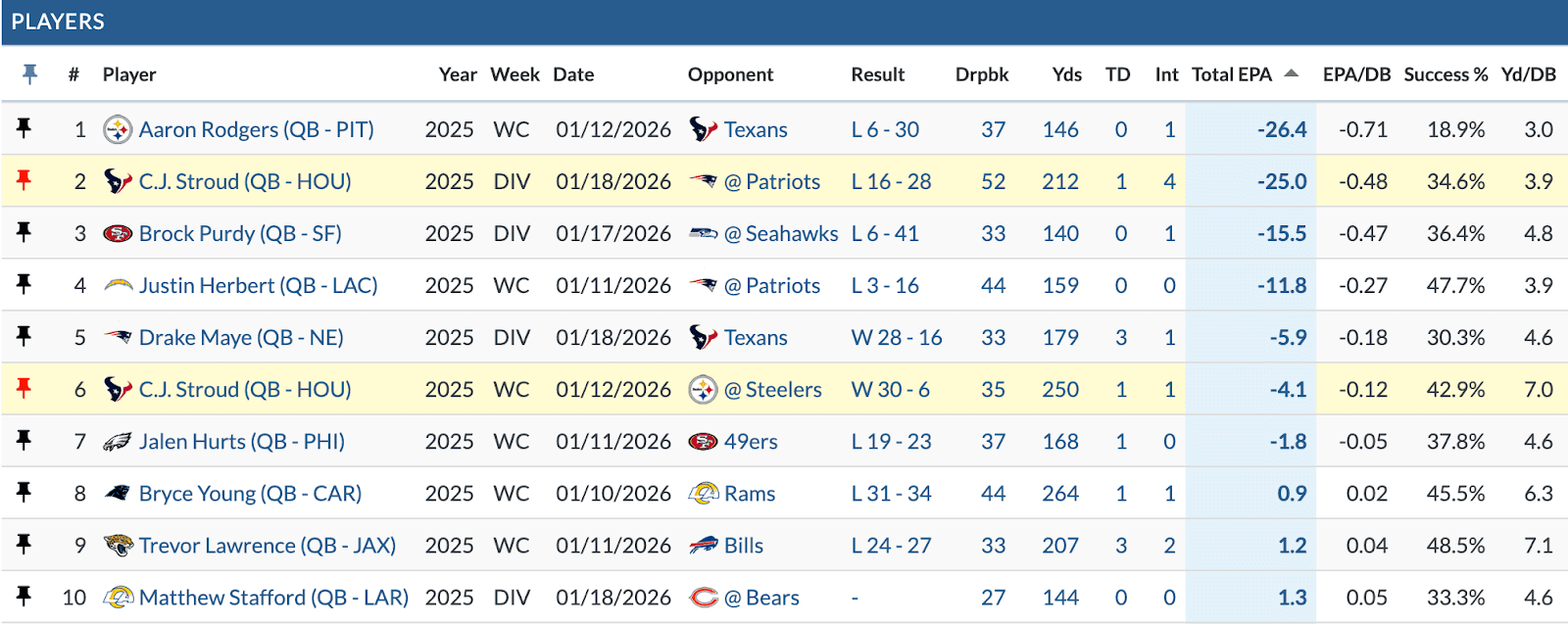
Those were just two of his four interceptions. Thanks to a valiant effort from the Texans defense, the pick-six by Marc Jones was the only Stroud turnover that resulted in points for New England. That makes Stroud’s performance all the more frustrating. His job was simply not to fuck things up for Houston. We saw the massive margin for error the defense provided in the wild-card round last Monday night, when Stroud turned it over three times in the blowout win over Pittsburgh. Remember how bad Aaron Rodgers looked against the Texans? Based on EPA, Stroud was just marginally better than that on Sunday against New England. His 52 dropbacks resulted in a loss of 25 EPA. It was the second-worst performance of this postseason, ahead of only Rodgers’s, giving Stroud two of the six worst games, per TruMedia.
You could see Ryans losing faith in his quarterback in real time. With the Texans trailing by 11 and facing fourth-and-2 on the 10-yard line, Ryans settled for a largely meaningless field goal instead of trusting Stroud to run a play that would pick up 6 feet.
I would typically trust the numbers there, but I don’t believe ESPN has figured out how to quantify the feeling of watching your quarterback shitting all over himself for 40 minutes and how that factored into Ryans’s decision.
Stroud’s postseason went as poorly as it possibly could have. He finished with seven turnovers and was generally unimpressive over two games. Stroud ended the regular season on a high note, and it appeared he was headed for a big payday, with the first extension window of his career opening this offseason. Now, the Texans might want to wait to see how 2026 goes before committing to Stroud long term. Houston will certainly pick up his fifth-year option, giving the team two more years of roster control before his rookie contract expires. Stroud has given the Texans no reason to rush into a decision.
Winner: The Patriot Way
Thanks to Stroud crapping his pants in spectacular fashion, the Patriots survived a sloppy game from Drake Maye and the offense, which needed to make exactly two big plays to snatch the win from Houston. Mike Vrabel’s decision to keep the offense on the field on fourth-and-1 was immediately rewarded with a Pop Douglas touchdown for the first big play.
Then Kayshon Boutte called game with an unreal one-handed grab for a touchdown. Maye set Boutte up for glory with a perfectly weighted ball to beat Derek Stingley Jr.’s tight coverage.
But before that touchdown put the game out of reach, New England was on pace to post the worst offensive success rate of any playoff team since 2000. Just eight of its first 41 plays of the game netted a positive EPA.
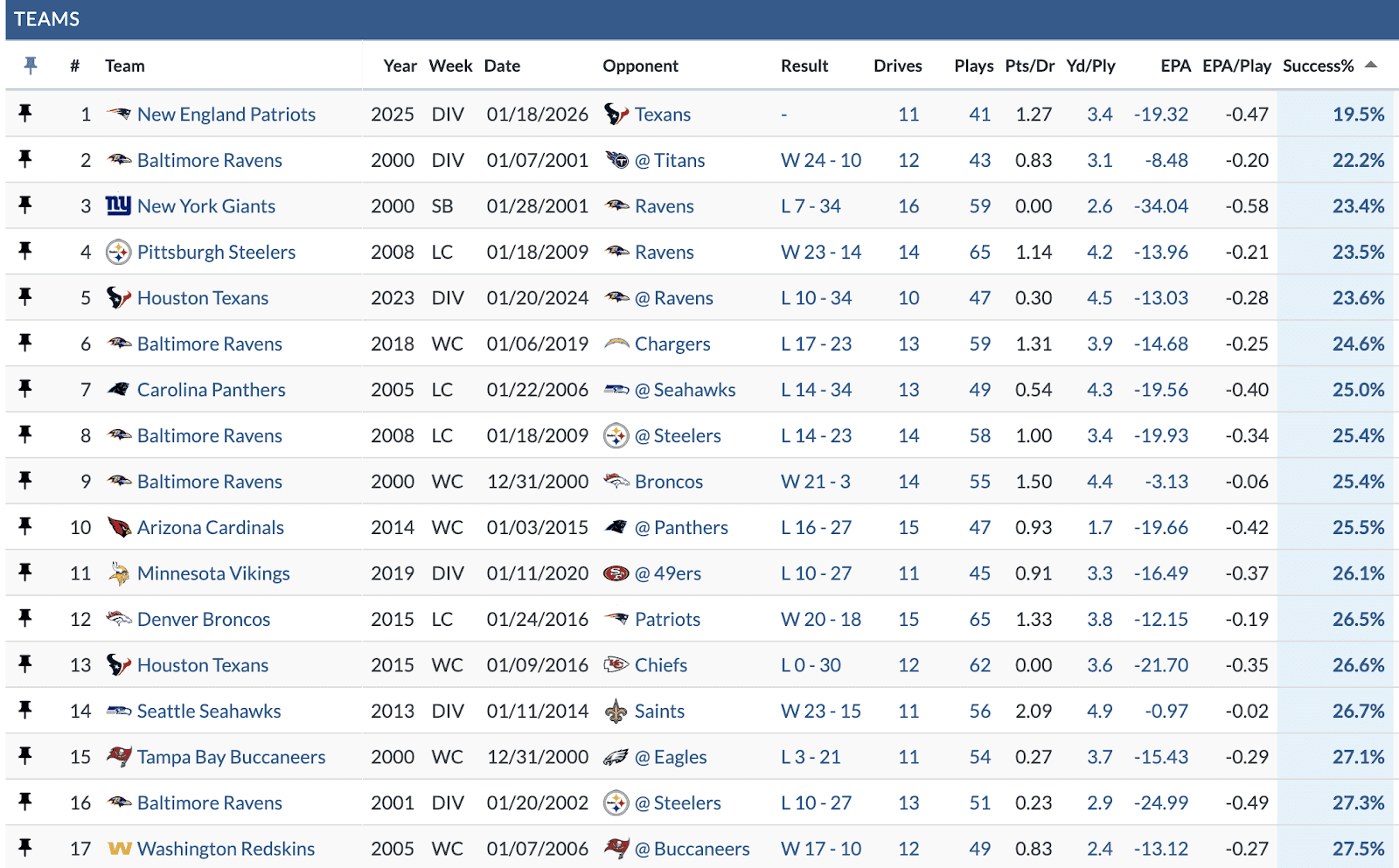
This was an ugly, sloppy game in the New England muck. It was like watching a bizarro version of the Josh Allen–Patrick Mahomes duel in 2022. Instead of trading explosive plays, Stroud and Maye traded turnovers. Stroud threw four picks; Maye fumbled four times, losing two of them, and threw an interception for good measure. The teams combined for eight turnovers, falling one short of the record set by the Packers and Rams in 2002, per TruMedia.
This felt like an early Belichick-era playoff game where the Pats would outlast a team that looked like the better squad on paper but made one too many mistakes in real life. Maye’s second-year breakout has been the biggest factor in this reboot of the glory days, but Vrabel has played the role of the coach who relentlessly hunts for small edges that can make the difference in a tightly contested football game.
Through two postseason games, Vrabel’s defense is playing like one of those early Belichick units. The defensive line, which got tackle Milton Williams back in time for a playoff run, devours blocks and frees the linebackers to make tackles in the run game. Every downhill run looks like a multicar pileup. Space is just as difficult to find in the passing game. Cornerbacks Christian Gonzalez and Carlton Davis III stick tight to routes and force tight-window throws. Even when Stroud had time to get through his progression on Sunday, open receivers were scarce.
Belichick’s defense could always be counted on to slop up a game if that’s what it would take to win. A young Tom Brady would always make enough plays in the fourth quarter to bring home the victory. That was the Patriot Way of winning games early in the dynasty, and this team is starting to bear a striking resemblance to those squads.
Loser: Sad Josh Allen
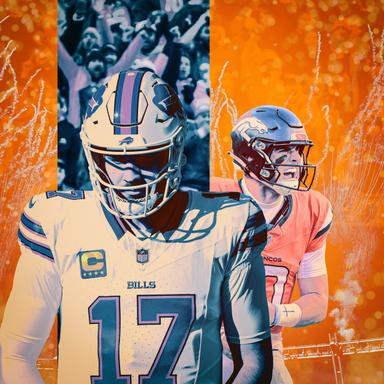
I know I’m supposed to be a callous football analyst who holds highly paid quarterbacks accountable for coming up small in a big game, but sad Josh broke me, and I just can’t bring myself to drum up a scathing take on the Bills star after seeing him like this.
While I’ll refrain from questioning Allen’s mental fortitude or asking whether he’s got what it takes to win a Super Bowl, I have to agree with sad Josh’s take on the role he played in Buffalo’s season-ending loss. His four turnovers cost the Bills the game. Allen’s team hasn’t made his job easy this season, but it played well enough to beat Denver on Saturday night. Buffalo’s best player did not. We’ll get to the controversial interception in overtime later, but Allen’s first three turnovers of the game are indefensible. His careless fumble late in the second quarter gave the Broncos a free three points.
Buffalo’s first drive out of the half ended in a similar fashion when Nik Bonitto stripped Allen from behind, setting up another Denver score. Dion Dawkins whiffed on his block—though the chip help from Brandin Cooks wasn’t very helpful—but Allen gave his left tackle no chance by dropping back 11 yards.
And Allen gave away more points with a lazy downfield heave that Broncos safety P.J. Locke easily tracked down for an interception.
Allen narrowly avoided a fourth turnover in regulation after losing the ball on a QB keeper, but only because his teammate was there to hop on the ball. This wasn’t one of those games where the Bills needed Allen to be Superman. The run game was productive, and the Buffalo defense made things difficult for the Broncos offense when Allen wasn’t providing it with a short field.
I’ll give Allen a pass for his final turnover, which came on a well-thrown ball that appeared to be in Cooks’s possession as the receiver was going to the ground. Broncos corner Ja’Quan McMillian ripped it away before Cooks could complete the process of the catch.
This certainly looks and feels like a catch, but based on the rule book, an interception was the correct call. Cooks has to survive on the ground with possession; the catch isn’t completed, and he can’t be ruled down by contact until it is.
Bills coach Sean McDermott was left incredulous by the decision and was seen sitting at his locker watching the replay over and over. He concluded that the “play is not even close” and “a catch all the way.” He also took issue with how the review process played out. The league office confirmed the call on the field without consulting head ref Carl Cheffers. “I just have no idea how the NFL handled it, in particular, the way that they did,” McDermott said. “I think the players and the fans deserve an explanation, you know?”
“That’s too big of a play, in my estimation, too big of a play in a play that decided the game, potentially, as well, to not even slow it down,” McDermott added. “That's why I had to call the timeout. It's not what I wanted to do, but I had to do it in order to make sure that I understood what was going on and that they did take a look at it."
The Bills also took issue with the two defensive pass interference penalties that pushed Denver into range for the game-winning field goal. The first was called against Taron Johnson, who grabbed and held Courtland Sutton’s arm. Joey Bosa was correctly flagged for roughing Bo Nix on the same play, so the Broncos were getting a chunk of penalty yardage either way.
The second DPI call, which ultimately decided the game, was a much softer penalty. Cornerback Tre’Davious White, who was flagged on the play, disputed the call after the game, claiming the referees “just don't know ball, man,” but he did contact the receiver before the ball arrived.
The close calls went in Denver’s favor down the stretch, but this wasn’t some shameful robbery. As a sad Allen said following Buffalo’s latest heartbreaker, you don’t deserve to win football games when you turn the ball over five times. The Bills didn’t lose this game due to officiating; the game was lost due to Allen’s mistakes and the defense’s inability to get a stop when it needed one to end the game, which has been the story of the Bills’ playoff losses since the start of the Allen-McDermott era.


Winner: Sean Payton’s Scheming
This is twofold. The Broncos beat the Bills on Saturday in large part because of head coach Sean Payton’s offensive creativity and his ability to draw up the right play at the right moment for quarterback Bo Nix to exploit the weaknesses in Buffalo’s defense—particularly a banged-up secondary.
In the final minute of the first half, Bills safety Cam Lewis headed to the locker room early because of cramping in his legs. He was replaced by Darnell Savage—and the Broncos immediately took advantage. Nix rolled out of the pocket to his right, planted his feet, and launched a pass deep for receiver Lil’Jordan Humphrey, who went streaking down the right seam and caught Savage out of position just outside the end zone. Savage could only dive at Humphrey’s feet as the receiver hauled in the touchdown.
Late in regulation, the Bills’ most experienced cornerback, Tre’Davious White, briefly left the game after getting pancaked by a Denver offensive lineman during a Nix scramble, and he was replaced by Dane Jackson. Payton determined it was the perfect time to dial up a pass play for Marvin Mims Jr. that the receiver ran to perfection earlier in the week in practice against Pat Surtain II, beating Denver’s best corner and last season’s NFL Defensive Player of the Year with a double move. Payton added the play to the call sheet Friday night and asked his assistants to remind him to call it in the game. “When we did our video the night before and we put the practice clip up, I said, ‘You’re beating the no. 1 corner in the world. All right? I don’t care who they put over there in the game tomorrow, we’re running this play,’” Payton told reporters Sunday morning.
That moment came as soon as White left the game. Mims motioned from the right side of the formation to the left to get lined up opposite of Jackson. A stutter-step about 6 yards into his route froze Jackson just enough for Mims to burst past the corner and get a step ahead as Nix laid the pass over Mims’s shoulder in the end zone. That 26-yard touchdown gave the Broncos a 30-27 lead with 55 seconds remaining.
And that’s not even giving Payton credit for calling a pass play for backup offensive lineman Frank Crum in the first half—a play Payton credited John Morton for getting into Denver’s playbook this week. Morton was recently fired from his job as the Detroit Lions' offensive coordinator and returned as a consultant to Payton’s staff, where he worked from 2023 to 2024. Late in the 2024 season, the Lions called a pass play for offensive lineman Dan Skipper against Buffalo. Morton and Payton stole it and put it in Saturday’s game plan for Crum.
But the play calling was only part of Payton’s scheming. The Broncos coach made an extremely unusual decision to return to the team’s media room Saturday night to address reporters who were waiting to speak with Nix. That was when Payton broke the news that Nix had suffered a broken ankle and would miss the rest of the season.
Payton had only learned of Nix’s diagnosis a short time earlier, and with the team scheduled to be off on Sunday, he didn’t want to risk the news leaking out from a source other than him. And since many of the players had already left the stadium, Payton decided a news conference was the most direct way to deliver the message. But it was more than just getting ahead of an Adam Schefter tweet. Payton used that podium time to start crafting a narrative about new QB1 Jarrett Stidham, who will make his first start in two years on Sunday against New England. “He’s ready. I’ve said this at the beginning of the season, I feel like I have a [QB]2 that’s capable of starting for a handful of, a number of teams. I know he feels the same way,” Payton said. “So watch out. Just watch.”
Payton rarely does anything by accident. He’s used his media sessions dating back to the preseason to pump up Nix, or to hype his team as a Super Bowl contender to any national reporter who would listen. I’ve often found those quotes to be as much for his players as they were for the general public. I expect we’ll hear more and more positivity coming from Payton’s mouth about Stidham in the coming days. That will be the easy part. Scheming up easy plays for a quarterback who has taken just one snap this season (a kneel-down) will be considerably more difficult. —Lindsay Jones
Winner: Mike Macdonald, the NFC West’s New Scheme Lord
By the time the 49ers played their 10th offensive snap Saturday night, they were already trailing the Seahawks by three scores. Rashid Shaheed gave Seattle a lead before the fans could even settle into their seats, taking the opening kickoff back 95 yards for a touchdown. Things just spiraled from there for Kyle Shanahan’s team. The Seahawks stuffed the Niners on fourth-and-short on San Francisco’s first possession, leading to three more points for the home team. 49ers tight end Jake Tonges coughed up the ball on the opening play of the second drive, setting up a quick 42-yard touchdown drive for Seattle. Shanahan was barely halfway through his opening script, and his team was already in catch-up mode.
Even at full strength, the 49ers offense isn’t designed to operate in such a way. When that unit is at its best, the run game is working and forcing the defense to sell out to stop it, which creates weaker pass coverage on the back end and opens up downfield opportunities in the passing game. “That's why they're number one in the league over the last two years,” Shanahan said of Seattle after the game. “Not giving up big plays. When you get down a lot, it's going to be tough to get back. You can't generate those big plays.”
Generating big plays is typically Shanahan’s thing. He usually has no problem bending the coverage rules of a defense until he eventually breaks it wide open. Those opportunities are harder to find against a Mike Macdonald defense, which is structured in such a way that it doesn’t have to strain to defend the run at the expense of its pass coverage. It doesn’t have to stack the box or play bulky linebackers to build a stout front that can stop the run. It plays with five defensive backs no matter the offensive personnel, keeps two safeties back deep, and puts an airtight dome over the opponent’s pass game. If an offense is able to find a leak in the coverage, Macdonald’s team moves quickly to plug it. It doesn’t give you many chances to hit on downfield throws, and second chances are even rarer. You have to take the few opportunities you get—and the 49ers did not do that on Saturday night.
This missed connection between Brock Purdy and Jauan Jennings stood out: Early in the second quarter, when San Francisco trailed 17-0 and had the ball on the edge of the red zone, Shanahan dialed up a good play that opened up a window for Purdy to hit Jennings on a deep corner route, but the ball sailed high.
The Seahawks were in quarters coverage, with four defenders dropping to the deep part of the field. Riq Woolen ran with Demarcus Robinson’s go route, so safety Coby Bryant was left one-on-one against Jennings, who had a two-way go.
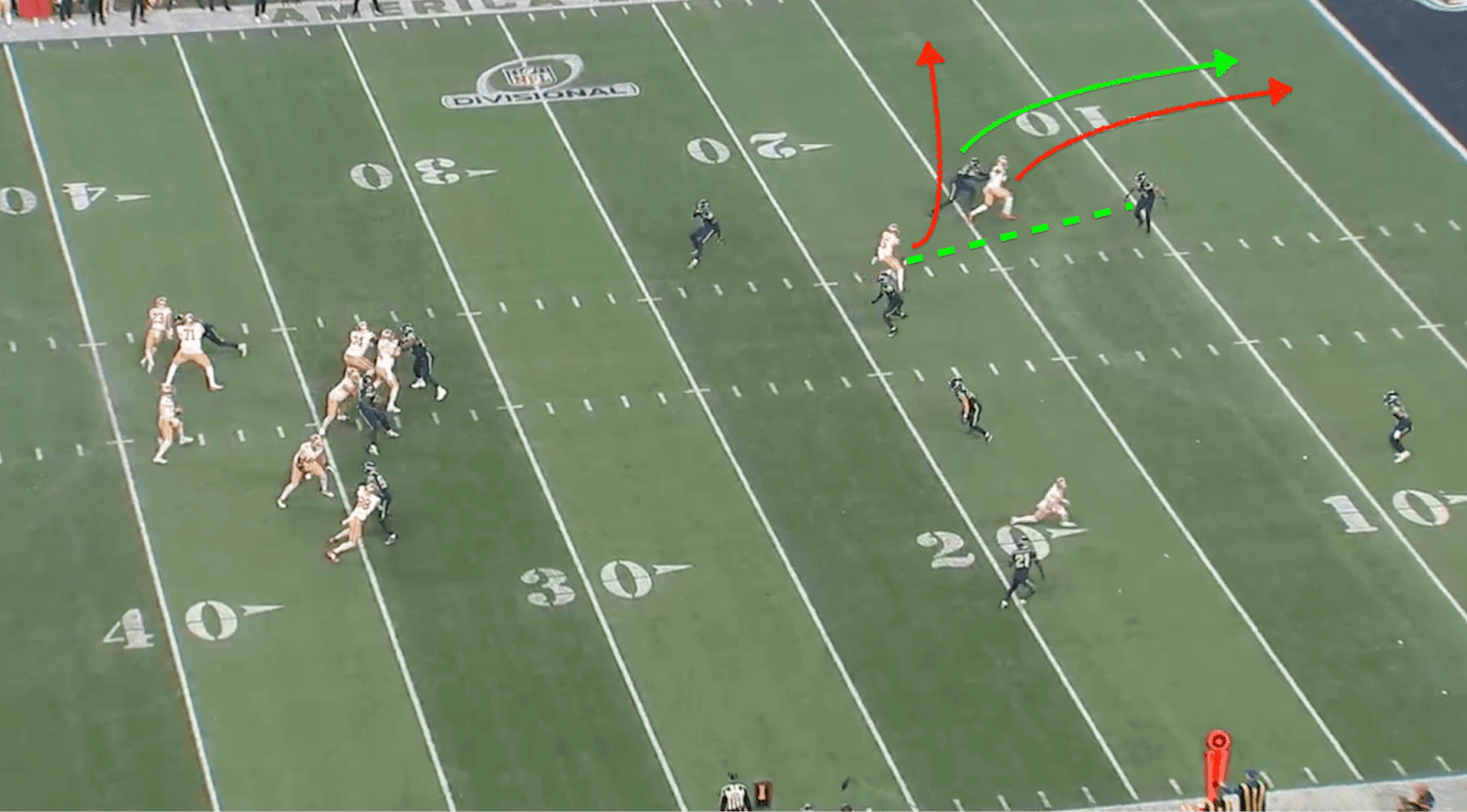
Jennings got open, but a bad ball spoiled the opportunity. Later in the game, Shanahan went back to the same concept—only with fullback Kyle Juszczyk running the corner route—and caught Seattle in the same quarters coverage. But this time, you see Bryant pass the corner off to Woolen, who’s in a better position to cover it, and he takes the deeper route.
Macdonald’s defense can come off as this complex scheme built on coverage disguises and designer blitzes, but the key element is how organized it all is. Next time you watch Seattle play, study the pre-snap communication between players. They’re constantly communicating, and every adjustment by the offense triggers even more conversation. The Seahawks don’t play a wide variety of coverages, but the players can make adjustments to account for whatever the offense throws at them. This is another quarters beater from San Francisco that Seattle seamlessly adjusts to mid-play. Watch how the two safeties exchange routes and take away both options for Purdy, who forces an underneath throw that’s intercepted.
Purdy completed just two of his eight attempts over 10 air yards in Saturday’s loss. The first was a blind throw over the middle that just barely made it over the outstretched hand of a Seahawks linebacker. The other came on a broken play, with Purdy making a tight-window throw to Jennings. Nothing came easy for the Niners quarterback, who played “in rhythm” on only nine of his 33 dropbacks, per Pro Football Focus, and even those in-stucture plays weren’t productive.
Brock Purdy vs. Seattle, Divisional Round (Via TruMedia/Pro Football Focus)
Macdonald was a step ahead of Shanahan all night, which has been the pattern in each of the three matchups between these two elite play callers this season. The 49ers scored just 26 points across 180 minutes against this Seahawks defense. Over the final 120 minutes, they didn’t find the end zone. Shanahan was shorthanded for two of those games, but Macdonald has consistently gotten the better of the 49ers coach since their first matchup in 2024. Shanahan won that game and scored 36 points, but his offenses haven’t scored more than 17 in the four games since then, and Macdonald has won three of the five matchups. There aren’t many defensive play callers who have Shanahan’s number, but the Seahawks head coach is one of them.