

Welcome to Statue Season! Each week leading up to the 98th Academy Awards ceremony, we’ll be checking in on the closest races, the winningest narratives, and the plain old movie magic that will decide who’s taking home the gold on March 15. This week, we’re crunching the numbers to see which precursor awards are most accurate in predicting Oscar winners.
At the Golden Globes this past Sunday, Sinners, despite its status as an Oscar Best Picture favorite, underperformed. It nabbed only two awards: for Cinematic and Box Office Achievement, in which it wasn’t going against any Academy Awards front-runners; and Best Original Score, which was relegated to a commercial break. One Battle After Another, on the other hand, came out the big winner. It took home a Globes-leading four awards, for Best Performance by a Female Actor in a Supporting Role, Best Director, Best Screenplay, and Best Motion Picture, Musical or Comedy. It also took a big, juicy bite out of Sinners’ awards momentum. But does that underwhelming Globes performance mean that the sun is officially setting (rising?) on the vampire flick’s Best Picture aspirations?
Short answer: not at all! In fact, Sinners’ placement in many Oscars prognosticators’ Best Picture hierarchies has hardly budged since Sunday. Variety still currently predicts that Sinners will win Best Picture over One Battle. But if you’re an awards season scholar with Gold Derby in your bookmarks bar, it’s not exactly news that the Golden Globes aren’t the greatest predictor of Oscars success. Even casuals probably noticed last year that neither Emilia Pérez nor The Brutalist, the two Golden Globe Best Picture recipients, went on to win the Oscars’ top prize. Plus, the Globes voting body of international journalists has around 300 members, while the Academy has nearly 11,000 potential voters within the film industry. Those are wildly different groups of people! That’s around 36 times the amount of unique tastes, dispositions, and possibly incoherent lines of thinking to appeal to. (For a peek into the psychology of a handful of nearly 11,000 Oscar voters, there are always the anonymous ballots published annually on Variety. We’re coming up on a full year of one of those voters saying, “We don’t see movies like A Complete Unknown made in Hollywood anymore [because] studios are scared of them.” I really need an update with their opinion on Springsteen: Deliver Me From Nowhere.)



Award Analysis
But I digress. If the Globes aren’t reliable in foreshadowing the Oscars, then what can we base our predictions off of? Vibes? (It genuinely might just be vibes.) Are there other awards given out before the Oscars that are more accurate? As we continue trudging along the awards season campaign trail, can we look to any of those preliminary trophies to paint a picture of who might be posing with an Academy Award come March?
We decided to crunch the numbers to find out which precursor awards are actually useful for informing us of what’s likely going to happen at the Oscars. For the sake of brevity, we narrowed the data down to the Oscars’ top four categories: Best Picture, Best Actor, Best Actress, and Best Director. We also chose to focus on the biggest non-Oscar trophies on the awards circuit: the Golden Globes, Critics Choice Awards, BAFTAs, Actor Awards presented by SAG-AFTRA, Producers Guild of America Awards, and the Directors Guild of America Awards. (Apologies to all of the various critics circles around the country—thank you for giving so many awards to Rose Byrne for If I Had Legs I’d Kick You.) First, here are all of those awards shows’ average accuracy rates in predicting those four Oscars categories combined since 2001.
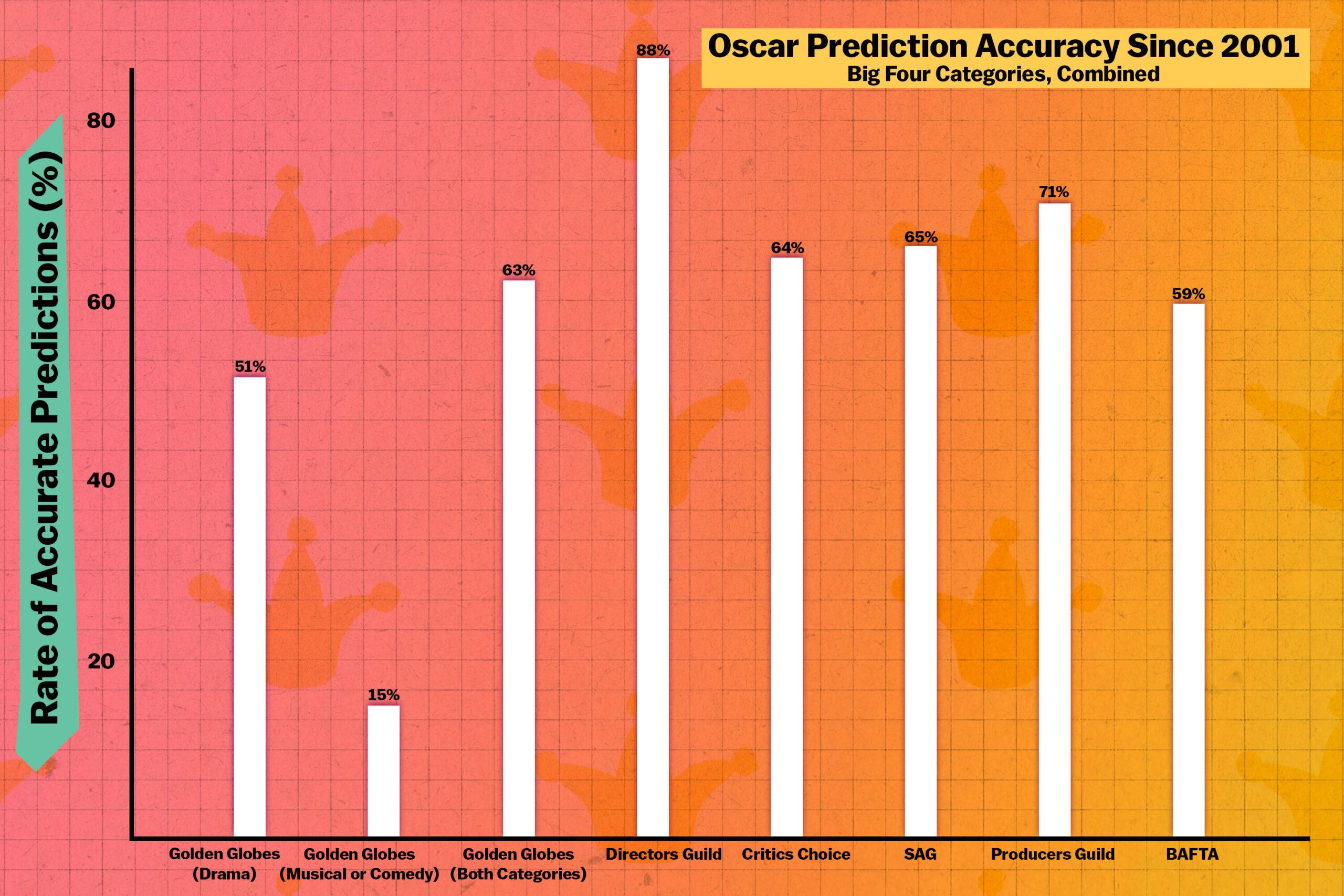
There are a few caveats in this data. For one, um, why is the DGA bar so high? That’s because the DGA Awards don’t have an equivalent for Best Picture, Best Actor, or Best Actress, so their overall accuracy rate here is just for Best Director (which is quite high—more on that later). Same with the PGA Awards, which only has a Best Picture equivalent, and SAG, which has an equivalent for three but not for Best Director.
Secondly, what the heck do we do about the Golden Globes splitting their Best Picture award into two categories? We decided to also split the data for drama and musical/comedy (unsurprisingly, more winners in the drama categories went on to win Oscars) and also include a combined accuracy rate for when a Globes winner in either category went on to win an Oscar. (It didn’t feel right to say that the Globes were half-wrong when their winner for Best Actress in a Musical or Comedy didn’t go on to win the Best Actress Oscar while their Best Actress in a Drama victor in the same year did.) This also informed how we counted the few ties we came across. Our philosophy was that if an eventual Oscar winner was handed a trophy from a precursor awards show, then that awards show predicted the Oscar correctly that year. But even a tie didn’t guarantee accuracy: In 2009, the CCA for Best Actress was a tie between Anne Hathaway for Rachel Getting Married and Meryl Streep for Doubt—ultimately, Kate Winslet ended up with the Oscar that year for The Reader.
As a result, the chart shows most awards shows linger in the 60 to 70 percent accuracy range when combining all of the categories together. But more can be gleaned from zeroing in on the individual categories. Let’s start with Best Picture.
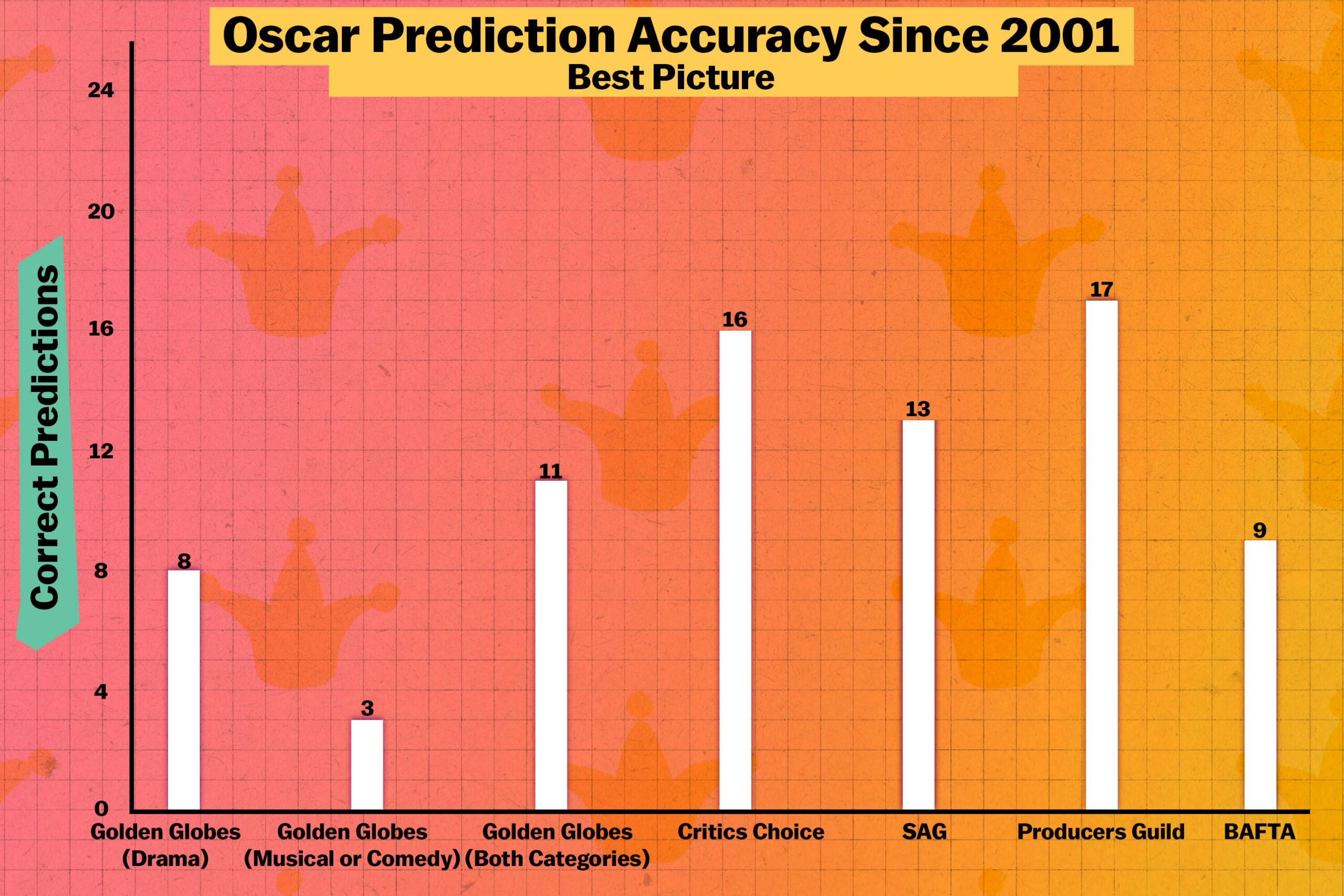
The PGA Award for Best Picture has a reputation for accurately predicting the Oscar, and our data showed no different—it’s missed the mark only seven times since 2001. And while critics famously don’t vote for Oscars, the CCA is right there with it, getting the Oscar right all but eight times. When one of the PGA Award or CCA are wrong, often the other has gotten it right, like in 2011 when the CCA gave its top prize to The Social Network, while the PGA awarded The King’s Speech, which ultimately won the Oscar. (A decision everyone still agrees with!) There have also been a few years in which Best Picture was a toss-up all throughout awards season and the CCA and PGA Award were given to different films—and neither went on to win the Oscar. In 2020, for example, the CCA went to Once Upon a Time … In Hollywood, the PGA Award went to 1917, and the Oscar went to Parasite. But only twice in our dataset were the CCA and PGA aligned and got it wrong, and they were the two most shocking (for different reasons) Best Picture winners of the century: They both picked Brokeback Mountain (which lost the Oscar to Crash) in 2006, and La La Land (which lost the Oscar to Moonlight) in 2017. One Battle After Another has already won this year’s CCA—if it nabs the PGA Award at the end of February as well, then, barring a turn of events á la the Warren Beatty and Faye Dunaway incident, its path to the Best Picture Oscar will look quite clear.
Meanwhile, the BAFTA Award for Best Film, which is one of the most prestigious awards on the circuit, actually somewhat rarely aligns with the Oscars. This could just be a case of British and American tastes differing. Last year, the BAFTAs preferred Conclave, whose papal drama naturally leant itself to a European audience, over eventual Oscar winner Anora, which had a distinctly New York sensibility. If a film wins a Best Film BAFTA in conjunction with other Best Picture equivalent awards, then it can definitely bolster that film’s Oscar résumé. But a surprise recipient of the top BAFTA prize doesn’t necessarily signal that the tides are turning in that movie’s favor. As for the stars of these award-hopeful films …
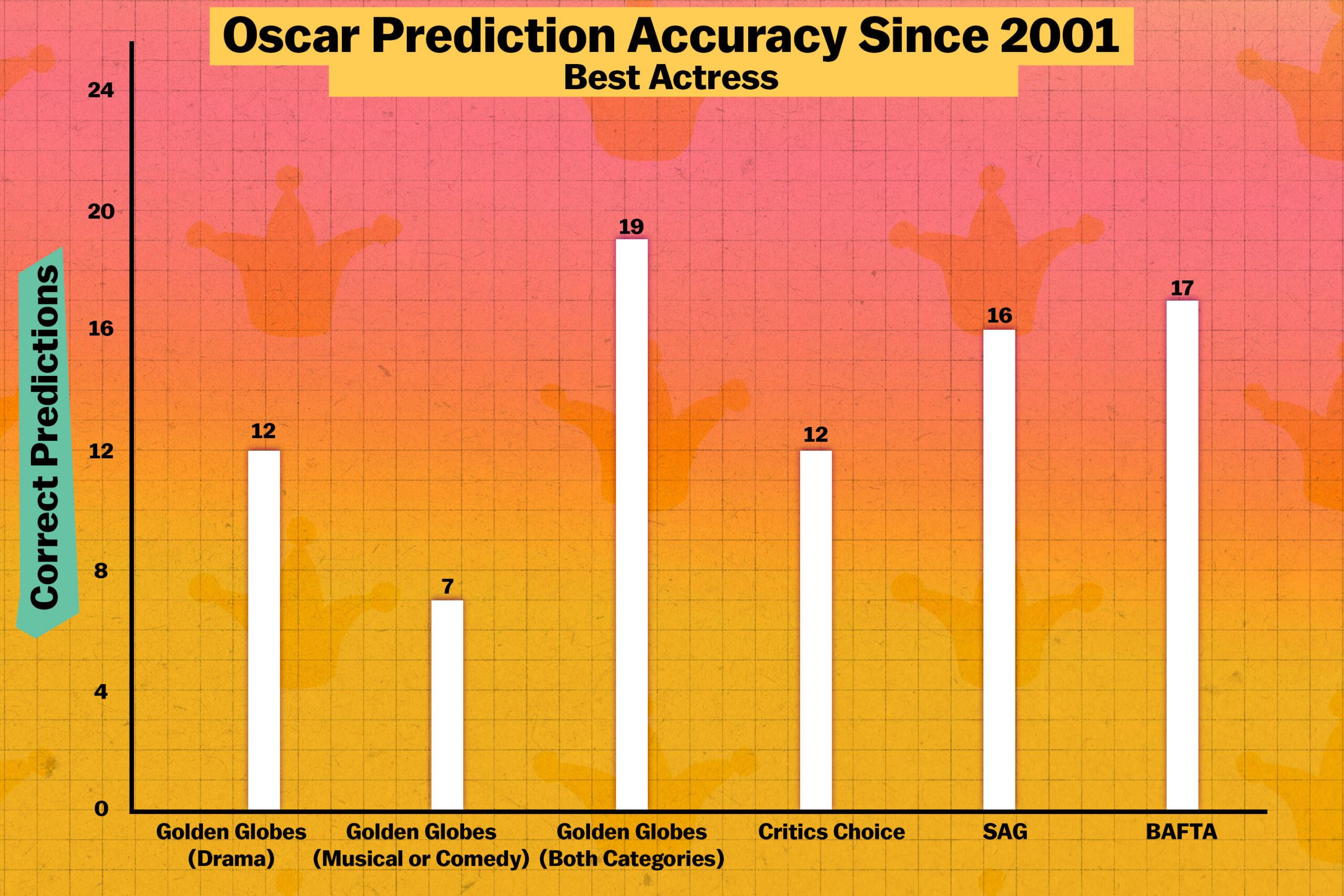
Granted that, again, the Golden Globes give out two awards for the category, the ceremony is actually a pretty good predictor of the Best Actress Oscar. (And they spread the wealth between the drama and musical/comedy categories much more than I thought they would.) There have been only five times since 2002 that the eventual Oscar winner wasn’t awarded with a Best Actress Golden Globe in either category. One of those was last year, when the drama award went to I’m Still Here’s Fernanda Torres and the musical/comedy award went to The Substance’s Demi Moore. Moore tore through that awards season, collecting the Globe, CCA, and SAG Award until Anora’s Mikey Madison snuck in for the BAFTA and eventually the Oscar. That was an anomaly, but it did speak to how strong the BAFTA can be at predicting Best Actress—it’s much more reliable in this category than it is for Best Picture. Hamnet’s Jessie Buckley is still the front-runner for this year’s Oscar after nabbing the Best Actress in a Drama Golden Globe on Sunday and the CCA earlier this month. If she lands the BAFTA as well they might just start engraving her Oscar in advance.
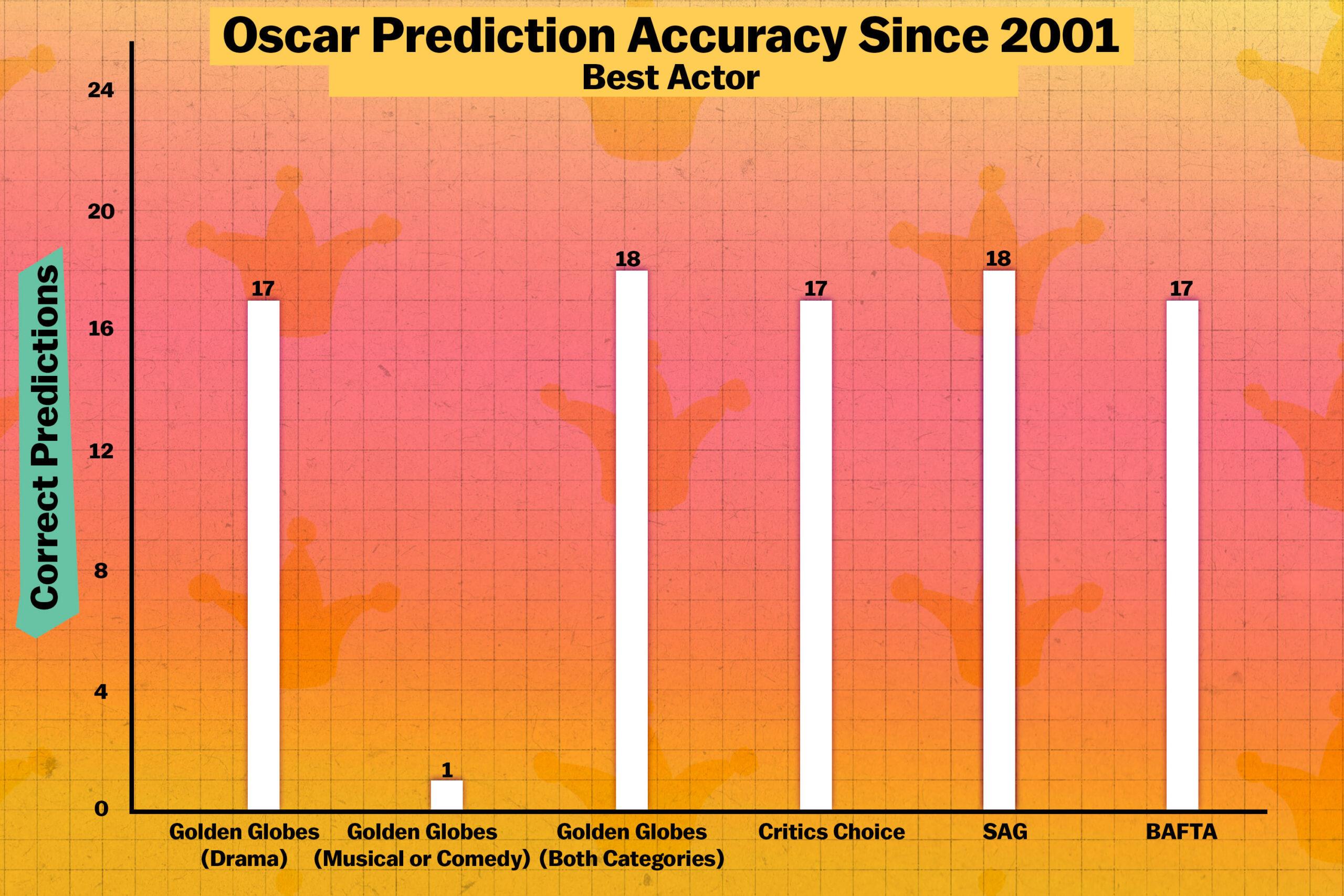
Analysis of the Best Actor data doesn’t reveal one particular awards show as a strong predictor. They all often get it right! That doesn’t necessarily mean these awards shows are aligned with each other every year—there have certainly been close races where the various preliminary awards were scattered. In 2023, for instance, Elvis’s Austin Butler snagged the Golden Globe and the BAFTA, while The Whale’s Brendan Fraser won the CCA and the SAG Award; Fraser ultimately won the Oscar. But overall, the awards ultimately even out to comparable accuracy across the board. But man, they really never give the Oscar to the Best Actor in a Musical or Comedy Golden Globe winner, huh? The only time it happened in our dataset was when Jamie Foxx nabbed both awards for Ray in 2005. Perhaps Timothée Chalamet, who just won that Golden Globe for Marty Supreme, can make it happen a second time?
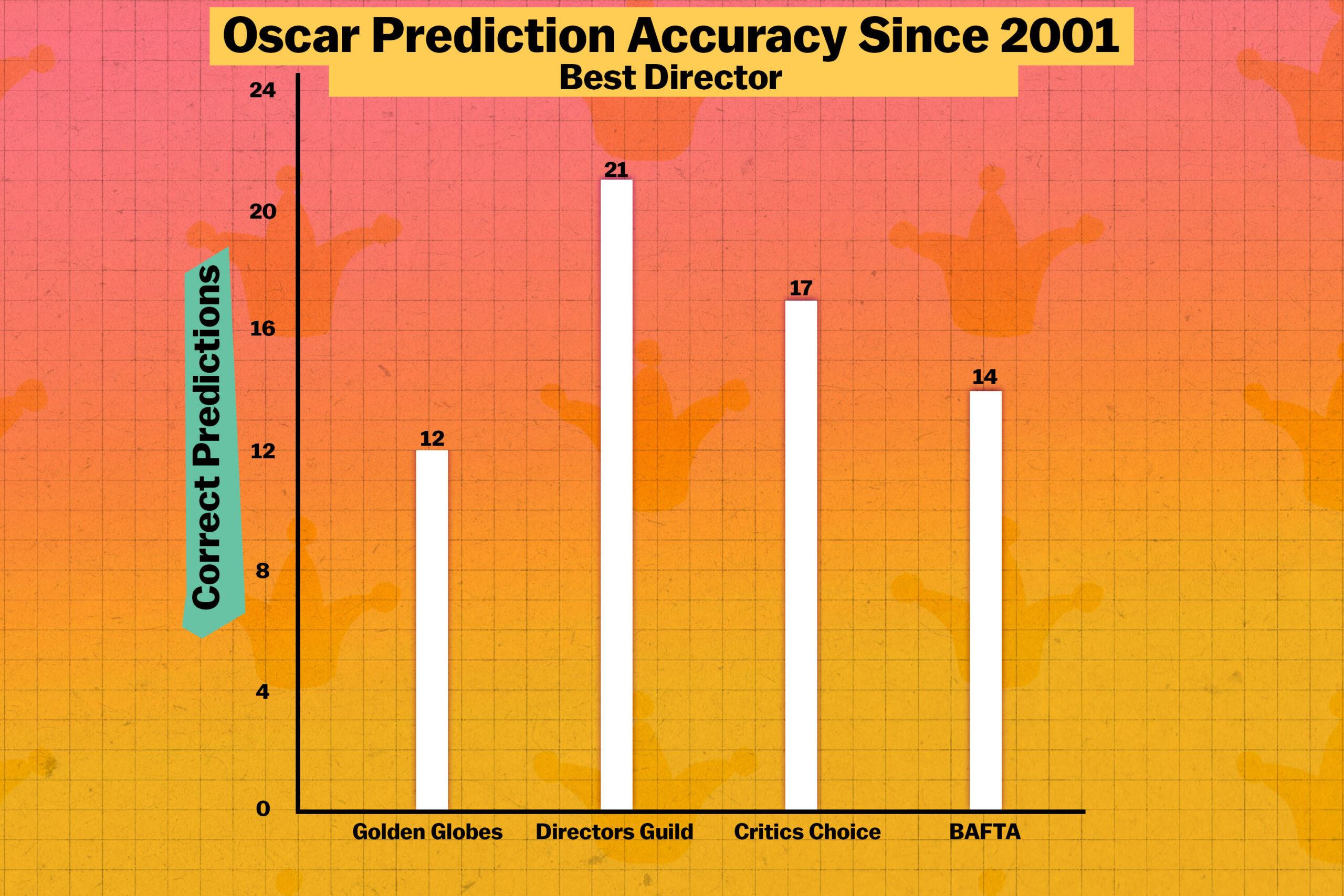
And now on to the single most accurate predictor on the major awards circuit: The winner of the DGA Award for Outstanding Directorial Achievement in Theatrical Feature Film will almost always go on to win the Best Director Oscar. It makes sense—you’d expect the members of the Directors Guild to know who the best director is—but still, it’s pretty astonishing that there are only three instances in our dataset where the DGA Award didn’t predict the Oscar. Those were in 2003, when the DGA gave the award to Chicago’s Rob Marshall and he lost the Oscar to The Pianist’s Roman Polanski; 2013, when the DGA awarded Argo’s Ben Affleck, who was infamously snubbed by the Academy for even a nomination; and 2020, when 1917’s Sam Mendes won it and then lost the Oscar to Parasite’s Bong Joon-ho. Paul Thomas Anderson of One Battle won the Golden Globe for Best Director last weekend, but Chloé Zhao (Hamnet) and Ryan Coogler (Sinners) are still very much in the mix, and all three are nominated for the DGA Award, along with Marty Supreme’s Josh Safdie and Frankenstein’s Guillermo del Toro. It’s safe to say that whoever prevails there will be the favorite for the Oscar. However, the guild awards can often overlook international features (the SAG nominations last week strongly favored English-language films) and there are directors like Jafar Panahi (It Was Just an Accident) and Joachim Trier (Sentimental Value) that could be quite competitive in this year’s Best Director race despite missing out on the nod from the DGA. The DGA Awards probably won’t be able to maintain its high rate of accuracy forever, as the increasingly international Academy continues to reward non-English filmmakers, but, so far, it’s been just about as good of a predictor as you can get.
Stock Watch
To paraphrase one of cinema’s great stockbrokers: Nobody knows if an Oscar stock is going to go up, down, sideways, or in circles. In this section, we’ll evaluate who’s on the up-and-up and whose momentum is sputtering out as the competition across categories heats up.
Stock up: Teyana Taylor’s lovely Golden Globes speech may have moved her to the front of a wide-open Best Supporting Actress category. Marty Supreme rallied past One Battle at the domestic box office, and is already one of A24’s most commercially successful films ever. I think watching Stellan Skarsgard (Sentimental Value) walk up to Usher’s “Yeah!” to accept his Golden Globe just made everyone root for his Oscar win even harder.
Stock down: Sean Penn’s Best Supporting Actor campaign has been on a downward slide over the past few weeks, but him smoking indoors at the Globes may have finally pushed it over the edge. With Jessie Buckley collecting back-to-back Best Actress trophies at the CCA and the Globes, If I Had Legs I’d Kick You’s Rose Byrne’s Oscar odds might be, well, kicked out from under her. The bar was set high (perhaps too high?) when many expected Avatar: Fire and Ash to cross the $2 billion mark at the global box office (as its predecessors both did), and as a result there’s been some concern over the sequel maybe not becoming one of the highest-grossing films of all time. Could ending up in merely the high billions dash its Oscar hopes?