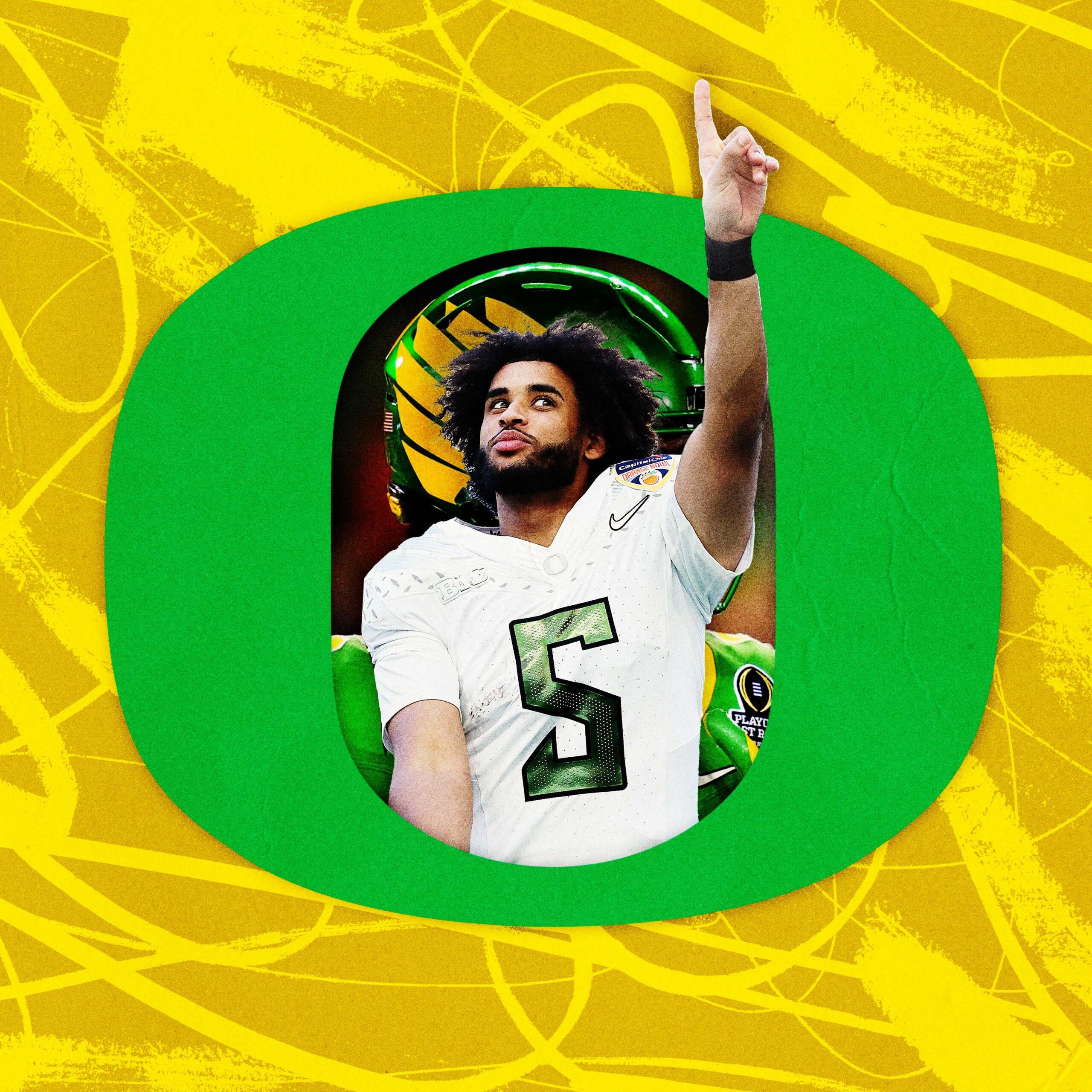

College football has a way of constantly reminding its fans that the sport isn’t what it used to be. Quarterback Dante Moore’s decision to return to the University of Oregon for one more year rather than enter the 2026 NFL draft was just another sign that any vestige of the old college football ecosystem is gone.
“I just want to do what’s best for my situation,” Moore said on ESPN’s SportsCenter, “especially as a quarterback.” His decision has significant ramifications across the sport. Oregon immediately becomes a top contender to win a championship next season, while the upcoming draft is left with just one elite prospect (Fernando Mendoza), and Moore’s choice to pass up being not just a first-round pick but potentially a top-three pick perhaps signals a new trajectory for top college quarterbacks going forward.
As a pro prospect, Moore checks the boxes NFL teams typically drool over: He is only 20 years old, a good athlete with a 6-foot-3 frame, and fresh off a breakout season in which he led his team to the semifinals of the College Football Playoff. He was considered one of the two best quarterbacks in this upcoming class—along with Indiana’s Mendoza—and was frequently linked to the Jets as the second pick in mock drafts (including here at The Ringer). Even in a worst-case scenario, I couldn’t imagine he’d fall past Cleveland, which currently owns the sixth pick.
It cannot be understated how rare it is for a player like Moore—a surefire first-round quarterback without any glaring red flags on his résumé—to decline the call of the league. Even in the age of the rookie wage scale, which was designed more than a decade ago to cap a player’s earning potential for the first few years of their NFL career, it has been unheard of for a player to forgo tens of millions of dollars in order to return for another year of college. The opportunity to start collecting an NFL check was too great, and the risks that came with returning to school were too high. An injury, a stretch of poor play, or both could quickly tank a player’s draft stock. Why do you think so many players skipped out on bowl games in the pre-NIL days? The risk-reward calculus has entirely changed in the NIL era.


Just a decade ago, the only way a highly touted college player could protect his future earnings was to take out a multimillion-dollar insurance policy—and there wasn’t a ton of security there, either. NIL deals have afforded college players a level of financial flexibility that was unimaginable even a decade ago. And while there isn’t a formal registry of NIL deals, we know the money, especially for quarterbacks, is substantial. ESPN’s Pete Thamel reported that Texas Tech quarterback Brendan Sorsby fielded offers in the range of $5 million this offseason, and Sorsby was just an above-average college quarterback in the transfer portal. Imagine how much Moore is earning to stay in Oregon. His valuation was already estimated at $2.5 million before he was able to leverage his potential draft position in negotiations. For the right amount of money, I can certainly see why Moore would return to school instead of playing for the Jets, who haven’t had a good long-term starter since … Chad Pennington. Or was it Ken O’Brien?
And in weighing Moore’s current earning potential at Oregon against an NFL rookie contract, we have to consider the struggles of highly drafted quarterbacks with a profile like Moore’s in recent years. Since 2020, there have been six quarterbacks selected in the first round who were 21 or younger at the start of their rookie seasons. In chronological order, they are Jordan Love (2020), Trevor Lawrence (2021), Trey Lance (2021), C.J. Stroud (2023), Anthony Richardson (2023), and J.J. McCarthy (2024). Richardson and Lance were near-immediate flameouts, and McCarthy might be on his way to a similar outcome. Love, Stroud, and Lawrence are all quality starters, but each of their careers has had ups and downs. Even if you look back further into the last decade, the results for the players drafted at age 20 or 21 don’t improve much. Neither Jameis Winston nor Marcus Mariota, the respective no. 1 and no. 2 picks in 2015, earned an extension after their rookie deal. Josh Rosen was one-and-done in Arizona after he was a first-round pick in 2018, and his draft classmate Sam Darnold didn’t turn a corner until last season, six years into his career. The successful cases of younger quarterback prospects drafted since 2015—Jared Goff, Patrick Mahomes, and Lamar Jackson—now feel like the exceptions that prove the rule.

If Moore came to the conclusion that he probably won’t immediately light the league on fire while playing for the Jets (or one of the other moribund franchises picking near the top of this draft), we should applaud his self-awareness. While he’s a tantalizing prospect because of his arm talent and mobility, he still lacks polish in key areas—namely his ball security, reaction to pressure, and accuracy in tight windows. The College Football Playoff semifinal game against Indiana was illuminating in that regard. Facing a defense he’d already played (and struggled) against earlier in the season, Moore seemed tentative; he turned down open throws and missed checkdowns, which led to sacks and turnovers. Texas Tech’s pass rush caused him some problems in the first round of the playoff, too, as he took two sacks, threw an interception, and fumbled in an attempt to throw. In watching those games, it seemed like Moore was lacking some of the quarterbacking instincts you see in pros. I’d describe him as a “see it then throw it” type of passer, someone who’s not quite ready to anticipate which windows are open. That’s a skill he can only properly develop with more time.
When you consider these limitations and compare him to the recent examples of players with steep NFL learning curves, it’s pretty clear that taking an extra season in the college ranks is the right thing for his development. Lance and Richardson, high-first-round picks with relatively short college résumés, have all the arm talent in the world, but neither managed to speed up their decision-making to match the NFL game. Stroud and Lawrence have had issues with managing pressure and muddy pockets in the league. Those issues turned Winston into a turnover machine and Mariota into a checkdown artist.
So instead of going to the league and wasting his time sitting behind a veteran or risking washing out of the NFL by starting immediately when he probably isn’t ready, Moore will get to spend another year at Oregon, getting the in-game reps he needs to turn his skill set into one that’ll win in the pros. It was a surprising decision, but ultimately, it could pay off. The NFL tends to be much better at maximizing the skill set a quarterback has when he arrives in the league than at developing an unpolished player.
For all of the quarterbacks who have gotten a second chance in recent years, from Darnold to Baker Mayfield to Daniel Jones to Geno Smith, there’s a much longer list of highly drafted quarterbacks who were only given one chance to fail.
So what does Moore’s decision mean for the NFL? The 2026 quarterback draft class might be light, with just Mendoza and potentially Alabama’s Ty Simpson going in the first round, so I would expect teams to focus on the areas where this draft has depth and talent: in the trenches and on defense. That could be a specific boon for teams like the Jets, Cardinals, and Browns, which each need help in at least one of those spots (and, obviously, at quarterback). All of those teams are in the early stages of a long-term rebuild (and two of them, Arizona and Cleveland, will be hiring new head coaches this offseason). It might be smarter to play the long game at quarterback, especially when next year’s draft should be loaded with talented quarterback prospects: Moore, Arch Manning (Texas), LaNorris Sellers (South Carolina), CJ Carr (Notre Dame), Jayden Maiava (USC), and Marcel Reed (Texas A&M). Each of those quarterbacks will arrive in the NFL in 2027 as experienced collegiate starters—and several will be on contending teams in 2026.
And if we’re looking at recent draft trends, it seems like the league is becoming more open to drafting highly experienced quarterback prospects in the first round than ever before. From 2016 to 2019, only three first-round quarterbacks were 23 or older to start their rookie seasons. Six have been drafted since Joe Burrow went no. 1 in 2020. Recent drafts have been full of older prospects, including Bo Nix, Michael Penix Jr., and Jayden Daniels in 2024, plus Cam Ward last year.
While I don’t think the league is chasing any particular archetype post-Burrow, his dominant 2019 campaign at LSU and subsequent run to Super Bowl LVI in his second NFL season may have drawn some teams to look for more polished players. Manning, Maiava, and Reed will be 23 or older to start their pro careers. Moore will be 22 in 2027. We’ll learn whether the league truly prioritizes experience in the 2027 draft, especially if an up-and-down campaign from any of these passers doesn’t significantly harm their draft stock.
The NIL and transfer portal era has forever changed the way we look at college football. When a player as good as Moore chooses to stay in school rather than be a top draft pick, quarterback trajectories may be forever changed, too. We’re exiting the times of teams craving baby-faced passers; they’re now in search of finished products.