
Matt Hoover wasn’t thinking about moral hazards, basketball karma, or the corrosion of the NBA’s competitive soul when he created the NBA’s definitive tanking tracker, back in the dreary winter of 2013. He swears that he wasn’t trying to shape the zeitgeist or to stoke our collective obsession with ping-pong balls and weighted odds.
No, Hoover—then a 28-year-old software engineer and mildly despondent Chicago Bulls fan—just wanted an easier way to monitor his team’s chances of landing the top pick in the 2014 draft, following another injury to Bulls star Derrick Rose. Back then, he’d wake up each morning, find the standings, flip them upside down, and then sort out the lottery odds. “And, I mean, I got tired of it,” he says.
So Hoover spent a week busily writing code before hitting publish on December 13, 2013. And boom, Tankathon was born, heralding a new era of perverse fandom, in which we, the cynical masses, root for bad teams to get worse, heaping praise on the “smart” executives who game the system and scorning the “foolish” ones who chase .500 while sacrificing their draft position.
“Tanking,” as both a term and a roster-building strategy, was spiking across the NBA, thanks largely to the brazen machinations of the Philadelphia 76ers, who under new general manager Sam Hinkie had embarked on a scheme known as “The Process,” a multiyear campaign of losing in pursuit of high draft picks. The 2014 draft class was said to be loaded with can’t-miss talent—Andrew Wiggins, Jabari Parker, and Joel Embiid—and several other teams appeared to be following the Sixers’ lead, albeit a little more subtly. Hinkie set off a crisis and a trend.
No one knew it at the time, but we were seeing the start of what has become, unofficially, the Tanking Era. And Tankathon would become, both symbolically and practically, its most vital resource for fans and media.
“I didn't do it with the intent of capitalizing on any sort of new rise in tanking interest,” Hoover says. “I really did it solely for self-serving Bulls reasons that I figured other people would also like to use for their teams. … I think that is an indication, like maybe that year really was kicking things off in terms of fans being aware of the strategy and the benefits of tanking.”
To be clear, tanking—our catchall term for strategic losing—did not begin with the 2013-14 season. The NBA has a long and inglorious history of teams manipulating their way to the top of the draft board, most infamously in 1984, when the Houston Rockets leaned into the losing and were rewarded with no. 1 pick Hakeem Olajuwon; the league instituted its first draft lottery the next year, in hopes of curbing the practice. Back then, tanking was considered a cardinal sin, discussed in hushed tones, employed sparingly, and referenced infrequently in the media.
But today, tanking is a broadly understood, even celebrated, strategy for downtrodden teams and a daily talking point for fans and pundits. We might decry the practice in moral terms, but we just as easily endorse it when it seems like the most practical course for a losing franchise.
And it might seem like this has always been the reality, but I am here to tell you that tanking as we now know it, as a common strategy and staple of NBA discourse, effectively took off with that 2013-14 season. It has hardly waned since, despite much hand-wringing and many reform measures. And we are all complicit in its rise.
It was in 2013-14 that Hinkie, the young, analytics-driven Sixers exec, began dismantling his roster in pursuit of better lottery odds and a franchise star. That’s the year this site’s founder, then writing at Grantland, penned a cheeky column titled “10 Steps to Tanking Perfection,” detailing the myriad methods for subtly sabotaging your team’s success—a piece inspired by the evident tanking surge across the league.
That’s the year Zach Lowe, also at Grantland, first reported on a revolutionary proposal, devised by Boston Celtics executive Mike Zarren, to eliminate tanking: the “Wheel,” in which teams would rotate through all 30 draft slots over a 30-year cycle, abolishing the reverse-order draft, and all its warped incentives, entirely.
That’s when not one but two independent websites, Tankathon and the now-defunct TankingforWiggins.com, were launched. They were, as far as anyone knows, the first sites solely dedicated to the concept.
And that’s when Adam Silver, newly installed as NBA commissioner, first publicly decried the practice, in an interview with Malcolm Gladwell at the annual MIT Sloan Sports Analytics Conference in March 2014. Silver pushed for immediate reforms. But a proposal to flatten the lottery odds failed to garner enough votes by team owners that fall, and the so-called race to the bottom continued apace.
A less drastic reform eventually passed and went into effect in 2019, giving the three worst teams equal odds at the top pick. A new play-in tournament, formally adopted in 2021, gave struggling teams another pathway to the playoffs, further reducing the incentive to be the NBA’s greatest loser. Reducing, not eliminating. In recent seasons, the NBA has fined the Dallas Mavericks ($750,000) and the Utah Jazz ($100,000) for tanking-related infractions. Bad teams shutting down key players for the stretch run has practically become a rite of spring—and a blight on the league. Last month, ESPN reported that league officials were considering yet another wave of anti-tanking reforms.
“We certainly believe that [previous reforms] have improved overall competitive incentives and team behavior,” says Evan Wasch, the NBA’s executive vice president of basketball strategy. “We have more teams in contention for the postseason each year, and the so-called race to the bottom has been tamped down a bit.”
But, league officials note, there are still teams strategically manipulating their rosters, both before and during the season, either to chase the best odds of the no. 1 pick (as the Jazz were last season) or to retain a protected pick that would otherwise be lost via trade (as the Mavericks did in 2023).
“We generally believe that any real or perceived effort by a team to not compete to the best of its ability can be corrosive to the competitive integrity of the league,” Wasch says, “and so it’s critical that we keep an eye on it and continue to look for additional changes that [discourage tanking tactics].”
But it’s hard to sermonize on the ills of tanking when the NBA’s current defending champion did it so well, just a few years ago. The Oklahoma City Thunder didn’t tank to get MVP Shai Gilgeous-Alexander or costar Jalen Williams (both arrived via trade), but some well-timed losing did net them star big man Chet Holmgren, the second pick of the 2022 draft.
Of course, tanking doesn’t always pay off. Teams pick the wrong player, or get screwed by the lottery balls, or get the top pick in the wrong season, when there’s no clear-cut star at the top of the board. But tanking works often enough to keep teams chasing the odds.
It’s easy to tsk-tsk the league for not doing enough to date, or even to deride league officials for trying to “fix” the system at all, since a reverse-order draft will always incentivize losing to some degree. But perhaps we should all look in the mirror before climbing our rickety stack of soapboxes. Because the fact is that we’re all to blame here.
At some point, we all bought into tanking as a sensible strategy, as wise, as warranted. We endorsed it, applauded it, gamified it, made it a staple of debate shows and podcasts. Losing in the pursuit of blue-chip talent became normalized, the smart thing to do. We gave lip service to the moral hazards, but we just as quickly lauded Hinkie and every other GM who timed their “rebuilding” seasons with a tantalizing draft class.
And we nodded approvingly when Kevin Pritchard, freshly let go by the Portland Trail Blazers and speaking at the Sloan Conference, famously referred to teams stuck in the middle—not good enough to contend, not bad enough to earn high draft picks—as running on a “treadmill of mediocrity.”
The only thing worse than losing 60 games today would be losing only 40 games and locking yourself out of a top pick. Today, even the most devout fans sometimes root against their teams. Alan Sepinwall, the longtime TV critic and a hardcore Knicks supporter, turned tank GIFs (as in, GIFs of actual tanks) into a running gag on his Twitter account in the late 2010s, when the Knicks were, well, not very good.
These are distinctly unromantic times in pro sports. It’s an era shaped by analytics, financial realities, and salary-cap strictures in which players are redefined as “assets,” draft picks are precious currency, and every fan is steeped in CBA jargon. Our sports brains have been rewired for cold, hard practicality. Sure, I’d like my team to win more … but have you seen Cameron Boozer and A.J. Dybantsa? Definitely worth tanking for!
We don’t even wait for the season to begin or the losses to start piling up before declaring which teams should sacrifice the season. We know who should lose, and we say so. There is no honor in losing, but it now comes with praise if done with intent, for the right reasons. It wasn’t always this way.
According to a Nexis search, the terms “NBA” and “tanking” appeared in major U.S. newspapers about 185 times per year in the 1990s—including 213 times in 1997, the year the San Antonio Spurs drafted Tim Duncan with the no. 1 pick, after losing David Robinson to a back injury for most of the season (amid suspicions that the Spurs held him out longer than necessary to boost their lottery odds).
From 2000 to 2009, the average number of tanking references shot up to 361 per year—peaking at 585 in 2007, the year Greg Oden and Kevin Durant topped the draft board. Tanking was still a passing topic, not yet an all-consuming discussion. That was about to change.
There were 463 references in 2013 (the year Hinkie was hired) and 673 references in 2014 (when Wiggins was drafted no. 1). From 2010 to 2019, the average was 486, but it was even higher—593 per year—in the stretch from 2014 to 2019, as tanking became embedded in the discourse. It has held steady at 400-plus references per year from 2000 through 2025, even as U.S. newspapers have withered and reduced coverage.
Whether those are all references to real tanking or merely perceived tanking is almost immaterial—the constancy of the discussion, indeed, the rhetorical mainstreaming of tanking, is itself corrosive.
“Analytics tell a certain story to teams—and that is that there's nothing like a high draft pick if you want to change your fortunes and rebuild your team,” Silver said last April, during an appearance on the Numbers on the Board podcast. “And it’s a little weird, too, because fans have gotten a lot more sophisticated, as well. … In some cases, you have fans saying to teams: What are you doing? Like, you don't want to finish, like, in the middle of the pack. … You’re better off doing worse. That used to never be the case in the old days.”
League officials believe that tanking has waned some in recent years, thanks to the introduction of flatter odds and the play-in tournament. The volatility of the lottery in recent years should—should—at least give teams pause before they flush a season.
The Mavericks won the top pick (and Cooper Flagg) last year, even though they had the 11th-worst record (and a 1.8 percent chance). In 2024, the Atlanta Hawks, with the 10th-worst record (3 percent chance) leaped to first. And of course, in 2019, the first year with the flatter odds, the New Orleans Pelicans won the first pick (and Zion Williamson), even though they’d finished with the seventh-worst record.
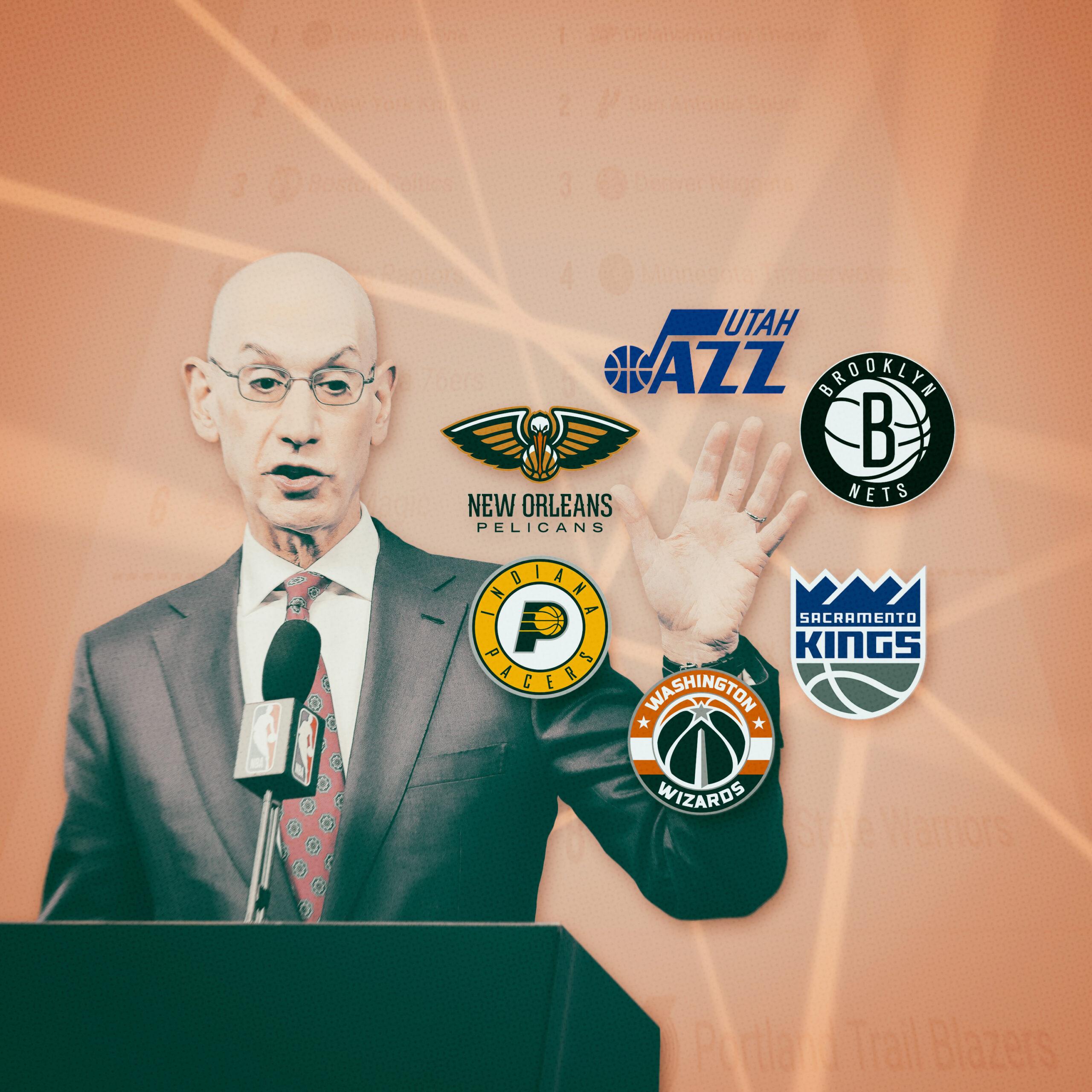
Then again, the Spurs got exactly what they wanted in 2023, when they meandered their way to a 22-60 record—second worst in the league—and won the lottery and the rights to draft Victor Wembanyama, a generational talent. Today, the Spurs are a legit title contender, highlighting once more why teams are so willing to place their faith in the ping-pong balls, no matter the odds … and why fans of the Washington Wizards (10-29), Brooklyn Nets (11-27), and Utah Jazz (14-26) feel profoundly conflicted when their teams win. Every fan of a bad team is dreaming of Boozer, Dybantsa, and Darryn Peterson. No one wants to ride the treadmill of mediocrity.
So league officials are back to brainstorming new anti-tanking measures. No specific proposals are under formal consideration yet. But, as ESPN reported (and The Ringer has confirmed), the NBA is considering new restrictions, including banning teams from drafting in the top four two years in a row, to discourage multiyear teardowns (e.g., the Process-era Sixers); locking the lottery odds based on team records as of March 1, to discourage teams from racing to the bottom once they’re out of the playoff mix; and limiting, or even eliminating, so-called pick protections, to discourage teams from losing intentionally in an effort to retain a traded pick (e.g., the Mavericks in 2023 or the Sixers in 2025).
The league’s renewed focus comes at a time when scouts are again salivating over a glitzy draft class. Yet, ironically, the tanking picture today has never been murkier.
Consider:
- Of the 11 teams in the NBA’s bottom tier, three don’t own their first-round draft picks (New Orleans, the L.A. Clippers, and the Milwaukee Bucks) and therefore have no incentive to tank.
- The East’s worst team, the Indiana Pacers, was in the NBA Finals last spring and is losing primarily because franchise star Tyrese Haliburton ruptured his Achilles last June. They did not set out to tank.
- The West’s worst team, the Sacramento Kings, loaded the roster with overpriced veterans in an attempt to be competitive. Typical of the Kings, they just made a lot of horrible moves. But they didn’t set out to tank.
- The Dallas Mavericks, Charlotte Hornets, and Memphis Grizzlies are all in the cellar because of some combination of bad decisions and bad luck.
- That leaves three teams that, by all appearances, began this season with an intention to lose by design. Each is in a rebuilding phase and committed to young, unproven players: Brooklyn, Washington, and Utah.
That’s where things get weird. The Nets went 7-4 in December and had the NBA’s second-best defense that month. (They’ve since lost seven of eight games in January.) The Wizards also recently won seven of 12 games, with shocking victories over the playoff-bound Orlando Magic and Toronto Raptors, a last-second defeat of Giannis Antetokounmpo’s Bucks, and wins against lottery rivals Brooklyn and Indiana. The Jazz, notably, have repeatedly declined to trade star Lauri Markkanen and have also won at a surprising rate, going 7-7 over a 14-game stretch from late November to late December. That included back-to-back wins, on consecutive nights, over the East-leading Detroit Pistons and over Wembanyama’s Spurs.
As of today, none of the presumed tankers look like they’ll challenge the NBA’s futility record (9-73, set by the 1973 Sixers) or even come close, which was often a real fear during the height of the Tanking Era. At the moment, only the Pelicans, Kings, and Pacers are on pace to finish with fewer than 20 wins. The Jazz are on pace for 28 wins, which would be an 11-game improvement over last season.
Of course, it’s only mid-January. The real tanking usually begins in the spring, once teams fall out of the playoff (or play-in) race, with key players missing games because of “back spasms” or “knee soreness.” Some of December’s surprisingly competitive teams could suddenly turn inept in April.
The murkiness is part of the issue. In a 30-team league, at least a third have to be losers in any given season, whether they set out to be or not. Every team goes through a legitimate rebuilding phase at some point and would do so even without a reverse-order draft. Not all losing is by design, and not all of those teams on the Tankathon board are actually tanking. But in our collective cynicism, we’ve made the terms synonymous and obliterated all distinctions. That, too, is a casualty of the Tanking Era.
So Silver will keep pushing for reform, Wasch and his team will keep formulating creative new proposals, and somewhere in New England, Mike Zarren might polish up his Wheel for another ride. As long as there’s a reverse-order draft of some sort, savvy team executives will keep looking for ways to game the system—just as savvy players will keep finding creative ways to draw fouls.
The real winner in all of this? Maybe it’s Matt Hoover. The NBA Tankathon site was so popular that he added NFL and NHL pages in 2015, followed by MLB in 2018 and the WNBA in 2023. The NFL is now his top traffic driver, although NBA engagement remains robust. Two years ago, Hoover quit his software job. Tankathon, which is now dotted with display ads, has become his sole source of income.
The very existence of Tankathon almost assuredly makes league officials cringe. They would prefer a world where every team tries to win every game, every season, where injury reports don’t require a forensics investigation and fans cheer only for victories. But that’s not the world we live in now, and it might never be.
As for Hoover and his futility-celebrating website? Sure, you could argue it’s somehow distasteful or perverse or a contributor to all the “moral hazards” we keep bemoaning. But Hoover didn’t invent tanking or the draft or the lottery system; he just created the best instruction manual for following it—and gave us one more reason to follow all 30 teams through the long slog of an 82-game season.
“It’s like a beacon of hope for fans of really bad teams,” Hoover says. “Sure, the site is named Tankathon and in a way glorifies or makes light of tanking. But it does keep people interested in the league and paying attention and scouting prospects and hoping for the future of their team, whereas maybe they would just be checked out without it. So really, no, I don't feel guilty. I've just served a need that people had.”
To paraphrase a notorious fictional military man stationed in Guantanamo Bay: The truth is, we live in a world that has tanking teams, and those teams have fans, and those fans need to be kept engaged. Who else is gonna do it? You could say that Matt Hoover is the Colonel Jessup of NBA tanking. That, deep down, in places league officials don’t talk about at parties, they want Hoover on that wall. They need him on that wall. And he would rather we just said, “Thank you.”