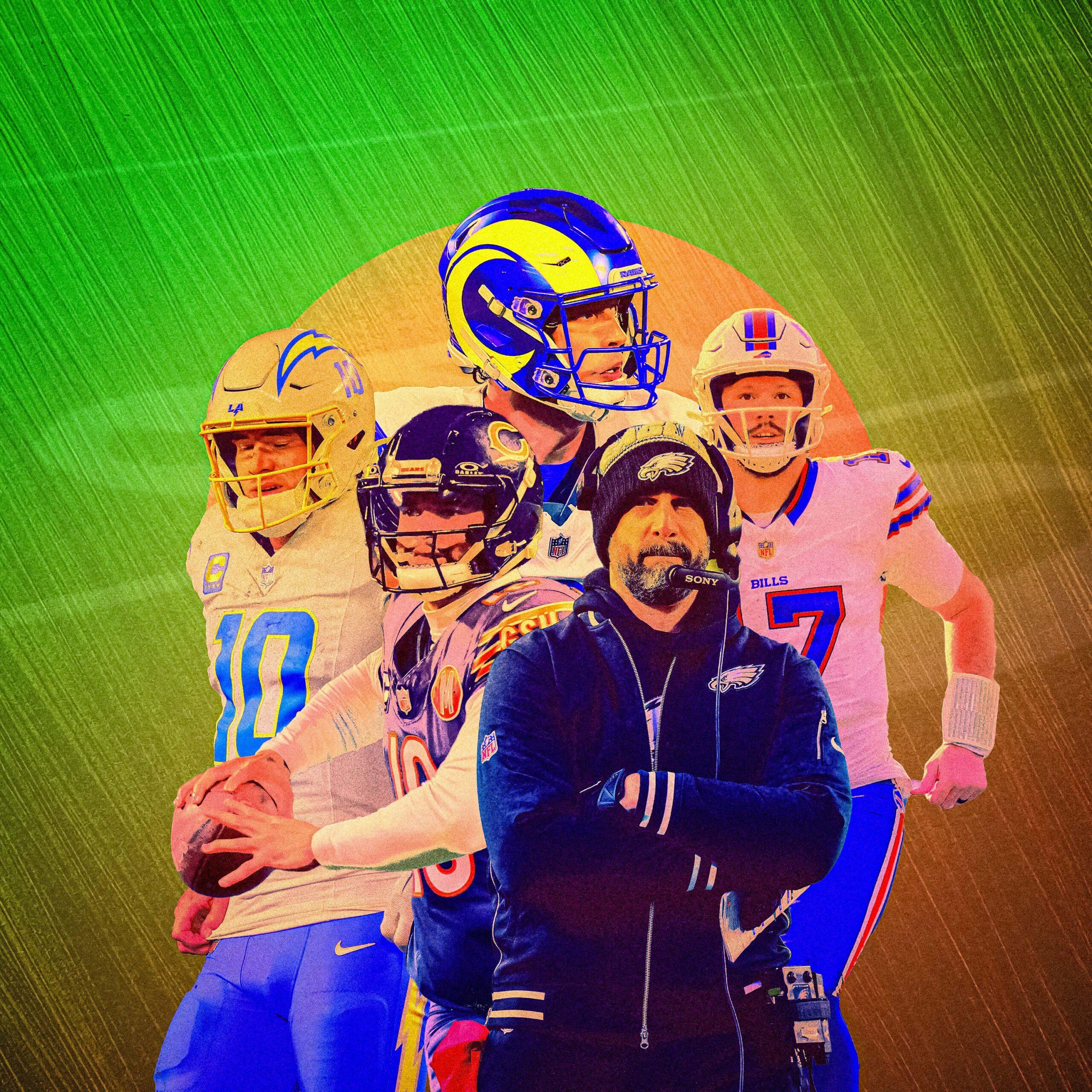

Every week this NFL season, we will break down the highs and lows—and everything in between—from the most recent slate of pro football. This week, we got maybe the most thrilling wild-card weekend ever, with four games decided in the final minutes. Welcome to Winners and Losers.
Winner: Ben Johnson
“Fuck the Packers. Fuck them. Fucking hate those guys.”
If Ben Johnson wasn’t already a made man in Chicago before Saturday, he is now after leading the Bears to a come-from-behind win to knock the hated Packers out of the playoffs. And after that victory, the Bears coach put on a master class in rubbing it in.
In addition to cutting a postgame WWE promo shitting on the Packers’ grave in the locker room, Johnson hit Matt LaFleur with the most dismissive coaches handshake of the 2025 season following the game and referenced the “noise coming out of their building up north … from players and coaches alike” as a motivating factor in the win during the postgame presser.
Johnson brings more to the table than viral moments, of course. Any remaining skepticism about his chops as an offensive designer and play caller after his time in Detroit should have evaporated after the first-year head coach turned the Bears offense into a wagon in just one season. Only three offenses generated more explosive plays (rushes of 12 or more yards or receptions of 16 or more yards) than Chicago’s did during the regular season. Those big plays powered Chicago’s NFC North title run during the regular season and fueled Saturday’s comeback. The Bears created seven explosive plays in the fourth quarter alone, per TruMedia.
And the Bears needed every one of them. This is being framed as some great collapse by the Packers, but they provided Chicago with no margin for error in the fourth quarter by scoring a touchdown and holding the ball for 7:33 of game time. After settling for three points on the first drive of the final quarter, the Bears had to score touchdowns on their final three possessions … and quickly. The first of those touchdown drives lasted just over two minutes, the second took up 2:30 of the clock, and the third was just 68 seconds long. Caleb Williams wasn’t dinking and dunking his way down the field against a prevent defense. He was slinging it into the second and third levels of the coverage. Here’s his passing map from the fourth quarter, via TruMedia.
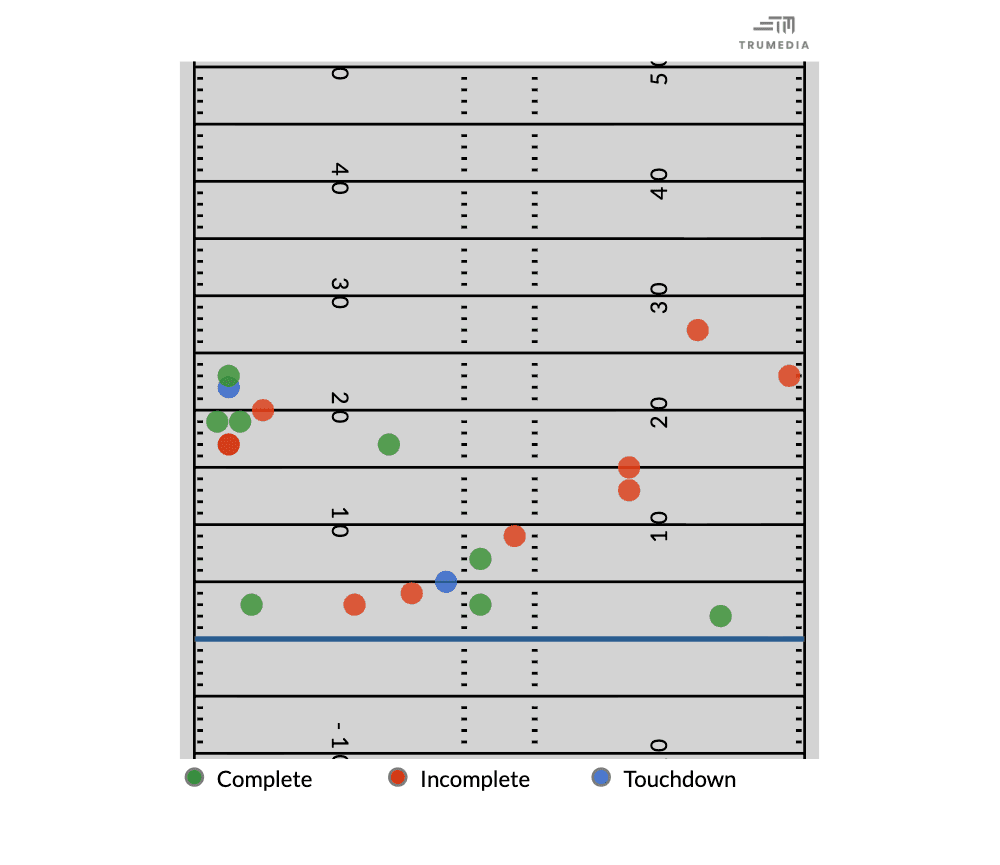
Nearly all of his explosive completions were aimed down the left sideline, including the one that will be remembered for solidifying Williams as the Bears’ first true franchise quarterback since the Sid Luckman days. You’ve probably already seen this throw dozens of times since Saturday night, but it’s worth watching again. Fourth-and-8, season on the line, Williams flushed out to his left, and he did this.
Per Next Gen Stats, Williams was running over 13 miles per hour when he made the throw, and the ball traveled over 35 yards through the air, on a line, while the guy re-created the Jordan logo in midair.
Just getting the ball to Rome Odunze from that throwing platform was a remarkable feat, but Williams got enough air under the ball to lead his receiver upfield and away from the coverage. You often hear about quarterbacks throwing their receivers open. Williams did that in exceptional fashion.
The Johnson-Williams partnership had some rocky moments early on, and questions about the quarterback’s fit in his new coach’s scheme were being asked as soon as news of the hire broke. Four months into their first season together, they’re looking like an ideal match. Johnson loves explosive plays, and Williams is a quarterback who hunts them relentlessly.
Johnson has had a lot of memorable sound bites during his first season in Chicago, but his take on the tush push from back in May remains my favorite one, and it does the best job of explaining his mentality as a coach and play caller. “Have you ever seen a tush push become an explosive play?” Johnson asked. “I like explosive plays. I like big plays. So I’m not a big tush push guy myself.”
After the Bears failed to convert on two fourth-and-short plays against the Packers, with Johnson opting to pass rather than run the ball or sneak the quarterback, those words may have been weaponized against him had his team lost. But as the game played out down the stretch, you could see why Johnson doesn’t like to waste any opportunity to generate another explosive on a play call that won’t go for more than a couple of yards. It’s that mentality that makes him one of the league’s top offensive minds.
Loser: Josh Allen Concern Trolling
The narrative piranhas were circling. With Allen’s path to the Super Bowl cleared of Patrick Mahomes, Lamar Jackson, and Joe Burrow, the Bills quarterback is supposedly out of excuses this postseason. If Allen doesn’t win his first AFC title against this playoff field, it will be on him … and not Buffalo’s terrible run defense or a receiving corps led by Brandin Cooks and Tyrell Shavers. Nah, it will fall on the superstar quarterback, who dragged a mediocre roster back to the playoffs while those three quarterbacks I listed could not do the same.
Allen won’t need any excuses this week after leading the Bills to a 27-24 win over the Jaguars in Jacksonville. This wasn’t his best postseason performance from a statistical standpoint. He went 28-of-35 for 273 yards and three touchdowns (two on the ground and one through the air). He’s put up numbers like that in a single half in his playoff career. But this still felt like a seminal moment for him given the current state of Buffalo’s roster. Allen couldn’t afford to make the one or two bozo plays he’s typically good for in a given week. Not against a well-rounded Jaguars team that looked on paper like a tricky matchup for the Bills. He didn’t log a single turnover-worthy play, per Pro Football Focus; had just two off-target throws on 35 attempts; and took only one sack despite being pressured on a third of his 39 dropbacks.
It was a spotless performance, but Allen didn’t abandon his playmaking instincts to keep his stat line clean. He pushed the ball downfield when the situation allowed for it.
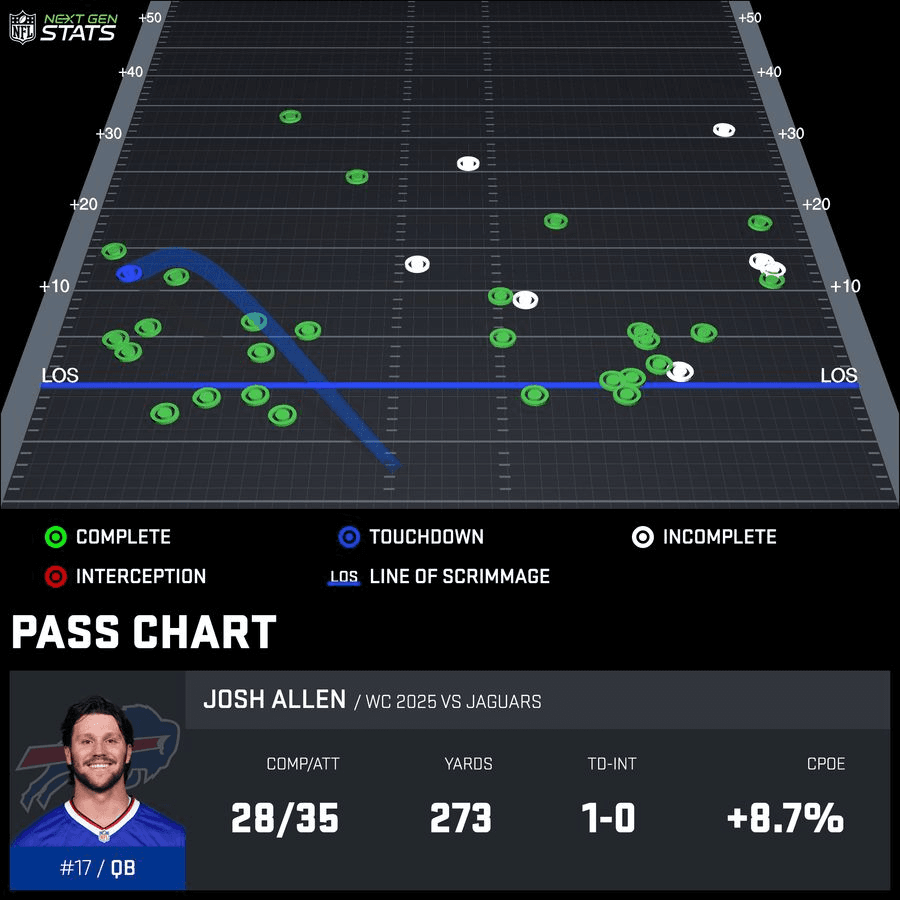
Allen’s best throw of the game was a risky, back-foot, downfield heave to Cooks. The Bills quarterback let go of the pass well before Cooks had cleared the coverage, but seeing Jaguars cornerback Greg Newsome II plant his feet ever so slightly was enough for Allen to go for glory.
The Allen experience isn’t complete without one ridiculous play that doubles as a visual gag, and the Bills quarterback gave it to us a few plays later on fourth-and-1. With everyone in the building bracing for an Allen sneak, he got the yard and picked up an extra 10 with an assist from his linemen. For once, it wasn’t Allen doing the carrying for the Bills offense.
He finished off the drive with a 1-yard touchdown plunge with just over a minute remaining on the clock, and the Bills closed it out by picking off Trevor Lawrence on the Jags’ subsequent drive.
Allen and the Bills staved off some awkward conversations about the quarterback’s capacity to lead this team to a Super Bowl and about Sean McDermott’s job security for at least one more week. But the issues that feel like they’ll ultimately keep Buffalo out of the Super Bowl—the porous run defense that gave up 154 yards against the Jags and the thin receiving corps—aren’t going away over the next seven days, and the hot take machine never slows down.


Winner: Matthew Stafford
If Rams fans are feeling uneasy about the close 34-31 win over the Panthers, they can find comfort in knowing that they still have the best quarterback on the NFC side of the playoff bracket. Stafford led Los Angeles back from two fourth-quarter deficits. He gave the Rams the lead for good with a steely two-minute drill that was punctuated by him fitting the ball through a pinhole on his game-winning touchdown pass to Colby Parkinson.
Stafford had some shaky moments during a cold spell in the middle of the game, but he was brilliant otherwise. He hit his first eight throws of the game for 114 yards and a touchdown while averaging 1.16 EPA per dropback. His 15 fourth-quarter dropbacks produced 143 yards and two touchdowns, and he averaged 0.66 EPA per play.
As good as Stafford was overall, he did struggle when the Panthers forced him to make perimeter throws. The Parkinson touchdown was his first completion beyond the line of scrimmage that was aimed outside the numbers. He missed his first 10 throws and threw an interception when targeting that area of the field.
Stafford did almost all of his damage on throws over the middle of the field with his typical fare of anticipatory throws and no-look passes. He re-created the most memorable play of his career—the no-look throw to extend the Super Bowl–winning drive against the Bengals—on his way to winning the game for Los Angeles. Stafford moved linebacker Christian Rozeboom out of the throwing window to Davante Adams, opening up the middle of the field for the biggest play of the drive.
That kind of play shows why Stafford is so effective throwing over the middle. He makes it look easy, but any hesitation can make the difference between a big play for the offense and one for the defense. Take Bryce Young’s first-quarter interception, for instance. At first glance, it appears that Jalen Coker stopping his route early was to blame for the pick.
But the all-22 angle shows that Young was late making a decision and missed his receiver settling down between two zone defenders.
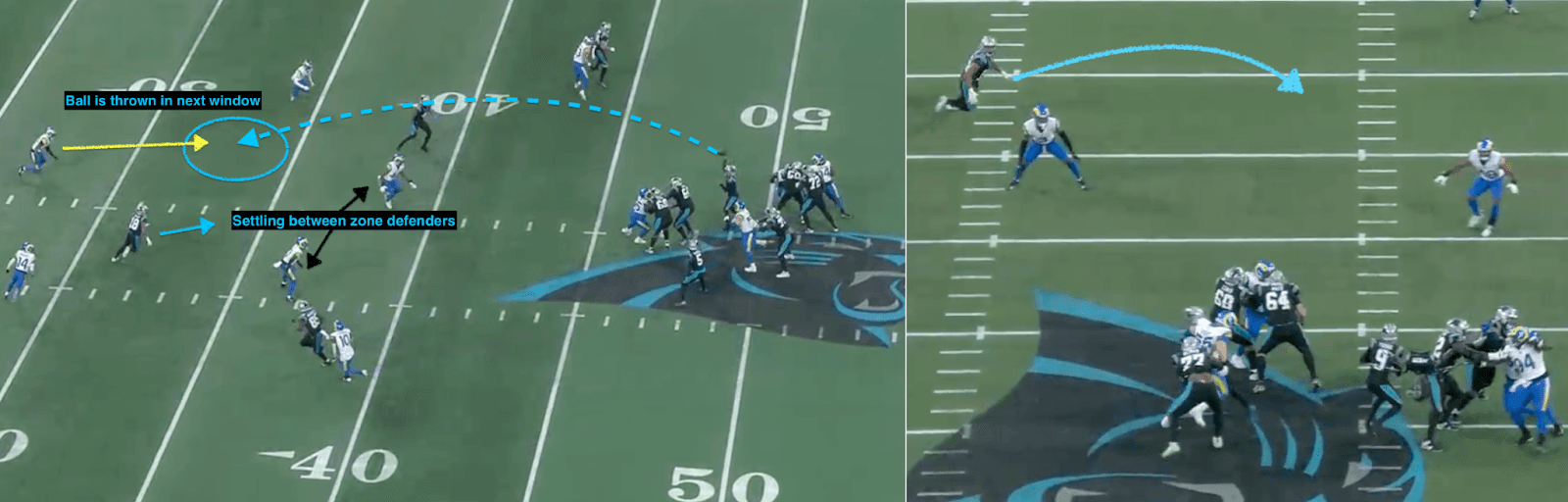
Young seemed to chill out after that interception, and the Panthers QB eventually had success exploiting an undersized Rams cornerback group with his big-bodied receivers. His biggest throw of the game was a deep in-breaker that hit Coker in stride to set up Carolina’s first go-ahead score of the fourth quarter. He linked up with Coker again for what appeared to be the game-winning score before Stafford worked his two-minute magic.
With Stafford avoiding a major injury after hurting his finger on an opponent’s helmet—X-rays came back negative—the Rams secondary remains the team’s biggest concern going forward. It couldn’t get the defense off the field in big moments, which made the game more difficult than it had to be. Los Angeles was dominant otherwise. Stafford was on his game, the run game was humming, the pass rush got to Young consistently, and Carolina’s run game was useless outside of goal-line situations. The secondary was almost enough to sink the entire team against a much inferior opponent. Fortunately for Sean McVay’s team, they have a quarterback built for these moments on their sideline.


Loser: Nick Sirianni
You’re going to need a hazmat suit to listen to WIP this week after the Eagles crashed out of the playoffs in a 23-19 loss to the 49ers. Philadelphia fans unpacking the last four months will produce some radioactive discourse, and I’m guessing Sirianni and Kevin Patullo will be the main topic of conversation. The Eagles offense this season was the reason the defending champs failed so spectacularly. It was poorly designed. The passing game was just a random assortment of plays. The running game was devoid of new ideas. Sirianni and Patullo made few adjustments, both over the course of the season and within games. The second-half ruts were a weekly feature of the offense.
Sunday’s loss to the Niners followed a familiar script. The offense marched down the field on its first three drives, scoring a pair of touchdowns and quickly racking up 177 yards. It cut Saquon Barkley loose early and eased Jalen Hurts into the game with quick passes. But then Philadelphia fell back into its typical habits. The offensive line, without Lane Johnson, started losing, and Hurts went into checkdown mode against soft zone coverage. Philadelphia mustered only six points on 119 yards in the second half. The defense intercepted Brock Purdy twice, but the offense turned those short fields into just three points. In the second half, Barkley was held to 3.2 yards per rush, and Jalen Hurts averaged 3.7 yards per dropback. “It felt like that was our story as the year progressed,” Sirianni said of the second-half struggles.
Beyond the inept offensive plan, Sirianni had a couple lowlights on the sideline. He got into it with A.J. Brown, and the two had to be separated by Big Dom, who always finds the camera.
It appeared that the Eagles coach was grilling his star wideout after a dropped pass, but Sirianni said he wanted Brown to get off the field on fourth down with a little more urgency. Either way, excoriating your irritable receiver doesn’t look good.
Sirianni also had a tactical screwup in a key spot, burning a timeout before a fourth-and-11 to talk over the play call. With just 43 seconds remaining in the game, the timeout erased any chance of the Eagles getting the ball back if they failed to convert. Sirianni and Patullo used that extra time to settle on the most basic call of all: four verticals, which has four receivers running straight down the field. That did not get a receiver open, and Hurts floated the ball into triple coverage.
Now the Eagles head into an offseason that feels like a pivot point for the franchise. In a world where John Harbaugh can get canned, Sirianni’s job will be questioned. There has to be a change at offensive coordinator. Brown could be on his way out. Johnson is 35 and coming off another season of injuries. This offense will almost certainly look different. Change is coming.
Winner: The NFC West
The NFC West has three of the nine remaining teams ahead of Monday night, confirming what we’ve known all season: This is the best division in football. The Seahawks and Rams are first and second in Super Bowl odds, respectively, and have looked like the NFC’s two best teams all season. After two close regular-season games, there’s not much separating the two teams. Los Angeles has the more trustworthy quarterback; Seattle has the more dominant defense and home-field advantage.
The 49ers are still alive, too, but lost another foundational player when George Kittle was carted off with an Achilles injury. If Kyle Shanahan’s team is going to make a Super Bowl run, it will have to do it without Nick Bosa, Fred Warner, and Kittle. Hanging 23 on Philadelphia’s defense without the star tight end was a commendable feat for San Francisco, but Seattle’s defense will require more out of Shanahan’s offense. The Seahawks defense stuffed it in a locker when these teams met in the Week 18 game for the division, a 13-3 win for Seattle. Brock Purdy threw for 127 yards, was sacked three times, and threw an interception. Christian McCaffrey was held to 23 yards on eight carries. Otherwise, Shanahan’s offense has been a Mack truck since getting Purdy back to 100 percent after an early-season turf toe injury and looks capable of scoring enough points to play with anyone ... except Seattle. Mike Macdonald’s defense just isn’t a good matchup for the Niners. It can stop the run without sacrificing its deep coverage. As Macdonald explained last season, “That’s some high-powered stuff” for a defense—especially against a Shanahan offense.
Seattle’s defense isn’t a good matchup for most offenses. The Rams may be the exception with Stafford under center. He threw for 457 yards and three touchdowns in the Week 16 matchup. Los Angeles was nearly as efficient in the first matchup, and Macdonald will have had plenty of time to learn from that loss and make the proper adjustments. If we do get a third installment, that side of the ball will determine which team is headed for the Super Bowl, where the Rams or Seahawks would be favored over their AFC opponent.
If Los Angeles knocks off Chicago next Sunday, we’re guaranteed an all–NFC West matchup in the championship game. That would be the third time that’s happened for the NFC West since 2012. The only other division to spar for a conference title in that span is the NFC East, with last year’s Eagles-Commanders game. This dominant season for the NFC West is part of a wider window of dominance for the division.
Loser: Justin Herbert
Defending Justin Herbert didn’t get any easier on Sunday night. No matter how difficult Herbert’s teammates made his job, there’s no way to put a positive spin on scoring three points in a playoff game. Herbert’s performance in the Chargers’ 16-3 loss to the Patriots isn’t worth defending anyway. He stunk, managing only 159 passing yards on 31 attempts. He scrambled for 57 yards but lost 39 of them back on six sacks. Herbert just didn’t cope well with the pressure New England predictably put him under all night. He was quick to leave the pocket but couldn’t make the necessary plays to keep the Chargers in it.
The 27-year-old, who’s now 0-3 in the playoffs through his first six seasons, did make those plays more often than not this season. He fought his way into the top five in MVP odds by overcoming the crappy situation created by rotten injury luck for the offensive line and substandard play calling from offensive coordinator Greg Roman. But that’s not what we saw on Sunday night in Foxborough. Herbert missed some throws high, and he left others short. He was uncharacteristically inaccurate.
When Herbert did manage to buy himself extra time, he didn’t do much with it. Against the Pats, Herbert posted his second-longest average time to throw (3.18 seconds) in a game this season. His 26 dropbacks that lasted at least three seconds produced just 75 yards (3.7 per dropback) and lost 10.5 expected points, per TruMedia. I’m sure a review of the all-22 will show that there weren’t many openings against the Patriots secondary. We saw replays of Chargers receivers blanketed across the field, but Herbert squandered most of the chances he was presented with.
The Patriots defense deserves some credit for Herbert’s quiet game. The secondary snuffed out the Chargers’ pass concepts, and the front hemmed Herbert in for the most part. He got loose for a few productive scrambles but didn’t manage any game-breaking plays that forced an adjustment to how Mike Vrabel’s team was defending him. There have been question marks about New England’s defense after it beat up on a soft schedule, but it passed its first playoff test.
The same goes for Drake Maye in his playoff debut. The second-year pro got off to a shaky start and made the game’s first big mistake with his tipped interception in the first quarter. The Chargers didn’t capitalize on the short field, failing to convert on fourth down near the goal line, and never really put game pressure on Maye. He eventually grew into the game and then broke it open in the second half. His teardrop pass to Hunter Henry for a touchdown pushed New England’s lead to double digits.
The Chargers defense had kept the team in the game through the first three quarters but eventually wilted under the pressure Maye put on it. The Patriots rushed for 146 yards, with the quarterback accounting for 66 of them. He finished with 268 yards passing on just 29 attempts—9.2 yards per pass against one of the league’s top defenses. Maye didn’t quite light it up, but he easily outplayed his counterpart on the other sideline.
Winner: Playoff Football
Patriots-Chargers was a bummer to watch, but that didn’t spoil an otherwise perfect weekend to kick off the postseason. The four other games were decided by 14 points combined. The first three games were decided by touchdowns scored in the final two minutes, which set an NFL playoff record, per CBS Sports researcher Doug Clawson. Rams-Panthers was only the fifth game in postseason history to feature four fourth-quarter lead changes. The Bills and Jaguars bumped that to six with the thrilling conclusion to their game.
Wild-card weekend offered more than dramatic finishes. We also saw some high-level performances. We’ve already covered Stafford’s master class in the middle of the field and Williams’s big-game hunting in Chicago’s comeback. We didn’t cover how well Jordan Love played in a losing effort. He threw for 323 yards and four touchdowns, and that doesn’t include this incredible throw that could have (and maybe should have) won Green Bay the game.
I don’t have the encyclopedic knowledge of the league to claim that this was the best round of games in playoff history, but it’s the best one I can remember in my time watching the sport. The 2021 divisional round, which featured four one-score games, including a Rams-Bucs thriller in Tampa and the unforgettable Chiefs-Bills nail-biter, may have the edge, but this was easily the best wild-card round of the last century.
It feels like there are complaints about the quality of the play every regular season. Scoring is either too low or too high, the league has a quarterback development problem, and the offensive line play has never been worse. Then the playoffs come around, and all of the poorly run/coached teams are at home, and we’re reminded why NFL football is the best product in sports. Let’s see if I still feel that way after watching Steelers-Texans on Monday night.