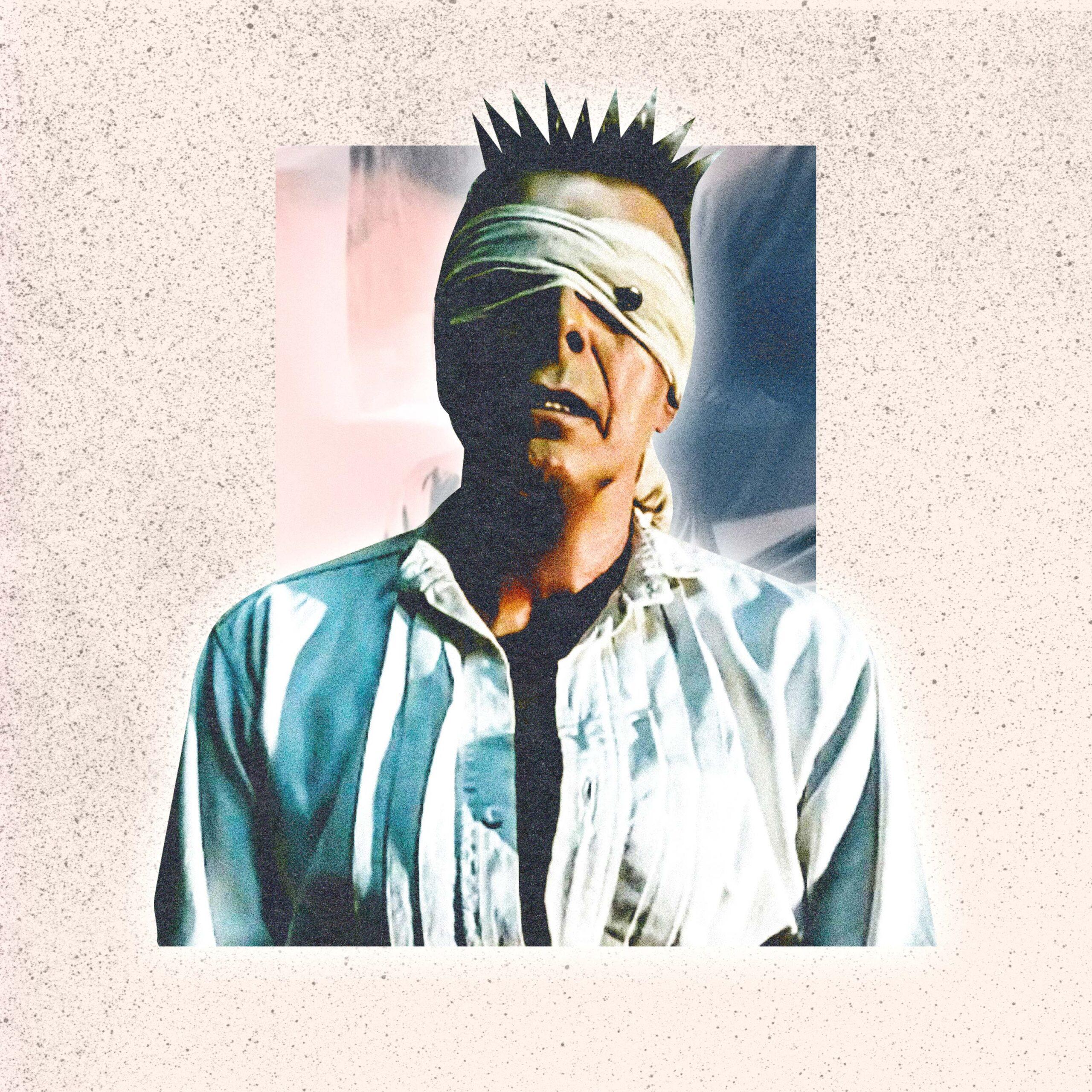
A decade ago this week, Blackstar became the first and last significant David Bowie album where the public (almost) instantly agreed on what it meant. Not coincidentally, it was also the first and last significant David Bowie album where Bowie was not around to poke holes in the consensus.
Blackstar arrived on January 8, 2016, Bowie’s 69th birthday. And then Bowie died on January 10, felled by liver cancer, a condition he never announced publicly. The widespread feelings of surprise and shock were swiftly followed by a revisionist reading of the record, which positioned Blackstar as a musical last will and testament, “a parting shot,” in the words of coproducer and decades-long collaborator Tony Visconti. “Few albums have ever been subjected to so much exegesis so quickly,” The Guardian observed. Only the constant analysis always hit upon the same general theme: This was the Thin White Duke’s message from the great beyond. In the process, Blackstar immediately became the most famous “final” album ever. Listeners pored over the lyrics in search of Easter eggs. One theory surmised that the title references a black star lesion, a type of radial scar associated with cancer. Or it might be a nod to Black Star, the Brooklyn hip-hop duo, who once “shared a rich, frank conversation” with Bowie “about the downsides of fashion and fame for Complex in 2003,” as noted by Slate. Others pointed out that Elvis Presley—a longtime hero of Bowie’s, who shared the same birthday—recorded his own “Black Star” in 1960, a cowboy number that includes a crucial line echoed in the title track of Bowie’s album: “And when a man sees his black star / He knows his time, his time has come.”
In the United States, Blackstar rose to no. 1 on the Billboard albums chart by the end of January, a first for a Bowie LP, despite being (in Rolling Stone’s estimation) “one of the most aggressively experimental records the singer has ever made.” (It was supplanted one week later by Panic! at the Disco’s aggressively nonexperimental Death of a Bachelor.) As 2016 unfolded, Blackstar assumed the weight of a grim harbinger, particularly for a generation of aging boomer musicians and the audience reluctant to let go of them. Eight days after Bowie died, Glenn Frey of the Eagles finally checked out of the Hotel California. Maurice White of Earth, Wind & Fire passed away two weeks after that, and Merle Haggard faced his maker two months after that. Just over two weeks later, it was time for Prince. Like Bowie, he was part of the “This person seems too much like an extraterrestrial to ever die” class of superstar. Countless fans paired them together in unfortunate “They made it OK to be weird!” tweets. At that point, the belief that 2016 was, as one prominent media outlet put it, “the year the music died” really took hold.
Over time, the gloomy outlook fomented by Blackstar accrued a deeper, broader, and even more disquieting resonance. “Don’t you feel that since he died, the world’s gone to shit?” Gary Oldman, a friend of Bowie’s, wondered aloud this past August. “It was like he was the cosmic glue or something. When he died, everything fell apart.” If that sounds hyperbolic, consider that similar sentiments were aired about Leonard Cohen in the wake of his death on November 7, 2016, just one day before the election of Donald Trump and about two and a half weeks after the release of You Want It Darker, a “final” album even more funereal than Blackstar. “I have been listening to him with an increased attention ever since November 2016—the ruinous election, the psychological fallout, that graceful asterisk of Cohen’s death—leaning close, like the dog in the old RCA Victor ads,” Pitchfork’s Jayson Greene wrote in 2020. “Four years later, as we stagger back out of the chaos to confront the wreckage, I am still listening.”
Are music fans prone to melodrama when confronted with the loss of their favorite artists? Surely. Was 2016 especially punishing in terms of rock star deaths? Not necessarily. 2017 was actually (probably?) worse, with the passings of older stars like Tom Petty, Chuck Berry, Gregg Allman, Fats Domino, Walter Becker of Steely Dan, and Malcolm Young of AC/DC, plus the suicides of Chris Cornell and Chester Bennington. But Blackstar nonetheless endures as a commonly recognized metaphor—for the death of the classic rock era, the end of the 20th century, the breakdown of the monoculture and the sociopolitical “common ground” allegedly associated with it, and the overall fragility of human existence, even for the seemingly indefatigable.
However, having been tasked with writing about Blackstar 10 years later, I am less interested in the metaphorical Blackstar than the Blackstar that was, for a brief window of time, just a late-career David Bowie record. For most people, that period lasted for barely 48 hours, though it stretched for days and even weeks for members of the music press. Reading the early reviews, it’s striking how little the following words appear: death, dying, die, mortality. The collective tone of the prose isn’t remotely mournful but rather alternately impressed and bemused by this sly old dog discovering a new trick or two. Eschewing all his familiar tropes—the decadent glam rocker; the chilly synth-pop deconstructionist; the swaggering MTV pinup; the wise, tenured professor of shape-shifting art-rock intellectualism—Bowie had suddenly embraced mad-man sax wailing and aggressively scattershot breakbeats, creating soundscapes that mashed up Death Grips, To Pimp a Butterfly, and Bill Pullman’s acid-jazz solos from Lost Highway.
The New York Times deployed a standard Bowie-esque rhetorical device when discussing the album, positing that the artist “may be briefly dropping his mask,” or “he may be trying on a new one.” The New Yorker, meanwhile, gushed about the “beautiful meaninglessness” of Blackstar, while Pitchfork declared that Bowie was “a no-fucks icon.” Really? “A no-fucks icon”? Engaged in “beautiful meaninglessness”? From, supposedly, behind a mask? How could critics miss what was considered, just days later, clearly a stone-serious personal statement of purpose, this deathbed confession signaling the rise of a dark new age?
If I’m being honest, my own initial response to Blackstar—I was between jobs then, so no advance stream for me—wasn’t “I am peering into a dying man’s soul and hearing the future.” It was, “Huh, this reminds me of Black Tie White Noise.” To be clear, I meant that comparison to Bowie’s mostly forgotten 1993 album commingling jazz, electronic, and hip-hop as a compliment. That record had the misfortune of coming out at a time when many critics were skeptical of new David Bowie records, even as grunge and Britpop bands were emulating or straight up covering his older material. It was the opposite of the environment that rapturously greeted The Next Day, the Bowie “comeback” album from 2013, which resembled the filler-heavy records he put out in the ’90s, only it came after a 10-year public absence that made music writers’ hearts grow fonder.
My review of that latter album was positive with a cynical undertow, but Blackstar announced itself as a work of grander artistic ambitions. Though it was how the album sounded, rather than what Bowie was saying (or interpreted to be saying), that grabbed you. It’s not that I missed the lyrical themes; Bowie’s health problems were already public knowledge, and he was writing about a biblical character who dies and then comes back to life, opening with the line, “Look up here, I’m in heaven.” In the video, he even put himself in a hospital bed.
The man was not subtle. But he also didn’t sound like he was about to shed his mortal coil. And the sound of Blackstar, for a few days at least, is what mattered most.
In the annals of “final” albums, Blackstar is an anomaly. Before Bowie, “final” albums were associated either with artists who died tragically young or older musicians leaning into every nook and cranny of their one-foot-in-the-grave cragginess. Of the former group, these records often appeared after the makers succumbed to the everlasting void—Joy Division’s Closer, Nirvana’s MTV Unplugged in New York, Tupac Shakur’s The Don Killuminati: The 7 Day Theory, the Notorious B.I.G.’s Life After Death. Other times, in the cases of Nick Drake’s Pink Moon, Jeff Buckley’s Grace, and Amy Winehouse’s Back to Black, the music seemed spookily prescient only once real-life circumstances took a turn for the worse years later.
In 1994, as the cohort of mid-20th-century musical legends entered the precipice of their senior years, Johnny Cash (with an assist from Rick Rubin) pioneered the “old man” style of personal-end-times music with the first installment of his American album series. (While Cash didn’t depart this world until 2003, he spent his last decade preparing for the eventuality on record.) In the early aughts, Warren Zevon took this one step further: He entered the studio right after he was diagnosed with terminal lung cancer, leveraged the publicity and goodwill to attract an all-star cast of support musicians (including Bruce Springsteen, Tom Petty, and Don Henley), and produced 2003’s The Wind, one of his most successful albums, just two weeks before he died.
At the time, The Next Day seemed like a stereotypical “final” record. Bowie’s extended retreat from public life, which started in the mid-aughts and lasted until the early 2010s, fueled rumors that he was battling a life-threatening illness. In 2012, my former colleagues at Grantland heard from a reliable source that he was near death, prompting a prolonged back-and-forth between Chuck Klosterman and Alex Pappademas that went on for nearly 16,000 words. Even though Bowie lived and put out The Next Day, their fascinating email string was published. I recommend taking a sick day or two and reading the entire thing, though one sentence from Klosterman sums up what would be the prevailing attitude about Bowie’s death once it actually happened: “He seemed neither real or unreal, which I unconsciously equate with immortality.”
When I heard The Next Day, I pegged it as another “old man” end-times LP, which it resembles both lyrically and musically. Whereas Blackstar retains an air of mystery, shrouded in layers of ancient literary and of-the-moment pop culture allusions, on The Next Day, Bowie comes right out and declares (on the title track) that he’s “not quite dying” with “my body left to rot in a dying tree.” He even sheds his usual put-upon youthful facade for the skronky R&B of “Dirty Boys,” which recalls the willfully haggard and bellicose strains of Bob Dylan’s and Tom Waits’s “geezer” eras.
And yet this persona, the craggy rock guy back from the dead (for now), was the one guise that Bowie couldn’t quite sell. As Klosterman suggested, Bowie was not a person made up of strictly flesh and bone or the whims of the popular imagination. He was like the sky or the ocean, a spectacular and unknowable force of nature that existed beyond human comprehension. He was famous and important when many of us first started paying attention to the outside world, and it seemed like he would always remain famous and important. Most rock stars aren’t like that. Prince and Leonard Cohen are “sky and ocean” people. Glenn Frey and Maurice White are not. Those guys were part of our lives. Bowie, Prince, and Leonard transcended life itself.
The irony of transcending life itself is that when you die, it becomes one of the things you’re remembered for. Dying is your last “most extraordinary,” culturally unifying act. And so it goes for Blackstar, which will always be defined by what happened to the man who made it right after the world heard it for the first time. The metaphor subsumes the music, now and forever. Nevertheless, it is worth noting how it stands apart from all the other iconic “final” albums. It is neither a snapshot of wasted promise nor a toast to a weathered has-been. It is, rather, something altogether typical and even mundane as an end-of-life climax: a slow exhale from someone who believed he still had more time.


Bowie’s closest associates have said that he did not intend for Blackstar to be his actual “final” album. He learned he was terminal in November 2015—apparently the same week he filmed the video for “Lazarus”—but even in his last conversation with Visconti, he was still talking about future projects. “At that late stage, he was planning the follow-up to Blackstar,” the producer told Rolling Stone in 2016. Bowie similarly told Ivo van Hove, director of Bowie’s surreal Lazarus, that he wanted to work on a sequel to the jukebox musical. Author Chris O’Leary, in the book Ashes to Ashes: The Songs of David Bowie 1976-2016, writes that Blackstar was conceived as something of a lark, “a side-road adventure, a dark vacation from his standard rock” in the style of “a wilder, funnier Heathen,” his arty curveball from 2002. Something to get away from being David Bowie for a while, the sort of diversionary tactic he could never resist. Once he started chemotherapy, Bowie “wrote Blackstar as a hedge: this could be the last album,” though he hoped it wouldn’t be.
Let’s imagine things had worked out differently. Had he not died then, I think Blackstar would be regarded as a companion to my personal favorite Bowie record, 1976’s Station to Station. Both albums are overstuffed with ideas, yet the presentations are economical. (Station to Station is composed of six songs running 38 minutes, while Blackstar is 41 minutes over seven tracks.) Both are informed by contemporary Black music (Philly soul and disco in the ’70s, Kendrick Lamar in the 2010s) and reshaped by a distinctly icy European sensibility. And they both open with epic 10-minute title tracks that rank with Bowie’s most mind-blowing music.
On the song “Station to Station,” Bowie sounds like he’s trying to outrun the devil himself, unsuccessfully. (He sings the phrase “It’s too late” 24 times.) This was in the midst of his coke-fueled Los Angeles period, when he famously granted an interview to Rolling Stone’s Cameron Crowe and said he could see bodies falling outside of his window. Perhaps he believed his own body would be the next to fall. (He later claimed not to remember a thing about recording the album.) On “Blackstar,” however, he’s resolute about rising again, as he did so many times in his long career and illustrious life; you can hear it in the way his voice morphs from a digitally distorted yelp to that unmistakably arch Bowie croon. “Something happened on the day he died / Spirit rose a meter then stepped aside / Somebody else took his place, and bravely cried / ‘I'm a blackstar, I'm a star's star, I'm a blackstar.’”
In that handful of hours between the album’s release and Bowie’s death, Blackstar was primarily a musical statement rather than a spiritual or philosophical one. And that’s how I still prefer to hear Blackstar, if I can somehow get past all the baggage. Revisiting it now, I try to think not of Bowie’s death but of how alive he must have felt making it.