College Football’s New World Order
Ole Miss. Indiana. Miami. Oregon. Sweeping changes to college football were supposed to make the sport’s historic powers more powerful. Something else happened instead.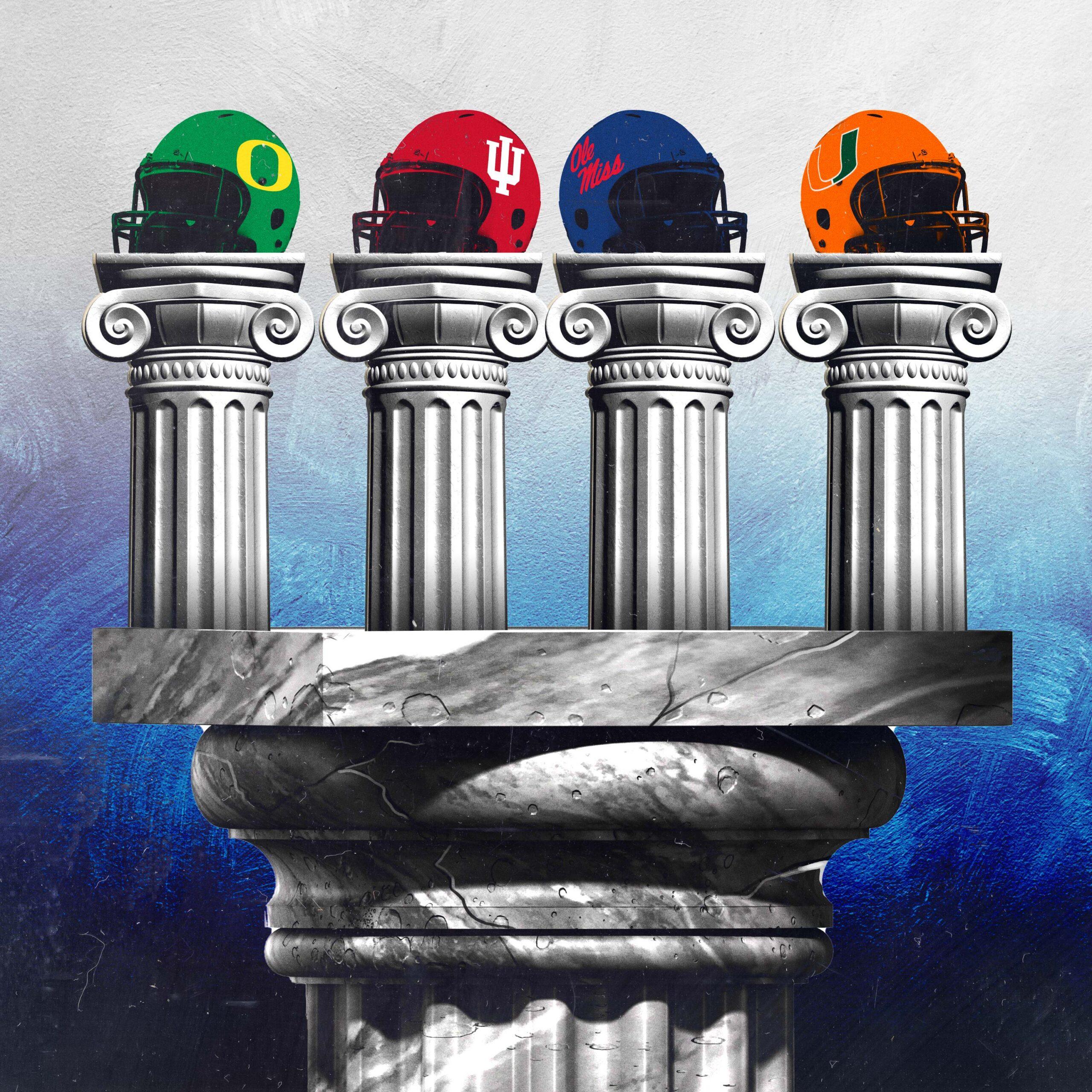

By the time Lane Kiffin and Ole Miss made their swaggering pitch to players in the transfer portal in April 2022, they had already landed more than two-thirds of that year’s recruiting class. There was promising quarterback Jaxson Dart, who had started three games as a true freshman for USC. There was defensive tackle J.J. Pegues, a recently converted tight end out of Auburn. There was Zach Evans, a running back who’d once been the first five-star recruit in the modern era to go to TCU. And there was a deep corps of receivers, including two from in-state rival Mississippi State.
Some of them were eventually stars of “Transfer to the Sip,” an invitation to join the growing class in Oxford. The video showed the players disembarking from a private jet and being driven through campus on a luxury bus over the Gucci Mane and Lil Durk song “Rumors.”
The clip was the culmination of a complete reversal of opinion by Kiffin, who only four months earlier had groused about the sweeping changes in major college football. “Let’s not make a mistake: We have free agency in college football,” Kiffin said in December 2021, a few weeks after clinching Ole Miss’s first 10-win regular season in program history. “It’s a new world.”
But it was a world in which Kiffin and Ole Miss were desperate to compete. They would have to either embrace the inevitable change or continue to trail next-door neighbors Alabama and LSU, who had then combined to win eight national titles in the previous 18 seasons. They embraced it: Ole Miss is now considered one of college football’s “big spenders”—and the program has gotten what it paid for.

Ole Miss finished with 247Sports’ second-ranked portal class in 2022, and then landed the second-, first-, and fourth-ranked transfer classes over the next three seasons. That success accelerated the Rebels’ rise, which will take center stage Thursday in the College Football Playoff semifinal in the Fiesta Bowl.
The Rebels are joined in college football’s final four by three other programs—no. 1 seed Indiana, no. 5 seed Oregon, and no. 10 seed Miami—that have used the transfer portal and court-ordered NCAA rule changes about player compensation to outperform their historical baselines. Of that group, only the Hurricanes count as something of a traditional power, and that was a generation ago, before most of today’s players were born. Indiana and Oregon have never won national titles; Ole Miss last won a share of one in 1960; and Miami won most recently in 2001.
Now, they’re all on the cusp of improbable glory, because they took advantage of new ways of roster building and benefited from increased access to the playoff with the CFP’s expansion to 12 teams. The future is here: Call it college football’s new world order.
The extra playoff spots were seemingly engineered to reward underachieving traditional powers, which routinely had teams that just missed the cut in the four-team format. They would help the likes of Ohio State, which had barely missed the CFP four times in the previous nine years, or Oklahoma, which had two-loss teams excluded in both 2016 and 2020.
Indeed, in the first edition of the expanded CFP last season, two-loss Ohio State took advantage of the mulligan. The Buckeyes entered the playoff as the no. 8 seed, won four games by an average margin of 18 points, and secured a national championship. “I think the most important thing for our team is that we had a chance to play together for another week,” Buckeyes head coach Ryan Day said after a 41-21 win over Oregon in the Rose Bowl. “So when you lose, you’ve got to figure out how to move forward.”
This was the new system working as intended.
Almost every change in recent years has redounded to the heavyweights’ benefit. College football is awash in billions of dollars and draws record TV ratings, as the SEC and Big Ten—the sport’s most powerful and wealthiest conferences—have pushed for more schools and more revenue at every turn. The real tipping point came in 2021, when the NCAA’s new rules about name, image, and likeness rights went into effect, and the organization changed legislation to allow all athletes to transfer once without sitting out a season, which soon led to immediate eligibility with unlimited transfers. Suddenly, the Georgias and Ohio States of the world had their pick of talent from most other rosters and retained all the same structural advantages that have always made them appealing to blue-chip athletes.
The other change came in July 2021, when Texas and Oklahoma announced that they would leave the Big 12 for the SEC. That led to another round of scrambling among other leagues, including the most audacious expansion yet: USC, UCLA, Oregon, and Washington abandoning the Pac-12 for the Big Ten. That changed the makeup of the Big 12 and ACC and killed the Pac-12 as we knew it, which currently exists as a two-team league of Washington State and Oregon State and plans to add five Mountain West schools and Texas State in 2026.
Add it all up, and the SEC and Big Ten were well positioned to snag more at-large berths in the 12-team playoff. They’d collect more playoff TV revenue. And the rich would invariably get richer.
That’s partly held true, but something funny happened before the bluebloods in these conferences could count all their money: A handful of upstart programs—Indiana, Ole Miss, Texas Tech, and Vanderbilt—found ways to thrive like they never had before. Meanwhile, usually reliable contenders like Alabama, LSU, Michigan, and Penn State have slipped.
“I would argue that some traditional powerhouses aren’t flourishing as much,” former Notre Dame athletic director Jack Swarbrick, one of the architects of the 12-team format, told The Athletic. “You’re changing out who’s in that position but are there really more (championship contenders)? I don’t know.”
None of the teams playing in this season’s semifinal were ranked higher than seventh (Oregon) in the preseason AP poll. Miami started the year at no. 10, Indiana was no. 20, and Ole Miss was no. 21.
In fact, very little about this season was predictable. The programs assumed to be the class of the sport almost universally flopped: AP preseason no. 1 Texas, no. 2 Penn State, and no. 4 Clemson all missed the playoff. No. 3 Ohio State and no. 5 Georgia both lost in the quarterfinals.
Opportunity generated money among schools that haven’t traditionally competed for titles, and that money led to further opportunity. And the sport’s unexpected final four could inspire other longtime bottom feeders in prominent conferences to follow suit. We may have entered an era when anyone can contend, so long as they’re willing to spend millions to get there.
Top seed Indiana has plunged unprecedented levels of money into its program, going from $23.9 million in 2021 to $61.6 million last season. It was the first year in nearly 20 years that Indiana finished above the Big Ten median in total football spending. “I felt a real commitment from the president Pam Whitten and the athletic director Scott Dolson to get football going,” Indiana head coach Curt Cignetti, who agreed to a new eight-year, $93 million contract in October, told The Daily Hoosier in May. “I mean, football generates 90 percent of the athletic revenue across the country, and they wanted to get it rolling. I think you can win anywhere in America with the proper commitment from the top.”
Miami has consistently been one of the biggest players in the game since Mario Cristobal left Oregon to return to his alma mater before the 2022 season. CBS Sports referred to the Hurricanes as one of the sport’s “elite spenders.” After signing transfer classes ranked 12th, seventh, and 10th in the previous three seasons, Miami landed the third-ranked class in 2025, according to 247. That group included quarterback Carson Beck, who came from Georgia after reportedly signing a $4 million deal.
And, of course, it’s little surprise that Oregon has been spreading its cash around with help from Nike cofounder and Ducks superfan Phil Knight and his collective, Division Street.
Ole Miss joined that group in recent years behind Kiffin’s aggressive approach toward the portal and NIL, giving the Rebels a leg up on some of their nearby rivals. The result has been the best season in program history, and administrators have indicated they’ll continue those efforts even after Kiffin decamped for LSU last month. Already, Ole Miss has renewed commitments from quarterback Trinidad Chambliss (assuming he’s granted an NCAA waiver to receive a sixth year of eligibility), running back Kewan Lacy, and other contributors to run it back next fall.
“We’re in a really good place,” Ole Miss athletic director Keith Carter told CBS Sports. “The brand is really strong. Clearly, we’re proving that we can win at a high level and make deep runs in the playoffs. So why would these guys want to leave? I think that’s what we have to continue to build here in Oxford.”
Kiffin left Ole Miss for a historic powerhouse, but it remains unclear how much history matters in the current landscape. The new world order is here—and the season and semifinals that no one saw coming may only be the start.