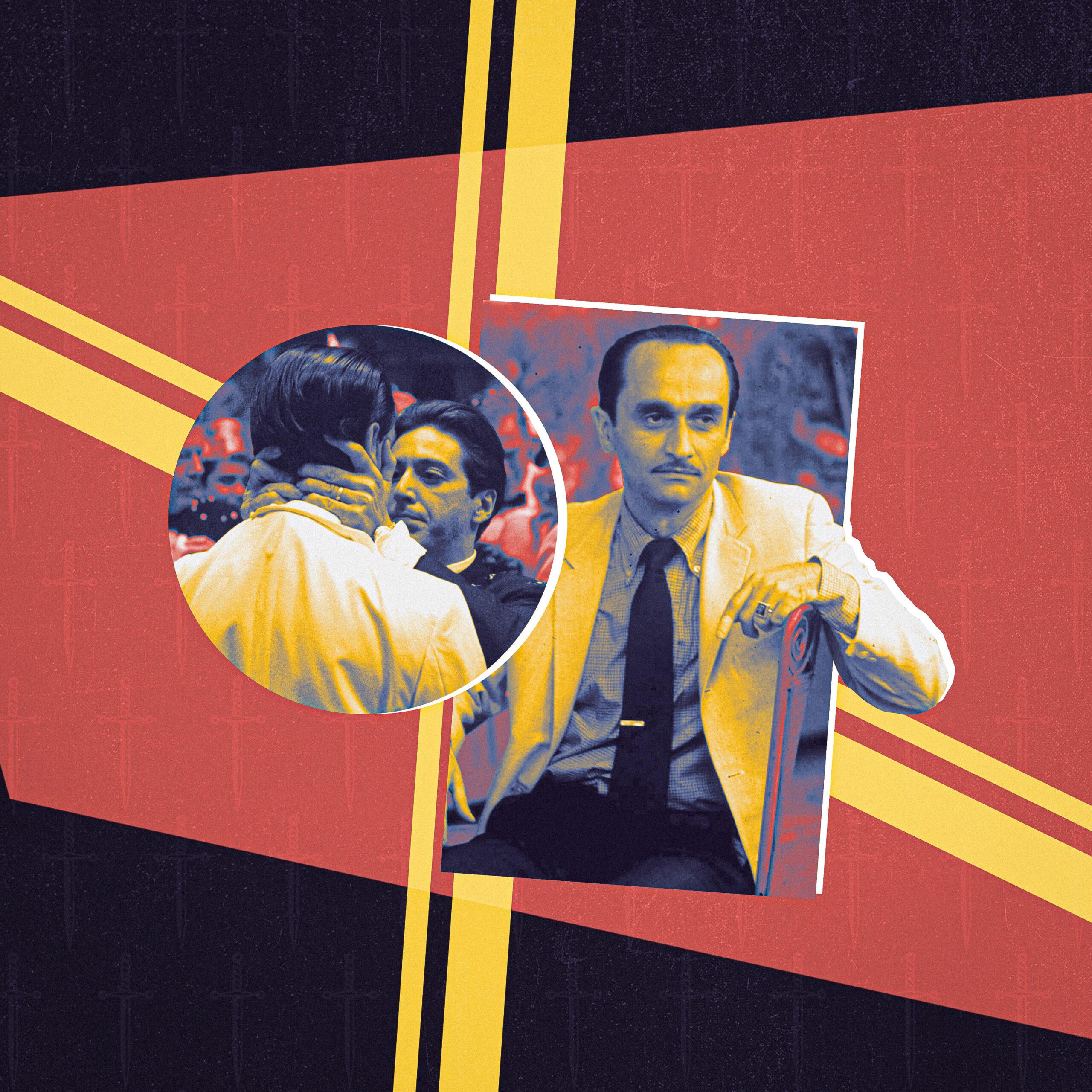
We knew it was him.
From the moment Fredo Corleone first appears in The Godfather, materializing out of the maelstrom of a lavish outdoor wedding banquet to not so playfully flick the back of his little brother’s head by way of greeting, it’s clear that he’s an irritant, and maybe even a usurper. Either way, he can’t keep his hands to himself. Fredo has come stag to the nuptials of his sister, Connie; lurching drunkenly around the edges of the party, he plunks himself down on one knee and jokingly propositions his brother Michael’s girlfriend Kay, planting an unwanted peck on her cheek with a mock suavity that’d be touching if it weren’t so pathetic.
Many years later, Michael will return the favor with a forcible and unexpected smooch whose murderous subtext is clear. It’s a thin line between sibling rivalry and fratricide, and one way to look at Fredo’s arc across the first two parts of Francis Ford Coppola’s epochal mob epic is as a downward spiral between two kisses—a kamikaze journey culminating in a lonely death and a fascinating afterlife.
In the same way that Marlon Brando’s eponymous power broker gradually aged, like a fine Coppola Winery vintage, into a symbol of Old World potency, John Cazale’s simpering, weak-chinned princeling squeezed out his own trickle-down legacy. With his high forehead and waxy mustache, Fredo is not just a cruel parody of his old man—he’s a lingering metonym for failson betrayal. “The implication of calling someone Fredo, like that of the alt-right insult ‘cuck,’ is of weakness, specifically a failure to live up to the masculine ideal,” wrote The New Yorker’s Michael Schulman in 2019. “But Fredo is more of a complex, tragic figure than political mudslinging would allow.”
The Ringer’s Ultimate Traitor Bracket
Schulman was trawling through the wreckage of Donald Trump’s very public dustup with CNN host Chris Cuomo, who’d railed that being compared to the middle Corleone child by the president was an anti-Italian slur. (“Is ‘Fredo’ a Movie Reference or an Ethnic Slight?” asked a headline in The New York Times Magazine before it answered its own rhetorical question: “Depends Who You’re Yelling At.”) Perhaps Trump—a master of splenetic projection—was stung that his own son Don Jr. had earned behind-his-back comparisons to the character. Fredo’s pop-cultural legacy, meanwhile, casts a long shadow, sparking references on shows from South Park to Gilmore Girls. On Breaking Bad, Saul Goodman tried to strong-arm Walter White during an argument over the latter’s criminal-mastermind bona fides by scoffing, “Right now, you’re Fredo.” More subtly: When Kendall Roy splutters, “I’m the eldest boy!” as his final justification for taking the reins at Waystar Royco in the finale of Succession, his delivery echoes Fredo’s tantrum near the end of The Godfather Part II, when he futilely tries to pull rank on Michael. “I’m your older brother, Mike,” Fredo rages, “and I was stepped over!” The fact that he’s right doesn’t make his whinging any less obnoxious.
Therein lies what might be called the Fredo paradox: the dilemma of an underdog who isn’t really worth rooting for in the first place. There’s no version of the Godfather saga where Fredo seizes power, because for all their wry gallows humor—“Leave the gun, take the cannoli”—Coppola’s classics aren’t ironic deconstructions or fun-house satires of Mafia rituals. They’re old-fashioned melodrama with a ruthless but realistic sense of cause and effect. None of the protagonists are idealized, exactly, but Fredo in particular is born to lose: a hapless, hopeless casualty of his own underworld birthright. It’s worth noting that in Mario Puzo’s original novel, the character was an afterthought, not just to his relatives but to the author, who didn’t give him much to do. Certainly, the reimagining of his character in the films—especially in Part II, spun out of whole cloth by Coppola and Puzo after the box office–busting success of its predecessor—is tied to the demands of an expanded narrative. But it also reflects Coppola’s tender and multifaceted empathy for a certain species of physical weakness. The story Fredo tells his nephew about catching fishes by reciting Hail Marys was based on the filmmaker’s own apparently magical childhood experience; Coppola’s battles with polio informed Fredo’s fragility. The fish story is a moment of grace tinged with terrible foreboding. It suggests that as an adult, our man is living on a prayer.
Fredo’s amorphousness in the first Godfather is deceptive: We don’t see much of him, but the fleeting references to his failings help to define the characters around him in counterpoint. Think of that opening wedding scene, with its juxtaposition of Fredo’s mortifying obliviousness and Michael’s relaxed golden-boy act. Or of Vito’s final heart-to-heart with Michael, when he essentially does a drive-by character assassination of his middle son to match the gruesome tollbooth execution of Sonny. “I knew Santino was going to have to go through all this,” the don says ruefully. “And Fredo ... well, Fredo was … ehhh.” Not exactly a ringing endorsement, but then Fredo was also the one who failed to protect his beloved pop during an assassination attempt. The character’s most memorable moment in Part I finds him sitting on the curb, weeping over Vito’s supine body like a lost little boy. In a movie filled with significant gunplay, Fredo fumbling his pistol at the moment of truth signifies as a symbol of almost cosmic impotence. A few scenes later, Michael makes his bones by steadily putting some bullets between the eyes of his enemies.
Where Fredo really comes to life and begins to diverge interestingly from his unremarkable presentation in the book is in the scenes set in Nevada. He’s been sent there both for his own protection and to learn the casino trade at the right hand of the ruthless (and unctuous) Moe Greene, who gets so sick of his shit that he’s forced to slap him around. What happens in Vegas stays in Vegas, and the implication is that Fredo belongs on the sideline. But Vegas is a bad place to be if you suffer from a lack of impulse control, and fueled by booze and insecurity—and a wandering eye—his recessive tendencies get turned inside out. At first, Fredo’s attempts at reinvention are endearingly comic: There he is, cosplaying as a gaudy playboy, shimmying goofily in time with the hired private band, a black sheep in wolf’s clothing. But the act is unconvincing. Fredo’s attempts to be taken more seriously as a tough guy backfire so severely that they turn him into a wimp and plant the seeds for his future disloyalty. The scene in which he oscillates between sucking up to a visiting (and unimpressed) Michael and standing behind Moe despite the latter’s abuse is brutal; it exists at the intersection between self-interest and self-loathing. Somehow, Fredo manages to alienate everybody with no benefit to himself.
More From Traitors Week
In Richard Shepard’s fine 2009 documentary, I Knew It Was You—a well-researched, star-studded study of Cazale’s short life and brilliant career—Sidney Lumet describes Cazale’s acting as Fredo gets quietly upbraided by his brother amid a roomful of gawping associates and expensively procured prostitutes. “A whole kind of person became present in that one reaction,” says Lumet as we watch Fredo’s eyes darken. “All of that vulnerability, all of that pain was John as a man.”
By the time Coppola and Puzo began writing The Godfather Part II, it was clear that Fredo had dramatic potential as something more than a stooge. In a narrative roughly patterned on King Lear, he comes into focus as a legitimately Shakespearean figure, somewhere between a fool (“How do you say ‘banana daiquiri’ in Spanish?”) and Richard III, scheming in the shadows. “Fredo? Well, he has a good heart,” says Michael to their adopted brother, Tom Hagen, “but he’s weak and he’s stupid, and this is life and death.” Michael’s only half right, though, and the revelation that Fredo’s physical and intellectual weakness extends to his heart—an organ rendered withered and sclerotic after he’s spent years bearing it fruitlessly on his sleeve to the ones he loves most—gives Cazale an opening to break ours. Throughout The Godfather Part II, we watch Fredo take inventory of petty resentments, both real and perceived. He tells Michael he wishes that he’d married a woman like Kay, a comment that not only suggests the limits of his insight (the Corleones aren’t exactly living happily ever after by that point) but is also flecked with jealousy; he covers his tracks as a conspirator with Hyman Roth so carelessly that he might subconsciously be longing to be caught. (A tip: Don’t pretend you’ve never met Johnny Ola when you’ve already talked at length about going to a sex show with Johnny Ola.)
Guilt and regret were squarely within Cazale’s sweet spot, and while he was superb in the movies he made after The Godfather Part II, Fredo remains his signature role. The genius of his performance is that he never appeals, even indirectly, to the audience’s sympathy. Instead, he offers a convincing depiction of a soul corroding in real time. In the homestretch of Part II, Cazale styles himself as a walking cadaver, the lusty overcompensation of his playboy days replaced by slumped resignation. (The line about being stepped over for the job of Godfather is made wickedly funny because it’s delivered while he’s literally reclining, basically horizontal, in an armchair.) It’s a particularly devastating bit of storytelling that the brothers end up living together long after the New Year’s Eve party in Havana where Michael accuses Fredo of working with Roth; their time at the compound on Lake Tahoe is pressurized by an open secret, like a summer vacation on death row.
Fredo’s final scene, reciting a hopeless prayer as he prepares to sleep with the same fishes he’d once so gleefully reeled in as a boy, is an all-timer. After two generations of Corleones have circled the proverbial wagons around the family, the violence, finally, comes home. The staging testifies to Coppola’s directorial mastery, with Fredo’s death seen in long shot, through binoculars. There’s no catharsis, no gore—and no sense of ceremony, either. Just an expendable, depersonalized cipher being dumped overboard and submerged, along with all of Michael’s other transgressions. He won’t be buried, which is just as well, because what would his tombstone even say?
Here lies Fredo Corleone. He was … ehhh. May he rest in peace, if not in power. Try not to step over him as you pass.