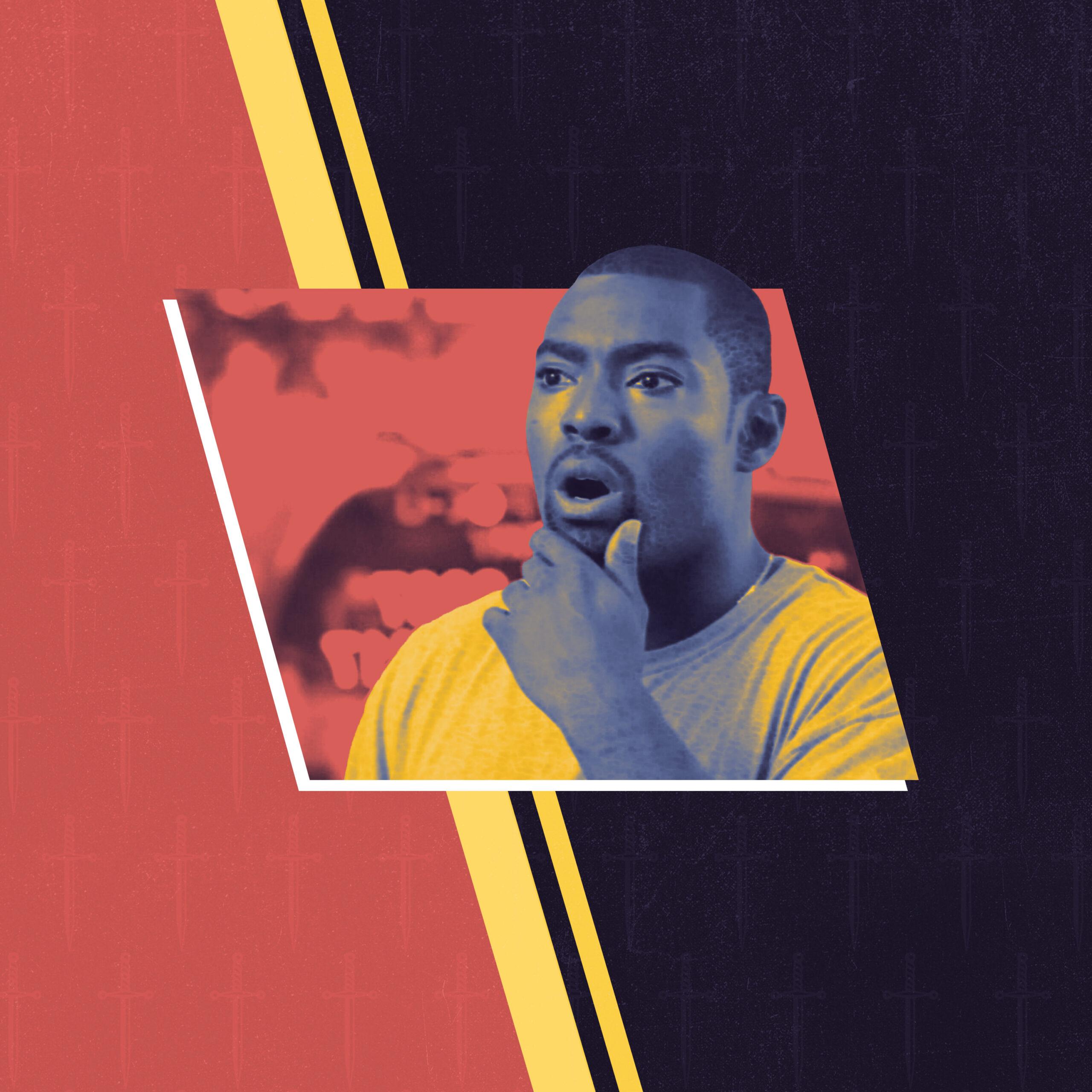

What is The Wire if not a pantheon of traitors, if not a 21st-century epic of personal and institutional betrayals?
And what is wee-bey.gif if not the perfect visual shorthand for the grimy fuckery of The Wire?

Of course, wee-bey.gif is an image ubiquitous in online spaces; it’s long escaped its formative context and become the most enduring and universal of memes. It’s a ready-made expression of shock at any and all manners of revelation: in politics, in entertainment, in your life or your work or your frivolous contributions to Reddit, in all seriousness, or in jest. Wee-bey.gif both serves and contains multitudes. It’s tough to pinpoint the most essential detail. Wee-Bey’s eyebrows comically furrowing at the realization? The mix of profound dread and grudging amusement in his face, in such a perfect display of tragicomic astonishment? The camera circling Wee-Bey so beautifully, highlighting the absurdity of his surroundings?
Wee-bey.gif is indispensable, as memes go. It apparently spread from NikeTalk through various other niche web forums before regularly circulating on Reddit and then Twitter by the mid-2010s. It is the moving image of the street kingpin Avon Barksdale’s principal enforcer, Wee-Bey Brice (played by Hassan Johnson), absorbing not one but two head-spinning revelations about a shooting that he’d orchestrated and executed on a strip club owner named Orlando. Initially, Wee-Bey is energetic and proud of a job well done as he recounts the events of the previous evening to Avon’s consigliere, Stringer Bell. Still, Wee-Bey expresses some mild annoyance with his accomplice, Little Man, who had fired a few extra shots into the car upon spotting a female passenger at the last minute. Alas, Stringer breaks the bad news to Wee-Bey about the strange woman who was sitting in the back seat when bullets started pouring through the windshield of Orlando’s old Lincoln Mark VI: “Shorty was a cop. And she ain’t dead.”
Such a treacherous misstep. Such a treacherous show.




Traitors Week at The Ringer
David Simon’s sprawling and streetwise TV series about the tense social fabric of Baltimore, Maryland, ran for five seasons on HBO in the 2000s, that landmark decade of prestige television. Each of the five seasons of The Wire foregrounded a particular segment of Baltimoreans: in order, street criminals, dockworkers, local politicians, students and teachers in the public school system, and, lastly, journalists. The central perspective that links these segments and their respective seasons, though, is the Baltimore Police Department, hence the show’s title, referring to the wiretaps used by its exasperated detectives to keep tabs on the city’s various criminal enterprises. What you have, then, is a street-level meditation on the interlocking failures of various institutions and the grim follies of some reformers.
Betrayal is the iron law of The Wire. There is no shortage of its explicit depiction in the series. And yet wee-bey.gif does not depict one of the show’s many typical betrayals, in the sense of one character turning on another. Here, Wee-Bey Brice is a man betrayed by reality itself, by the fact that a routine hit that went off with only a minor hitch was not as it seemed—was a catastrophe, in fact. Wee-Bey goes on to insist to Stringer that the woman in the back seat couldn’t have been a cop: “She looked like one of Orlando’s hoes!” Mind you, Wee-Bey and Stringer are reconvening in somewhat silly circumstances: In wee-bey.gif, these two are debriefing in Stringer’s print shop, a front—so, a place that’s not as it seems—where Stringer uses the loud hum of the copiers as a surveillance countermeasure. Deception runs deep in The Wire. At this point in the first season, Wee-Bey Brice and Stringer Bell have both only begun to scratch the surface. One of them is eventually buried beneath it.
Life in The Wire was cheap, and any character that canonically survived through the series finale with their liberty intact could consider themselves lucky; though, alternatively, the characters who met violent ends might savor the honor of belonging in a montage of all-time great character deaths. Survival in The Wire isn’t an achievement so much as a fluke, generally speaking. That said, Wee-Bey Brice and Stringer Bell meet very different ends in The Wire, and their respective fates are certainly earned. Wee-Bey is unflinchingly loyal to the Barksdale crew, ultimately eating a dozen or so murder charges, including a few for killings committed by others in the Barksdale organization, and serving life without parole in order to spare his coconspirators. He’s a knucklehead, but as enforcers go, he’s savvy and sensible enough, and he’s a relatively admirable figure in a series where the true villains are generally distinguished by arrogance and self-absorption. By the end of the series, Wee-Bey has settled into prison life with a certain serenity about him, as he relinquishes his son, Namond, to the retired detective Bunny Colvin, affording Namond a rare bright future among the otherwise ill-fated children of The Wire.
Stringer Bell, on the other hand, is a fool so treacherous that I regard him as the no-brainer pick to win Traitors Week. He has arrogance in spades, though he’s somewhat more methodical and deliberative than the true egomaniacs of The Wire; Stringer masks his own arrogance with earnest stabs at professionalization and sophistication. He’s a supposedly enlightened figure who’s somehow too good for the game he’s playing but then also too blinkered to see the limits—and the goofiness—of his efforts to give the drug game a business school–brochure gloss. Stringer Bell cultivates his distinct capacity for betrayal to compensate for his naivety in every other respect. In this sense, Stringer Bell is more similar to Prop Joe’s punk-ass nephew Cheese than he’d ever want to admit. He betrays the Barksdale organization so thoroughly, going so far as to have Avon’s nephew D’Angelo killed in the supposed best interests of the crew, that he single-handedly drives its demise. But then he’s ultimately, beautifully betrayed by Avon, who gives Stringer up to the hitman tag team of Brother Mouzone and Omar in the defining moment of Season 3.
Wee-Bey Brice is neither a mastermind nor an innovator; he takes a dim view of Stringer’s efforts to reinvent the game they’re all playing and Stringer’s disregard for its codes. He’s one of the more humble and pragmatic players in The Wire. He knows his place and plays his part. He does what must be done to contain the blowback from the shooting of Detective Kima Greggs, sequestering himself in Philly and eventually killing Little Man under orders from Stringer.
It’s a world where no degree of savviness will totally save you from being blindsided by fate. We’ve all been Wee-Bey, at some point—wrong-footed, dumbstruck, and wearing an expression as beyond our control as our present predicament. And none of us wear the expression as well as Hassan Johnson in 720p.