

When it comes to Avatar, it’s the goofy imperfections that make the franchise so compelling. Coming off the record-breaking success of Titanic, James Cameron had carte blanche to create the most expensive blockbuster to date, and he proceeded to [sigh] give us a revamped Dances With Wolves featuring giant blue aliens and a human man who gets the hots for one of them. When our protagonist, Jake Sully, inhabits a genetically engineered Na’vi body for the first time, he runs into some other avatars hooping. The Na’vi’s version of sex involves tendrils from appendages hidden within their hair connecting, kind of like a horny mind meld. Their connection to Eywa is so deep-seated that the climax centers on the destruction of a sacred tree.
Please don’t mistake any of this for an insult: Avatar is a deeply strange film, but I wouldn’t have it any other way. The immersive nature of Pandora is so intense that I don’t blame moviegoers who apparently got depressed that the world doesn’t really exist. When that sacred tree was razed by the evil sky people—a.k.a. humans who are too jaded to appreciate Eywa’s greatness—I cried a river. Seeing Jake fall for Neytiri, well, I get it. Of all his strengths as a filmmaker, this might be Cameron’s greatest gift: Any idea, no matter how silly or misguided, can work on the power of his convictions. His movies are unapologetically earnest, which is why something like Rose and Jack’s farewell in Titanic is so moving, but it also makes the ending of The Abyss—where sea-dwelling aliens save Ed Harris because he loves his estranged wife—surprisingly effective despite its corniness. Cameron delivers big emotions, and time and again, audiences eat it up.
So when Cameron finally returned to Pandora with Avatar: The Way of Water, I was ready to surrender myself to its wonders once again. Sure enough, the sequel doubles down on what made the original Avatar so captivating: the transportive visuals, the otherworldly fauna, the earnest message about cherishing nature and your loved ones in equal measure. The new elements of the film were just as thrilling, none better than the introduction of the tulkun: a hyper-intelligent, whale-like species whose vocalizations were translated with the franchise’s beloved Papyrus font. And then … there was Spider.
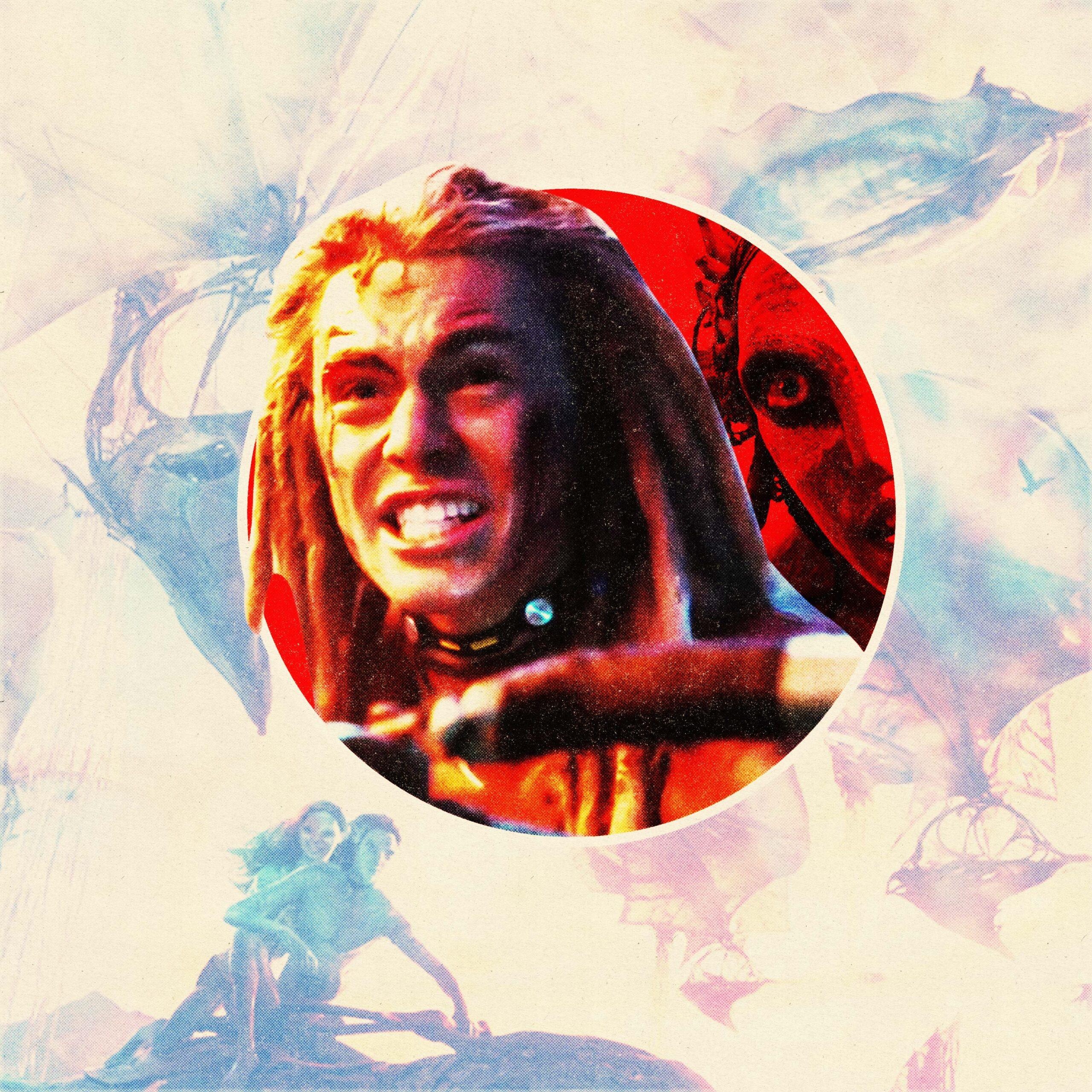
Between the events of Avatar and The Way of Water, the Sully clan raises four children: Neteyam, Lo’ak, Tuk, and Kiri, the latter of whom was born from the avatar body of Sigourney Weaver’s Dr. Grace Augustine and, thus, is played by Weaver. (Yes, it’s as weird as it sounds.) But while most of the humans were sent home, a small group of scientists loyal to the Na’vi remained, as did little Miles Socorro. Too young to make the long journey back to Earth in cryosleep, Miles was raised on Pandora, becoming an unofficial member of #TeamSully and getting the nickname Spider. He’s basically Pandora Tarzan—all the way down to rocking a dainty loincloth. Whenever Spider showed up on-screen at the start of The Way of Water, my brain short-circuited. Amid all the CGI wizardry, a white teenager with dreadlocks hanging out with the Na’vi felt like some weird fan fiction, or an expensive Make-a-Wish campaign. Make this make sense:
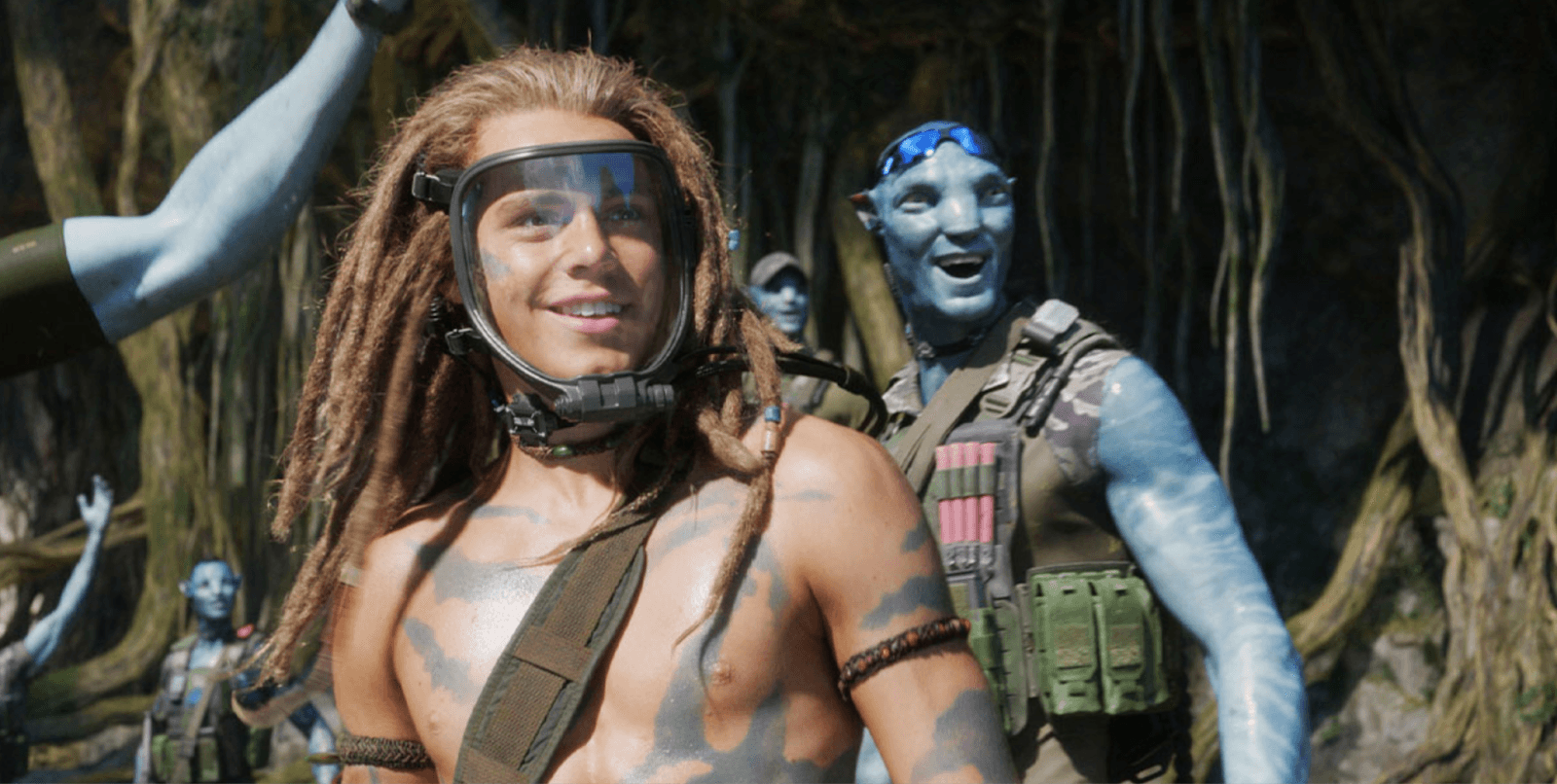
And yet, against my better judgment, over the course of this (very long) movie, I began to care for Spider. He’s got one of the most interesting arcs in The Way of Water: Before long, we learn that his biological father is none other than Colonel Miles Quaritch, the antagonist of the first film, who’s been resurrected in an avatar body. When Spider is captured by Quaritch, it adds new depth to a villain that was previously one-dimensional and gives Spider an identity crisis of his own to deal with. Does this version of Quaritch care that he has a son? Will Spider feel connected to the father he never had? Where do Spider’s allegiances truly lie? Another wrinkle is Neytiri’s open contempt for Spider because she doesn’t believe he belongs in their world. Soon after Neteyam is killed, an anguished Neytiri holds Spider at knifepoint and doesn’t hesitate to cut him; in a deleted scene that should’ve stayed in the final cut, she ponders ending his life even after Quaritch surrenders.
However you slice it, that dreadlock-rocking teen became an integral part of the franchise’s core themes of identity, belonging, and retribution. Now, with the release of Avatar: Fire and Ash, it’s clear that Spider’s web is entangled in every part of this sprawling story. For better or worse, Spider has emerged as the emotional linchpin of the franchise, and tying his arc to the greater Avatar universe might be Cameron’s most daunting challenge yet.
Picking up right after the events of the previous film, Fire and Ash sees the Sully family reeling from Neteyam’s death. Spider, meanwhile, is living among the reef-based Metkayina, but, if you’ll permit me, he’s a fish out of water. This is mostly a practical concern: Spider can’t breathe Pandora’s air, and resupplying his oxygen is difficult in this corner of the planet. Jake and Neytiri decide to send him back to the Na’vi forest base, but their kids protest losing their best friend. As a compromise, the Sullys decide to make the journey as a family—one big farewell to Spider—with some nomadic traders. Unfortunately, the group is attacked by raiders from the volcano-dwelling Mangkwan Clan, and the Sullys are split apart in the chaos.
Here’s where things get interesting: Spider’s oxygen is depleted, and he gets separated from his spare mask during the raid. As he runs out of air, we assume the worst. Then Kiri, who has a special connection to Eywa, summons the roots of the planet to envelop his body, not unlike what happened to Dr. Augustine at the end of her life. This time, however, it has the effect of resuscitating Spider and, much to everyone’s shock, allows him to breathe Pandora’s air. Just like that, Spider has managed to assimilate to the point of his dreads containing the same appendage that allows the Na’vi to connect to Eywa and [clears throat] each other. Spider was already one of a kind—a child raised on an alien planet who feels disconnected from his own species—and now that extends to his actual biology.



More on ‘Avatar: Fire and Ash’
It’s a bold narrative swing, to say the least, and one that carries with it serious ramifications. If Spider falls into the hands of the enemy, and whatever Kiri did to him can be replicated, it would allow the sky people to colonize Pandora unabated. Thus, after inevitably getting captured by Quaritch in the film, Spider’s very existence becomes an ethical quandary for our heroes. He’s done nothing wrong, but should he be left alive when he could single-handedly lead to the destruction of the planet?
After rescuing Spider from Bridgehead City, Jake and Neytiri consider the unthinkable: killing their children’s best friend for the greater good. It’s absolutely devastating, especially when Jake takes Neytiri’s knife to do the deed himself. If anyone can sympathize with Spider being caught between two worlds, it’s Jake, who leaves his literal body behind to start a new life with the Na’vi. As Spider realizes what Jake is about to do, he says the words that’ve echoed in my head every day since I saw the movie: “Please, Dad … do you still love me?” I should stress that, throughout this sequence, Jack Champion gives, with all due respect, a woefully stilted performance that threatens to undercut the dramatic stakes. That the moment still lands with the requisite pathos is a testament to Cameron’s unwavering ability to elevate raw emotion above even the clunkiest acting or dialogue. Reader, I was on the verge of tears over Spider.
Mercifully, Jake doesn’t have the heart to do it, and even Neytiri realizes that killing Spider would mark a point of no return, allowing the fire of hate to smolder over the ashes of grief. Instead, they finally come to accept Spider as one of their own. Like Jake, Spider has been embraced by a family that judges him by his actions rather than where he comes from. (I see you.) Ultimately, Spider represents not just a bridge between the Na’vi and mankind but also the common thread linking the ideologically opposed father figures in his life.
Echoing The Way of Water, Fire and Ash culminates in another fateful Jake-Quaritch showdown, each Marine-cum-avatar wounded by arrows but willing to fight to the last breath. The fact that they square off in front of Spider underlines that the stakes are as personal as they are existential. And when both men set aside their differences to save Spider from falling to his death, it’s clear that the bonds of family will always transcend orders or animosity. This doesn’t redeem Quaritch, but it reinforces the idea that Spider is the only tether to his humanity. If Quaritch is the franchise’s equivalent of Darth Vader, perhaps the fate of this universe rests on Spider showing his father the light.

Unfortunately, even though some of the fourth Avatar film is already in the can, Cameron has said that the franchise’s future will depend on the success of Fire and Ash. Were Fire and Ash to officially close the book on Pandora, its parting scene might become something of a punch line: Spider, visiting the Spirit World, being welcomed by generations of Na’vi. Even in a movie featuring space whales holding a tribunal in the middle of the ocean, there’s a level of goofiness here that could undermine Cameron’s intended gravitas.
Considering all the criticisms that Avatar has a white savior narrative because it foregrounds Jake Sully, the image of a human treading on sacred Na’vi ground will be hard to shake off. But if we accept Spider as an avatar (sorry) for some of the franchise’s biggest ideas—that identity, loyalty, and even specieshood are fluid things, reshaped by the bonds we choose—then perhaps we can accept this supremely silly ending at face value. Within the world of Avatar, Spider embodies the franchise’s most sincere conviction: that belonging is not bestowed by birth, but earned through those we care for. In other words, his web connects them all.