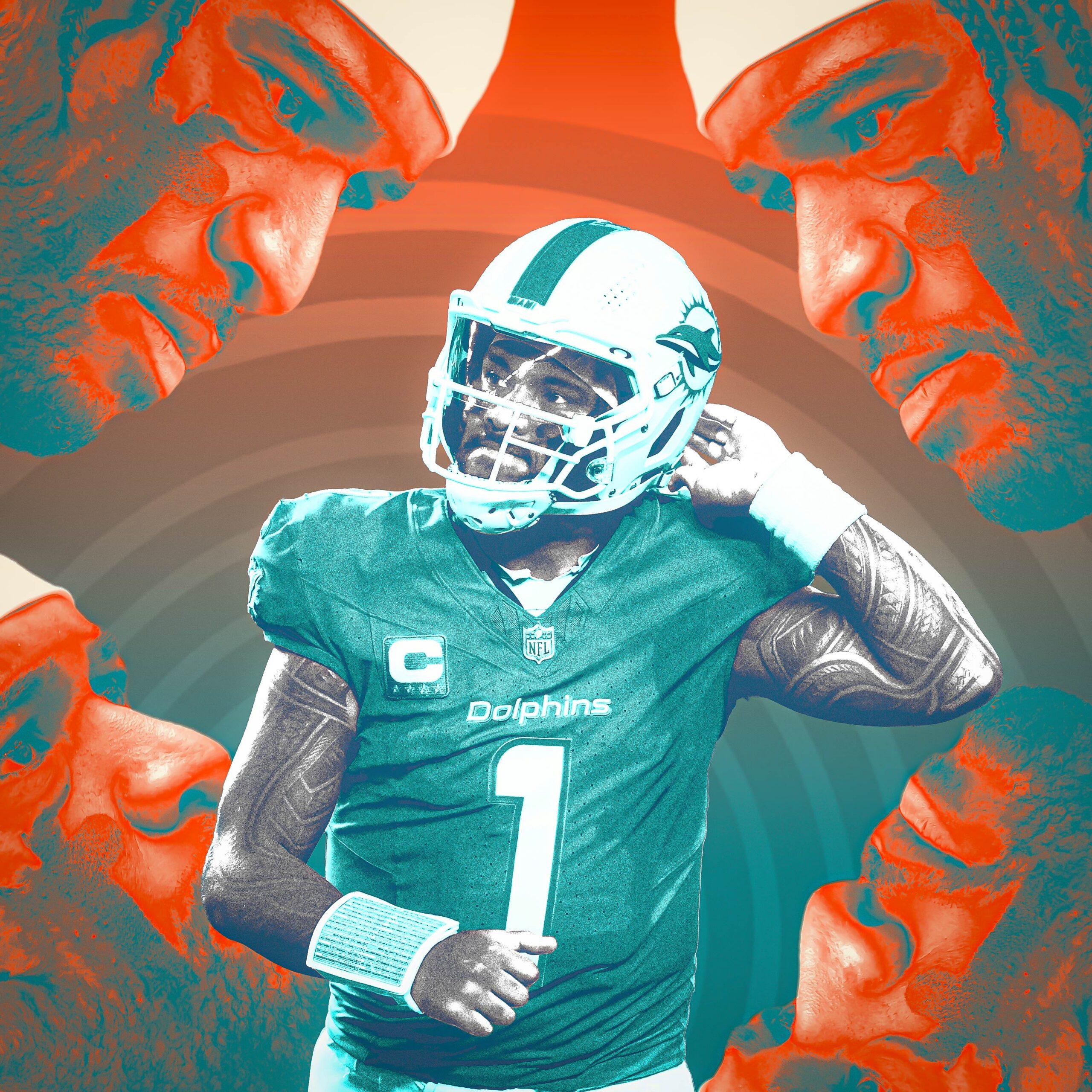

Miami Dolphins quarterback Tua Tagovailoa has been benched, demoted to the third quarterback on the depth chart as Miami prepares to play out the string on a disappointing season. This isn’t just the team changing gears for the final few weeks of 2025. It’s a signal that the franchise is moving into a new phase—and likely away from the quarterback it gave a $212.4 million contract to less than two years ago.
As rookie quarterback Quinn Ewers takes the mantle, the franchise will begin its journey into a rebuild—but Miami had been slowly marching toward ending the Tua era for a while. The Dolphins have gone 12-13 in Tagovailoa’s last 25 starts (and they’re just 2-9 against teams with winning records in that span), and he’s played much more like a league-average quarterback than the $53 million budding star Miami thought it had. “This team needs convicted quarterback play,” head coach Mike McDaniel said on Wednesday of his decision to bench Tagovailoa.
There once was a time when Tagovailoa exemplified conviction and confidence in the pocket. His ball would go flying into the middle of the field—usually to receivers Tyreek Hill or Jaylen Waddle—no matter how defenses tried to attack him. The Dolphins had the sixth-best success rate on passes in the 2022 and 2023 seasons, marrying Tagovailoa’s anticipation and trust in the scheme with McDaniel’s RPO- and play-action-heavy offense. When Tagovailoa was operating on time and McDaniel was scheming receivers open, Miami’s offense was unstoppable.
Tagovailoa is a shell of that quarterback now. He’s hesitant when he should be aggressive, reckless when he should be cautious—and those weaknesses have borne out in the data. His success rate on throws of 15 or more air yards is at 39 percent this year, the lowest since his rookie year and below the league average of 43 percent. He also has a 30 percent success rate when he holds the ball for more than three seconds this season; that’s the worst mark of his career and nine points below league average. In today’s NFL, the ability to create explosive offense and be creative in and out of the pocket is a necessity for a quarterback, not a luxury, and there’s no way to build a sustainable offense around a player who does neither.
If Tagovailoa is never again viewed as a long-term starter (and I suspect he won't be), there’s plenty to lament about his career that isn’t totally his fault. Tagovailoa was a remarkably athletic quarterback at Alabama and was on pace to have one of the greatest college careers ever—he proved that he was a QB with the skills to thrive in the NFL. He could anticipate open windows and evade pressure, and he showed that he could rise to the biggest moments after he came off the bench and beat Georgia for the national championship in the 2017 season.
Tagovailoa wasn’t Lamar Jackson, but before his injuries, his mobility was akin to Baker Mayfield’s, and defenses had to respect his legs. In 2019, Dolphins fans famously adopted the #TankForTua mantra, and they wouldn’t have been the only ones excited to draft a champion and efficient passer who was coming from that time’s preeminent college football program.
But we never got to see that version of him in the pros because of ankle surgeries and a dislocated hip that he suffered in the final weeks of the 2019 college season. The hip injury, in particular, seemed to force him to become exclusively a pocket passer, and his arm talent (while decent) wasn’t good enough to allow him to be successful without major help from his coaches and NFL scheme.
We can blame the injuries he suffered once he reached the NFL, too. Tagovailoa sustained another hip injury that ended his season early in 2024, but the bigger issue has been his concussions. He suffered at least two concussions in 2022, including one against the Bengals on a Thursday night game that required hospitalization. That scary scene came just four days after he was seen staggering from a hit in a game against Buffalo but was then allowed to return—and later in the year, he suffered another concussion that effectively ended his season. After that season, former players expressed their concerns about Tagovailoa’s long-term health, with several publicly appealing for him to retire. But Tagovailoa has seemed to embrace the risks that come with playing the position the way he does—and chose to focus on things like learning to fall safely in the hopes that it would give him better protection. He had his third concussion last season against the Bills and took four weeks to recover.
His recent dip in performance, compared with his peak in 2022 and 2023, could also be directly related to Tagovailoa’s supporting cast. Hill’s production took a step back in 2024 after his blistering production in prior seasons, and he missed most of this season after suffering a dislocated knee in Week 4. Miami’s offense had a 48 percent success rate on passes when the star receiver was on the field, which dipped to 42 percent without him. Losing the threat of explosive plays robbed Miami of what made its offense unique. Tagovailoa hasn’t been able to elevate the offense without help from Hill as a downfield threat, and McDaniel has been unable to adapt the scheme to be successful when defenses take away short and intermediate throws in the middle of the field.
Tagovailoa’s regression is part of an overall downward trend for the Dolphins as a whole—a total top-to-bottom system failure. Miami’s defense has taken a step back over the past two years, and the Dolphins have never figured out how to build a competent offensive line. McDaniel, once heralded as the next big thing in NFL coaching, seemed to lose some juice as a play caller in 2024—and that decline has continued this season. Miami’s run game has worked at times this year, but the passing game has stagnated.
Miami has been called soft. Defensive players struggled to connect with former defensive coordinator Vic Fangio and his old-school coaching style. And this fair-weather team tends to flop when it has to play in the cold. The Dolphins have gone 8-11 in December and January since McDaniel was hired—and just 2-6 in games played at or below 50 degrees. Tua is particularly bad in the cold, and is winless when the temperature is sub-40. Miami seemingly knew how it was perceived around the league and made an effort to address it. Every couple of weeks last offseason, we saw new headlines about how the Dolphins were toughening up, resetting their culture, or encouraging players to take the lead on accountability. But then they promptly got blown out by the Colts, 33-8, in the season opener, and Tagovailoa challenged his teammates’ commitment in his postgame press conference.
A month later, with the season spiraling away after a loss to the Chargers—in which Tagovailoa threw three interceptions—the quarterback again called out his teammates for skipping or showing up late to film sessions. McDaniel later called the quarterback’s comments a “misguided representation of player-orchestrated film sessions.” The coach, quarterback, and team were clearly not on the same page, and it certainly seemed like all the talk we’d heard over the past two years about a culture change in Miami was a waste of time. If the meetings are player led and the head coach publicly disagrees with his franchise quarterback, whose words carry the most weight in the building? And if the team can’t present a unified front after an embarrassing loss or doesn’t rally behind its struggling quarterback, when exactly would all these player-led culture changes actually show up? If a $53 million quarterback can’t perform at a high level or capture the attention of his team when he needs to, then he isn’t the franchise guy, and he can’t factor into the team’s long-term future.
That brings us to this week’s benching, two days after the Dolphins were eliminated from playoff contention with a loss to the Steelers on Monday night. Tagovailoa’s final stat line from that game looks decent—253 passing yards and two touchdowns, with one interception—but is misleading. Both of his scores came in garbage time; for much of the game, he was completely ineffective. “The quarterback play last night was not good enough,” McDaniel said the morning after the game. “So for me, everything is on the table.”
In the short term, that means a switch to the rookie Ewers (who jumped over Zach Wilson on the depth chart). In the long term, the benching is likely the start of a long rebuilding process, undoing the mistakes of the past few years. The biggest error committed by former GM Chris Grier, who was fired in October, was clearly the massive investment in Tagovailoa, but it was hardly the only issue.
Grier also gave both Hill and cornerback Jalen Ramsey a combined $162 million in contract extensions in 2024, when both players were in their age-30 season. Ramsey was traded to Pittsburgh less than a year later, and Hill will almost certainly be cut at the start of the new league year in March. The team will take on just under $48 million in dead cap charges next year from those two players alone.
And that leaves us to consider Miami’s options for Tagovailoa now, each one carrying painful financial consequences. A trade is likely the preferred outcome for Miami, but it seems nearly impossible to pull together. With Tagovailoa’s stock at an all-time low, it’s hard to imagine that another team will be interested in giving up capital for him and taking on the burden of his hefty contract. And even if Miami were able to make a trade, it would still be left with about $45 million in dead cap charges, per ESPN, in 2026 alone. If the Dolphins opt to cut Tagovailoa, the best option would be a post–June 1 designation, which would spread out the $99 million in accelerated cap charges over a couple of offseasons—but would still significantly handcuff the team’s roster-building options for multiple years.
Tagovailoa’s contract becomes less expensive after the 2026 season (when he has a $56.4 million cap hit), but keeping him around all of next year after this benching can’t be a realistic option. NFL franchises rarely hold on to veteran former starters once they’ve been benched (the Falcons and Kirk Cousins are a notable exception). The GM who drafted and paid Tagovailoa is already gone, and McDaniel seems to sense that he could be next to be let go. McDaniel and Tagovailoa once seemed like a package deal, but the coach may have determined that the QB could no longer save his job.
This whole situation is reminiscent of where Denver was with Russell Wilson in late 2023, when it needed to break free of an albatross of a quarterback contract. The Broncos benched Wilson before Christmas, cut him in March, and took on a record $85 million in dead cap charges over the next two years. They found their next QB in the 2024 draft and added him to what was a fairly well-built roster, and they are currently the no. 1 seed in the AFC. A rebuild in Miami might not be quite as smooth. The Dolphins’ next GM will be handed his office key and a balance sheet with those huge impending dead cap hits on it—and will have to draft nearly perfectly to dig the team out of that hole. Denver did it under the direction of champion head coach Sean Payton, and I doubt that any coach as good as he is will be walking through Miami’s door in the offseason.
In the modern NFL, teams churn through quarterbacks quickly. The Tagovailoa situation could become further proof that a massive contract won’t stop any franchise from making a change in desperate times. If Tagovailoa wants to get another shot as a starter, he could look to the Raiders’ quarterback for inspiration. Geno Smith didn’t have a lengthy injury history like Tagovailoa does, but his tenure as a backup and spot starter in Seattle helped rinse away the bad times he had with the New York Jets. A couple of hot years as the Seahawks starter got him around $90 million in contract value from 2023 to 2025. Quarterbacks like Smith, Sam Darnold, and Mayfield are proof that someone like Tagovailoa is just one good supporting cast and good coaching staff away from resetting his career trajectory. It’s probably best for Tagovailoa to embrace a divorce from Miami this offseason and take a one-year prove-it type of deal in Indianapolis (to compete for a starting position while Daniel Jones recovers from his Achilles injury). Or he could become a backup in Minnesota, work with QB whisperer Kevin O’Connell, and hope that there’s a long-term starting job awaiting him in a couple of years.
Tagovailoa never delivered on becoming a true franchise quarterback, and the Dolphins never toughened up or smartened up enough to compete atop the AFC. We’ll never know what he could’ve been without so many injuries before and during his time in the NFL. But we also know that the book never truly closes for a quarterback with talent and experience. Tagovailoa could return as a starting quarterback in the future; it just won’t be in Miami.