 Van Lathan
 Van Lathan
 Rachel Lindsay
 Rachel Lindsay
About the episode
Surprise, Thought Warriors! Higher Learning is here with a pop-up episode featuring none other than Colin Kaepernick in the studio! Kaepernick drops by not just to promote his new book, The Perilous Fight, but to have a real conversation with Van and Rachel about everything. From civil rights to NFL blackballing to racial identity to protesting against police brutality to Target, no topic is off limits.
In the following excerpt, Colin Kaepernick speaks with Van and Rachel about the details of his settlement with the NFL.
Van Lathan: So are they a weak union? Is the NFLPA a weak union or a fake union?
Colin Kaepernick: I would say, at best, it’s a weak union. At worst, it’s a fake or co-opted union.
Lathan: Let’s come back to the settlement real quick because that’s another thing that people bring up a lot. So you talked about the way the players could organize their powers and change stuff. I remember being on TMZ when the settlement was released because I thought the settlement was that instrument—or the collusion case. I thought that was that instrument. I thought the collusion case was, OK, you prove collusion, you break the CBA, put everything back to zero, and then the players now have this strong position by which to move the NFL around.
And so when—because I’m on TMZ and I’m going hard. It’s Kap, Kap, Kap, Kap, Kap. And then when this happens, they go, “Kap settled with the NFL.” And Harvey goes, “Van?” And I’m like, “Yo, what?” And so I had to go in there and be like, “Yo, man, I don’t agree with this.” And the whole nine.
For people who still feel that way—and there are still people who feel that way, because there are still narratives being pushed. And we’re not mentioning certain names in this entire interview. I don’t even fucking feel like it, dog.
Rachel Lindsay: Are we not? OK.
Lathan: You can if you want. No, you can if, that’s on—but I don’t even fucking feel like it.
But for people that either had that misconception then or are going to hear what you just said about the power. There will be people that listen to this and go, “Well, you had the power to destroy the CBA and bring the NFL to its knees by continuing with that case, seeing it all the way through, and then getting a favorable verdict or judgment from the judge or the legal system.” Explain that to people as far as what’s said about the case and the settlement and what really happened.
Kaepernick: Yeah. So I would say going through the litigation process was a learning process for me as well. Going into it, I didn’t think we would be able to dismantle the CBA as part of it. But I did think all of the documentation would be able to be exposed and revealed.
Lathan: OK. So you thought for sure that these depositions would come out and all this—
Kaepernick: The depositions—
Lindsay: The discovery.
Kaepernick: The discovery.
Lathan: The discovery. All of this stuff.
Kaepernick: All of that. Which I was like, “Just release that to everyone, and it’s a wrap for y’all.”
The part that I didn’t understand going into the grievance process was within the collective bargaining agreement, as soon as you file a grievance, which is the legal process you go through, that’s essentially litigation under the CBA. As soon as you file a grievance, everything is bound by the CBA rules within that already. You have to go to arbitration, and you go to their special arbitrator. Everything is confidential from the start. So when you sign your employment contract, there’s confidentiality. When you go to the grievance process, there’s confidentiality. And all of that is laid out in advance before I ever filed anything.
Lindsay: Sure.
Kaepernick: I now fully understand that process going in, because I thought we would be able to expose more.
Now through that process, we had a lot of successes that ultimately led to the settlement. But there are also a few factors that played out that made us not continue to move forward. Part of that is the structure of the grievance process. So you have a special arbitrator—I think it might have a slightly different name than that—but essentially a special arbitrator that’s agreed upon between the NFL and NFLPA. At any point in time, the NFL can terminate them, though. So if they make a decision that’s not favorable, they don’t get their paycheck anymore and they’re out.
So the incentive is already laid for them to be favorable to the NFL to maintain their own position. If you clear that hurdle and you have success there, you then go to a three-person special arbitration. That’s the secondary level of this. Same rules for those arbitrators. So you have to go through that process.
Now, the other part is, in this, we thought about going the federal route. Can we try to pull this out of the jurisdiction of the CBA? On the legal side, that turns into a yearslong battle around jurisdiction. The lawyer’s recommendations were, if we do that, they’re going to send it back to arbitration, go through arbitration. You can try to bring it back out, but that’s really not an effective path.
And then the last part is during this time period, if we look at, I believe Deflategate ultimately went up to the Supreme Court with Tom Brady. When we were looking at potential pathways like that, this is also the moment that [Brett] Kavanaugh gets put on the Supreme Court, [Neil] Gorsuch gets put on the Supreme Court. So we now have a Trump-loaded or Republican-loaded Supreme Court—
Lathan: So you’re fucked, then.
Kaepernick: That’s six-three. Those two appointees were also backed by Michael Bidwill in Arizona, one of the owners, and John Elway in Denver. So when you think about the alignment of Trump, the justices, and the NFL owners and NFL as an organization, it was like, well, that landscape is already set up for us to fail.
And for us, the opportunity is if we go out there and we have a Supreme Court that actually isn’t going to approach things in good faith and make a decision because it’s loaded one way and backed one way, if that isn’t successful, then what’s on the other side of that? A legitimacy for the NFL to be able to take this approach forever. For them to be able to push the bounds further in relation to how they can attack players, how they can try to restrict what they can do, how they can approach litigation.
And that ultimately led us to a space of, well, here’s the pathway within the CBA for us to be able to execute. Settlement is typically going to be the outcome as part of that. And that’s typically how the process plays out. But there are a lot of factors within that and also a lot of learning on my end in relation to what you can and can’t do within the process and what you can and can’t expose.
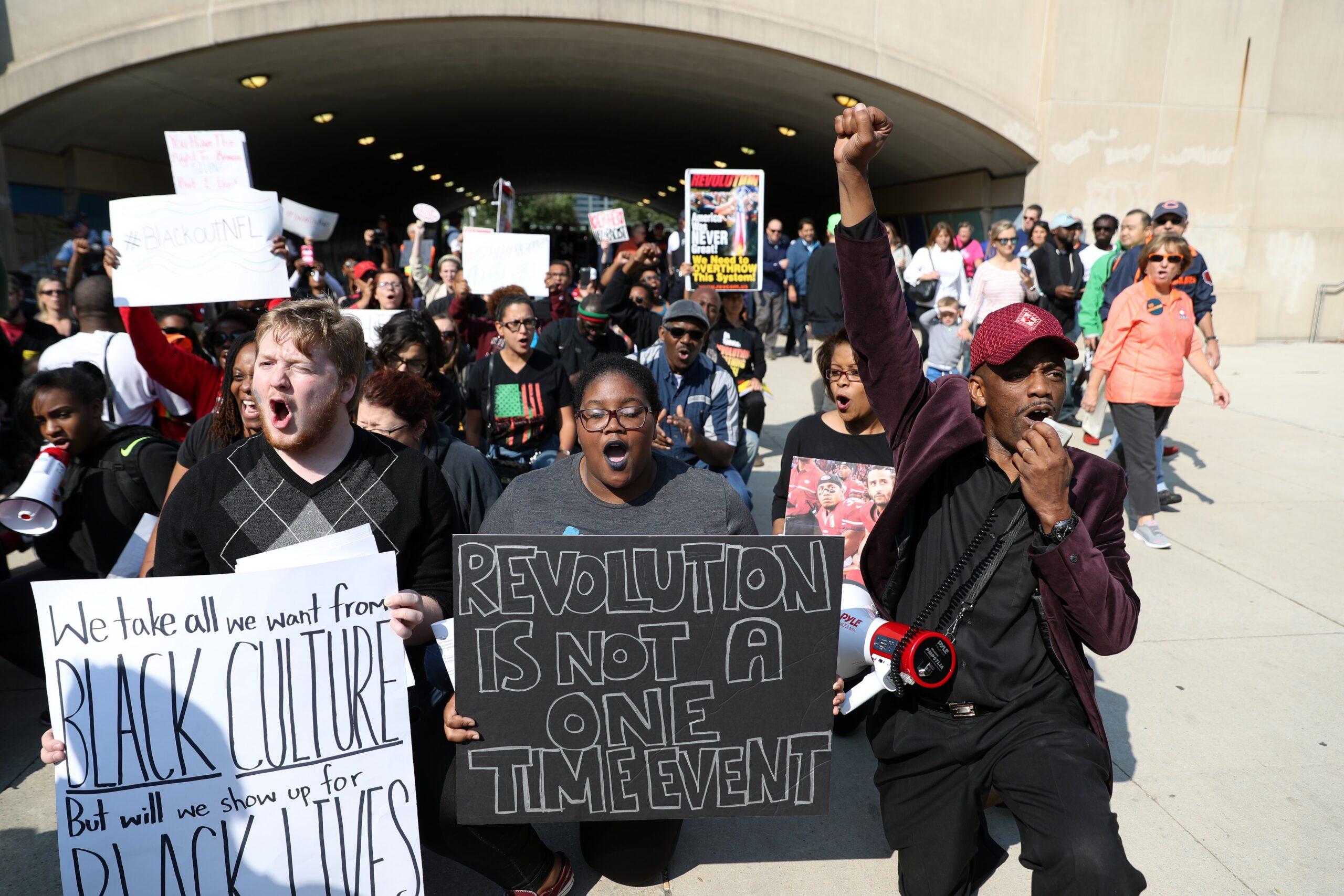
Protesters stage a rally against the NFL in support of Colin Kaepernick on September 10, 2017
Lathan: Did you anticipate how the announcement of the settlement would be weaponized against you?
Kaepernick: No, I didn’t think it would be positioned the way that it was on the other side of it. I also will say I have empathy, a level of understanding, because I went into the process with a different understanding of what could come out the other side. So without going through the process, I would’ve been sitting in the same seat of like, “Oh man, I thought there could be more from this.”
Now, I also want to say, Eric Reid had separately filed a grievance, had won that grievance. But basically there was, within the arbitration process, they effectively ruled, like, “Yeah, they did it, but there’s nothing we can really do to hold them accountable,” which was a weird insight to be able to see come from that. And Eric can speak more specifically to the details around it, but that was also something that was happening during this.
So we got to see the inner workings of how things actually play out in practice versus in theory, which just made it a lot tougher landscape to be able to navigate. But I have a lot of empathy for people in that process of “Oh, I thought there was going to be more to be able to come from it.”
Well, I’ll also say that doesn’t restrict my ability to go out and pursue my career still. That doesn’t restrict my ability to critique or talk about the NFL. And I think those were important distinctions for us as part of that process as well.
Lindsay: Yeah. I mean, I’m not going to even get into the whole, “Oh, you won a settlement. Why do you want to play?” Because you already shut me up about that one. And rightfully so.
Kaepernick: We’re just having a conversation.
Lindsay: Let it out, let it out.
Kaepernick: We’re just having a conversation.
Lindsay: I’ve been dying to ask you the question. I love the response from it. It makes all the sense in the world. But at the end of the day, you did prove that there was collusion. So there is a benefit of it, of, no, we don’t get the details. No, we don’t know how specifically they did it. But at the end of the day, you did something where you were able to show that they all came together and blackballed you from being able to play. They worked together. That was a huge deal.
Kaepernick: Yeah.
Lindsay: So it did prove something, and I understand the legality of it and why you made the decisions that you did. I’m really glad that you laid that out. But I love the latter part of what you said because that’s something that’s come up again. And this is also a part of you controlling the narrative and speaking out.
There were roadblocks set up against you before where you were never going to be able to disclose certain things. And the term NDA has been thrown out here. NDA—nondisclosure agreement versus non-disparaging agreement, two totally different things, which I from the outside laid out on this podcast, but you being directly impacted by it, you get it. You’ve already explained to us that you were never going to be able to disclose certain things because of the agreement that had been negotiated for you. But you were able to maintain the fact that you could continue to try to play. And you could speak out in ways, however you wanted to.
Can you speak a little bit more on that? Because there have been other people that are speaking, trying to do that for you.
Kaepernick: Yeah. Just to make very clear in this, a nondisclosure agreement means the information that’s part of that process can’t be made public without both parties agreeing to it. That was laid as part of the CBA before we entered the grievance process. Also, they include that language as part of the settlement. That is standard practice. It didn’t change anything. It’s just a reiteration of what was already at play.
Non-disparagement becomes, “Hey, not only is this information not able to be disclosed, but you can’t speak about us in any form or fashion that is negative.” I can speak about the NFL however I please.
Lindsay: You didn’t sign that.
Kaepernick: There is no non-disparagement agreement. I can say what I want about the NFL. You’ve probably seen some of that today already. But there’s nothing that restricts me in relation to how I want to talk about the NFL, how I want to talk about positions that they’ve taken, about them blackballing me, about them targeting other players. They have no control there.
Lindsay: Did they try to get you to sign a non-disparaging agreement?
Kaepernick: Yes.
Lathan: And you refused?
Kaepernick: I refused.
Lathan: And then disparaged the league. I saw it, we covered it.
This excerpt has been edited and condensed.
Hosts: Van Lathan and Rachel Lindsay
Guest: Colin Kaepernick
Producers: Marco Escalante and Jade Whaley
Social Producer: Bernard Moore
Video Supervision: Chris Thomas