
Hosts
 Derek Thompson
 Derek Thompson
About the episode
Four months ago, the U.S. and Israel launched a surprise attack on Iran. Supporters predicted a decisive victory that would curb Iran’s nuclear ambitions and reshape the balance of power in the Middle East. Instead, the war became a costly stalemate. Iran’s power continued, the conflict dragged on, and the closure of the Strait of Hormuz disrupted global energy markets, sending economic shockwaves around the world.
Now, a ceasefire has ended the fighting. But critics argue that the agreement gives Iran major concessions in exchange for empty promises about its nuclear program that prove difficult to enforce.
Today, Karim Sadjadpour returns to the podcast to examine the end of the Iran war. Why did the Trump administration agree to this deal, and will history remember it as a necessary compromise or a strategic failure?
Subscribe to our YouTube channel here.
If you have questions, observations, or ideas for future episodes, email us at PlainEnglish@Spotify.com.
In the following excerpt, Derek talks to Karim Sadjadpour about the end of the war in Iran.
Derek Thompson: Karim Sadjadpour, welcome back to the show.
Karim Sadjadpour: Thank you so much, Derek. Great to be with you.
Thompson: So the president just signed a framework to end the war in Iran, with negotiations to follow. Help us read this memorandum. What is the most important thing that is in the agreement, and what’s the most important thing that’s not in the agreement?
Sadjadpour: Well, Derek, if any objective observer reads this document, they will come to the conclusion that the war did not go well for the United States. Because, of the 14 main bullet points in this memorandum of understanding, really only one demands anything from Iran, and that’s some nuclear concessions. But the rest of those 13 points either favor Iran, or they’re just kind of boilerplate diplomatic language. You can tell, just based on that document, what the outcome of the war was.
Now, I think from the vantage point of the Trump administration, and their negotiating team, and Vice President Vance, my sense is they’re not really even focused on the text of this MoU. Vice President Vance said as much, that we have gentleman’s agreements. I think they’re really conceiving of these negotiations and that document not as a potentially narrow nonproliferation nuclear deal. They actually are hoping for a broader transformation in the U.S.-Iran relationship, kind of a grand bargain of sorts. I’m very skeptical that they’re going to be able to achieve that.
Thompson: Two points of the memorandum that I want to dive into a little bit more deeply, and both of them you can think of as kind of weapons in possession or potentially in the possession of Iran: one being its ability to control the strait, and no. 2 being its bomb-grade uranium. Let’s just do one and two, in that order.
What is this memorandum? What does this framework say about the degree to which Iran is no longer allowed to shut down the Strait of Hormuz and thereby shut down the global flow of hydrocarbons? What specifically is in this framework to open the strait and ensure that it remains open for the foreseeable future?
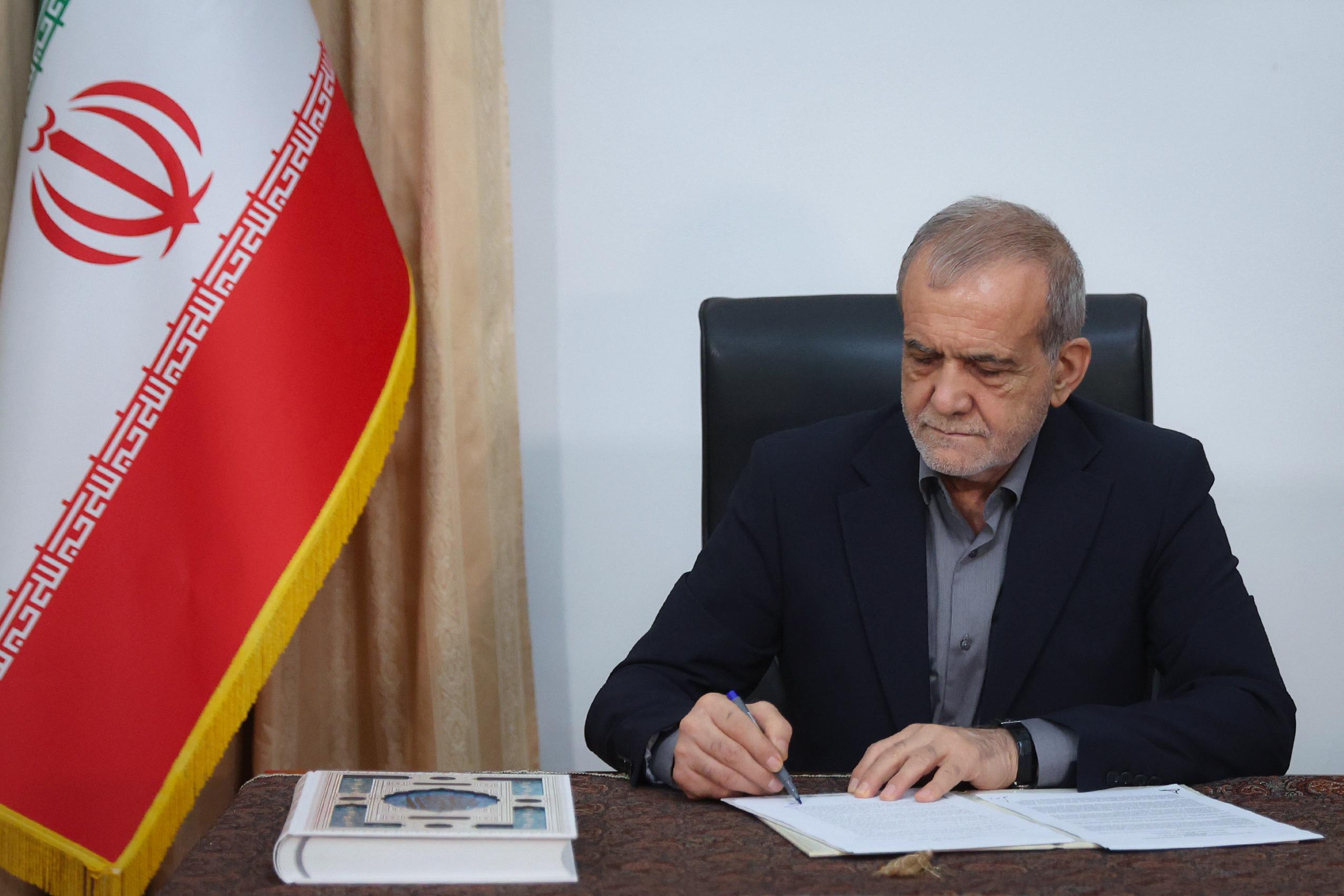
Iranian President Masoud Pezeshkian signs a memorandum of understanding aimed at ending the war between Iran and the United States on June 18
Sadjadpour: That is one of the weakest points about this memo. Because, certainly in my reading of it, what it says is that for the next 60 days, while these talks are being negotiated, the Strait of Hormuz should be open for business, back to status quo ante. But beyond that 60 days, there are no reassurances that the Strait of Hormuz goes back to being an international waterway. And if indeed the outcome of this war is that Iran retains administrative control over the Strait of Hormuz, that’s an enormous defeat, strategic defeat for the United States. And certainly all of the statements from senior Iranian officials imply that they plan on maintaining their control over the strait.
For the Iranian regime, control over the Strait of Hormuz is both kind of a fixed revenue stream that could be potentially in the hundreds of millions, if not billions of dollars, depending on how they want to try to turn that into a fixed revenue stream. And it’s also a deterrent against future U.S. and Israeli coercion. We’ve seen even in the last 48 hours that they’ve threatened that if Israel attacks Lebanese Hezbollah, they’re going to close down the strait. So I fear that this is now a new tool in Iran’s pocket, and they’re going to continue to try to play it.
Thompson: Right. The irony from my perspective is that the U.S., at least one of its stated goals was to shut down Iran’s ability to possess a superweapon in the form of a nuclear bomb. But in the process of trying to shut down their access to that superweapon, we accidentally introduced them to access to this other superweapon, which is the ability to insert a tollbooth on the Strait of Hormuz or even shut down flow through the strait entirely. And the countries that will be paying that toll, a lot of them disproportionately are the countries that neighbor the strait and are on the Persian Gulf, whether it’s Qatar or the UAE or Saudi Arabia.
How are these Middle Eastern countries responding to a memorandum that you say might, after two months, give Iran the ability to tax these countries whenever they want to send their stuff through the strait into the Persian Gulf and out into the world?
Sadjadpour: So Iran’s control over the Strait of Hormuz, as you said, Derek, is most of all an existential economic threat to the neighboring countries in the Persian Gulf, in different ways and to different degrees.
Saudi Arabia is an example of a country which has access to not only the Persian Gulf, but also the Red Sea. So they’ve diverted a lot of their oil resources through the Red Sea and then the Bab el Mandeb. And so far, Iran’s Yemeni militia, the Houthis, haven’t yet gone after Saudi exports there, and we can talk about that.
The United Arab Emirates is another country which has suffered a lot from this blockade, but they also have alternative routes that can bypass the Strait.
Arguably the country that suffered most over the last four months has actually been a country which is a friend of Iran, which is Qatar, which shares this enormous natural gas field with Iran. And there’s at the moment no other way for Qatar to get their LNG, their liquefied natural gas, out of the country. And so they really haven’t had any revenue over the last four months. And some people would argue that for that reason, it’s been somewhat of a conflict of interest for Qatar to be one of the chief mediators between America and Iran. Because for them, they really wanted any deal because they’ve been hurt the most economically as a result of this.
Also, Bahrain, Iraq have been really damaged by this. And so those countries are the ones that stand to lose most. But as everyone now knows, also the bulk of the fuel, the energy, the natural gas, the fertilizer that goes out of this trade is destined for Asia and for China in particular. And so China, in my view, doesn’t want an outcome in which Iran is dominating the strait.
This excerpt has been edited and condensed.
Host: Derek Thompson
Guest: Karim Sadjadpour
Producer: Devon Baroldi
Additional Production Support: Ben Glicksman