
 Derek Thompson
 Derek Thompson
2:14:00
Hosts
About the episode
Dramatic regime change. Moderate regime evolution. A calamitous regional conflict. Or … no change at all. Today, we consider how the Iran conflict might evolve following the killing of Supreme Leader Khamenei with Karim Sadjadpour, an American policy analyst at the Carnegie Endowment for International Peace.
Subscribe to our YouTube channel here.
If you have questions, observations, or ideas for future episodes, email us at PlainEnglish@Spotify.com.
In the following excerpt, Derek and Karim Sadjadpour dive into the potential motivations behind the U.S. and Israeli strikes on Iran.
Derek Thompson: You have written that to understand why Trump attacked Iran, we have to understand the miscalculations of both Trump and Khamenei. Why did each man miscalculate?
Karim Sadjadpour: So if we start with President Trump, I think that what he wanted to do in Iran was what he managed to do in Venezuela, which was he subjected Venezuela to significant economic pressure, significant military threats as a prelude to essentially a political decapitation. Maduro was captured from Venezuela, taken to New York City, and within a very quick period of time, the Trump administration managed to do a deal with his successor, Delcy Rodríguez. I think that was what he had been hoping for in Iran. And so we saw over the last six weeks this remarkable military escalation in the region. And Steve Witkoff, Trump’s special envoy, even alluded to the fact that they were surprised that Iran hadn’t yet capitulated. And so that essentially, in my view, was kind of, in the broad sense, Trump’s miscalculation. He thought that with enough economic and military pressure, he could have a Venezuela-style outcome in Iran.
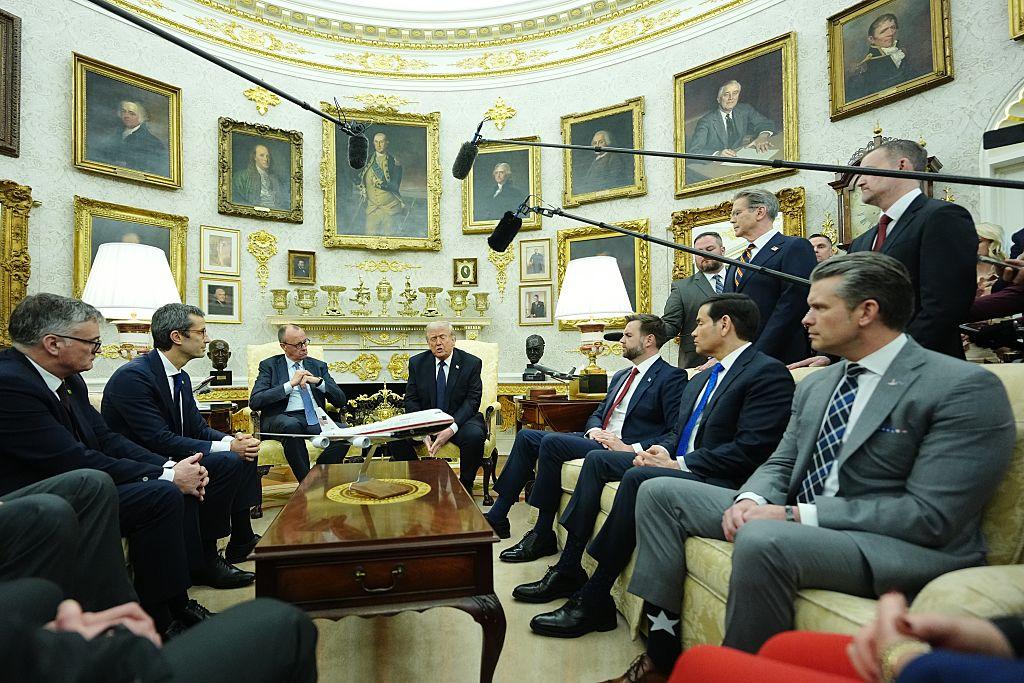
President Trump speaks to reporters in the Oval Office on Tuesday during a meeting with German Chancellor Friedrich Merz, U.S. Vice President JD Vance, Secretary of State Marco Rubio, and Defense Secretary Pete Hegseth.
And I think he actually, when you listen to his public statements, he’s still somehow hoping for that outcome. In the case of Ayatollah Khamenei, he’s really had one big idea over the last four decades, and that’s resistance against the United States. And he’s actually continuously miscalculated vis-a-vis Trump. I think that they had often at times not taken Trump seriously, thinking he was merely bluffing. There’s a few good examples of this. The most notable one perhaps is in 2020, January of 2020, when Iran did a number of provocative acts against the United States and U.S. allies in the Middle East, and Khamenei was publicly taunting Trump. And a few days after that public taunting, Trump chose to assassinate Iran’s top military commander, Qasem Soleimani. Last summer was Operation Midnight Hammer. Iran thought it was in the midst of negotiations with the United States and the United States wasn’t possibly going to attack. They thought Trump wanted to do—he’s a deal maker—he wanted to do a deal. That was another miscalculation. And so this time around, Ayatollah Khamenei paid for that miscalculation with his life.
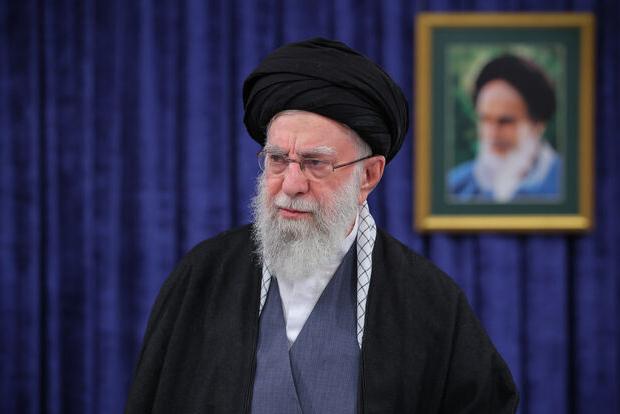
Iranian Supreme Leader Ali Khamenei addresses the public during the 47th anniversary of the Iranian Revolution, according to Iranian state television, in Tehran on February 9
Thompson: Turning to the strike itself, can you walk us through what the U.S. actually did here? What was targeted? What was at least the stated military objective? And what distinguishes this from previous U.S. military actions in the Middle East?
Sadjadpour: So we’re still early days. I don’t think it’s even been 72 hours. And the administration hasn’t been terribly forthcoming on the specifics of the operation. And I should note, Derek, that it’s not only a U.S. operation; it’s a joint U.S.-Israeli military operation. It seems that the division of labor is that the United States is focused on military targets, degrading Iran’s missile capacities, perhaps some of the nuclear facilities, perhaps the command and control of the Revolutionary Guards. It seems that Israelis are the ones that are more focused on the targeted political assassinations. And so I think it’s still unclear to us whether it was American missiles or Israeli missiles that actually killed Iran’s supreme leader. There’s been some reporting that it was U.S. intelligence which led to his killing. Let me repeat that.
So when President Trump has been making public statements about his endgame, he says contradictory things. He said that he’s … First, he’s repeated the fact that he aspires for the Venezuela model in Iran. He said that he knows who the new leaders of Iran are, and he’s prepared to do a deal with them. He’s also said that he’s willing to keep these hostilities for another five weeks, and his goal is to essentially implode the regime. And so this style, in which it’s almost like a kind of regime change by jazz improvisation, is really unsettling if you’re the Iranian regime. Obviously, this is an existential moment for the remainder of Iran’s leadership. A lot of its top leadership has been wiped out. And in part, it’s a period of tremendous, it’s the fog of war. Do they believe that they can save themselves by escalating, or do they believe that they can save themselves by deescalating and trying to compromise? And we can talk about the arguments for both.
This excerpt has been edited and condensed.
Host: Derek Thompson
Guest: Karim Sadjadpour
Producer: Devon Baroldi
More on Iran

Episode Breakdown
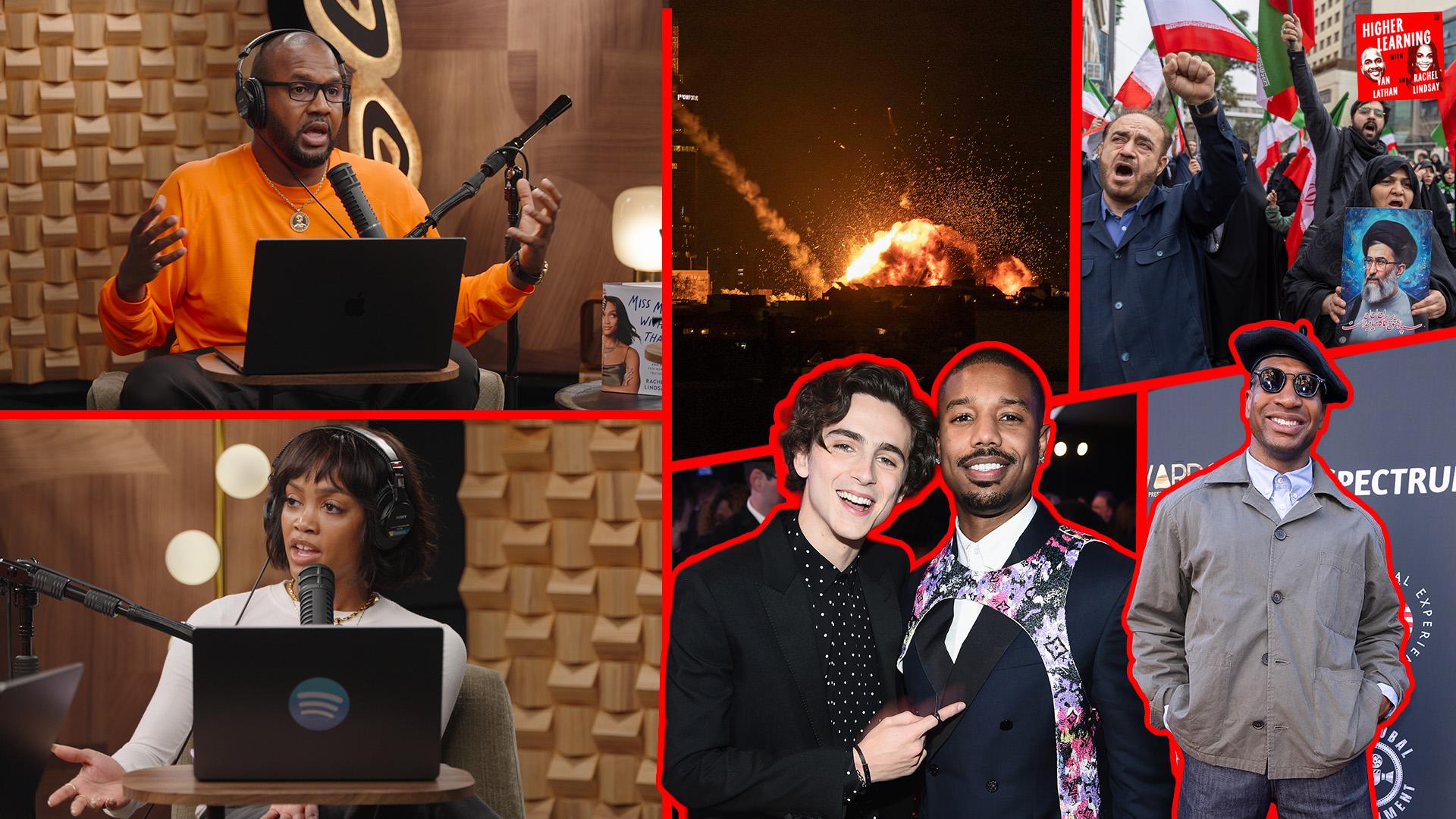
Van and Rachel welcome Hussein Banai to give insight on the joint strikes against Iran.
 Rachel Lindsay
 Rachel Lindsay
 Van Lathan
 Van Lathan
2:14:00
Episode Breakdown
Van and Rachel welcome Hussein Banai to give insight on the joint strikes against Iran.