

 Bryan Curtis
 Bryan Curtis
 David Shoemaker
 David Shoemaker
About the episode
Today on The Press Box, Bryan and David react to the contentious Democratic Senate primary race in Michigan between Abdul El-Sayed and Haley Stevens in which El-Sayed claimed the narrow victory. They talk about what El-Sayed’s victory means, all the think pieces that will come out of this race, cable news coverage, and more.
In the following excerpt, Bryan and David talk about the potential ripple effects of El-Sayed’s victory in the Democratic Party and the 2028 presidential race.
Bryan Curtis: I think this entire election cycle, and even specifically last night in Michigan, is going to birth one million think pieces. You could argue that besides [Abdul] El-Sayed, presumably, the real winner was think pieces. Because, man, you can look at this and find exactly the reality of the Democratic Party that you prefer. So if you look at just the top-line numbers, and again, we’re assuming an El-Sayed victory here, he found Democratic voters where they increasingly are on issues like Israel, to name one. And if you want to go antiestablishment, you want to go Medicare for All, whatever it is, he found voters where they are moving within the Democratic Party.
David Shoemaker: Sure.
Curtis: If you want to contort yourself a little bit, you can be like, “Hey, the establishment had a lot of power last night. They just had the wrong candidate,” with [Haley] Stevens losing by a few votes. I saw a “[Mallory] McMorrow could have won” lure thrown in the water at least once last night.
Shoemaker: Mm-hmm.
Curtis: That’s out there if you want it. Another think piece, McMorrow and Elissa Slotkin screwed up by not endorsing Stevens. They both sat out this race. A lot of people called this a preview of the 2028 Democratic presidential primary. It’s certainly still on the table if you want to write that.
Shoemaker: You mean that both Stevens and El-Sayed will be in the primary, or just politically, this is where we’re going to be?
Curtis: The ideological battles in Michigan will be the ideological battles in the primary.
Shoemaker: I kind of take exception to that, but finish what you’re saying before I go in.
Curtis: Well, and there were a lot of like, “Hey, if El-Sayed wins and then beats Mike Rogers in November, maybe he will run for president.” That’s not crazy at all. Somebody is going to take up the left lane in the Democratic primaries. And if it’s not AOC, if she decides not to run, then somebody’s going to be. And I don’t think it’s going to be Ro Khanna, or at least only Ro Khanna.
Shoemaker: If you were to believe the various think pieces and news pieces on the subject, the DSA has a disproportionate amount of power in Democrat politics right now. And who knows? Maybe they have a level of organization heretofore unknown in American politics. But separate from that idea, I’d find it hard to believe it’d be only one left lane. I think that AOC, if she chooses to run, will be the establishment left lane. And I think there’ll be a big lane open for someone who’s a perceived outsider. Even someone like El-Sayed, who, like I said, has been in politics for a long time, can come in with a different vibe than her and then drop out and endorse her at some point.
Curtis: The outsider to the outsider?
Shoemaker: The lefty outsider. I mean, AOC is an insider outsider, right? So I think that there’s going to be space for everybody. But to go to what you said about the preview of the general, the Israel-Palestine issue. And I don’t want to belabor it, because again, that’s not really what this election was about. But that issue, which really kind of came into focus with the Iran war—obviously, there’s been stuff going on long before, and this had been a topic of conversation—but the war in Iran happens right as this election’s nationalizing, right? Right as the reporters from CNN and everywhere else just show up on the campaign trail. And there was a sort of over-sampling of how much the voters were specifically—it was more of a signifier of political affiliation than it was a real platform piece for either one of them.
And I don’t know that a lot of people’s votes were changed by that, but certainly, maybe they were. But frankly, the fact that it happened in real time, I think, really skewed the Stevens campaign and their point of view. Because I, frankly—and this is where I don’t think it’s going to be nationalized. I think of Israel as this much of a hot-button topic. AIPAC and all of its associated money-giving organizations will not be out there forcing, asking any candidates to make the pro-Israel case in a public way. I think there’ll be lots of donations, and I don’t think that the ads will be about Israel. I think they’ll be about everything else.
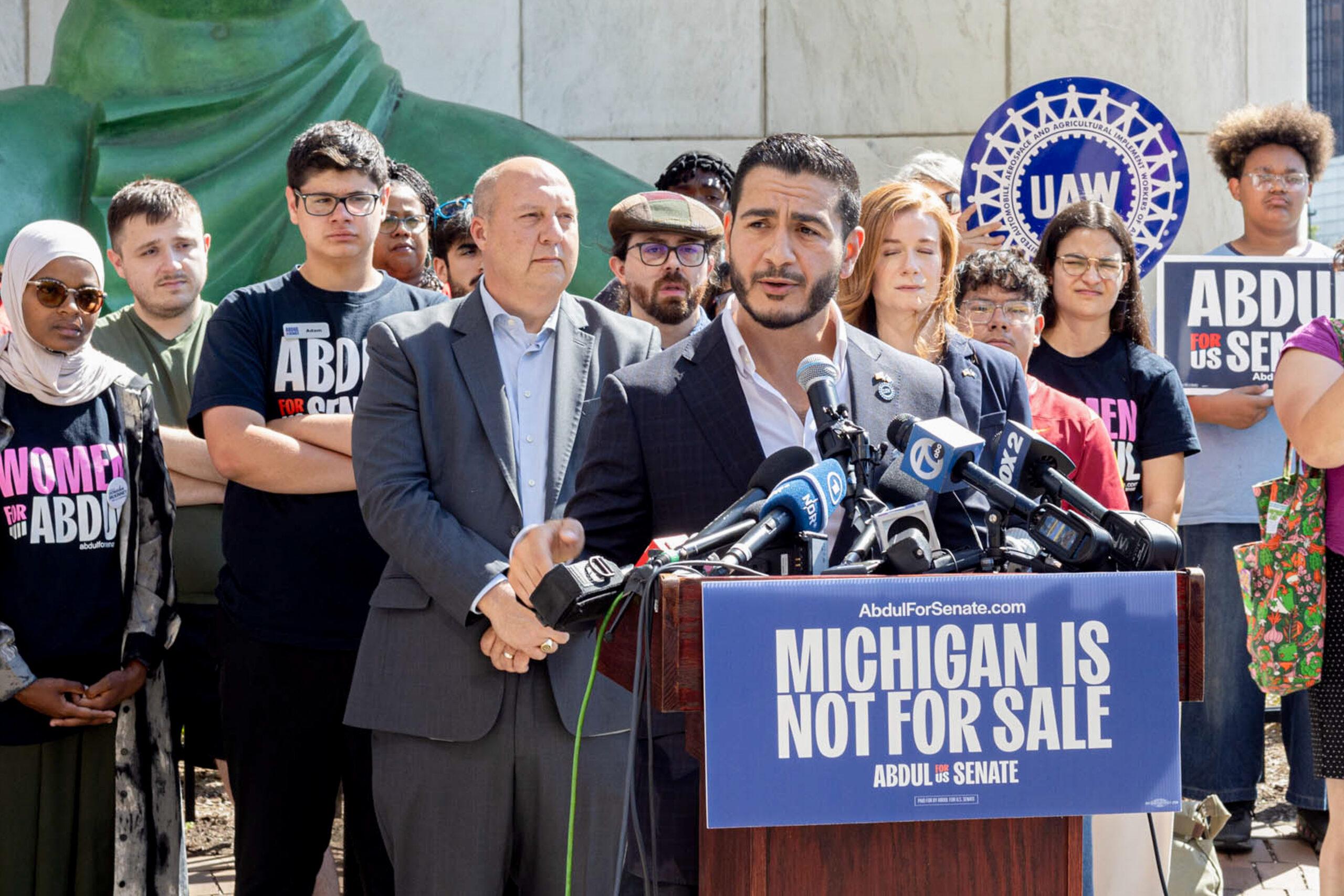
Abdul El-Sayed during a news conference following the primary election
Curtis: You think the issue will just kind of get taken off the table because it will be so volatile or just so one-sided?
Shoemaker: I think it’ll be both of those things, to the point where I don’t think—we’ve seen it already. AIPAC is not intent on their candidates running on a pro-Israel platform if it’s not going to help the candidates. And I think in the primary, the presidential primary, sure, it’ll be a thing that the media keeps asking and asking and asking. But I think, just like you saw in the waning days of the Stevens campaign, the outside group–funded ads are not going to be about America’s longing for its commitment to Israel. It’s going to be about completely different things and just shoved out into the massive amounts of airwaves. I mean, I think when they do the postmortem of this race, what we’re going to see is the sheer number of votes that those ads really bought. We kept hearing it last night: TV still works.
There’s huge swaths of that state where you’re not doing one-on-one politicking. If you’re running for those seats and you’re leaving it up to the commercials, and the Stevens campaign just had a whole bunch more really evocative commercials running in those places. And America’s an even bigger, obviously a much bigger—or even state by state for the primary, you’re dealing with other huge swaths. So I think that obviously, it’s going to be a huge front and center issue because the national media won’t stop asking about it, and with good reason. But I just find it hard to believe there’s going to be a whole lot of people, a whole lot of mainstream or middle-of-the-road candidates on the left, that are going to want to get into that battle.
Curtis: Because there’s not a win there for that.
Shoemaker: There’s no win.
Curtis: I’ll do a flip-side take, when you mention the commercials, a flip-side media-centric take. Which is, El-Sayed’s ability to go on podcasts and do lots of interviews in a way Stevens could not was an interesting part of this race. I think if you look at Stevens’s moments that are even close to that, it was probably that one with Jacob Wasserman of TMZ DC in the house where she sort of figured it out. But again, I don’t know how decisive that was, but if, going forward, not every Democrat is going to believe what El-Sayed believes, which I think is certainly true, most of them are going to need the ability to talk on podcasts, to fill your Twitter feeds in the way he did. You talk about requirements going forward. I don’t totally see a candidate who can just bypass that on a national level, if we’re talking about president in 2028.
Shoemaker: Bypass the issue?
Curtis: No, bypass just the ability to go on and just do those kinds of interviews and get in people’s Twitter feeds, other than just purely through commercials, airwave, campaigns, speeches, et cetera.
Shoemaker: Totally true. And this is a point that might be totally meaningless within a couple of years, but it does seem like, because of the reach of podcasts, that we’re going to see a giant shift in politics. It behooves candidates who, for better or worse—and obviously our president’s an example of this—who kind of believe their own bullshit. You can’t be such a manufactured political character in 2026, because that character can’t sit down and do an hour-and-a-half interview. You know what I mean? You kind of have to be real. And not that you couldn’t fake what El-Sayed is doing, don’t get me wrong. I mean, the jury’s still out on to what degree Graham Platner was full of shit. I mean, he was completely full of shit in a lot of ways, but you could create that character. I just think in general, you have to sort of be able to be yourself.
JD Vance is obviously capable of doing it and talking about political beliefs that he didn’t have a couple years ago. Whatever. But I do think that, especially on the state level, actually believing your own platform is suddenly super important.
This excerpt has been edited and condensed.
Hosts: Bryan Curtis and David Shoemaker
Producers: Isaiah Blakely and Jon Jones