

Hosts
 Derek Thompson
 Derek Thompson
About the episode
Ten years after Donald Trump stunned the world by winning the 2016 election, his political movement may be approaching its end. Tuesday’s midterms delivered a historic rebuke to the Republican Party, with Democrats making astonishing gains in states Trump carried comfortably just two years ago. So … how did we get here? And is the Trump era really over for good?
Today, in conversation with New York Times chief political analyst Nate Cohn, Derek goes over the six biggest lessons from the midterms: the pendulum swings of the youth vote, the death of the Trump coalition, the revival of the swing voter, the identity death of the Republican Party, the limits of money in politics, and, finally, the historical analogies over the past 100 years that should shape our understanding of what happens next.
Subscribe to our YouTube channel here.
If you have questions, observations, or ideas for future episodes, email us at PlainEnglish@Spotify.com.
In the following excerpt, Derek talks to Nate Cohn about how accurately The New York Times’ polling predicted the midterm election results.
Derek Thompson: You oversee what might be one of the most respected polling outfits in the country. There are forecasters like Nate Silver who give more weight to the New York Times/Siena poll than any other poll in the country. Let’s just start big picture. How does this outcome fit with your highly respected forecasts?
Nate Cohn: Well, it came very close to our final polls. The last polls that we released on the Sunday before the election had the Democrats tighter ahead in the seven closest Senate contests, with an average lead of five points across those races. And as of this hour, the Democrats are tighter ahead in all seven of those races, with only Alaska outstanding, and the Democrats head by an average of five points. So to be honest, our polls are never going to be perfect, but we can’t really do much better than that. Interestingly, if you look a little further back, say three weeks ago, our polls are a little worse for Democrats compared to the final result. And if you look in September, they’re even farther back. So if you look back over the course of our polling over the cycle, there’s a very clear trend towards the Democrats, and that sort of finishes with this late surge in our final wave of polls that ultimately ends in a Democratic landslide.
Thompson: As someone who spent literally a thousand times more time obsessing about the midterms than I have in the last few months, I really want to know, what was your holy shit moment from Tuesday? Or what’s the holy shit result from Tuesday that you still can’t quite wrap your head around? Because when I look at this map right now, I think, like I wrote earlier this week, it’s an America that I don’t recognize. And typically when people say, “I don’t recognize this country,” 99.9 percent of the time they mean it in a bad way. You know, as a liberal, I mean this in a good way, but I don’t recognize this map. It looks like a map from another century. What’s the biggest holy shit moments here?
Cohn: Well, in terms of the way I experienced it on election night, the first holy shit moment was around 7:20, 7:30, when we got our first little bit of data from South Carolina. I think everyone sort of knew that Florida could be a reasonably close race. Florida’s been a reasonably close state before. But those first results came in from South Carolina, and every one of them, whether it was Election Day vote or absentee vote or early vote or from majority Black areas or white areas, it was all better than what Annie Andrews, the Democrat, needed to beat Darline Graham. And it was like, well, that’s a different tier of Democratic breakthrough than we’ve had in the past. It’s like their best-case scenario to get not just into those districts or states that voted for Trump by 12 or 13 points, like Ohio or Texas or Florida, but 17 or 18 points, like South Carolina and soon, it seems, Mississippi.
So that, for me, was the real moment when it was clear that we weren’t just dealing with any big blue wave, but the biggest big blue wave that we’ve seen in a half century. Stepping even later in the night, 10 or 11 p.m., finally stepping back from those key Senate races, once it was clear that we could call the Senate, and looking at the House for the first time in a while. Seeing those gerrymandered congressional districts in North Carolina and Tennessee that were drawn to be Trump plus-20 and that no one would’ve given a thought to—all too close to call, or in some cases even leaning Democratic. That was, again, an extraordinarily vivid illustration of how the Democrats had broken through the usual political fault lines in America.
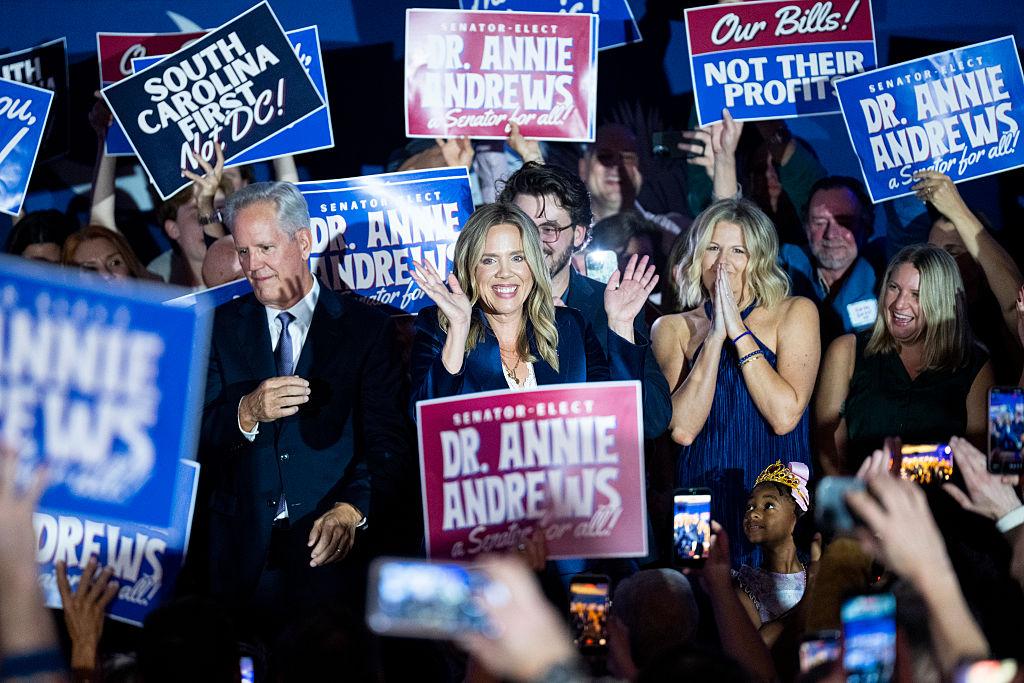
Annie Andrews delivers her victory speech on November 3
Thompson: I want to zoom into specific demographic groups: men and women; old versus young; college, noncollege. Where were the biggest shifts toward the Democratic Party between 2024 and the midterm of ’26?
Cohn: The biggest swings are among the young and non-white voters who swung toward Donald Trump in the last presidential election but who then snapped back towards the Democrats very early in Donald Trump’s second term. Among Latino voters, we have the Democrats leading by 40 points right now, 69 to 29. That’s up from a 10-point win for Kamala Harris in 2024. So that’s a 30-point swing. A story similar among young voters: We have the Democrats at 70 percent of young voters. Again, that was less than 10 points by our estimates in 2024. So that’s more than a 30-point swing toward the Democrats. It’s also worth noting that in these cases, they’re not just bringing the Democrats back to where Joe Biden was in 2020, but they give Democrats an even larger lead than, say, Barack Obama had among young voters in 2008 or 2012, which we might think of as being the highest point of Democratic support among those groups in recent memory.
After that, then basically everyone else also swings 10 points towards the Democrats. So there’s both this enormous snapback, where the Democrats win all of the voters that they lost, and then across the board, additional gains. And the end result is that many traditionally Republican constituencies also end up being strikingly good for the Democrats, even beyond the traditionally Democratic ones, like young and non-white voters, who I was just referring to. We have the Democrats tied or ahead among men. We have the Democrats at 40 percent of white, working-class voters. We have Democrats leading among voters who don’t have a college degree. These just aren’t things we’ve seen in a long time.
Thompson: If I recall, Democrats have not won men in a presidential election since the 1970s.
Cohn: I’ll be honest, I don’t even know.
Thompson: I think Jimmy Carter might be the last Democrat to win the male vote in a presidential year, which just gives you a sense of how extraordinarily blue this electorate was.
Cohn: And—yeah, sorry, go on.
Thompson: No …
Cohn: I was just going to say I had a lot of historic stats prepared ahead of the election to be ready for: “This is the biggest since 2008 or 1982 or 1976.” And for the demographic groups, I had a lot prepared: Black voters, Latino voters, young voters. I didn’t have men on the list. I should have, perhaps. But it’s an illustration, again, that while the polls, I think, were basically in the ballpark, it was still hard to really imagine what it might mean for them to be right.
This excerpt has been edited and condensed.
Host: Derek Thompson
Guest: Nate Cohn
Producer: Devon Baroldi
Additional Production Support: Ben Glicksman