
Hosts
 Derek Thompson
 Derek Thompson
About the episode
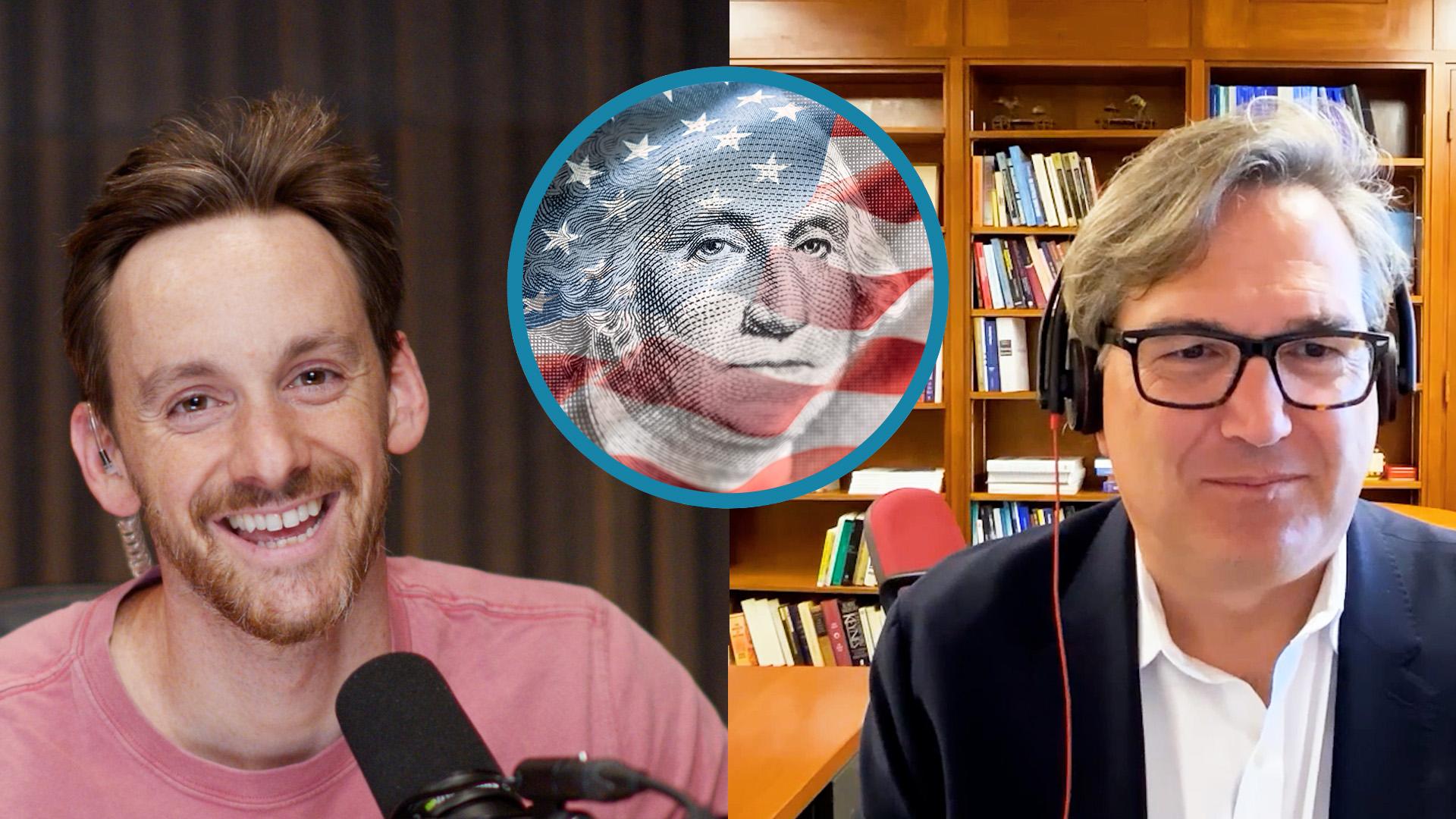
Expert economists keep making predictions about America’s financial future, and those predictions keep being … wrong. Over the past few years, we’ve heard warnings about a recession, inflation, tariffs, wars, deficits, and an AI bubble, yet the economy continues chugging along. Today, Derek talks with economist Jason Furman about what economists and commentators might be missing and why exactly the U.S. economy has been so much more resilient than many expected.
Subscribe to our YouTube channel here.
If you have questions, observations, or ideas for future episodes, email us at PlainEnglish@Spotify.com.
In the following excerpt, Derek and Jason Furman dive into why economic commentators have been so wrong about the state of the U.S. economy.
Derek Thompson: So I brought you back on to ask you to be a little bit of a traitor to your class here. That would be the class of economists and economic commentators who have spent the last few years finding reason after reason after reason why the economy is about to implode: inflation, interest rates, Ukraine, tariffs, Iran, AI, deficits. And in the face of all these predictions, the economy just keeps on not imploding. So at the highest level, why do you think experts keep getting the economy so wrong?
Jason Furman: So it’s great to be back with you. I hope no one goes back and listens to every single thing I’ve said, even just on your show, on these topics. But what I think the biggest answer to your question is there’s a difference between economic models and economists that you hear. And so if you read—any of the investment banks have macro models that track what’s going on in the economy and do lots of analysis about what happens if the Strait of Hormuz closes or Trump does his tariffs or whatever it is. The Congressional Budget Office does it. Academic macroeconomists do it a little bit but not nearly as much.
And generally, when you look at those models, you see things denominated in the tenths of a percent. When you see someone on TV, they sound much bigger than tenths of a percent. Now, if it’s me, sometimes, if they’re quite worked up, and I really was about tariffs and to some degree still am, I’ll sound incredibly worked up, but if asked about a number, I’ll give one in the tenths.
Other people might talk about catastrophe, devastating, “Everything is going to change.” And then that also raises the question of: Why do the models give answers in the tenths? And the answer is, first of all, that the economy’s really big. Oil matters less than it used to. Trade is 10 percent of the economy. Whatever it is you’re talking about touches less of the economy than you think. And there’s a lot of mechanisms for healing and adjustment. So the price of one input goes up, you shift away from it. You use another input. There tend to not be a lot of things in the economy that are nearly quite as bottlenecky as we think they [are]. So I think economics, in summary, is a little bit better than economists on this set of questions.
Thompson: I take this as a defense of the models against the economic commentators who are sometimes representing those models on CNBC or Bloomberg or some podcast. I do think that that answer might even be a little bit too nice to the economic models themselves. I think that sometimes the economic models have failed to see surprises in the real world, pockets of resiliency in the real world that have made the U.S. economy even more resilient than some of those models suggested they might be. But we’re going to get to some of those examples in a bit. There’s a part of me that wants to preview the fact that I’ll be arguing against the models a bit, but I don’t want to show my hand too much. I think it should be very specific just to that.
Furman: We may not disagree when we get there.
Thompson: Sure.
Furman: So I was doing the first-order difference between: People talk about catastrophe; we haven’t had catastrophe; the models never said catastrophe. Now we can debate how many tenths off they were.
Thompson: I want to go through a few specific recession predictions to understand why you think they were specifically wrong. And I think we should start with inflation and interest rates. So to catch people up, under Joe Biden, annual inflation went crazy. Annual inflation rates went all the way up to 8, 9 percent, the highest level since the early 1980s. The Fed jacked up interest rates in 2022 to cool off demand in the economy. The pace of interest rate acceleration was the fastest in modern history. Many economists said that a recession was practically inevitable, that we were essentially back in the 1970s, that we’d seen this movie before, and we were back to the stagnation film. A recession did not happen. Why not?
Furman: Yeah. First of all, by the way, let me just say one place the models did go wrong was the inflation. There they were wrong by several percentage points, which is to say there were some economists that predicted inflation. There were no large-scale economic models that did, whether the Fed, the Congressional Budget Office, the IMF, etc.—all of them didn’t have it.
But then when it came to the sky falling, I mean, the amazing thing there was how bipartisan it was. I remember there was one month when Greg Mankiw, who was chair of the Council of Economic Advisers for President Bush, said, “We’ve raised rates so much. Rates affect the economy with a lag. This is getting increasingly risky. Maybe they should stop.” And that same month, Paul Krugman wrote basically the same thing. I believe this was December 2022, and the Fed ended up hiking for another six or so months after that.
So yeah, so the idea that the economy would go into recession was a bipartisan one. It was very credible, serious economists. In some sense, the last time we had raised rates this much was in the early 1980s, and it did lead to a recession. And so I don’t think it was crazy that they were predicting that. At the time, I was a bit less worried in part because I believed there was so much fiscal stimulus that hadn’t yet worked its way through the system that would provide enough of a counterweight to the interest rate hikes. But all of this is sort of instinct and guess and a little bit hard to work out the exact numbers on.
This excerpt has been edited and condensed.
Host: Derek Thompson
Guest: Jason Furman
Producer: Devon Baroldi
Additional Production Support: Ben Glicksman