
Hosts
 Derek Thompson
 Derek Thompson
About the episode
It seems a universal fact that AI has become an indispensable part of the American economy. At the same time, opposing AI has also become one of the most influential causes in American politics. Nowhere is that tension more obvious than in the fight over data centers. Across the country, communities are organizing to stop the massive facilities that power artificial intelligence from being built in their backyards.
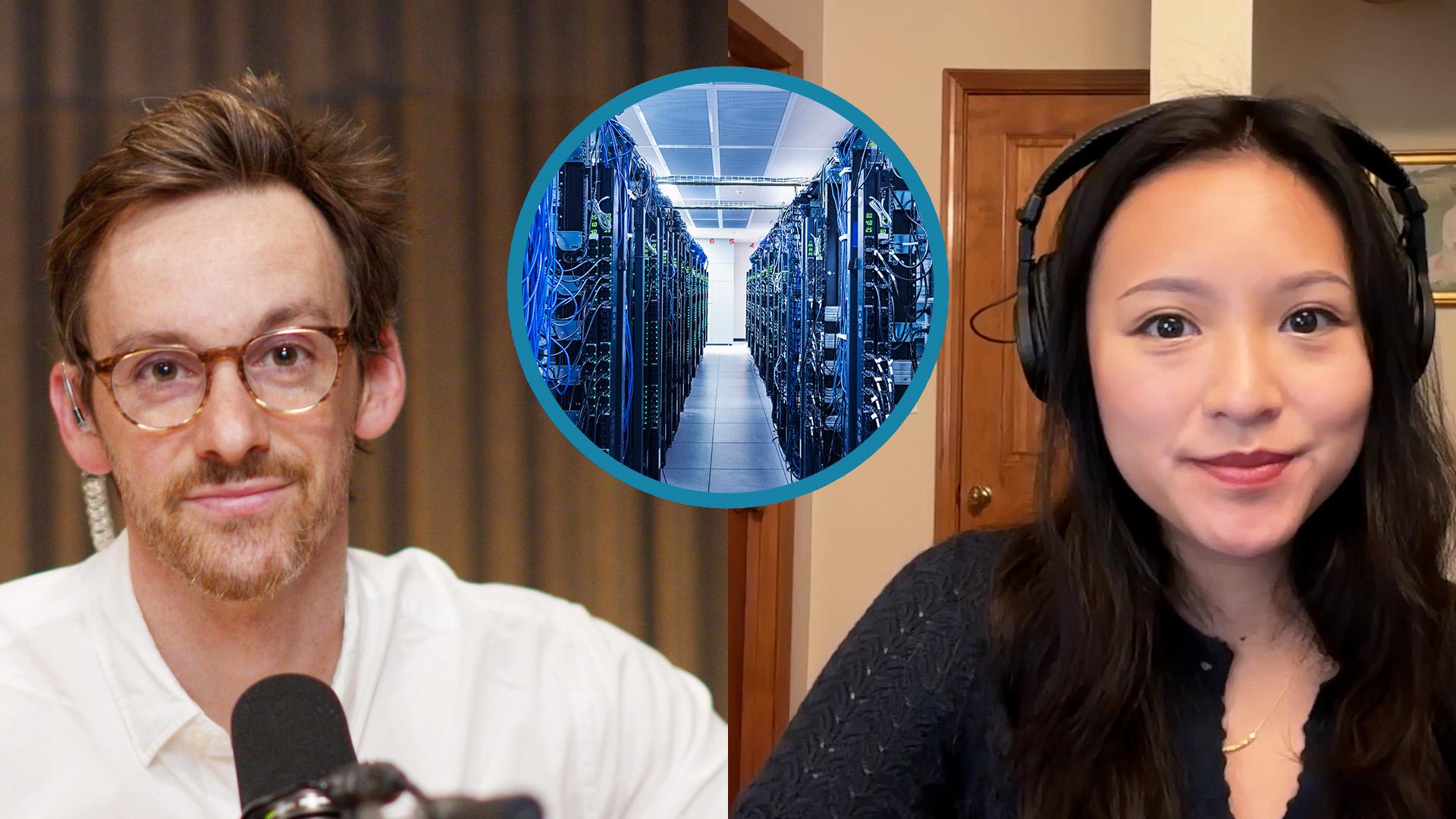
In today’s episode, Derek talks with writer Jasmine Sun, who traveled through the Midwest to investigate the growing animosity toward AI infrastructure. Why do Americans hate data centers? Plus, if this trend continues, what happens when one of the most important forces in the U.S. economy runs headfirst into local politics?
Subscribe to our YouTube channel here.
If you have questions, observations, or ideas for future episodes, email us at PlainEnglish@Spotify.com.
In the following excerpt, Derek and Jasmine Sun explore the on-the-ground arguments against data centers.
Jasmine Sun: So I had been seeing throughout the spring this sense of a data center backlash across the U.S. bubble up. I had been seeing first stories about the compute build-out—how big it is, how much money these companies were investing into building data centers—and then, simultaneously, maps and news articles showing how people were protesting data centers, how they were introducing local moratoriums, Bernie and AOC at the national level talking about data center moratoriums. And I was just really shocked, I think, and surprised at some of the intensity of the opposition and the polling. For example, in Michigan and Wisconsin, which are purple states, states where both Republicans and Democrats are very competitive and also rarely agree on anything, you’ll see something like a 70-30 opposition to data centers, which is much more bipartisan and much more sort of one-sided than solar farms or nuclear or almost any other issue related to development that you can find.
And so I was really curious about what is driving the data center backlash and what is sort of building this and motivating this new political coalition that’s forming against AI data centers. And I felt that the only way I could actually learn what was going on was to go on the ground to a bunch of places where data centers were being proposed, where they were being fought, where they were being built. So I ended up visiting four sites and talking to people, workers, officials, activists in Michigan and Wisconsin. It was also a good time to be there because they both have or had these very interesting Democratic primaries going on: the Michigan Senate race, which Abdul El-Sayed just won, the Wisconsin governor’s race, where a DSA candidate, Francesca Hong, is pulling ahead. And AI and data centers have become an important part of both races and the story of them. So I was also sort of hoping to understand whether these two states and these local stories might end up being a bit of a bellwether for the politics of AI at a national level.
Derek Thompson: You live in San Francisco. You know the people who work on artificial intelligence. You write about the people who work in artificial intelligence. What do people in the Bay Area think that data center opposition is all about? And to what extent did your on-the-ground reporting validate or invalidate some of those assumptions?
Sun: In San Francisco, I would say that the default assumption or caricature of somebody who hates a data center is that they’re kind of a TikTok-brained idiot. They’ve watched too many short-form videos, and they’ve eaten up too many myths about these things sucking up the oceans, about maybe they’re emitting radioactive waves or something like that. I think the fact that the water meme and the sense that, “Oh, AI data centers just use way too much water, and the primary risk in harmed communities is how much water they use”—which I don’t think the research proves out is a primary risk that data centers pose—the fact that that, however, has become so memetic and so prevalent on social media has, I think, given a lot of Silicon Valley folks the impression that data center opponents are just highly misinformed and they are just worried about the wrong things.
And maybe there’s some sense that people’s opposition to data centers is also about their fear of AI, whether that’s AI job loss or other ways of not wanting AI in their communities, which I think has something to it. But honestly, what I found when I was on the ground was that the anti–data center opposition was so much more about the way that residents lost trust in their local officials, their local governments, and the way that big corporations were coming in and interacting with them. I actually almost never heard people talk about, say, OpenAI, the customer that the data center was serving. I almost never heard a resident or an activist talk about specific AI harms like job loss or deepfakes or whatever.
What I much more often heard was “How could my mayor sign this NDA and keep this project secret from us? How could my city council sell out to this gigantic corporation and bring in this huge development with unclear impacts without any public input?” I think fury at both the lack of transparency, the sense that backroom deals were being made, and that these big sums of money were involved in that and sort of corrupting people’s small-d democracy at home was much more the sense that I got when I was on the ground.
Thompson: I want to re-circle something that you said because I think it’s so important. When I’m on social media, on Twitter, following the arguments among people who are building AI, I’ll often see them make this fact check where they’ll say, “There’s this popular claim about data centers using all of this water, but in fact, data centers use much less water than is commonly assumed.” But that fact check is often assumed to do the job of proving that anti–data center politics is based on a myth. And what your reporting, I think, does so well is it shows that the actual on-the-ground opposition to data centers is so much more complicated than just a single factoid about water use.
And we’re going to spend most of this interview, I think, unpacking the many, many layers of local data center opposition. Before we get to those layers, you go to the Midwest, you see these data centers up close. Tell me what’s inside a data center, for those who don’t know, and what’s outside a data center, for those who haven’t seen it. What is its function, and what does it look like?
Sun: Data centers are the most visible physical manifestations of the AI boom. They’ve existed for a while. During the original internet boom, you started to see smaller data centers used for literally processing or housing data. But data centers today, the primary thing that they do is they train new AI models, or they serve inference, i.e., when you send a query or a question to ChatGPT or another chatbot, that query has to go somewhere. The model has to process it, do a million complex mathematical calculations, and then send it back. So inside these gigantic buildings, which often span hundreds of acres, live all of these chips and servers that process these queries and train these models. And they have all these interconnects between them that require incredible amounts of compute and electricity to make sure that the speeds are fast, that all of these chips are talking to each other.
There’s big, gigantic fans inside. So the AC that requires the water and the cooling systems comes from the fact that the chips run super hot and that tons of AC is required to keep these things cool. And so when you drive past a data center, it often takes even a minute and a half going at 70 miles per hour, at freeway speed. These things are gigantic. They’re kind of like these gigantic, flat warehouses. They’re windowless. They’re often gray or beige. They’re very ugly, frankly. They’re often surrounded in a web of transmission lines that have been built to hook up the data center to the grid. And I do think that there is a role that the aesthetic unpleasantness of a data center plays in the reason that people don’t like it.
This excerpt has been edited and condensed.
Host: Derek Thompson
Guest: Jasmine Sun
Producer: Devon Baroldi
Additional Production Support: Ben Glicksman