
Hosts
 Derek Thompson
 Derek Thompson
About the episode
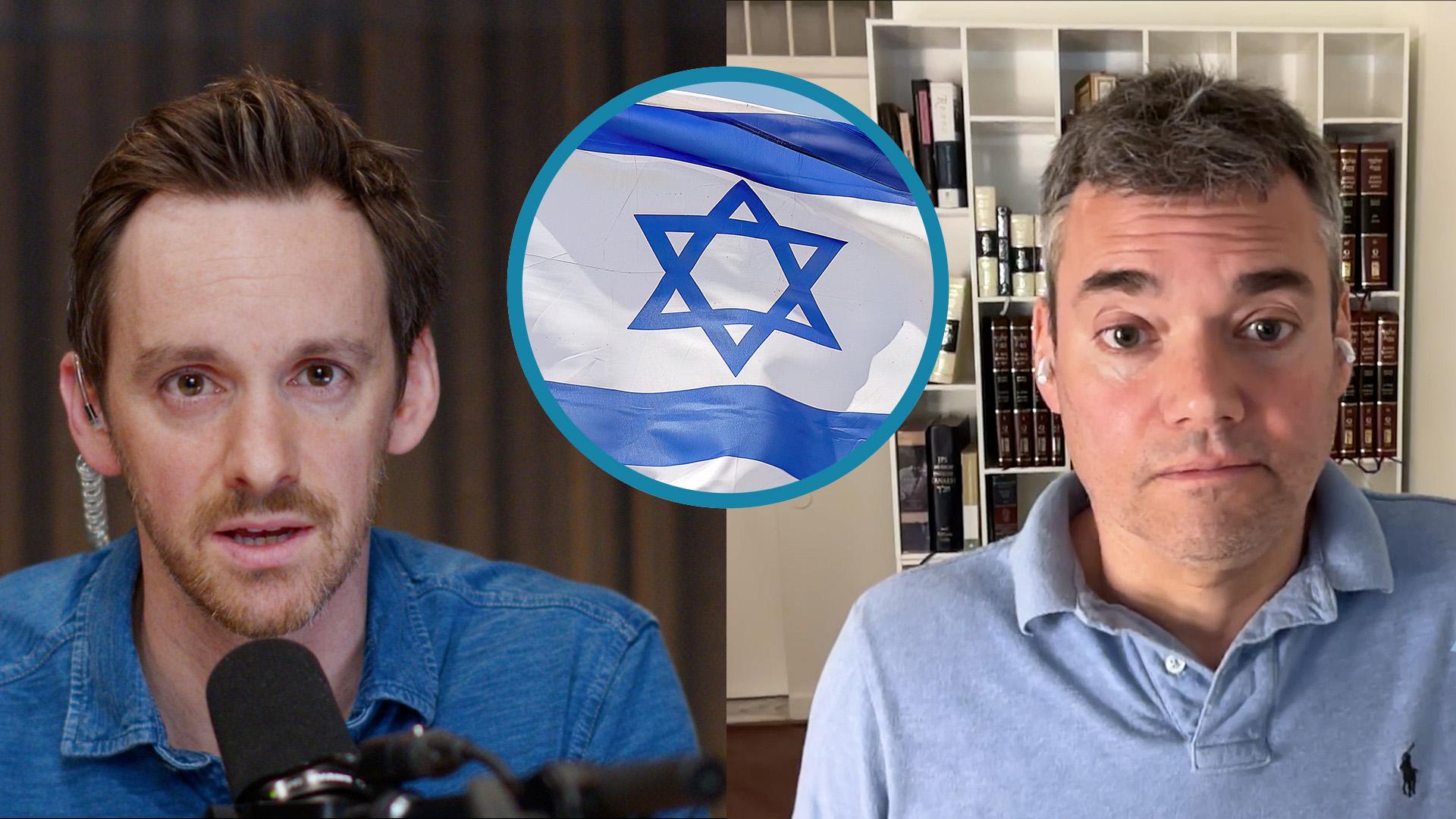
Peter Beinart joins Derek to unpack a major shift inside the Democratic Party. As Democratic Socialist–backed candidates notch a string of surprising primary victories, one issue has emerged as a defining political litmus test: Israel and the war in Gaza. But it’s difficult to hold two ideas at once … that the war in Gaza is a moral catastrophe, and that antisemitism is rising in some of the spaces where that catastrophe is being debated. Derek and Peter discuss why the conflict has become so central to Democratic primaries, how debates over anti-Zionism and antisemitism are reshaping public life, and what it all means for the future of the Democratic coalition.
Subscribe to our YouTube channel here.
If you have questions, observations, or ideas for future episodes, email us at PlainEnglish@Spotify.com.
In the following excerpt, Derek and Peter Beinart examine the role that Gaza has played in the identity of the new left and in the Democratic primaries.
Derek Thompson: My first question for you is pretty straightforward but also quite weighty: How would you describe the role that Gaza has played in the Democratic primary elections in the last few weeks?
Peter Beinart: I think Gaza has played a quite significant role. It was one of the striking things about the candidates who have won—the candidates running from the left, many of them associated with the [Democratic Socialists of America] in New York, in Philadelphia, in Colorado (these are all House races, but I also think in the Michigan Senate race)—is that the candidates who are running on the left have a very, very deep concern about Gaza. It’s something they talk about a lot. It’s something they care about a lot. And I think it’s part of what is defining them in voters’ minds as people who are authentic and people who have courage and people who kind of have a moral vision that’s appealing to progressive Democrats.
Thompson: And why, going a little bit deeper, do you think Gaza has come to play such a significant role in the self-identity of this generation of the new left?
Beinart: So I think the first thing that one should start with is just how utterly horrifying what Israel and America have done in Gaza has been. I think there’s a tendency sometimes to kind of skip that over. I mean, what Israel has done in Gaza has been now described as a genocide by the world’s leading human rights organizations, by Israel’s leading human rights organizations, by the United Nations. In the 1990s, the United States considered very seriously intervening militarily. We did intervene militarily to prevent, try to fight against the genocide in Yugoslavia. We are sending weapons to the Ukrainians to respond to something that Russia’s doing that probably doesn’t even meet that threshold of genocide. Here, we have spent $20 billion to arm a genocide.
So this is something that I think before one gets into the larger kind of questions of why Israel has a particular status, simply the fact that the United States has spent $20 billion to basically fund something that is widely understood—the International Association of Genocide Scholars has called it a genocide—is something that I think on its face is astonishing and deeply horrifying, and should be. And so I think we kind of need to start there, especially because social media has meant that this particular genocide, much more than, let’s say, Bosnia or Rwanda or Cambodia, let alone the Nazi Holocaust, is much more available to people. We see it. So I think that’s part of it.
The second thing I would say is that I think Gaza has become kind of a manifestation of two things progressives see. First is that we are entering a world of extraordinary brutality and profound racism of a kind of really crude sort on the right. And in the Democratic Party establishment, what you see is an unwillingness to actually really resist that. It was a Democratic president who enabled this genocide to take place. And I think the fact that the Biden administration, for all its protestations about international law, basically armed this genocide is representative of a larger sense that the Democratic Party and its leaders are not actually willing to fight seriously hard enough against the kind of racism and brutality of this moment.
Thompson: Peter, do you see a connection between the issue of Gaza and the other issues that populate the identity of the new left? It’s one thing to say, as I think you have said, that there’s a moral shock looking at the death counts coming out of Gaza and the images coming out of Gaza. It’s another thing for that event in Israel to act as, in many cases, a kind of litmus test, as it has in many of the Democratic primaries. And so I wonder where you see and how you see the war in Gaza sort of clicking into the rest of the progressive left’s identity. It’s their case against corporate power, their case, which in many cases I take as one about power and powerlessness. So maybe just talk a little bit about the role that you think it plays within that portfolio of issues that the left talks about.
Beinart: I think what progressives have noticed is that politicians who support Israel unconditionally and take money from AIPAC [the American Israel Public Affairs Committee], even if they are kind of conventionally described as liberals, tend to not be people who actually really fight hard against the kind of American political and economic system. One of the things you notice in a lot of these campaigns is that when AIPAC or other pro-Israel organizations go in against a progressive candidate, other corporate interests, whether it’s crypto or others, basically go in as well. There tends to be an overlap between one’s view about Israel and how radical one’s critique of the American economic system is. And so I think that’s one of the things that people have noticed, that basically this serves to some degree as a kind of proxy for how much you’re going to be a “go along, get along” Democrat or whether you’re going to be someone more like AOC and Zohran Mamdani, who basically has a very serious structural critique of the way in which business is done in Washington and the way in which American capitalism works.
So I think that’s part of the reason that the issue matters so much, but it also intersects. And I think the analogy here that’s interesting to think about would be the role of the anti-apartheid movement in the 1980s in American politics, where for a period of time it was a significant force, but it didn’t meet the same kind of resistance that this movement for Palestinian freedom did. And that debate in some ways about South Africa in the ’80s was, during the Reagan era, 20 years after the Voting and Civil Rights Act, a kind of proxy for debates about race in America in the 1980s. And I think coming in the wake of the George Floyd 1619 moment, this debate about Israel and its settler-colonial project—and that’s a controversial word to use in American politics, but it’s not really a controversial word to use among academics who study Israel-Palestine—the question of how you think about that settler-colonial project and what it says about how you think about America’s settler-colonial project, I think, is also a kind of connection that people make.
One of the things that Darializa Avila Chevalier, who just won the congressional seat, the Democratic nomination in a district in Northern Manhattan, mentioned was that she went and spent two months in the West Bank, and she reflected on the way in which she saw parallels between the use and abuse of state power and the way it was racialized there and what she had seen in New York.
This excerpt has been edited and condensed.
Host: Derek Thompson
Guest: Peter Beinart
Producer: Devon Baroldi
Additional Production Support: Ben Glicksman