
Hosts
 Derek Thompson
 Derek Thompson
About the episode
From the bombing campaigns of World War II to the precision strikes of the modern era, for 80 years air power has defined modern warfare. But today, a new technology is changing the battlefield: drones.
From Ukraine to the Middle East, cheap drones are transforming how wars are fought, giving countries and even small groups capabilities that once belonged only to the world’s most powerful militaries. They’re changing not just how wars are fought, but who can fight them.
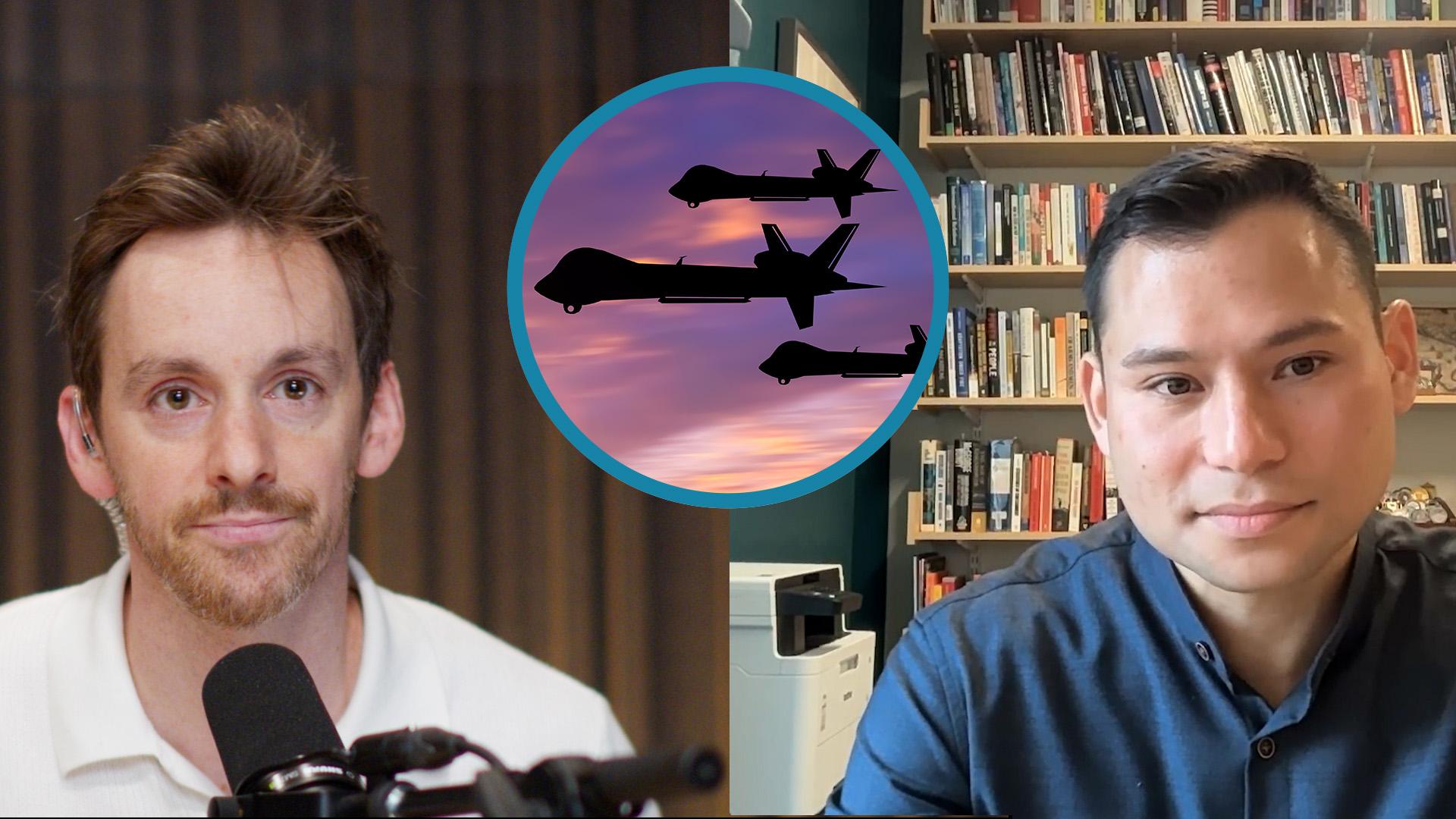
Today, Derek is joined by Erik Lin-Greenberg, an MIT professor and author of The Remote Revolution: Drones and Modern Statecraft, to explore how drones are reshaping modern warfare and what this new era could mean for the future of conflict.
Subscribe to our YouTube channel here.
If you have questions, observations, or ideas for future episodes, email us at PlainEnglish@Spotify.com.
In the following excerpt, Derek talks to Erik Lin-Greenberg about Russia and Ukraine, the U.S. and Iran, and how drones are changing modern warfare.
Derek Thompson: So let me start by telling you why I wanted to have you on the show. It really started with this observation that seemed too interesting to not explore with an expert in a full episode. On the last week of February 2022, Russia invaded Ukraine believing that its military superiority was sufficient to topple the government in Kyiv in a few days to a few weeks. But today it’s now engaged in a clearly protracted, expensive, and bloody war due to, among other things, Ukraine’s extraordinary drone capabilities.
And four years later to the week that Russia invaded Ukraine, the US attacked Iran, similarly believing that it had the military superiority to topple Iran’s regime in a few days to a few weeks, but now the US finds itself, or has until the last memorandum, found itself engaged in a protracted war due to among other things, Iran’s drone capabilities.
And so the fact that the two great powers, the second half of the 20th century both found their military superiority stymied by a drone-wielding adversary seemed too significant to not stop and ask, are we seeing the future of war play out in front of our very eyes?
So before we talk about your scholarship on the history and the future of drones, I would just love us to park in this moment. What do you think is most significant about the role that drones are playing in the war as in Ukraine and Iran today?
Erik Lin-Greenberg: So I think we really see drones changing the character of warfare because of a few things. First, you have this new technology that is enabling actors, both states and non-state actors, so generally weaker actors, to carry up precision strikes in a way that, in the past, only great powers could. And what I think is important here is it’s not just drones as a single technology, it’s drones coupled with things like commercial satellite imagery that enable actors that previously didn’t have access to precise intelligence that can be used or targeting to have that information. Then to couple that with a relatively low cost system like a drone, in many cases, a one-way attack drone that allows them to go destroy infrastructure that in many cases is far, far more expensive than the drones themselves.
And I think what we’re also seeing is that great power, so the United States and Russia, to the extent that they are still a great power, are struggling to intercept these large numbers of relatively cheap drones that are approaching them. And that is why we’re seeing, I think, this fundamental change in how states are engaged in conflict.
Thompson: Yeah. When I look at these campaigns, I see this extraordinary asymmetry. The US is so much richer than Iran, so much more powerful, spends so much more on military through the Pentagon. And yet drones seem, and I think this was in your answer, to level the field in a really amazing way. When the US launches a patriot missile against an Iranian drone, that’s often a multimillion dollar expenditure trying to take on a $30,000 weapon. That is two orders of magnitude. And so it’s like it doesn’t matter in the context of that moment that the US is an order of magnitude richer than Iran because the drone technology takes it up another order of magnitude. What does that asymmetry alone tell us about how drones are changing the calculus of modern war?
Lin-Greenberg: Sure. So I think on this notion of what the exchange looks like, defense analysts and pundits often refer to something known as the cause-exchange ratio. And right now that is not in the favor of the defender. I can send a $10,000 drone, try to destroy something that’s really expensive. And as you noted, launching Patriots or even launching fighter jets to try to shoot these things down is a very, very expensive endeavor that doesn’t right now put the defender in an advantage.
So what does this mean about conflict more broadly? Well, it means I think that these weaker actors are able to initiate, potentially, uses of force they might not otherwise want to do, because they realize now that they have a chance of potentially destroying adversary infrastructure, whatever targets they’re trying to strike, in a way that they can potentially get around the defender in a way that they just couldn’t before. So that leads, I think, to this notion of more militarized interactions than we might’ve previously seen just because it’s easier to do. You’re lowering essentially the barrier to entry to precision strike and precision engagement in a way that we previously didn’t have.
Thompson: I’m going to hold on to this answer that you just gave. The idea that drones might increase the frequency of military engagements, because the way that that plays out in your ultimate thesis is very interesting and I think very surprising. But still holding onto the moment, what’s the right way to think about the difference in the role that drones are playing in the war versus Russia and the war versus Iran? Are we looking essentially at the same use case or is it more sophisticated to say that the way that Ukraine is using its drone cache is very different than the way that Iran has replied to initial US strikes with drones?
Lin-Greenberg: Yeah. So I think before answering that question, I think we need to talk about what we mean when we say drone, because I think this is really important in answering your question. So when we think of the term drone, I think we really think of a broad range of technologies. So on the high end, you have very, very expensive drones like those operated by the United States, things like the Global Hawk that cost tens of millions of dollars. And then on the very low end, we have modified commercial off-the-shelf drones or things that are even built using 3D printers, these very, very inexpensive systems. And then you have everything in between.
So what we’re seeing in both Iran and Ukraine is both sides using medium-range, medium-cost drones that are pretty inexpensive to carry out precision strikes. And so I think that is one of the similarities. Both Iran and the Ukrainians are using relatively inexpensive drones as precision guided munitions to strike critical infrastructure, whether that is a radar site, whether that is an energy production facility. So they’re using these effectively as cruise missiles. So I think that is one of the similarities.
One of the things, though, that I think is fundamentally different between the two use cases is the Ukrainians and also the Russians are using very, very inexpensive drones. In many cases, these first-person view drones, where you have people wearing a headset and seeing essentially what’s going on to essentially use them for battlefield operations along the front lines. And so they’re using these to target individual troops in a way that I think changes the psychology of conflict. If you are a soldier fighting on the front lines, now you’re not only worried about the adversary that’s approaching you from a few hundred meters away, but you’re also afraid that you could potentially be attacked by a drone that is constantly present.
So in the Ukraine war, you’re seeing both the strategic use of drones, but also this incredibly tactical use of drones where as of now, at least in the Iran war, we’ve really seen drones being used primarily in this kind of long-range fires type of context.
This excerpt has been edited and condensed.
Host: Derek Thompson
Guest: Erik Lin-Greenberg
Producer: Devon Baroldi
Additional Production Support: Ben Glicksman