
Hosts
 Derek Thompson
 Derek Thompson
About the episode
Over the past century, attitudes about gender roles have become one of the clearest dividing lines in the country. Many Republicans, both men and women, say that men are getting a raw deal in modern America. Many Democrats see that claim as completely off base.
So where does that split come from, and why has it become so central to politics?
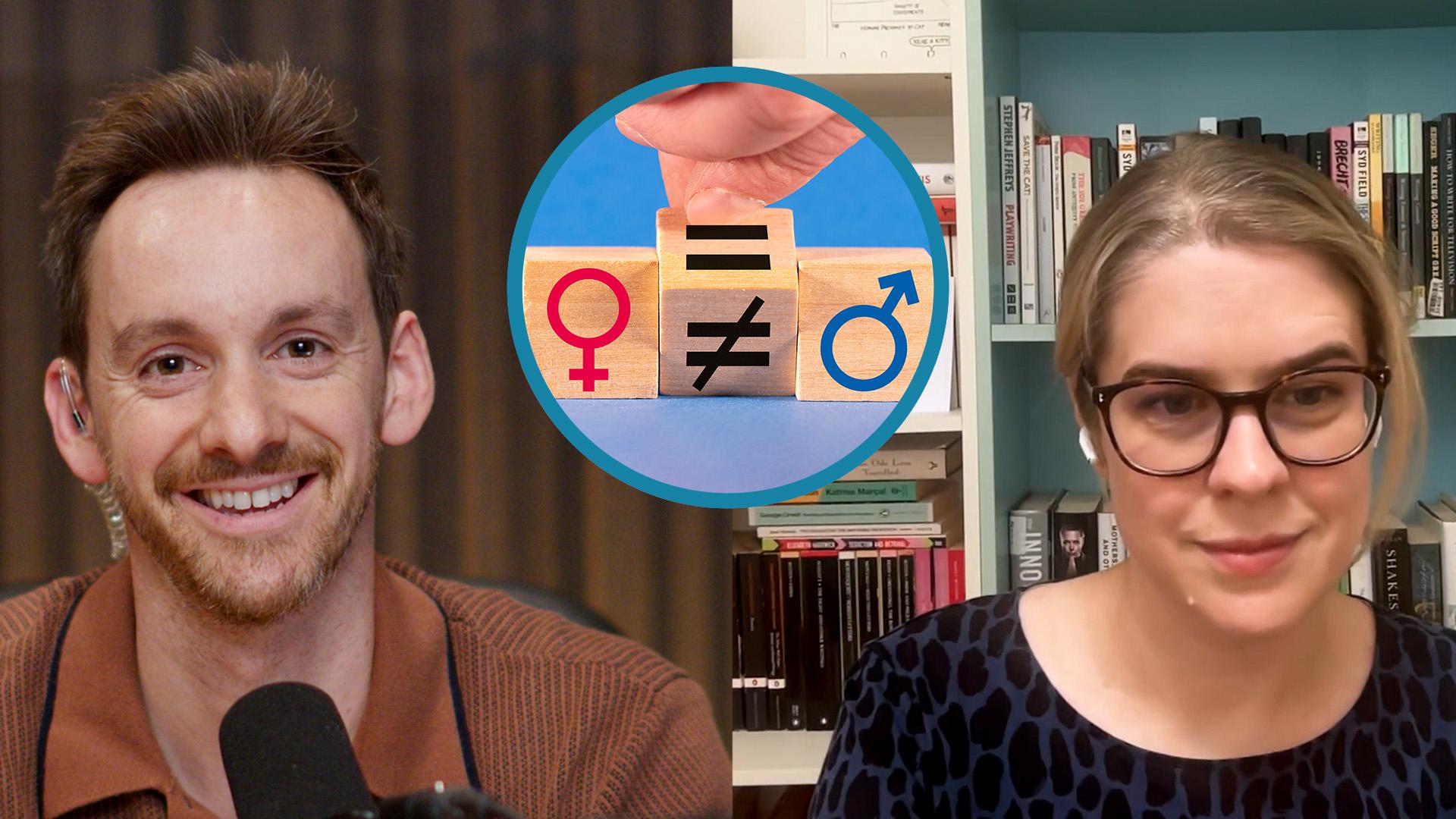
Journalist Helen Lewis calls this emerging worldview “masculinism,” an ideology that pushes back against feminism and reflects a broader nostalgia for traditional gender roles. Today, Lewis joins Derek to talk about the rise of this phenomenon and what it reveals about the growing schism in American politics.
Subscribe to our YouTube channel here.
If you have questions, observations, or ideas for future episodes, email us at PlainEnglish@Spotify.com.
In the following excerpt, Derek talks to Helen Lewis about why there’s been so much backlash against feminism.
Derek Thompson: Everybody knows the word feminism, but in your new cover story in The Atlantic, you introduce or talk about a phenomenon that you call masculinism. What is masculinism, and what makes this a new idea as opposed to just a retread of traditional chauvinism?
Helen Lewis: Right. To some extent, it is just simply anti-feminism. It is a belief that feminism has gone too far, that American life is now skewed too much in favor of women, that men are discriminated against. But it’s also—I wanted to use, it’s not a new word, it’s been around since at least the 1990s—but I wanted to get beyond the idea of the manosphere. So we’ve heard a lot about the manosphere, which people tend to regard as influencers and slightly shock jocks, your Andrew Tates or whoever it might be. But I wanted to say that behind that is a really serious intellectual movement that encompasses quite a lot of religious elements, this being America, but also people working in think tanks, for example, or online commentators working in pretty highbrow magazines. These are some serious arguments.
And what’s new about it is it is the glue holding together MAGA, which I hadn’t really thought about before until I talked to Laura Field, who wrote a brilliant book called Furious Minds, which is tying together all the different strands of the American online right, the Claremont Institute people, the post-liberals, the social conservatives, the people worried about birth rates, all of this kind of stuff. That MAGA coalition, as we’re now seeing, has got some pretty big divides across it. Very divided on Israel, divided on free trade versus protectionism, divided on big tech and whether or not it’s good. But the one thing they can basically all agree on is that traditional gender roles are better, feminism has gone too far, and that public life has become feminized. And they don’t like it, and they would like to turn the clock back on that.
Thompson: What is this phenomenon reacting to most recently? Because some of these phenomena that you’re talking about, the rise of feminism, even something like working women, these are old phenomena. These are 50-, 60-, 70-year-old phenomena. What is this newest instantiation of masculinism responding to?
Lewis: Yeah. When I was doing my research for this, I found a quote from the Henry James novel The Bostonians, in which one of the characters complains about how we now live in a hysterical, canting, chattering age where men are not being risk averse enough. And it could have come from one of these masculinist manifestos online now. I think the immediate reaction is to the 2010s and to that very—I hated it at the time. My first book, Difficult Women, is a reaction to this. It starts off with me getting very cross about a children’s book, one of those Little People, Big Dreams books, and this one’s about Coco Chanel. And it was like, Coco Chanel, a fashion designer, she set up her own business. Wasn’t it amazing? You go, girl. And you’re like, well, she confiscated the business from her co-owner, who was Jewish, under the Nuremberg Laws. And she very probably slept with a Nazi officer and was a collaborator during the Second World War in order to keep hold of her business. Hooray, feminism.
It was this feminism empowered by everything a woman does. I think that was the Onion headline. But there was this really shallow, corporate version of feminism. Actually, to take it up to date, Chanel under Karl Lagerfeld did have a little catwalk show where they all held “Future Is Female” signs while wearing $5,000 tweed jackets. It was seen as being feel-good, uplifting, the future is female, aren’t men crap. Because it didn’t really feel like a grassroots social movement. It felt like a marketing technique. But it clearly rubbed a lot of people up the wrong way. And I think you can see masculinism as the reaction to that.
Thompson: Could you go one level deeper on why you think it rubbed today’s masculinists the wrong way? Because the story that you just told about the way in which, say, 2010s feminism, in an attempt to uphold a girlboss theory of everything, had to whitewash the story of Chanel in order to make her seem like a hero. But I can’t imagine that there’s a lot of modern Republicans that are significantly averse to the whitewashing of Chanel. They’re reacting to other strands of this phenomenon that you’re putting your finger on. And so could you just go a little bit deeper into talking about what strands of 2010 feminism you think this is a response to?
Lewis: I mean, I think some of it is really about the vibes, and we’re also talking about the era of social media in which it became trivially easy to start a cancellation campaign. The first one I can really remember was Cancel Colbert, which was, I think, over an anti-Asian joke he’d supposedly made. And it now just became an easy way to just rampage across the internet, saying that somebody had committed a sin against some particular progressive shibboleth that maybe had only really existed for 10 minutes. And that’s a technological change and a kind of economic change. Because the companies involved didn’t have to respond to those things, but they did. You had this situation where companies would just panic because 5,000 people on the internet had started a hashtag. And I think that’s the kind of thing that if you look at some of the, like an anti-DEI activist like Christopher Rufo now, they’re reacting to that level of power. They also want it for themselves.
And the same thing, I would say, is probably true of antidiscrimination laws. There is a feeling that during this time, actually, people started acting in unconstitutional ways. They wanted to massively increase the number of, say, minorities in adult education or women in higher education. And the way that they did that was by janking the hiring procedures and explicitly favoring women, which in America is unconstitutional; it’s sex discrimination. And some of these people appear to have been stupid enough to write that down. And so I think we’re now seeing the fallout of lawsuits from that.
So there was this feeling that the system was rigged, which again speaks very deeply to lots of antiestablishment voters. And the feeling was that it had been rigged in favor of particularly college-educated women, away from non-college-educated men. And that’s not a completely ridiculous thing to think because—and you can give me the figures, I’m sure better than I can remember them—but college-educated people of both sexes have done much better in the last 20 years than non-college people. So you have a situation in which lots of these gains have happened for women, and actually non-college-educated men have not seen the same uptick in prestige, status, and wages during that time.
This excerpt has been edited and condensed.
Host: Derek Thompson
Guest: Helen Lewis
Producer: Devon Baroldi
Additional Production Support: Ben Glicksman