
Hosts
 Derek Thompson
 Derek Thompson
About the episode
On his 40th birthday, Derek Thompson takes a step back and looks at how his thinking on the national debt has changed. Back when he first covered fiscal policy, concern about government borrowing was mostly a conservative position, with many liberals arguing it was overblown.
That’s starting to shift.
The U.S. now spends far more than it brings in, and the gap is still growing. For the first time, interest payments on the debt have surpassed military spending. And deficits that once rose during crises like the Great Recession and the COVID pandemic haven’t really come back down.
So what changed, and how worried should we be?
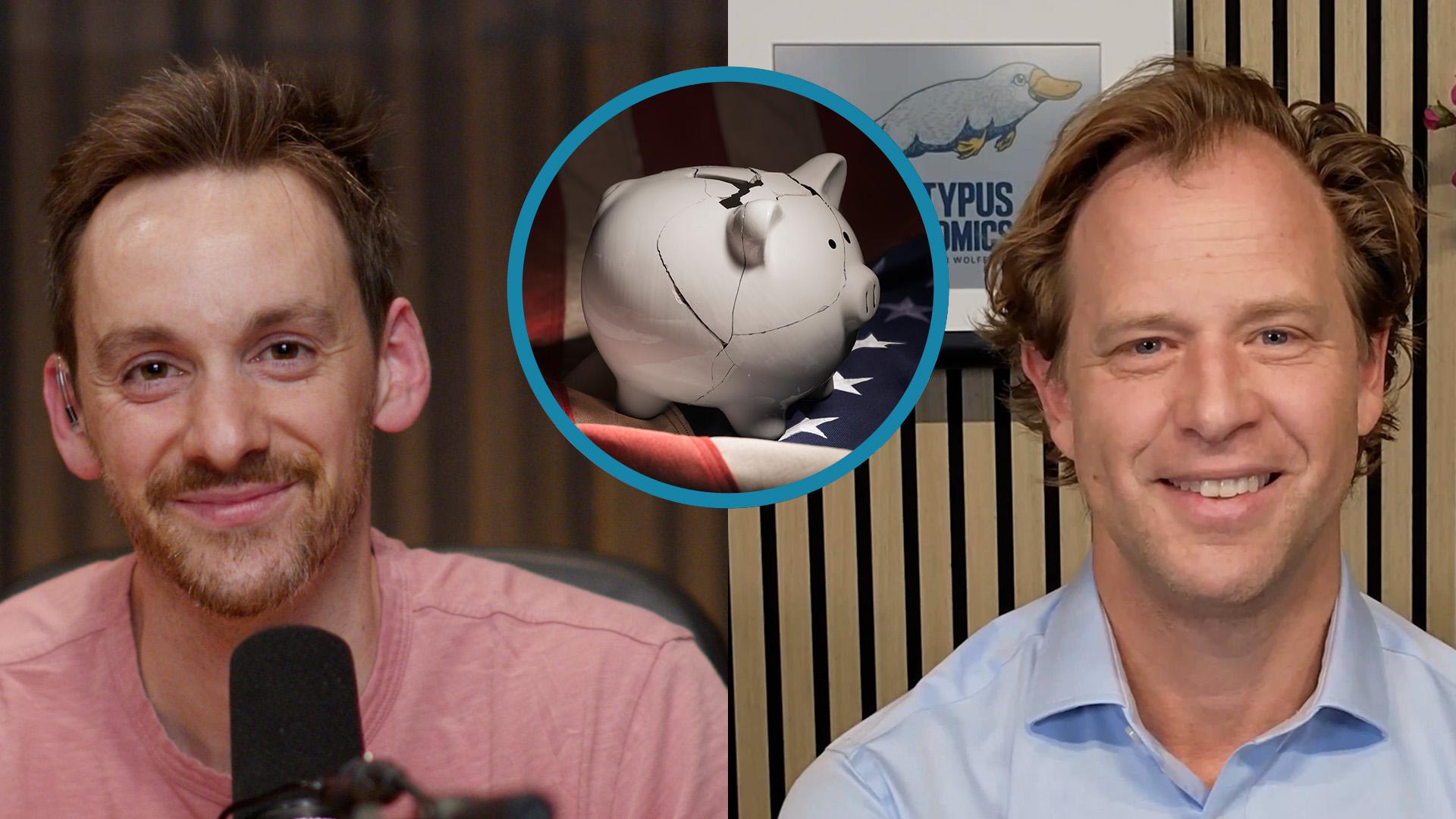
Derek is joined by economist Justin Wolfers to walk through the basics of the federal budget, the evolving debate around the national debt, and why more economists are starting to take persistent deficits seriously.
In the following excerpt, Derek talks to Justin Wolfers about why the U.S. government can’t just print more money to pay off its debts.
Derek Thompson: It is great to see you. So it has probably been, God, at least 10 to 15 years since fiscal policy was my direct and exclusive beat. So I think what I want to do with you first is this: I want you to refresh me on some of the basics here. When people hear that the U.S. government is “borrowing money,” what is literally happening? Who is the government borrowing from? How do Treasury markets work? Why are people around the world buying U.S. debt anyway?
Justin Wolfers: Great. So to start with, why do we borrow money? Because we spend more than we take in. When that happens, everyone still wants to get paid, so you need cash. The government’s not different than that. What you and I would do is if we were spending more than we were taking in, we’d go to the bank and we’d ask for a loan. The problem is the U.S. government talks in billions and sometimes trillions. And if you walked into Wells Fargo and asked for that, they would laugh. They just don’t have that much cash in their vault. So really, what you need is a whole bunch of banks to pitch in to this really big customer called the U.S. government.
There’s a simple way of doing that. It’s called a bond. Here’s a bond. The U.S. government says, “I have a piece of paper right here. This piece of paper, if you give it back to me in a year’s time, I’ll give you $105. How much are you willing to pay for it?” Right now, people might be willing to pay a hundred bucks for that piece of paper. Let’s think about that. So they’re going to hand over their hundred; the government gets the hundred, gives over the piece of paper. What happens a year later? They get back the piece of paper, and the government gives them 105 bucks. You’ll notice that basically the government gets a hundred bucks today and pays back 105 in the future. That’s just like a bank loan.
But the thing about this is—so that piece of paper’s called a bond or a bill. The thing about this is you don’t just walk into one bank to do business this way. You say to the whole world, “I’ve got lots of pieces of paper, trillions of dollars of pieces of paper. Who wants to buy these pieces of paper?” Which is effectively the same thing as saying, “Lend the U.S. government money.” Why do people want to do that? They want to do that because they like interest and they really like lending money to folks who have a tendency to repay, and the U.S. government has a tendency to repay, which is why the U.S. government tends to pay less interest than anyone else. How’s that, mate?
Thompson: That’s pretty good. That’s pretty good. There’s always this question of why doesn’t the government just print the money that it needs, “print” being the operative verb here. No one who uses the term “print the money” is actually referring to any kind of magical printer here. That’s a bit of an old-fashioned aphorism. But what is this aphorism pointing to, and why is it relevant to this discussion of government debt?
In the extreme, if you tried to repay all of our debt by printing money, you’d cause such inflation, you’d basically end up with hyperinflation. Hyperinflation is when you get paid at lunch, but what you can buy by dinnertime has gone down, which means you literally have to reorganize your life around not holding on to money.
Wolfers: Right. So it is much easier to think about it as the government printing money. And the government can print money. It literally prints money, and it sends it out to the bank. It does a bunch of this digitally as well, just like you and I do a lot of our lives on Venmo, but sometimes we still use those pieces of paper with dead presidents on them. So if the government decides to print more pieces of paper with dead presidents on them and nothing else changes, then we’ve got the same number of groceries at the local grocery store, but more pieces of paper, more money chasing those groceries. So when that happens, the exchange rate between groceries and pieces of paper changes. Basically, you’re going to have to give up more dead presidents to get a can of beans. Another way of saying that is prices rise. We get inflation.
Now, I just want to be clear about this. Printing money to repay the debt works. You print the money, you repay a bunch of people the loans. It literally works. The point is there are two ways of repaying our debt. One is you save some money and send it back to the bondholders, and the other is you print some money and you send that to the bondholders. Both work. The first way, we tax people, and we might use a progressive income tax that takes more from the rich than the poor. We might have a sophisticated tax system that encourages investment and discourages slovenliness or whatever the values of the government are.
If we do this by printing more money, you’ll notice the thing that happened was when we print more money, the number of pieces of paper required to buy a can of beans goes up, which is to say the value of a piece of paper falls, which is to say the value of money falls, which is to say someone is paying, bearing the burden of that tax, bearing the burden of printing the money. It’s the people who hold U.S. dollars. Their U.S. dollars become worth less. And so, really, then, the question is, would you like us to repay what we owe by taxing people more and sending the money that way, or by printing money, which effectively turns out to be an inflation tax that taxes people in proportion to their holdings of U.S. dollars?
Now, you’ll notice the thing about inflation taxes, you can’t make it more aggressive or more progressive. You can’t hit the rich even harder. You can’t do political favors for your friends. You can’t design industrial policy around it. It’s a one-size-fits-all policy. So you’ve got these two technologies. They both work. One allows you to achieve a bunch of economic gains, the other does not. One step further, the problem with printing money, that’s an inflation tax, is you’re now telling people, “Don’t use money because we might make it worth less.” And in the extreme, if you tried to repay all of our debt by printing money, you’d cause such inflation, you’d basically end up with hyperinflation. Hyperinflation is when you get paid at lunch, but what you can buy by dinnertime has gone down, which means you literally have to reorganize your life around not holding on to money. It’s a shitty way of living your life. All of which is to say, yes, you can, literally can, repay your debts by printing money. We just think it’s probably a bad idea.
This excerpt has been edited and condensed.
Host: Derek Thompson
Guest: Justin Wolfers
Producer: Devon Baroldi
Additional Production Support: Ben Glicksman