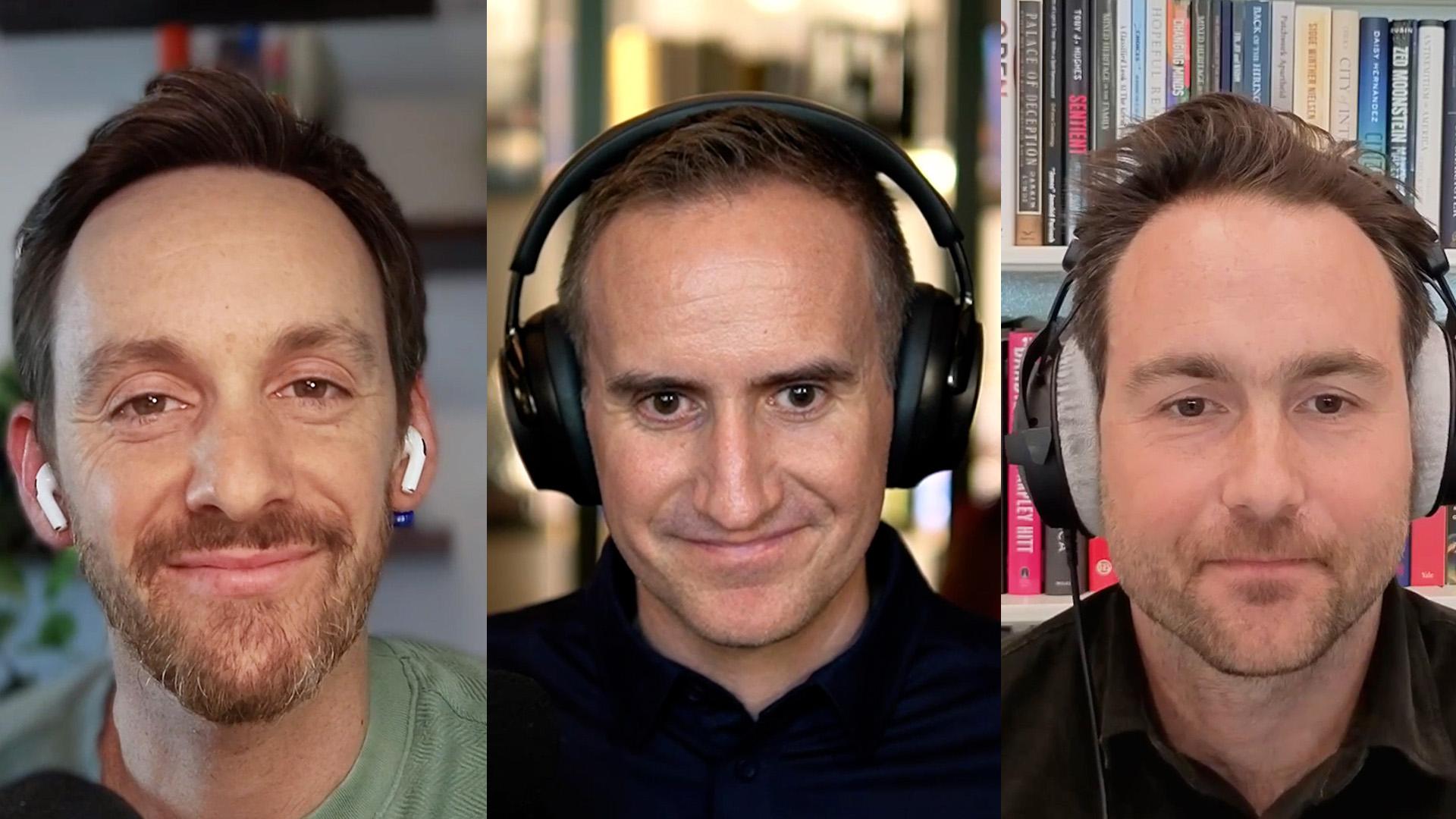

Hosts
 Derek Thompson
 Derek Thompson
About the episode
America is richer than ever. Unemployment is low. Wages are high. According to traditional metrics, the economy looks strong. So why are Americans feeling so bad?
Today, Derek talks with bestselling author Morgan Housel and journalist David Wallace-Wells about what Derek calls the “Tragic Twenties”: the strange and sudden collapse in American happiness that began during COVID and never really stopped.
What’s behind the country’s emotional downturn? Inflation and the lingering psychological effects of the pandemic are certainly part of the story. But so are collapsing trust in institutions, rising social isolation, the negativity feedback loop of social media, and the feeling that we’re living through one crisis after another. Derek, Morgan, and David unpack why the wealthiest society in history still feels deeply adrift and what this happiness recession says about the future of American life.
Subscribe to our YouTube channel here.
If you have questions, observations, or ideas for future episodes, email us at PlainEnglish@Spotify.com.
In the following excerpt, Derek, Morgan Housel, and Derek Wallace-Wells map the ways that Americans’ trust in institutions and each other has declined and the effects that inflation has had on nationwide happiness.
Derek Wallace-Wells: The way that I think about it is that these are long-term trends which were punctuated in profound ways by the experience of the pandemic. And here I actually disagree a little bit with Sam Peltzman in the sense that when I look at surveys of social trust going back decades, I see pretty linear declines. In certain sectors, there’s a bigger drop-off around the pandemic. In some cases, a bigger drop-off around the arrival of the smartphone.
But trust in media has been declining since 1972. It wasn’t because of how we covered the pandemic. It wasn’t because of how we covered Donald Trump. The decline has been very steady. The decline has been very steady in trust in the U.S. Congress and the president, in the Supreme Court. And even some institutions that we think of as being somewhat resilient in the face of declining social trust, like the military or public schools, they are also experiencing long-term declines here.
And so I often think we focus a lot on the last 10 years, and maybe when we’re talking about the pandemic on the last five years, but the truth is these are much longer-term stories which are only becoming visible to us in the recent past, and then we shouldn’t forget the longer-term trajectories. But that’s not to say that the experience of the pandemic didn’t worsen our faith in all of these institutions.
And one thing that I think is really tricky and complicated about that part of the story is that different Americans have different ideas about what went wrong here. So when people like you and me talk in places like this or publications like the ones that we write for, we often tend to emphasize the sense of public health overreach, that the government was excessive in its caution, that people’s lives were too disrupted by this quite punishing deadly disease.
And I don’t even want to adjudicate that question on a moral level, just to say that that is one perspective on COVID. And another one is that we didn’t do enough to protect one another. And there are actually plenty of people in the surveys who say that too.
But overall, actually, the numbers are relatively surprising that Americans are not en masse raging still about the experience of the pandemic. There are pockets, maybe 10, 20 percent on either side of the argument, who think things went wrong. But what that tells you is that the outcome here—where we went through this, again, once-in-a-century biological trauma and came out the other side really frustrated with our institutions—I’m not sure how much better we could have done it because if we had recalibrated things slightly in one direction, we probably would have alienated people on the other side. And if we had turned things in the first direction, the reverse would have happened.
So again, I think even these effects are in some ways fundamentally about the disease itself, the difficulty of navigating a disease like this, especially at a time like ours, when we don’t expect to have our lives disturbed by so much turmoil, illness, and death as we did.
And any outcome in that context is going to frustrate and anger and distress many different kinds of people. And I do think that one of the most profound experiences of the pandemic was that all of us retreated from our social lives, began living, even if it was for a period of two, three, four months, in a much more circumscribed way, and that that taught us that the distant society that we used to think of as our community was now not just farther from us but also in certain ways a threat to us.
It trained us to see one another as risks as opposed to part of a social network. And it did make us, as you say, I think not just more self-interested but also more competitive, more avaricious, and fundamentally more zero-sum. And I think all of that has been quite corrosive.
Derek Thompson: To flesh out that last point that you made, for decades, the general social surveys asked Americans the same question. And that question is: “Do you think more people would try to take advantage of you if they got a chance, or would they try to be fair?”
In the 1970s, 1980s, 1990s, Americans overwhelmingly agreed that other people were more or less trustworthy. Confidence in strangers plummeted between the 2010s and the 2020s, according to Peltzman. So it’s not just, as we were just discussing, our faith in institutions that has declined over a long period of time. It’s our faith in each other, person to person, that seems to decline even more, more recently.
Morgan, I want to bring you in because we’ve talked about biology, and we’ve talked about psychology, but I think we have to talk about economics. Inflation has been the story of the decade that simply will not go away. Consumer prices and home prices have basically increased roughly three times as fast in the 2020s as they did in the 2010s or the 2000s.
So everything that people buy feels like it is constantly slipping out of the zone of affordability even if they are getting raises. They still feel like everything is getting expensive three times faster than normal. As the author of a book entitled The Psychology of Money, why do you think inflation, maybe even more than economic recessions, maybe even more than unemployment, might be a unique tax on broad, nationwide happiness?
Morgan Housel: Derek, I think there’s two big points here to bring up with inflation. One is that it is one of the only economic variables that people are very cognizant of what is happening in real time. If you go out in the street and ask and pick a random person and say, “Hey, last year, what was GDP growth, or what do you think it was? Do you think it was 3 percent, 3.6 percent?” they have no idea.
The average person, even the very informed, educated person, has no idea. But ask them, “How much does a gallon of gas cost at your station?” they will tell you $4.67. And two weeks ago, it was $4.48. So they know exactly. And as they’re filling up, they can see the tick, tick, tick, tick, tick. It’s like their bank account draining. It’s a very psychologically pertinent thing that you’re aware of more than almost anything else.
Even the stock market, where we have a daily ticker, all the surveys would show that most people, even investors, don’t really grasp what happened in the last year. Years when, such as 2009, 2010, years where the stock market was actually doing quite well, people thought that it did quite poorly. But inflation, gas, rent, they remember. I remember what gas cost when I was a child. People just remember these things in a way that they don’t any other economic variables.
The other thing that you brought up that’s so pertinent right now is I think the economy, particularly among young people, is split. It’s halved in the center of: Did you own a house before 2020, or did you not? And that makes such a profound difference. And not only is it the people who did not are, by and large, priced out; it’s the people who did feel incredibly wealthy.
So imagine someone who bought in 2019; they might say, “I bought a house for $700,000, and now it’s worth $1.8 million.” They feel like geniuses. They feel rich. There’s a spending component that comes with that because they feel like they’re wealthy. And so the biggest economic boon to them, to the other person who didn’t buy, or maybe was just one or two years behind them, it’s the biggest economic weight on their shoulders.
This excerpt has been edited and condensed.
Host: Derek Thompson
Guests: Morgan Housel and Derek Wallace-Wells
Producer: Devon Baroldi
Additional Production Support: Ben Glicksman
Links: https://www.derekthompson.org/p/if-americas-so-rich-howd-it-get-so