 Derek Thompson
 Derek Thompson
 Sean Fennessey
 Sean Fennessey
Special Project


Plain English With Derek Thompson
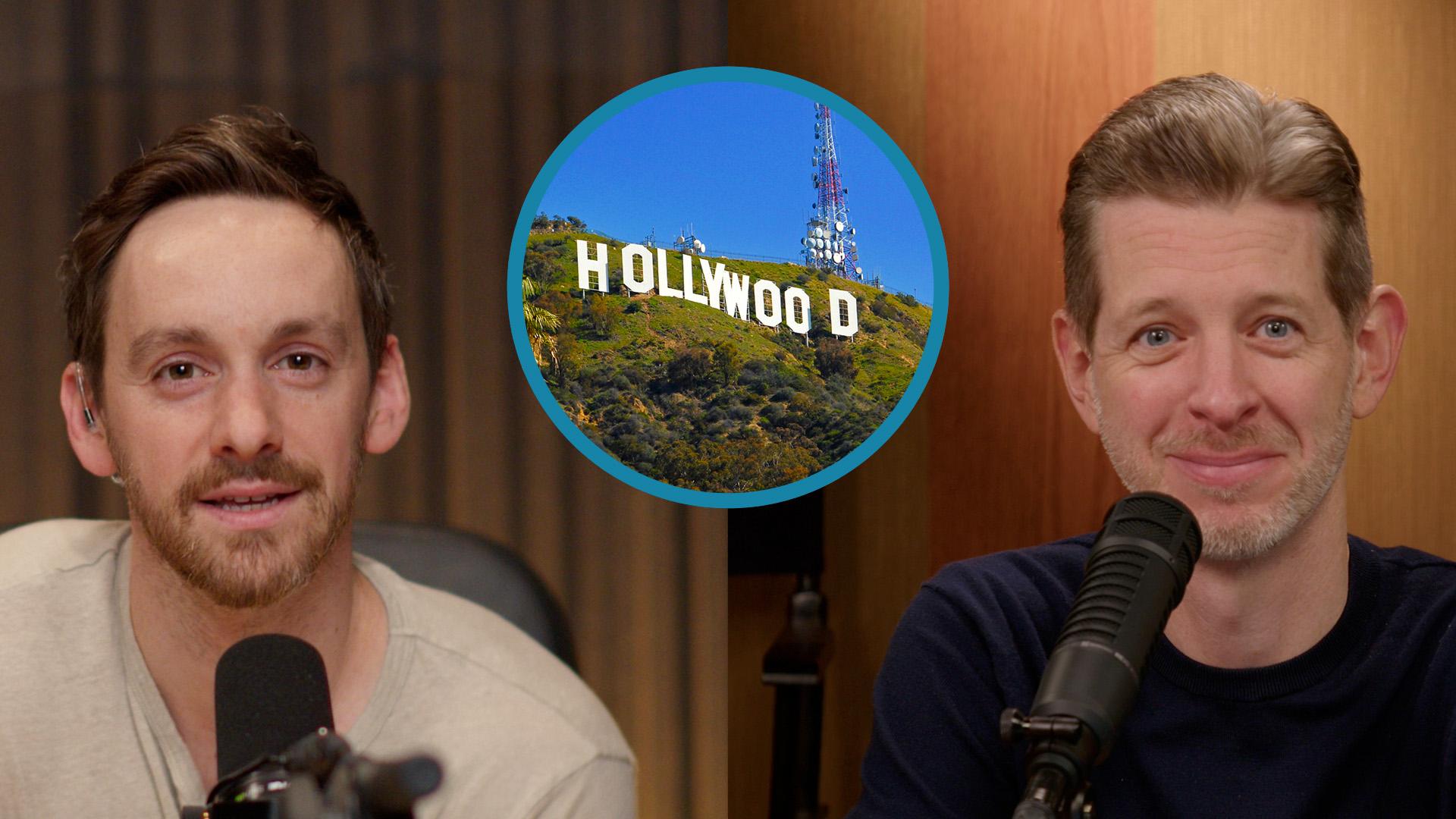
Hollywood is in the middle of a triple crisis. You can measure it in tickets, jobs, and ideas.
Start with tickets. The best year for the movie business this century was 2002, when Americans and Canadians bought 1.6 billion tickets, or about five per person. Last year, Americans bought half that number. Eighty years ago, the typical American went to the movies twice a month. Now they go about twice a year.
Then there are the jobs. Studios are making fewer movies and shows than they did just a few years ago, and the projects they green-light are increasingly shot overseas, where governments hand out generous subsidies. According to The Wall Street Journal, employment in Hollywood has fallen 30 percent since 2022 across the hundreds of trades—actors, carpenters—that make film and television possible.
And then there’s the creativity problem. It’s not just that studios keep reheating 20th-century IP. The stars are getting older, too. Among the 14 most important movie stars of this decade, the average age is 57. Half are over 60. None is under 45. Even many of Gen Z’s favorite movie stars—the Rock, Ryan Reynolds, Tom Cruise, Brad Pitt, Denzel Washington—had hit films before Gen Z was born.
Today’s guest is Sean Fennessey, host of The Ringer‘s The Big Picture and author of the new Substack Projections. In an essay published this week, Sean argues that all the gloom is missing something real: Attendance is perking up, young stars are breaking through, and the auteurs we’ve followed for 20 years are ascending to the center of the culture. Today, Sean and Derek talk about the new rules of Hollywood and what they tell us about the changing winds of American culture.
Subscribe to our YouTube channel here.
If you have questions, observations, or ideas for future episodes, email us at PlainEnglish@Spotify.com.
Host: Derek Thompson
Guest: Sean Fennessey
Producer: Devon Baroldi
Additional Production Support: Ben Glicksman
In the following excerpt, Derek talks to Sean Fennessey about the shifting landscape of movie stardom.
Derek Thompson: So I have three goals for this conversation. I want to talk about the state of Hollywood today. I want to talk about the future of movies. And I want to connect some of your predictions about the future of film to the larger project of trying to understand the direction of American culture, American life, human existence. How does that generally sound to you as a 58-minute project for us?
Sean Fennessey: Seems super easy. I think we’ll solve everything, and then everybody will be able to figure out how to go forward with their lives after this.
Thompson: OK, great. Question no. 1. Sean, how’s Hollywood doing these days?
Fennessey: Well, very bad, but also good, I think, possibly. There’s obviously a tremendous crisis happening in the industry because of consolidation, because of a post-COVID struggle to recover, because of the radically shifting tides in terms of what these entertainment conglomerates think is going to be valuable relative to what has been valuable historically. And so there’s a lot of tumult, there’s a lot of job loss, there’s a lot of struggle, particularly amongst the middle class of people who make movies. So I think there’s a true feeling of sadness, frustration, and anxiety kind of rippling through the business of Hollywood. That, to me, though, is a bit distinct from what is actually being made and what we’re learning about what people want in the future. So we can kind of talk about both of those tracks if you’d like.
Thompson: Yeah. I mean, one of the curiosities I’ve always had of Hollywood in the last 10, 15 years in particular is this phenomenon that I guess you could call the novelty recession. It’s widely recognized that there’s been an increasing reliance on 20th-century IP to make 21st-century entertainment. And maybe as an adjunct to that, I’m very interested in the remarkable stickiness of old movie stars. I was really struck, as I mentioned just now in my open, by Matt Belloni’s reporting, that even if you ask Gen Z for their top movie stars, the movie stars that move them into movie theaters, according to National Research Group. Their top 10 stars are, in order, the Rock, Ryan Reynolds, Kevin Hart, Tom Cruise, Adam Sandler, Brad Pitt, Denzel Washington, Keanu Reeves, Leonardo DiCaprio, and Zendaya.
The average age of that group, especially when you take out Zendaya, it’s somewhere around 60. And I should say that survey, I think, was released about 12 months ago, and maybe a survey released this morning might put Timmy Chalamet on the list, it might put Michael B. Jordan on the list. But I wonder, what do you think explains this phenomenon, the novelty recession, this struggle to not only break out new IP, but also to break out new stars in, really, the last 20 years?
Fennessey: I think that’s too singular a piece of data to analyze and discuss about what has actually happened. I think one other poll that would be useful, would be who are your favorite movie characters of the last 20 years? And if you polled people, particularly young people, about that, I think you’d get a very predictable set of responses: Captain America and Iron Man and Batman and all of these familiar IP strongholds. And I do think that those characters effectively replaced movie stars, or at least the development of a crop of movie stars, over a roughly 20-year period in Hollywood. You’ve got, in 2002, Sam Raimi’s Spider-Man, that leads pretty elegantly into Christopher Nolan’s Batman trilogy and the launch of the Marvel Cinematic Universe. And with that, alongside a handful of other sturdy franchises, the Jurassic World films, Fast & the Furious, a handful of others. They’re effectively replacing what we come to know as your “Tom Cruise can carry any style of movie” movie star.
And so what I think is now happening, after this 20-year excursion into IP-forward movie marketing, is a bit of a retrenchment into stardom. It’s going to take about 10 years to develop more stars, to get us to whatever it felt like was happening in the 1990s. Roughly the first 80 years of American movies were sold on the faces on the big screen and the relationship that you had to them. This century has been much more about, not just IP, but characters that you have built a relationship with over time. And I do think that they have kind of exhausted a lot of those means in Hollywood. We’ve seen that with the pretty dramatic decline in box office for all of those IP franchises that I’ve been talking about.
So I think we’re in a little bit of a middle stage, we’re in a bit of a transition. And I don’t think we’re ever going back to Julia Roberts, Will Smith, Tom Cruise, Bruce Willis. That period that we were raised on is impossible to recapture because of the stratified nature of all entertainment content across the world. But something is happening. You mentioned no. 10 is Zendaya. And a person like Zendaya emerging into our popular consciousness in the way that she has, and the very strategic way that she has put herself into it, with two different kinds of projects in her relatively short career, I think is super instructive. Maybe she’s just a Halley’s comet of stardom that comes along once every 25 or 30 years. But I think she’s actually carving a path for other young stars and showing the way that both young audiences and old audiences can get connected to what she’s interested in.
Thompson: Is Zendaya a movie star in the same way that, say, Julia Roberts was a movie star in the 1990s? I loved Challengers, I loved it. It was one of my favorite movies of the year. It was not an enormous blockbuster. The movies that I would guess are her highest-grossing movies are movies where she is not the lead, whether it’s a Spider-Man or a Dune. She has a celebrity that in some ways exists both within Hollywood and outside of the context of Hollywood. And that way it’s maybe a little bit like Sydney Sweeney, who has been in movies that were blockbuster hits, but has also definitely been in movies that were enormous flops. And in a way, her fame is like this Venn diagram that contains her movie stardom, but also exists, her fame does, outside of the degree to which she is a movie star.
Whereas Julia Roberts was a movie star, beginning, end. Tom Hanks was a movie star. Tom Cruise was not someone who was famous for doing advertisements and also was good in A Few Good Men. No, he was famous for being a movie star. And I wonder if there’s an evolution of stardom that parallels sort of the fragmentation of culture, that in order to be a movie star today, movies have to be like one piece of the constellation, but they’re not the entire identity of your celebrity. Is that a shift, maybe, that’s happened the last 25 years?
This excerpt has been edited and condensed.
Host: Derek Thompson
Guest: Sean Fennessey
Producer: Devon Baroldi
Additional Production Support: Ben Glicksman