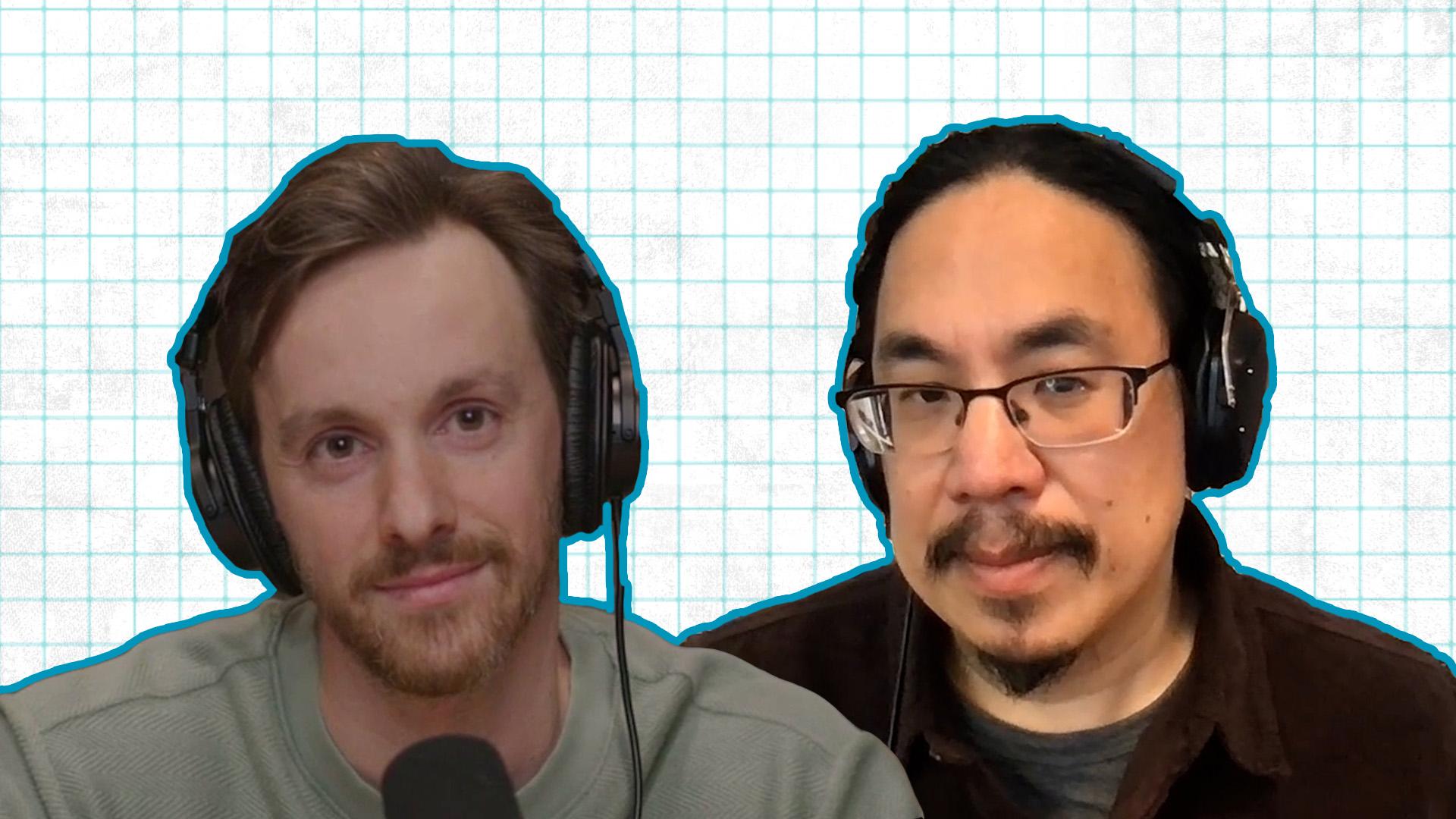

Hosts
 Derek Thompson
 Derek Thompson
About the episode
The modern world swims in numbers: work metrics, fitness metrics, health metrics, social media metrics. Sometimes the quantification of life can make things better. But very often, I think they force us to play the games we can measure rather than the games we value. The quantified life has become a modern religion: a system of values that takes us over and keeps us from living the life we want.
Today’s guest is the philosopher C. Thi Nguyen. He is the author of the book The Score: How to Stop Playing Somebody Else’s Game. We talk about metrics, the games of life, and how to listen to the parts of ourselves that cannot be reduced to numbers.
Subscribe to our YouTube channel here.
If you have questions, observations, or ideas for future episodes, email us at PlainEnglish@Spotify.com.
In the following excerpt, C. Thi Nguyen explains to Derek his experience with the scoring systems in his life, both in rock climbing and in philosophy.
Derek Thompson: C. Thi Nguyen, welcome to the show.
C. Thi Nguyen: Hello. Hello.
Thompson: Tell me about rock climbing.
Nguyen: Rock climbing is one of the best things that’s ever happened to me in my life, and I think it’s particularly beautiful to me and interesting to me because I’m so bad at it. I mean, part of what happened was I was one of these people, I grew up playing computer games and reading, and I was like, “Life of the mind, screw the body.” And I hated everything about embodiment. And I started to realize there was a problem. I did some yoga. And then at one point I …
Actually, what happened first was I tried to learn to surf, and I found out that seasick asthmatics should not try to surf. It’s very deadly. And then I tried climbing, and I thought climbing was dumb. So I had this image in my mind where climbing was muscle bros screaming, like Arnold Schwarzenegger just hauling himself. I thought it was a pure muscle thing, and I found out that was completely wrong, that rock climbing is this delicate balance sport.
What I found out was that it was kind of like solving logic puzzles with your body in yoga, right? You have to find your way through. And I think the really interesting thing to me was how much the scoring system in rock climbing mattered to me. And I think in some ways, this book I wrote is a fight I had with a friend of mine in grad school, and she was always like, “When I go climbing, I don’t want to climb the routes that are given. I don’t want to go. That’s too constraining for me. I want perfect freedom.” And I realized one thing you do if you have perfect freedom in climbing is you basically goof around in your capacities, and you’re not pushed.
And the central scoring system of climbing is a difficulty scale. And when I adopted it—’cause I am a game player; I tend to orient on scoring systems—it forced me to do something that I’d never done before, which was hyper-attune my senses to my body and listen to such quiet signals. I mean, in rock climbing, I don’t know if you rock climb, but when you climb, often what matters is the exact millimeter your hip is at, the exact half a degree of turn and tension on your ankle.
And you wouldn’t notice this if you’re just climbing easy stuff. But if the system is telling you, “Go harder, go harder,” then you have to get to a higher level of refinement of your awareness of your body and your delicacy. And over the course of this, what it taught me was that movement is beautiful. And I had no idea this was possible. I was like, “I thought beauty was a thing only for novels and poetry and maybe math proofs, but certainly not my god-awful body.” And climbing showed that to me, and it showed it to me by pushing me.
And that was great for about six years. And then I hit a wall. And I think the wall is there because a really important thing is that I’m a terrible climber. I’m significantly sub-mediocre. I think there are strong, agile people that show up and within a year are better than I got in 10 years. It’s just, I’m terrible. And I kept advancing. I kept being good until I hit a wall. That wall was partly because I’m busy, partly for my own athletic cap, and partly because I became a parent, and I just couldn’t advance.
And when I kept to the scoring system of climbing, I became miserable. I kept trying to advance to the next level, and I just couldn’t. And I ended up having to … I mean, first I got depressed, and the main thing that was keeping me happy was now miserable. And I kept doing it for a while, miserably. And then I finally started reformulating it to myself. And I was inspired by other people who would say things, especially some older climbers are like, “Oh, I don’t do difficulty anymore. I try to be graceful,” or whatever.
And I started, instead of trying to go harder, to go more graceful. It’s super interesting because that gave me the joy back, and it involved reprogramming the scoring system to suit my needs. But I also have to admit that I never would’ve been in the position to reprogram it in that way if I hadn’t kind of blindly followed it at first. And I just find that fascinating.
Thompson: With rock climbing, you fall in love with an activity. You find a metric that at first seems to push you toward becoming a more advanced rock climber, but ultimately that metric becomes the single thing that you focus on. It takes over your life. It plunges you into a depression over the activity that you initially fell in love with. And then ultimately, you find some kind of synthesis. You say, “I’m going to find a way to adhere to my own values but also live with this metric that exists.” Tell me, how is your professional life, being a philosopher, like rock climbing?
Nguyen: Yeah, so this is the most embarrassing story, and I put it in the book. So I went into philosophy—
Thompson: In Chapter 1, I should say.
Nguyen: In Chapter 1. Yeah, it’s in Chapter 1, so I have no one to blame but myself. I got into philosophy because I loved it. I was supposed to be something else. Asian immigrant’s kid, doctor, at worst a lawyer. I thought I was going to be bound for all kinds of other things. I just kept getting pulled to these weird, fascinating questions. Is beauty subjective? What is the meaning of life? They were big. How do I know anything? Is there anything at the bottom of science that’s rock solid? All this stuff, I had these big questions.
And then I went to philosophy grad school. And in philosophy grad school, I encountered the rankings. There are two rankings that people care about. One is a ranking system of journals by status, and the other is a ranking system of university departments by status. They’re on websites, they’re public, you can find them, and you get quietly enculturated to them in graduate school.
It’s really common, and you start getting focused. And what you get focused on is going up the rankings. And that’s a very specific methodology. So high-end philosophy journals typically feature a kind of very technical, very careful, very slow work on a set of fairly prescribed questions. And I do want to say that a lot of this work is extremely important, and it’s very valuable, but it wasn’t my jam, but I found myself working on it, which is kind of weird because it’s not like anyone goes into philosophy for worldly success.
You basically burned your life and career opportunities by throwing yourself in this stupid discipline. The only reason to do it is for love. And then suddenly, I found myself working on things that I was bored by for like five years. And I also got super depressed, and I also basically lost my love of philosophy, and I was going to quit. And in this case, the thing that I did was I basically ended up having to ignore the ranking system altogether. It was too pervasive; it was too powerful. I had to get rid of it completely. I had to force away and alienate it from myself and basically go back to working on things I loved. And that involved basically giving up on any kind of status in the profession, because what I did was I started working on the philosophy of games, and that’s not really a legitimate topic in philosophy. You’re not supposed to work on that. That’s not real.
This excerpt has been edited and condensed.
Host: Derek Thompson
Guest: C. Thi Nguyen
Producer: Devon Baroldi