
Hosts
 Derek Thompson
 Derek Thompson
About the episode
Donald Trump suffered a huge blow Friday when the Supreme Court struck down the centerpiece of his economic policy: his vast system of tariffs. So what happens now? Harvard’s Jason Furman explains the implications for the U.S. economy, consumers, global trade, and Trump’s strategy of centralizing power in the executive branch and using trade policy as a means of wringing concessions out of other countries.
If you have questions, observations, or ideas for future episodes, email us at PlainEnglish@Spotify.com.
Host: Derek Thompson
Guest: Jason Furman
Producer: Devon Baroldi
In the following excerpt, Derek Thompson and Jason Furman discuss how the Supreme Court ruling has—and hasn’t—constricted Trump’s trade policy.
Derek Thompson: Let’s jump right into the news of the moment, I suppose. In your own words, what just happened today?
Jason Furman: Well, what happened today was I was caught totally by surprise. There were multiple days starting in January where I was at 10 a.m. refreshing SCOTUSblog waiting for this decision, and then I think I had just entirely given up, forgotten about it, and then got a text at like 10:10 that it had come out. So it finally came.
The chief justice, John Roberts, wrote the decision and completely and totally took away the authority that President Trump was using for about two-thirds of his tariff increases, something called the International Emergency Economic Powers Act, IEEPA. And so all of those tariffs are almost immediately null and void. That was done under that. A few hours later, Donald Trump, who—maybe he had also forgotten about it, maybe he had stopped refreshing SCOTUSblog, maybe he got a text, too, reminding him—put under a different legal authority, a new set of tariffs of 10 percentage points. Basically undoing about 80 percent of what the Supreme Court had undone with his tariffs. So leaving them a little bit lower than they were before, but only a little bit.
But the thing is, the new thing that Donald Trump did can only last for 150 days, and unless it’s extended by Congress, it goes away. So that’s where we are now. One set of tariffs gone, a new set of tariffs here, but some uncertainty about what will happen going forward.
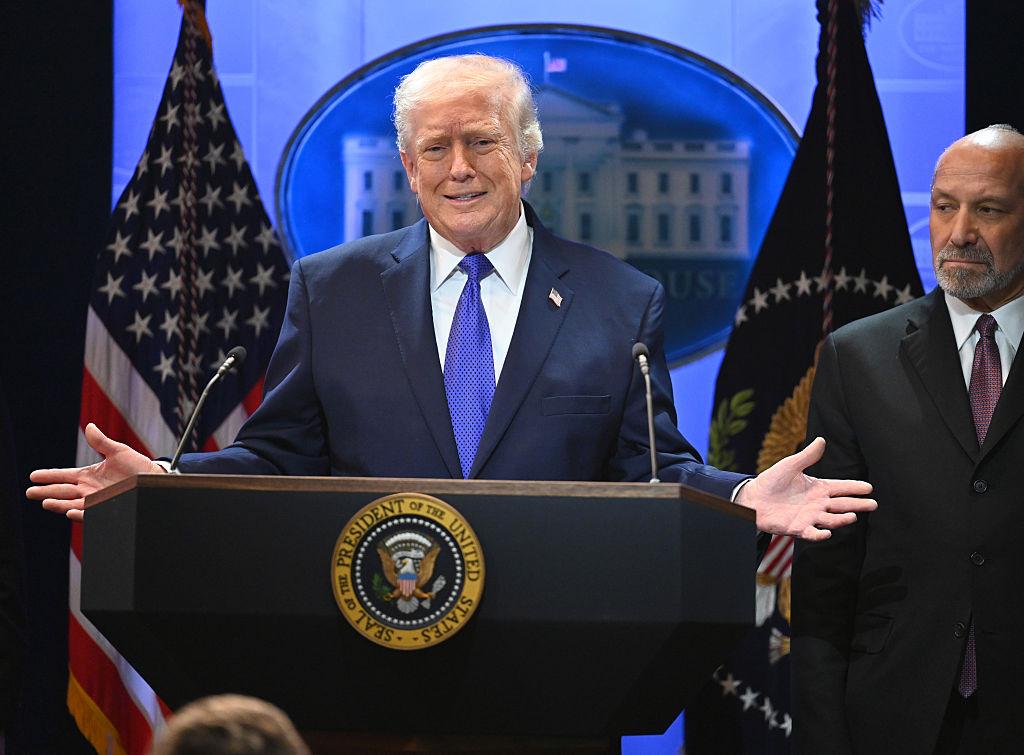
President Trump speaks during a press briefing at the White House on Friday
Thompson: I appreciate that you introduced the very funny possibility that on Trump’s Chrome browser, he has one website bookmarked, which is just SCOTUSblog, and he’s just constantly refreshing to read SCOTUS analysis, which is quite good there, but it seems a little bit unlikely. Can you go a little bit deeper into why, by a 6-3 vote, IEEPA was thrown out as a justification for these tariffs? I mean, we’re having you on as the macroeconomics expert here, but if you put on the legal hat even briefly, what fundamentally was the reasoning behind this ruling?
Furman: The law that they invoked doesn’t use the word tariffs and it’s never [been] used before to justify tariffs, and the justices didn’t think it applied to tariffs. Now, the administration made arguments that there were other words that could be understood as possibly implying or meaning tariffs. Three of the justices accepted that, but six of them just said simply no. Congress didn’t say tariffs. They meant this for things like very specific sanctions against banks or a financial system for a country you’re trying to punish for some sort of reason, but that this was just not allowed under that law, and that’s why it was quite sweeping, at least as far as that law is concerned. It does not give them a path back using the IEEPA law.
This could have a very large impact on deals going forward, with China … being the most important part.
Thompson: What kind of a mess are we looking at right now given that these tariffs have collected $200 billion already at the border? I mean, if these tariffs have now been struck down then, and I believe this was a part of the decision itself, even if it was left a little bit unclear, the companies who paid those tariffs might expect refunds. Is there an orderly process by which refunds would be paid by the government back to the companies who have been paying these tariffs? Or is this basically, hey, if you’re a company that’s been paying tariffs on stuff coming over from China and Europe, time to lawyer up and start begging the government for money? I mean, is there any playbook here for these companies to make their money back?
Furman: Another thing that we just don’t know the answer to. The Supreme Court did not resolve the issue of whether companies would get paid back. Moreover, not necessarily every company’s going to want to get paid back. This lawsuit itself was brought by some smaller, more random companies. The big companies we’ve all heard of were not a party to this lawsuit, maybe because they didn’t want to anger Donald Trump with it.
As a macroeconomist, I’m actually not super fascinated by the repayment part of it. I think it doesn’t have a big effect on the macroeconomy because when you give money to a corporation, they just don’t go out and spend it the same way if you give money to a middle-class family, they go out and spend it. It doesn’t really change their investment behavior that much because mostly they need things with a good rate of return. It’s not cash that’s usually the constraint on investment. And they probably don’t pass the savings on to consumers, either. So I find it, you know, interesting. I’m going to enjoy the drama of it, but very little of the macroeconomist part of me feels any need to pay attention to it.
Thompson: Maybe this next question will instigate and galvanize the macroeconomist in you. I mean, the decision isn’t just going to have an effect on companies in the U.S. that paid these tariffs. It’s also going to have an effect on folks outside the U.S. I mean, the U.S. has been out signing trade agreements for the last few years under the auspices of—under the sword of Damocles of—these tariffs. In a weird way, because these tariffs are now wiped out, it’s the … countries that were paying the highest tariff rates that are going to benefit the most from this decision. Countries like China. And so what does this mean for other countries that we’re trading with?
Furman: So with everything, we don’t know, but I’m not going to keep saying that. So I’ll give you my best guess, which is that all the deals we’ve already struck will stay in place and largely be unchanged, but that this could have a very large impact on deals going forward, with China, as you just alluded to in your question, being the most important part.
So for example, Japan and Korea have both agreed to make investments into the United States. I don’t think they’re going to turn around and say, “IEEPA was struck down. So, Donald Trump, we’re not making these investments in the United States anymore.” They don’t want to anger the United States. By the way, a lot of the concessions we’ve gotten from different countries around the world were both relatively small and often in the interests of those countries or maybe repackaging something they were perfectly happy to do or going to do anyway. So the deals we have, which include places like Japan and Korea, I expect them not to change basically at all.
But we are in the middle of a negotiation with China. We have sort of an interim truce, but we have President Trump going there in April. Under IEEPA, he had enormous flexibility of just turning tariffs up and down. In some cases, that was on a whim in a quite terrible way—if he didn’t like the tone of voice of the leader of Switzerland or a television advertisement done by what is effectively a local official in Canada. But with China, there was some benefit to having that.
He doesn’t, like—he still has tools. There’s something called Section 301, which lets you investigate a country, decide it’s been unfair, and do tariffs on it. That’s what most of our China tariffs that we did in Trump’s first term, that Biden kept and expanded on, were done under. So he has tools like that that he could do more, but they all take more time, more effort, and so this will mean both less chaotic randomness, but maybe a little bit less leverage for future negotiations too.