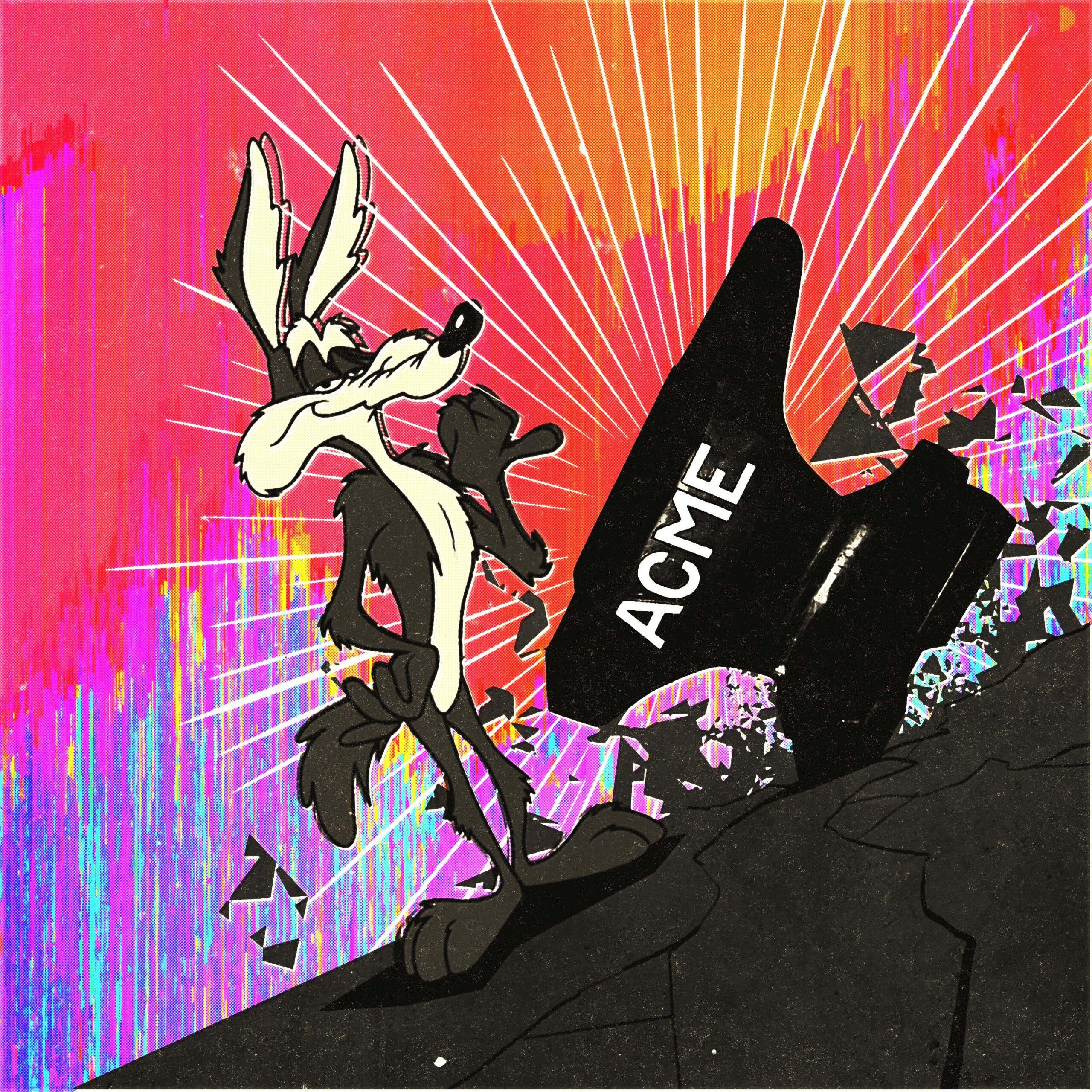
Keep Chasing That Bird: The Oral History of ‘Coyote vs. Acme’
The ‘Looney Tunes’ movie is finally hitting theaters after its controversial shelving three years ago—this is the story of how it got out from under the anvilKeep Chasing That Bird: The Oral History of ‘Coyote vs. Acme’
The ‘Looney Tunes’ movie is finally hitting theaters after its controversial shelving three years ago—this is the story of how it got out from under the anvil
Life is absolute hell for Wile E. Coyote.
Every day, he wakes up hungry. Every day, he hatches an intricate plan to catch his dinner. And every day, it looks like his ingenuity is going to pay off. But then a 500-pound anvil drops onto his head. Adding insult to injury, his nemesis and potential meal, the Road Runner, always speeds right on by with a dumb smile on his face.
In an instant, everything Wile E. worked so hard for goes down the drain. But he’ll wake up the next morning and do it again. And again. And again. He has to keep chasing that bird. It’s his purpose. Nothing can stop him—not even Acme, the giant corporation that makes the shoddy traps, gadgets, and machines that always fail him when he needs them most.
There’s an obvious metaphor here. Wile E. Coyote is, at heart, a frustrated artist. He’s one of the most creative, detail-oriented, and totally relentless underdogs in the history of American fiction. That’s what makes a movie about him so intriguing.
All the way back in 2018, Warner Bros. announced Coyote vs. Acme. The premise was simple and clever: Wile E. sues the Acme Corporation for damages after years of injuries caused by its faulty products. You know: spring-powered shoes, rocket skates, dynamite.
Gradually, the live-action/animated hybrid took shape. In late 2020, the studio gave it a release date: July 21, 2023. In early 2022, filming started in Albuquerque. But not long after that, there was an ominous development. Warner Bros. took the Looney Tunes movie’s release date and gave it to someone else.
“A couple weeks into our shoot, we heard that Barbie got our date,” says Coyote vs. Acme director Dave Green. “We were like, ‘OK, we’ll eventually get another date. It’ll happen.’ And then we never did.”
On November 9, 2023, the same day the Screen Actors Guild strike ended, news broke that Warner Bros. was planning to shelve Coyote vs. Acme. That meant no theatrical or streaming release. It was shocking. The movie was completed. Test audiences liked it.
So why did Warner Bros. and its new CEO, David Zaslav, reportedly pull the plug on a $70 million film? For a $30 million tax write-off. A boulder came down on Coyote vs. Acme and flattened it into a line item on a budget.
The cast and crew were devastated. They thought their passion project might never see the light of day. But sometimes, life imitates art in a way that’s so on the nose the outside world takes notice. All of a sudden, their broad comedy about the little guy taking on the man felt awfully specific.
Which is why what came next felt so … life-affirming. The day the movie died, Hollywood’s creative types launched a grassroots mission to save it. The campaign worked. Coyote vs. Acme hits theaters on Friday.
These days, battles between art and commerce don’t tend to end well for the artists. But every so often, the little guy manages to avoid the anvil—and win.
Part 1: “How Do You Make Wile E. Coyote Sympathetic?”
Over the years, Wile E. Coyote became a symbol of futility. But his redemption arc finally began in 1990. That year, The New Yorker published “Coyote v. Acme” by Ian Frazier. In the short story, Coyote’s lawyer lays out his client’s case against Acme and requests almost $39 million in damages.
For the next three decades, producers tried to turn “Coyote v. Acme” into a movie. James Gunn almost got there in the late 2010s. The Guardians of the Galaxy director, who’s now the cohead of DC Studios, even commissioned a script. But—fittingly—there was a failure to launch. At least for a while.
Dave Green (director): An agent that I had a long time ago told me about this project. This is like 2016. I was like, “That sounds amazing. I want to read it.” And I just loved the one-sentence idea. Which is, Wile E. Coyote sues Acme for product malfeasance and his 80 years of mistreatment and injury. And I thought that was the funniest possible concept.
Chris DeFaria (producer): My wife and I would go for walks, and every week we would see a coyote. It was like they were hovering around my house saying, “You should make this movie.”
Green: I never heard anything back about it until I think 2019. And I read a script. I knew that the studio was looking for a director who had had hybrid experience, and I had done the Ninja Turtles movie. So I was a person who got to meet on this film. I was having a very exploratory meeting and had just to test boundaries. And I think I had said, “What if this was a true-crime documentary?” And the executive I met with at the time was like, “Great, sure, whatever.” And I was like, “OK, cool. There are no boundaries.”
DeFaria: The studio sent me a draft of an older script. And I knew Dave Green because he and I had been trying to do a movie 10 years before. And they said, “Dave is hovering around this, would you want to take a look at it? What would you guys do?” So I read it. I loved the material. I loved the premise of Ian Frazier’s article. So Dave and I sat around and brainstormed for a while.
Green: I looked at the core of the [New Yorker] article, and then I looked at the core of the scripts that existed. And I really wanted to think about what would make a theatrical movie that would exist beyond an SNL sketch. I felt like in order to tell that story, you would really have to invest in Wile E. and get people to care about what he cared about.
Coyote is the ultimate optimist, and we could all learn something from him. He gets up every morning, and he sets the table for Road Runner stew. And every night he puts the silverware away, goes to bed, and wakes up and does it the next day.Chris DeFaria
Samy Burch (writer): I got involved because I had a coffee with Dave Green that was set up from a producer named Alex Plapinger, who had just read a spec script of mine called May December that nobody was attached to.
Green: It was floating around as a spec script. It’s like a work of art on paper. I had met Samy. I told Chris DeFaria, “Hey, I recently read this. What do you think about her?” He read May December. He’s like, “Yeah, it’s obviously super smart and funny and dry and dark.”
Burch: I went in having no expectations that I was in the running for this movie, of course. But we did get along, and [Green] asked me to read an old draft of the script. This was, I think, January of 2020. And I read it, I gave some thoughts in an email, as any friend would. And I woke up to a message the next morning saying, “Hey, can you get down to Warner Bros. right now? I really want them to hear your thoughts on this.” It was so Old Hollywood. It was so “Get to the studio, Barton Fink.” Like, run. So I did. I showed up. That was the very first conversation with me and Dave and Chris DeFaria.
Green: The studio loved what she had to say.
Burch: So much came from Dave’s pitch of what he wanted to do with it, really committing to the comedy of the references of legal thrillers. You know, putting it into this family space, just like Roger Rabbit was able to do with film noir.
Green: There was a push-pull effect, where it was built for families and made for families but seemed, like, a little dangerous and a little dark for kids, in the kind of way that really appealed to me. And I felt the same way about [Tim] Burton’s Batman and Beetlejuice. They were dark and scary and funny all at the same time. Roger Rabbit had all those things.
DeFaria: We really connected over a concept which we arrived at very quickly in the room, which was “How do you make [Wile E. Coyote] sympathetic?”
Wile E. was conceived as the kind of mangy underdog who’s fun to root for. When he was a kid, legendary animator Chuck Jones read Mark Twain’s Roughing It. In his travelogue, Twain describes the coyote as “a living, breathing allegory of Want. He is always hungry. He is always poor, out of luck and friendless.”
In the late ’40s, Jones and writer Michael Maltese brought Wile E. Coyote and Road Runner to life. In all of their cartoons, Wile E. obsessively chases that bird through the beautiful landscapes of the American West—without ever catching him. That was by design. In his autobiography, Jones lists his nine rules for Coyote–Road Runner cartoons. Here’s no. 2: “No outside force can harm the Coyote—only his own ineptitude or the failure of the Acme products.”
Burch: This is Wile E. Coyote’s movie. I don’t know if you could pick any random Looney Tune and really justify it. I think Wile E. justifies it because he has a lot of pathos.
Ian Frazier (author, “Coyote v. Acme,” to The New York Times): He’s trying to be murderous, but there’s something about him—he just can’t be murderous enough. And there is that peaceful moment of knowing. Sometimes he gets very peaceful at the end, when he runs off the cliff. The moment of realization is always very touching.
DeFaria: He’s been forever portrayed as this fanatical, persistent predator. And we sort of moved to this idea that you know who he really is. Coyote is the ultimate optimist, and we could all learn something from him. He gets up every morning, and he sets the table for Road Runner stew. And every night he puts the silverware away, goes to bed, and wakes up and does it the next day. And he believes one day it’s gonna happen. And I think that’s an incredibly aspirational attribute.
Green: He’s a great physical comedian. He’s a hard worker. He’s a thinker. He’s passionate. And he’s also a fool.
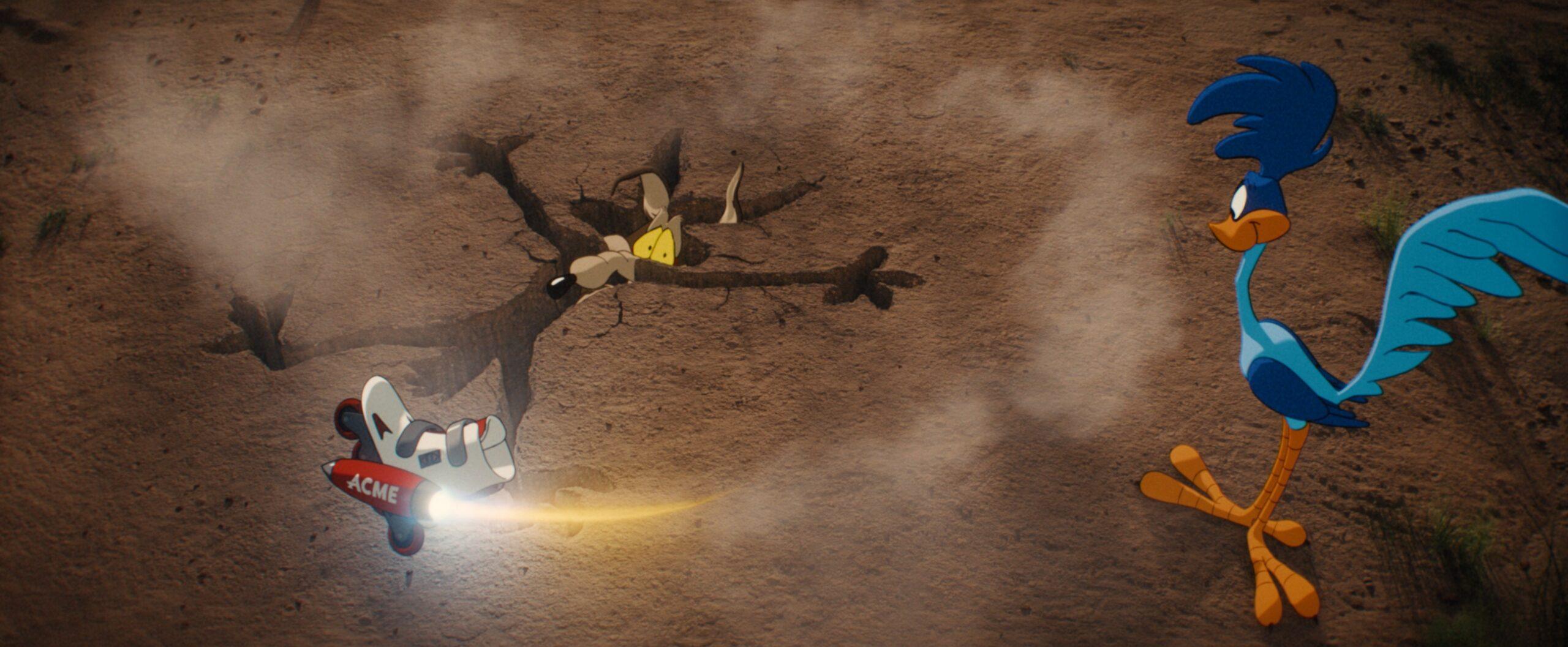
Part 2: “It’s a Magic Trick”
The movie belongs to Wile E. Coyote. But he needed costars. The cast is stacked with funny people: Will Forte, John Cena, Lana Condor from Netflix’s To All the Boys series, P.J. Byrne from Wolf of Wall Street, character actor Luis Guzmán, and comedian Tone Bell.
Will Forte (Kevin Avery, Wile E.’s attorney): I got a chance to act with one of the all-time legends of television and movie history. How do you turn that down?
Green: There’s nothing Will can do to not be kind and good-hearted. As hard as he tries, it is part of who he is, and it’s part of his soul. He’s genuinely kind. And I think the genuine kindness means that we can go along with this character’s wanting to cut corners and his laziness. Samy and Chris and I were really kind of averse to the idea of a very sharpshooting, unlikable lawyer who was too slick. And Will is just—sorry, Will—he’s not that person.
If the film has a secret weapon, it’s Eric Bauza. He’s the voice of several Looney Tunes characters.
Eric Bauza (Bugs Bunny, Daffy Duck, Foghorn Leghorn, and more): I was asked to do a table read [with] some of the cast there. I didn’t audition. I was looking at the people on the Zoom, and I was like, “Oh, Will Forte is going to be on this Zoom.” He’s a comedy legend and hero and genius. OK, well, no pressure. So we’re reading. My characters don’t really show up until a little bit later in the script. They’re probably wondering, “Who’s this guy that’s not saying anything on the Zoom?” And I start doing the voices. I got that reaction. I got Will Forte to smile and giggle. And then when I met him, he was like, “Goddamn it, Bauza. I don’t know how you do it, but whatever you’re doing, it’s freaking me out.”
Forte: Mel Blanc, how do you fill those shoes? And yet Eric comes in, and he’s just so talented.
Bauza: I would watch The Bugs Bunny and Tweety Show in Toronto, Canada. That’s where I’m from originally. Mel Blanc was the originator of these, I don’t want to say voices. They’re like personalities. Over 90 years now, we’ve been with these characters, like our oldest relatives. These are characters that you would find sitting across the table from you at Thanksgiving. “Pass the gravy, ya idiot.” My mom sounds like Yosemite Sam.
Green: When you hear Bugs Bunny coming out of Eric’s face, you’re like, “How is this happening?”
Bauza: As a kid, though, you just sound like a kid doing the voices, until you hit puberty and then your voice changes. And all of a sudden, you sound like Richard Dreyfuss with a lisp. That’s my Daffy, Richard Dreyfuss with a lisp. “Mayor Vaughn, what we’re dealing with here is a perfect eating machine. OK? And all he wants to do is eat tourists on the Fourth of July.”
Green: It’s a magic trick.
Making a live-action/animated hybrid movie is basically a magic trick, too. It takes an extraordinary amount of effort, manpower, and time. Coyote vs. Acme was no exception.
Green: The movie began in previs. We did a long one-year previs phase during COVID with our editor and then with a team in London. Then our sketch vis artists working in 2D would basically draw on top of previs.
Carsten Kurpanek (editor): I was cutting previs in May 2021. I was like two months into the the journey that was Coyote vs. Acme. We’re working remote during the back end of COVID. And [my daughter] was 3 then. And the movie now is coming out, she will be 9.
Green: The earliest iteration of this movie was kind of like Tim and Eric looking, super weird. It was previs of actors moving around with voices. And then on top of that, you would see Wile E. in poses and expressions articulating what he wanted in the scene. And you could watch the whole movie this way. It was 90 minutes. And we gave this to the crew as our guide because it was an amazing tool.
Carlos Lutterbach (director of animation): When Dave went on set to direct the actors, he had all this material to say, “Look, in this scene, this is what we imagined the scene would be, and this is what the characters would be doing.”
Kurpanek: We went to shoot it in Albuquerque for three months in the spring of 2022.
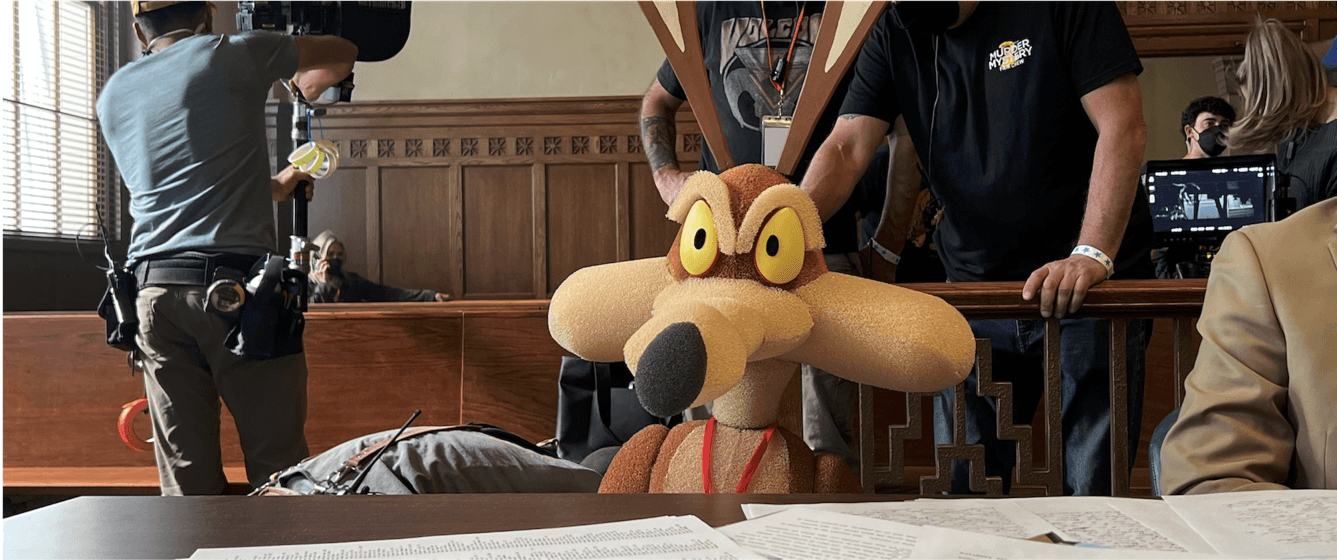
Green: We had a puppeteer on set. His name is Dave Barclay. He’s a legend. He worked on The Dark Crystal. He was a puppeteer for Jabba the Hut.
Dave Barclay (puppeteer): I had a phone call and a Zoom from Chris DeFaria. We’d worked together on many films. I created puppets for him for Looney Tunes: Back in Action, and we used those as reference puppets to stand in for Bugs and Daffy.
Green: He built a life-sized Wile E. Coyote puppet that is foam and has brows that articulate and go up and down. And his arms move, and he can hold up a sign.
Forte: Here’s this other legend puppeting this animated legend.
Green: Basically, this puppet was Will and Lana and John and P.J.’s scene partner. He was there for eyeline and also to show the actors Wile E.’s blocking and what his wants and needs were in a scene.
Forte: It really brought the scene to life. The first couple takes would be with the cartoon—or, excuse me—with the puppet in it. And then after a couple takes, when you really got a sense of what was going on, they would pull the puppet and just bring in a tennis ball, and the tennis ball would be the eyeline.
Green: It was great to have this puppet on set because the actors felt this camaraderie with him. And the puppet would sometimes hang out in a director’s chair. And I think they really kind of fell for him and made it feel like Wile E. was never invisible or fictional.
Barclay: It was some of the nicest screen moments I’ve had my whole career. I started off in the movie industry in 1979, helping Frank Oz with Yoda on Empire Strikes Back, and I was the kid on set. And now on Coyote, I was the granddad on set. Still doing the same crazy stuff. But loving every second of it.
DeFaria: You do have moments where you’re sitting in the desert in Albuquerque with a big Coyote puppet, and everybody’s sweating and you’re gonna drive a car really fast down toward a cliff with an actor, and you’re going, “What do we do? Is this even funny? Is anybody gonna care?” But Samy Burch, Dave [Green], and I got on so well. We were speaking the same language from the beginning.
Burch: Dave [Green] is such a great vessel for Wile E. Because he is so tireless in his pursuit of the quality that he was hoping for. The joy and the comedy.
Forte: You sometimes forgot the level of sophistication that went into every single thing. And then even with the amount of planning, every once in a while, something would just happen that threw everything into pandemonium. Like there was this big dust storm, and everybody had to huddle in the big studio for protection. Totally blew our day.
Week 2, I got COVID. And this was right when John Cena was coming in. And we had two weeks with him. And one of those weeks, which was the second week of production, I’m all of a sudden unable to come in. Throughout that all, Dave’s just unflappable.
Part 3: “Loads of Expletives”
By the time the fall of 2023 rolled around, the cast and crew of Coyote vs. Acme were still eagerly awaiting a release date. But there were signs of impending doom. Warner Bros. had recently shelved two films: One was a $40 million animated Scooby Doo movie. The other was the live-action Batgirl, which cost about $90 million. They were both originally slated for release on HBO Max, but neither made it there.
At the time, a Hollywood Reporter story chalked the moves up to Zaslav prioritizing “cost-cutting” and “creating theatrical films rather than projects for streaming.” There were also reports that Batgirl wasn’t testing well and that WB didn’t want to “throw good money after bad.”
Coyote vs. Acme had been planned as a theatrical release. And test audiences praised it.
Green: We were just kind of waiting, going through the phases of postproduction and screening the movie, testing the movie. But then after the film was done, then I was kind of like, “Oh, when’s our date coming? What’s going to happen?” So it was really in limbo.
Bauza: We were like, “Ah, we’re going to be fine.” And it was that hot, sweaty summer. Writers strike came and went, actors strike came and went. And then we were like, “Want to grab a bite to eat and talk about marketing for the movie?” And then we get this call.
Green: I was visiting a friend on the East Coast and just got a phone call [from my agents] one afternoon. And they just got a call from [studio] leadership.
Bauza: Like, “Sorry. You’re no longer going to be seen.” Even though it was done on time, under budget. It had good [test] scores.
Forte: I got this call from my agent and manager. And I know when they call together, it’s either gonna be something really good or something really bad. And then they gave me the news. They said, “Warner Bros. is not going to release the movie theatrically.” And I kind of jumped on it immediately, like, “That’s too bad. I thought that would have been really fun to see it on the big screen.” And they’re like, “We’re not done. Or release it on streaming.” And then I thought it was a joke at first.
Lutterbach: I was just incredulous.
Barclay: Loads of expletives.
Forte: It was like they punched me in the face with it.
If you have the greatest masterpiece and you hang it in a room that is dark, then no one ever gets to see it. It is as if it didn’t exist.Carlos Lutterbach
Burch: Getting that news, it was really crazy. An entire lifetime in about a couple of hours.
DeFaria: My office was on the lot, and I was walking to lunch. I got a phone call from, at the time, the presidents of the studio. They just said, “Hey, Chris, just want to bring you up to date. We’ve done some work internally here, and we’re actually not going to release the movie.” I just was like, “What? What?” I just couldn’t understand that.
I said, “Well, hang on a second.” I had sensed something, and so I had actually put feelers out to a couple of other studios to see if someone might be interested in buying it. And so I asked on that call, “Well, can we sell it to someone else?” They go, “No, no, we’re just, we’re gonna take the write-down on this.” That was the only conversation I ever had with the studio. And the people I was speaking to on the phone, frankly, they’d never seen the movie.
According to a report by Drew Taylor of The Wrap, the Warner Bros. executives who made the call to cast it aside indeed hadn’t seen a finished cut of the film. That included motion picture heads Michael De Luca and Pam Abdy, animation chief Bill Damaschke, and Zaslav.
But why would the studio kill Coyote vs. Acme? Well, the Zaslav regime had taken over when Warner Bros. merged with Discovery in 2022, when the film was already deep in production. This was not their movie. By then, executive vice president Jesse Ehrman was the only exec left at WB who’d worked on it. So the brass apparently made a deeply unsentimental calculation. To them, reporting the budget as a loss and taking a tax write-off of $30 million was a better bet than spending millions more than that to market and release a Looney Tunes movie that wasn’t Space Jam.
DeFaria: I just spent the last three to four years asking people to work their tail off, stay late at night, dig a little bit deeper, not charge me for overtime. Because I said, “This movie is going to be amazing, and it’ll be a movie that you can show your family, your kids.” And now I’m not gonna be able to make good on that promise.
Burch: All the craftsmen, all the people figuring out “How do we get this car to crunch in practical effects in real life so that we can animate a piano falling on it later?” All the animations, all the actors. It’s overwhelming the amount of work that went into the movie.
Kurpanek: I had to get therapy. It hurt me. I got pretty depressed for a little bit. I learned some valuable lessons through this experience. I do wish I didn’t have to go through it, but I also am kind of grateful I did. As artists, sometimes we put too much pressure on ourselves. We focus on one thing. My entire persona was built around being an editor and achieving these goals and getting these movies released. Three years of my life are being invalidated. When the movie gets vanished, that’s the de facto result.
Barclay: I was really, really miserable ’cause I was thinking, “Well, I’m retired now. It might well be my last movie. No one’s gonna get to see it.”
Lutterbach: With any piece of art, you’re making a bet. The bet is that you have a good plan and a good process, and at the end you’ll have something to show for it. It doesn’t always pan out. And distribution, of course, is a part of the work of art’s existence because you know if you have the greatest masterpiece and you hang it in a room that is dark, then no one ever gets to see it. It is as if it didn’t exist.
Burch: We’re doing everything according to plan. You see the blueprint. We should catch the bird here! It was perfect. I didn’t see it coming at all.
Kurpanek: It is strange that the plot of the movie mirrors real life, and we are the underdog fighting the corporation.
Green: There were just meta mirrors in the movie that reflect back what was happening to the film itself and what happened to us.
DeFaria: From that moment forward, we just went to work trying to think about “How do we get this out there?”
Green: That began our long journey.
Part 4: “We Chase That Bird”
A few days after Warner Bros. shelved Coyote vs. Acme, the cast and crew gathered with their friends and family on the studio lot for what they thought might be a funeral screening.
DeFaria: We did not accept that it was ever over. So there was never a farewell screening. We had already had set just a normal screening for the cast and their representatives. A very typical thing you would do while you’re waiting for your release date.
Green: Anytime you get to watch the movie—or anything you make—with an audience, that’s the reason why we do what we do. So I was like, “Yeah, this is great.”
Burch: There were really cool people in the room. Lord and Miller were both there. Jason Woliner is such a comedic genius. Will Forte, who had never seen it.
Jason Woliner (director, Borat Subsequent Moviefilm): Paul Scheer sent me a text. “Are you around Tuesday at 3? I’m gonna see if I can get you into this Coyote vs. Acme screening before it’s forever vaulted.” It was a great screening and also this kind of real sadness underneath, where it really seemed like it was not gonna come out.
Paul Scheer (comedian and actor): Samy Burch and Dave [Green] were there. And they basically said, “This might be the only time that we can ever show this to anyone.” And that felt incredibly special, right? Because, I mean, it was a birth and a death at the same time.
Forte: It’s gotta suck, right? Why would they be doing this to the movie if it was any good? So just why? I don’t know. I just had all these thoughts swirling around in my head. And then we go and see the movie, and it’s fucking awesome. It’s so good.
Bauza: I’ll tell you what, though. It was not the funeral screening it was supposed to be. It turned out to be a glimmer of hope.
Afterward, Phil Lord took to Twitter and called Coyote vs. Acme “hilarious smart existential and moving.” And Scheer posted that it “might be the best version of the Looney Tunes on the Big Screen ever.” Showbiz types had begun to take up the movie’s cause. And then the story seemed to break containment. Representative Joaquin Castro (D-Texas) even weighed in, calling the practice of scrapping movies for tax breaks “predatory and anti-competitive.”
Scheer: There was a little bit of an energy around the movie that it wasn’t good. And so I think part of my championing of it was to be like, “It’s very good. And I’m so sorry that you’ll never be able to see it.”
Steven Price (composer): I remember seeing a clip of the choir we had doing this sort of “meep meep” thing that I’ve got running through the score. This sound of insanity in Wile E.’s head. I put a little clip of that up online. “Well, you’re never gonna see this now. You’re never gonna hear it, so this is it.” And then I went off to do this talk. And as I was doing the talk, my phone was in my top pocket, and it was kind of beeping, beeping, beeping all the time, ’cause this thing had suddenly started taking off. And that was the first time you got a sense that it’s not just us who’s sad about this.
DeFaria: One of our editors got together and combed through all of what was posted on social media and edited it together into a four-minute piece that’s amazing when you see it all. So it was incredibly heartening and validating and kind of felt remarkable that it had all that buzz. And then it became ironic beyond irony. The corporation was shutting us down.
Burch: There were times where Dave [Green] and I were like, “Isn’t that in the movie?”
Green: When you have people who get angry on your behalf, you can kind of chill out a little bit. I read Will Forte throwing spicy language around in an interview, and I’m like, “Great, Will, that’s awesome.” I’m not saying he’s saying things that I don’t or I didn’t or I can’t, but I love a saucy quote from Will.
Scheer: This business, if anything, it’s smaller than you think. And when trouble kind of arises, people get each other’s back.
The groundswell seemed to make a difference. Several unnamed filmmakers were reportedly so angry about Coyote vs. Acme that they started canceling meetings with Warner Bros. Then, on November 13, 2023, Matt Belloni of The Town (a Ringer podcast) broke the news in Puck that the studio had a change of heart. Instead of stashing the movie away in a vault, WB would allow the filmmakers to shop it around.
Although a sale still wasn’t guaranteed. There was always a chance that Wile E. Coyote would be wandering the desert forever. Netflix, Amazon, and Paramount all supposedly wanted to buy the movie—but Warner Bros. turned down their offers.
Price: It never felt like realistically it was happening.
Kurpanek: I think hope is sometimes the most brutal emotion. I know Dave [Green] and Chris and everyone, they were fighting so hard.
Burch: There were long stretches where I thought, “I don’t know what’s gonna happen.”
DeFaria: And then I got a buzz from somebody that said, “Hey, there’s a little bit of activity around this from the same company that had done the most recent Looney Tunes animated film.” And I began calling people, trying to find out that was true and also willing it to be true by pretending it was true and getting people to report that it was true.
The company that was interested in the movie was Ketchup Entertainment, which had released The Day the Earth Blew Up—Daffy Duck and Porky Pig take on aliens—in 2024. In March 2025, the indie studio purchased Coyote vs. Acme for a reported price of around $50 million.
Green: I had gotten a call from Jesse Ehrman, who is our studio executive at Warner Bros., telling me this news the day before it was public. And I was in shock, basically. I was just like, “This can’t be true.” And maybe the day before that, I heard a rumor about it and I said, “That would be great. But no.” Jesse told me, “Tomorrow there’ll be an announcement.” I was like, “How? How can this be possible?” I had not even met the Ketchup people yet, but I sent a thank-you to Gareth West, who runs the company. Just wrote this long letter thanking him because it’s a miracle that they did this.
It feels like the right thing happened. It feels like the good guys won. It feels like art triumphed over commerce, just even in a small way.DeFaria
Burch: Right before the news broke is when I heard from Dave [Green]. It was just very exciting. It felt like I had at that point resolved to the movie being in the vault until TCM would have a special screening of it in 30 years.
Bauza: I called Dave [Green] immediately and go, “Is this real? Is this happening?” It’s this big, elaborate joke. But no, it was real.
Forte: I just had given up on it. And it was because of those depths that I was feeling, the elation was so over the top. It was, you know, as amplified as the anger and feeling of loss.
DeFaria: It feels like the right thing happened. It feels like the good guys won. It feels like art triumphed over commerce, just even in a small way.
Green: It’s been so many months of disbelief leading up until now that it’s really happening. And then there have been several phases of becoming aware that it’s actually happening. Last year, we went to Comic-Con and we showed a scene and a trailer, and that felt even more real than it did months before that.
Scheer: I have been lucky enough to host and be on many a Comic-Con panel. And I was very adamant with Dave [Green]. I was like, “We need to make this a show. We need to make this a spectacle.” And not everyone agreed with me. And I really appreciate that Dave got my back because we created something where we had P.J. Byrne coming in from the Acme Corporation trying to picket the panel. And we had Coyote on our panel with signs. We had Forte getting tackled.
Bauza: It worked perfectly. I like to say that the marketing has already been done for the movie, really. If you’ve been following along, it’s all art imitating life, imitating Bugs Bunny.
DeFaria: Is there a lesson in this? I hope there is. We’re having this interview at a time before the film is opened. As has always been the case in Hollywood, nothing replaces the box office as a data point. That’s it. It’s a huge uphill battle for the film; it doesn’t have the marketing dollars behind it that a [major] studio [film] would. It’s a competitive environment at the time that it’s coming out.
All of those hurdles still exist ahead of us. But if somehow it manages to clear them and this movie does well at the box office, yeah, there will be a takeaway, and I think people will listen. Good movies should be seen, and good movies make money. But I also think from a sort of mercenary standpoint, if you can activate a community around an idea and you can remain on the right side of that idea, they’ll reward you. And I want that to be the case.
Bauza: If it wasn’t going to be seen, it was surely going to be a new chapter in new textbooks that are handed out to filmmakers. The Coyote vs. Acme Debacle or whatever you want to call it. It’s like, “This could happen to you.” It gets a little scary. But then people find a way. Life will find a way.
Green: We tried to appreciate what we had and not what we didn’t have. What we had was a movie that we had made that maybe no one would ever see, but it was a movie that we made that we were proud of that was a courtroom drama for kids that stars Looney Tunes, which is an absurd sentence. And it’s an absurd thing to have made in the first place. So we felt like we had kind of robbed the bank.
Burch: I think it really does come back to just being hopeful. I think that’s really what moves me the most about the character is his resilience.
Kurpanek: We fail, and we get up again. We get knocked down a lot, you know? And then we brush off, and we chase that bird.
These interviews have been condensed and edited for clarity.
